
美元指数

Search documents
年内离岸人民币对美元汇率涨超2% 人民币汇率将维持双向波动格局
Zheng Quan Ri Bao· 2025-08-18 16:25
Core Viewpoint - The Chinese yuan has shown a steady appreciation against the US dollar in 2023, supported by both domestic policies and international factors [1][2] Group 1: Exchange Rate Performance - As of August 18, 2023, the onshore yuan closed at 7.1792 against the US dollar, reflecting a year-to-date increase of 1.64%, while the offshore yuan was at 7.182, with a year-to-date rise of 2.11% [1] - Since August 4, both onshore and offshore yuan rates have fluctuated below 7.2 [1] Group 2: Economic Factors Influencing Yuan Appreciation - Internationally, concerns over the sustainability of US fiscal policies, including large tax cuts and spending bills, have supported the yuan's appreciation [1] - Domestically, ongoing counter-cyclical and growth-stabilizing policies, stable economic data, and advancements in technology and industry have bolstered growth potential [1] - The "anti-involution" trend has stabilized prices, and improved risk appetite in financial markets has provided a solid foundation for the yuan's exchange rate [1] Group 3: Central Bank Policies - The People's Bank of China (PBOC) emphasizes a managed floating exchange rate system based on market supply and demand, aiming to stabilize market expectations and prevent excessive fluctuations [1] - The PBOC's recent report signals a commitment to maintaining basic stability in the exchange rate, which is crucial for guiding market expectations amid rising global financial uncertainties [2] Group 4: Future Outlook - The yuan is expected to maintain a dual-directional fluctuation pattern, with domestic growth policies continuing to support the currency [2] - Anticipated interest rate cuts by the Federal Reserve could narrow the interest rate differential between China and the US, further stabilizing the yuan [2] - The PBOC has sufficient tools, such as counter-cyclical factors and offshore central bank bills, to support the yuan's resilience [2]
关税仍在影响PPI,美联储9月降息预期生变?
Jing Ji Guan Cha Wang· 2025-08-18 12:02
Group 1 - The core CPI in the US for July 2025 ended a five-month streak of underperformance, with a month-on-month increase of 0.2%, aligning with expectations, while core CPI rose by 0.32% [1] - The US economy is facing uncertainties, with signs of weakening consumer market momentum and cautious corporate investment, leading to speculation that the Federal Reserve may consider interest rate cuts despite current inflation data [1] - Market expectations have shifted towards a "rate cut anticipation leading to a reinforced soft landing expectation," resulting in declines in the 2-year Treasury yield and the dollar index, while 10-year TIPS, 10-year Treasury yields, and US stocks have risen [1] Group 2 - The July PPI data indicates that tariff pressures may have been transmitted to US wholesalers, with a month-on-month increase of 0.95%, significantly exceeding the expected 0.2%, and core PPI rising by 0.92%, the highest since 2022 [2] - The impact of tariffs on wholesale, retail, and end-consumer prices remains uncertain, and the market's expectation for a September rate cut is not guaranteed due to the variability in data quality [2] - In optimistic scenarios, the Federal Reserve may cut rates twice this year, while in pessimistic scenarios, only once in October; looking ahead to mid-2026, a new Fed chair may lead to a more accommodative monetary policy with potential rate cuts ranging from 4 to 6 times next year [2] Group 3 - Prior to the September FOMC meeting, the dollar index and 2-year Treasury yield are expected to rise, reflecting a correction of overly optimistic rate cut expectations [3] - Following the September FOMC, market bets on rate cuts in 2026 are anticipated to increase, with concerns about the Fed's independence and debt sustainability likely to widen the yield spread between 2-year and 10-year Treasuries [3] - Recent discussions between Trump and Putin regarding the Russia-Ukraine conflict may enhance short-term market risk appetite, potentially leading to downward pressure on gold prices as safe-haven sentiment diminishes [3]
【comex黄金库存】8月15日COMEX黄金库较上一交易日减少0.18吨
Jin Tou Wang· 2025-08-18 07:18
Group 1 - COMEX gold inventory recorded at 1201.73 tons on August 15, a decrease of 0.18 tons from the previous trading day [1][2] - COMEX gold price closed at $3381.70 per ounce on August 15, down 0.02%, with an intraday high of $3394.80 and a low of $3377.70 [1][2] Group 2 - Expectations for a Federal Reserve rate cut in September are rising, while concerns about tariff-related inflation persist [2] - The U.S. Producer Price Index (PPI) and import prices increased in July, making the upcoming Jackson Hole central bank policy symposium a focal point for the week [2] - India's Prime Minister Modi's proposed reduction in consumption tax is expected to boost the economy without harming government finances, potentially alleviating the impact of U.S. tariffs [2]
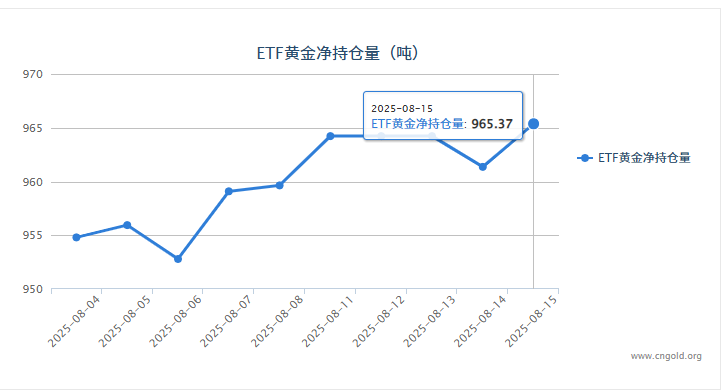
【黄金etf持仓量】8月15日黄金ETF较上一交易日增加4.01吨
Jin Tou Wang· 2025-08-18 06:15
Group 1 - The iShares Silver Trust report indicates that as of August 15, the gold ETF holdings increased by 4.01 tons to a total of 965.37 tons [1] - Spot gold closed at $3,335.69 per ounce on August 15, with a daily increase of 0.91%, reaching a high of $3,348.74 and a low of $3,331.63 during the day [1] Group 2 - Current spot gold is trading around $3,344.16 per ounce, showing an increase of approximately 0.25%, after previously dropping to the lowest level since August 1 at $3,323.43 [3] - December futures for U.S. gold rose by 0.18% to $3,389.10, supported by a weak U.S. dollar index [3] - Geopolitical risks, including potential territorial exchanges in the Russia-Ukraine peace proposal and uncertainty from the U.S. canceling trade talks with India, are contributing to gold's appeal as a safe-haven asset [3]

野村转向预计美联储9月将首降
Jin Tou Wang· 2025-08-18 05:40
Core Viewpoint - The article discusses the expectation of the Federal Reserve to lower interest rates starting in September due to a weak labor market and reduced inflation risks [1] Group 1: Economic Predictions - Nomura's economists predict a 25 basis point rate cut by the Federal Reserve in September, followed by additional cuts in December and March of the following year [1] - The median analyst expectation is also for a 25 basis point cut within the next three months, although there is disagreement among economists regarding the timing of these cuts [1] Group 2: Market Indicators - The current USD index is at 97.86, with a slight increase of 0.02% from an opening price of 97.80 [1] - The 20-period moving average (97.5513) and the 50-period moving average (97.7919) are converging, indicating short-term bullish sentiment, but the price has not effectively broken through the resistance at the 50-period moving average [1] - The RSI indicator is at 71.91, indicating an overbought condition, and a potential "divergence" pattern is forming, where the price reaches a new high while the RSI does not [1]
美联储转向在即 道明预测9月首降全年六次
Jin Tou Wang· 2025-08-18 05:40
Group 1 - The core viewpoint of the article indicates that due to the recent U.S. July CPI report, there is a shift in expectations regarding the Federal Reserve's interest rate cuts, with predictions now suggesting a potential start in September rather than October [1] - According to the report from TD Securities, the Federal Reserve is expected to implement a total of six rate cuts, each by 25 basis points, leading to a final rate of 3% [1] - The strategy team at TD Securities has revised their forecast for the 5-year U.S. Treasury yield at the end of 2025 from 3.70% to 3.65% [1] Group 2 - The article notes that the current U.S. dollar index (DXY) is at 97.87, showing a slight increase of 0.02% from the opening price of 97.80 [1] - The dollar index is still within a downward channel, with the price having previously reached the upper Bollinger Band near 98.66 before experiencing a strong pullback [1] - There are concerns regarding the support level as the price approaches the lower Bollinger Band around 97.60 [1]
美俄关系向好,金价承压
Bao Cheng Qi Huo· 2025-08-18 03:15
Group 1: Report Investment Rating - No information provided on the industry investment rating in the report Group 2: Core Viewpoints - Last week, the gold price was under pressure, with New York gold falling below the $3,400 mark. The easing of geopolitical tensions between the US and Russia and the Russia-Ukraine situation over the weekend was negative for the gold price. Technically, New York gold was at the high end of the trading range since the second quarter, and there was strong willingness among long positions to liquidate [3][27]. - The expectation of a Fed rate cut may increase as the economic outlook weakens, and the US dollar index may weaken again, which is positive for the gold price. The Jackson Hole Global Central Bank Annual Meeting will be held from August 21st to 23rd, and attention can be paid to the speech of Fed Chairman Powell [3][27]. - Overall, the easing of geopolitical tensions puts pressure on the gold price, while the increasing expectation of a US rate cut provides support. It is expected that the gold price will fluctuate weakly [3][27]. Group 3: Summary by Directory 1. Market Review 1.1 Weekly Trend - The report shows the linkage between the US dollar index and COMEX gold, but no specific summary of the weekly trend is provided [7] 1.2 Indicator Price Changes - From August 8th to August 15th, COMEX gold decreased by 2.21% from $3,458.20 to $3,381.70, COMEX silver decreased by 1.27% from $38.51 to $38.02, SHFE gold main contract decreased by 1.52% from 787.80 to 775.80, and SHFE silver main contract decreased by 0.80% from 9,278.00 to 9,204.00. The US dollar index decreased by 0.42% from 98.26 to 97.85, the 10-year US Treasury real yield increased by 0.07 from 1.88 to 1.95, the S&P 500 increased by 0.94% from 6,389.45 to 6,449.80, and the US crude oil continuous decreased by 0.33% from 63.35 to 63.14. The COMEX gold-silver ratio decreased by 0.95% from 89.80 to 88.95, and the SHFE gold-silver ratio decreased by 0.73% from 84.91 to 84.29. The SPDR Gold ETF increased by 5.73 from 959.64 to 965.37, and the iShare Gold ETF increased by 0.68 from 452.61 to 453.29 [8] 2. Gold Price Reached a High and Then Fell - Last week, the gold price was under pressure and declined. On one hand, US President Trump refuted rumors about gold tariffs; on the other hand, the expectation of the US-Russia meeting led to a relaxation of geopolitical tensions. Additionally, the gold price reached a high and then fell, and New York gold was still in the trading range since the second quarter, facing significant technical pressure [10] 3. Tracking of Other Indicators - As of August 12th, compared with the previous week, long positions decreased by 4,079 contracts, short positions increased by 3,486 contracts, and net long positions decreased by 7,565 contracts. This indicator is more sensitive to the price trend of precious metals than gold ETFs, but has a lower update frequency and poor timeliness [16] - Recently, the changes in precious metal ETFs have been relatively small [18] - Last week, the gold-silver ratio decreased as the gold price weakened [21] - Last week, the 10-year US Treasury yield increased, while the 2-year US Treasury yield remained stable, and the 10-2 year spread widened [22] 4. Conclusion - The conclusion is consistent with the core viewpoints, stating that the easing of geopolitical tensions puts pressure on the gold price, while the increasing expectation of a US rate cut provides support. It is expected that the gold price will fluctuate weakly [3][27]
国泰海通|国别研究:服务业强劲,英国股市稳定上涨——欧洲市场跟踪系列第一期
国泰海通证券研究· 2025-08-17 12:27
Financial Market Performance - The European industrial production showed weakness in Q2, while the US dollar index remained weak, leading to a decline in investor confidence in August. The investor confidence index in Europe fell again, with institutional investors showing stronger confidence than individual investors [1] - Following the appreciation of the euro against the dollar in May-June 2025, the dollar index rebounded in July, but uncertainty in US economic data increased in August, leading to a rise in the euro to 1.17 against the dollar by August 15 [1] - Expectations of increased defense spending in Germany and other countries are anticipated to boost the Eurozone economy, alongside improved expectations regarding the Russia-Ukraine conflict [1] Bond Market Analysis - The European bond market continues to exhibit a bear flattening trend, with 10-year government bond yields in the UK, Germany, and France remaining relatively high. In August, the yield spread on government bonds widened slightly [2] - Concerns over potential inflation fluctuations and uncertainties regarding US tariff agreements are driving the widening of bond spreads, while the European Central Bank maintains a cautious stance on interest rate cuts for the remainder of 2025 [2] Stock Market Performance - Since April, the UK stock market has shown stable growth, with the German stock market performing well since the beginning of the year. European bank stocks have recently led the market [3] - The Eurozone STOXX50 index has seen a cumulative increase of 24.6% over the past quarter, driven by the return of overseas funds to the European market and the resilience of the European economy [3][4] - The UK FTSE 100 index reached a record high on August 15, supported by economic resilience and service sector growth [4] Sector Performance - In the past two weeks, large-cap value stocks in banking and energy sectors have performed well, while sectors like biotechnology, transportation, food, and airlines have also shown strong performance. The AI technology sector, however, faced pressure [5] - Current valuations for major indices in the UK, France, and Germany are around 17-20 times PE, close to historical averages. In comparison, the S&P 500 index stands at 29 times, significantly higher than European indices [5] - The European stock market is expected to have allocation value and potential for growth in 2025, supported by active fiscal policies and a relatively loose monetary policy environment [5]


6月中国增持美国国债1亿美元
中国基金报· 2025-08-16 14:53
Core Viewpoint - China has increased its holdings of US Treasury bonds, marking a shift in investment strategy amid changing economic conditions [1][3]. Group 1: US Treasury Holdings - As of June, foreign investors held a total of $9.1277 trillion in US Treasury bonds, an increase of $80.2 billion from the previous month [1]. - China holds $756.4 billion in US Treasury bonds, having increased its holdings by $1 million, marking the first increase since March [1]. - Japan remains the largest holder of US Treasury bonds at $1.1476 trillion, with an increase of $126 million, while the UK holds $858.1 billion, having increased by $487 million [3]. Group 2: Foreign Investment Trends - In June, foreign investors net increased their holdings of US securities by $77.8 billion, with private foreign investors contributing $7.3 billion and official foreign investors reversing from net selling to net buying of $70.5 billion [1]. - The net increase in long-term US securities was $192.3 billion, driven primarily by private foreign investors who net bought $154.6 billion [1]. Group 3: Economic Outlook and Implications - A report suggests that if the momentum in US stocks weakens, risk appetite may decline, potentially leading to increased investment in US Treasury bonds [2]. - Concerns over stagflation due to tariffs and fiscal sustainability may lead to a weaker dollar, impacting the volatility of US stocks and bonds [3].

美元指数跌0.36%,报97.8509
Sou Hu Cai Jing· 2025-08-15 23:25
Core Viewpoint - The US dollar index decreased by 0.36% to 97.8509, indicating a strengthening of non-US currencies against the dollar [1] Currency Movements - The euro appreciated by 0.48% against the dollar, reaching 1.1704 [1] - The British pound rose by 0.19% to 1.3556 against the dollar [1] - The Australian dollar increased by 0.18% to 0.6508 against the dollar [1] - The Japanese yen saw a decline of 0.39% against the dollar, with a rate of 147.1630 [1] - The Canadian dollar remained stable against the dollar at 1.3819 [1] - The Swiss franc decreased by 0.09% against the dollar, reaching 0.8068 [1]