自动驾驶

Search documents
香港2026年将推动自动驾驶无人化测试 萝卜快跑领跑进程
Cai Jing Wang· 2026-01-12 12:46
Core Insights - The Hong Kong government has issued six pilot licenses for 62 autonomous vehicles to conduct multi-area testing, with the first approved company, Loabokuaipao, already testing in Kwun Tong and Kowloon City [1] - The Transport Department plans to gradually promote unmanned testing of autonomous vehicles this year, with only remote backup operators present [1] - Loabokuaipao has made significant technological breakthroughs, laying the foundation for unmanned testing, and aims to adapt to local road conditions in Hong Kong [1] Group 1 - Loabokuaipao is the first company to receive a pilot license in Hong Kong, starting large-scale testing in November 2024 [1] - The company has expanded its testing areas four times over the past year, achieving full scene coverage from suburban to urban road networks [1] - The company is continuously optimizing its algorithm models and training machine learning to enhance system accuracy in response to local driving challenges [1] Group 2 - The project manager from Loabokuaipao highlighted the complexity of Hong Kong's road conditions, necessitating optimization of the driving system to comply with local rules [2] - The Transport Department's engineer noted that the testing project has been operating smoothly, achieving four major technological advancements, including multi-vehicle operation and speed enhancement [2] - The 2025 Hong Kong Policy Address emphasizes accelerating the development of unmanned and large-scale autonomous driving, with Loabokuaipao's practices providing critical support for this goal [2]
智能辅助驾驶≠自动驾驶!L3级自动驾驶试点运营 有何“升级”?
Yang Shi Wang· 2026-01-12 11:43
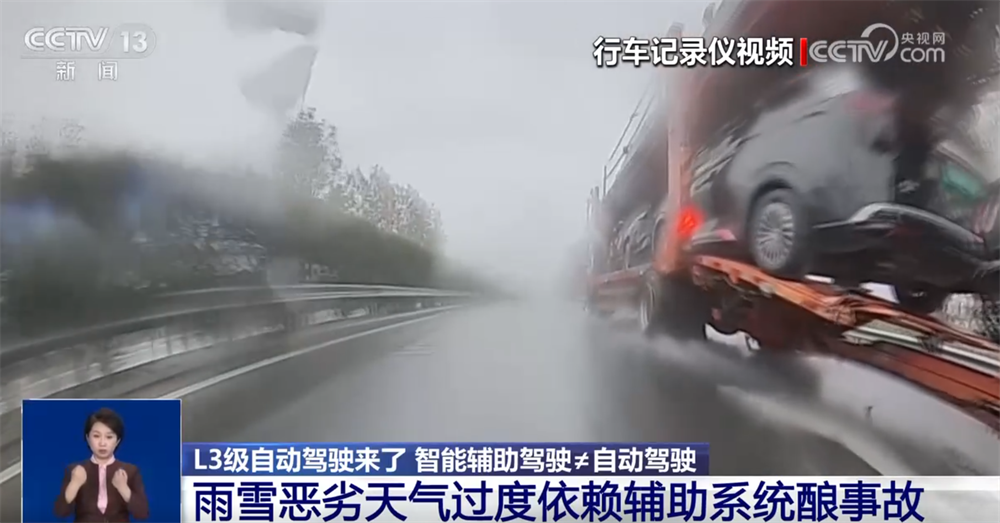
Group 1 - The increasing reliance on driver assistance systems can lead to dangerous situations, as evidenced by recent accidents where drivers fell asleep while using these systems [1][3] - Current vehicles on the market primarily feature Level 2 automation, which requires drivers to remain engaged and ready to take control at any moment [7][9] - The introduction of Level 3 automated driving vehicles is underway, with pilot programs allowing for limited autonomous operation in specific areas, but these vehicles still require a safety operator present [11][17] Group 2 - The responsibility for safe driving ultimately lies with the driver, who must continuously monitor the road and be prepared to intervene when using driver assistance features [9][11] - The complexity of accident liability increases with Level 3 automation, as multiple parties, including drivers and manufacturers, may share responsibility in the event of a collision [18] - Pilot programs for Level 3 vehicles are currently limited to specific use cases and do not yet allow for general consumer access, although future ride-hailing services may provide opportunities for consumers to experience this technology [15][17]

比亚迪发布宋Pro DM-i 长续航版,售价13.98万元起;大众汽车牵手高通打造智能网联座舱体验丨汽车交通日报
创业邦· 2026-01-12 10:19
Group 1 - Xiaoma Zhixing and BAIC New Energy have produced over 600 units of the Arcfox Alpha T5 Robotaxi, with plans to expand services to more first-tier cities in China [2] - BYD has launched the 2026 model of the Song Pro DM-i Long Range version, featuring a comprehensive range of 1600 kilometers and an enhanced pure electric range of 220 kilometers [2] - XPeng Motors is reportedly preparing for an IPO for its flying car division in Hong Kong, with JPMorgan and Morgan Stanley as advisors, potentially completing the process within this year [2] - Volkswagen has partnered with Qualcomm to develop a software-defined vehicle architecture, aiming to enhance infotainment features and accelerate automated driving development [2]

汽车行业周报:英伟达发布自动驾驶模型平台,Robotaxi产业化持续推进-20260112
CHINA DRAGON SECURITIES· 2026-01-12 10:04
Investment Rating - The report maintains a "Recommended" investment rating for the automotive industry [2]. Core Insights - Nvidia has launched a new open-source AI model platform, Alpamayo, aimed at enhancing the capabilities of autonomous vehicles and facilitating the industrialization of Robotaxi services [5][15]. - The first fully autonomous vehicle utilizing Nvidia's system is set to undergo road testing in the US in Q1 2026, with plans for L4 level autonomous taxi services to commence in 2027 [5][25]. - The report highlights significant growth opportunities for companies involved in the autonomous driving ecosystem, including hardware suppliers and Robotaxi operators, due to reduced development costs and shorter timelines [5][16]. Industry Dynamics - Key industry news includes the announcement that China aims to achieve 18.3 million vehicle trade-ins from 2024 to 2025, with nearly 60% expected to be electric vehicles [18]. - Geely has received a license for L3 level autonomous driving road tests, marking a significant step in the development of smart driving technologies [21]. - The report notes that the automotive sector's performance has been mixed, with the automotive index underperforming compared to the broader market [5][35]. Market Performance - From January 5 to January 9, 2026, the automotive sector's index increased by 2.53%, lagging behind the Shanghai Composite Index, which rose by 2.79% [5][35]. - The report provides detailed performance metrics for various automotive sub-sectors, indicating a positive trend in automotive services and parts, with the automotive services sector seeing a 6.01% increase [5][35]. Data Tracking - In December 2025, retail sales of passenger vehicles reached 2.261 million units, reflecting a year-on-year decline of 14.15% but a month-on-month increase of 1.60% [46]. - The penetration rate of new energy vehicles in retail sales reached 59.1%, with retail sales of new energy passenger vehicles totaling 1.337 million units in December 2025, marking a year-on-year increase of 2.68% [60]. - The report also highlights the increasing adoption of advanced driving assistance systems, with L2.5 and above penetration rates reaching 37.96% in November 2025 [73].




东吴证券:首次覆盖文远知行-W给予“买入”评级 RoboX商业化落地龙头
Zhi Tong Cai Jing· 2026-01-12 09:56
公司2017年成立,创始人为计算机视觉、机器学习领域专家,具有百度、微软工作背景,业务从 Robotaxi拓展至Robobus、Robovan、Robosweeper等多种L4场景,同时布局L2+辅助驾驶业务。2025年 Q3,公司总营收达1.71亿元,同比增长144%,核心增长引擎来自Robotaxi业务,单季收入约3530万元, 同比激增761.0%,占总营收比重升至20.7%,Robotaxi业务占比提升,反映公司主业商业化进展顺利, 公司市场拓展能力较强。2025年三季度公司毛利率32.9%,截至2025年9月30日,现金及资本储备达54 亿元,能够支撑公司的研发投入与规模化扩张,为长期竞争力奠定基础。 L4牌照获取进度全球领先,商业化路径清晰 公司是全球唯一在8个国家获得自动驾驶许可的企业。国内方面,已在北京和广州实现纯无人商业运营 (都能做到限定区域随处上下车),广州每辆商业化Robotaxi在每日24小时运营时段内完成至高25单行程 (在优惠单价驱动下),2025年7月获上海浦东新区主驾无人示范应用资质,补齐一线城市布局;海外以 中东为核心,2025年相继在阿布扎比启动纯无人商业运营、在沙特利雅 ...

东吴证券:首次覆盖文远知行-W(00800)给予“买入”评级 RoboX商业化落地龙头
智通财经网· 2026-01-12 09:52
Core Viewpoint - Dongwu Securities reports that WeRide (00800) is a leader in Robotaxi technology and is expected to benefit from gradual policy openings, continuous breakthroughs in autonomous driving technology, and cost reductions in the supply chain, with a potential for rapid scaling and profitability after achieving a positive unit economic model [1] Group 1: Company Overview - WeRide was established in 2017 by experts in computer vision and machine learning with backgrounds at Baidu and Microsoft, expanding its business from Robotaxi to various L4 scenarios including Robobus, Robovan, and Robosweeper, while also venturing into L2+ assisted driving [2] - In Q3 2025, the company achieved total revenue of 171 million yuan, a year-on-year increase of 144%, with Robotaxi business contributing significantly, generating approximately 35.3 million yuan, a staggering increase of 761.0% year-on-year, and accounting for 20.7% of total revenue [2] - The company reported a gross margin of 32.9% in Q3 2025, and as of September 30, 2025, it had cash and capital reserves of 5.4 billion yuan, supporting its R&D investments and scaling efforts [2] Group 2: Licensing and Commercialization - WeRide is the only company globally to have obtained autonomous driving licenses in eight countries, with successful commercial operations in Beijing and Guangzhou, where each Robotaxi can complete up to 25 rides per day during a 24-hour operational period [3] - The company received a qualification for driverless demonstration applications in Shanghai's Pudong New Area in July 2025, enhancing its presence in major cities, and has initiated pure driverless commercial operations in Abu Dhabi, Riyadh, and Dubai [3] Group 3: Market and Profitability Outlook - The Robotaxi sector is approaching a commercial tipping point, with a clear profitability path driven by advancements in technology such as multi-sensor fusion and integrated vehicle-road-cloud systems, significantly reducing accident rates compared to human driving [4] - The cost of solid-state LiDAR has decreased from millions to under 300,000 yuan, optimizing the unit economic model, while the B-end shared mobility market in China is steadily expanding, with Robotaxi expected to replace parts of traditional and private transportation markets, potentially reaching a scale of 200 billion yuan by 2030 [4] - The theoretical market reach for Robotaxi in developed and underdeveloped regions is estimated to be 4.4 and 3.4 times that of the Chinese market, respectively, indicating a competitive advantage in developed regions [4] - Policies in China are supportive, with 51 cities opening pilot programs for fully driverless operations, while Middle Eastern countries are strategically driven to promote autonomous driving, and Singapore is cautiously opening up to various autonomous vehicle types [4]
高盛展望2026大中华区科技趋势:ASIC成AI服务器增量核心,光模块迈向1.6T,果链领跑智能手机.......
Hua Er Jie Jian Wen· 2026-01-12 09:47
Core Insights - Goldman Sachs released a report on the outlook for the Greater China technology sector in 2026, highlighting three main themes: AI infrastructure upgrades, innovations in consumer electronics, and localization of semiconductors. The report identifies the increasing penetration of ASIC AI servers and changes in iPhone form factors as key drivers for industry growth. Group 1: AI Infrastructure and Server Trends - AI servers are transitioning from a GPU-dominated landscape to a parallel development of GPU and ASIC, with ASIC becoming the core increment due to its advantages in specific training and inference scenarios [2] - By 2026, the penetration rate of ASIC in AI servers is expected to rise significantly, leading to rapid growth in rack-level AI server shipments and a shift towards higher integration and power density in server architecture [2] - The demand for high-speed interconnects, cooling, and power systems will increase as the value of the entire machine rises [2] Group 2: Networking and Cooling Technologies - The evolution of high-speed optical interconnects is a key trend, with a transition from 400G to 800G and eventually to 1.6T driven by the expanding scale of computing power [3] - New technologies like silicon photonics and CPO are maturing, setting the stage for significant growth in high-speed optical modules by 2026 [3] - Liquid cooling solutions are expected to see increased adoption in ASIC AI servers, transitioning from localized applications to more systematic solutions, enhancing cooling efficiency and creating new technical barriers [4] Group 3: ODM and Competitive Landscape - The complexity of AI servers is increasing customer reliance on ODM manufacturers, with competitive advantages shifting towards multi-chip platform adaptability and rapid delivery capabilities [5] - Leading ODMs with advanced manufacturing capabilities and long-term service relationships with cloud vendors are expected to dominate AI server orders, while smaller players will face limited opportunities [5] Group 4: Consumer Electronics and iPhone Innovations - The global PC market is projected to face growth pressures, with the end of pandemic-driven demand and rising memory costs impacting terminal demand [7] - The iPhone is entering a continuous cycle of form factor innovation, with foldable models expected to significantly influence consumer upgrade behavior and drive demand for high-end components [8] - The smartphone market is experiencing a mild recovery, with growth driven by an increase in high-end models and AI functionalities enhancing user experience [9] Group 5: Semiconductor and PCB Market Dynamics - The high-end PCB and CCL markets are experiencing supply constraints due to rising demand from AI servers and high-end consumer electronics, leading to increased pricing power and profitability [10] - The domestic semiconductor industry is entering an accelerated phase, driven by growing demand for computing power and local acceptance of domestic chips and materials [11] - Emerging fields such as L4 autonomous driving and low-orbit satellites are expected to open up long-term growth opportunities, with increasing demand for chips and system integration [12]
汽车行业周报:全年销量符合预期,智驾引领再提速-20260112
Guoyuan Securities· 2026-01-12 09:47
Investment Rating - The report maintains a "Recommended" investment rating for the automotive and automotive parts industry [6] Core Insights - The overall sales of passenger vehicles met expectations with a year-on-year growth of 9%, while new energy passenger vehicles saw a growth of 25% [1][2] - In December 2025, the retail sales of passenger vehicles were 2.296 million units, a year-on-year decrease of 13%, but a month-on-month increase of 3%. Cumulatively, retail sales for the year reached 23.779 million units, a year-on-year increase of 4% [1][20] - The report highlights the rapid advancements in intelligent driving technologies, with multiple automakers updating their systems and competing in the autonomous driving sector [3][4] Summary by Sections Sales Performance - In December 2025, wholesale sales of passenger vehicles were 2.759 million units, a year-on-year decrease of 10%, with cumulative wholesale sales for the year reaching 29.524 million units, a year-on-year increase of 9% [1][20] - For new energy vehicles, December retail sales were 1.387 million units, a year-on-year increase of 7%, with cumulative retail sales for the year at 12.859 million units, a year-on-year increase of 18% [1][20] Industry Developments - Several automakers, including Zeekr and Geely, are enhancing their intelligent driving systems, indicating a shift towards integrated decision-making models in vehicle technology [3][4][32] - The report emphasizes the importance of continued policy support for the automotive industry and the potential investment opportunities arising from advancements in autonomous driving technology [4] Market Trends - The automotive sector saw a 2.53% increase in the week of January 3-9, 2026, with most related sub-sectors also experiencing growth [12] - The report notes that the intelligent driving technology is becoming a key competitive area among automakers, with significant investments and innovations being made [3][4][39]
欧菲光三年巨亏百亿对外收购频遭质疑 融资35亿后欲定增再募26亿|光学成像并购潮
Xin Lang Cai Jing· 2026-01-12 09:30
Core Viewpoint - The optical imaging industry is experiencing a capital operation wave characterized by mergers, acquisitions, and financing driven by the promising market prospects in emerging technology fields such as automotive lenses, AR/VR optics, and machine vision. However, the acquisition logic and integration effectiveness of some companies are under scrutiny due to weak profitability, uncertainty of target assets, and regulatory risks [2][15]. Company Overview - O-Film Technology Co., Ltd. has engaged in multiple acquisitions in recent years, including the establishment of a joint venture with Anhui Car Union and subsequent acquisition of its remaining minority stake, despite the target company continuously incurring losses while transaction valuations have increased [3][16]. - O-Film's main business includes the design, research, production, and sales of optical camera modules, optical lenses, fingerprint recognition modules, smart driving, smart cockpit, body electronics, and smart locks, covering three major business segments: smartphones, smart vehicles, and new fields [4][17]. Recent Financial Activities - In 2023, O-Film accelerated its capital operations, selling properties and state-owned land use rights for 340 million and 610 million yuan respectively, recovering funds while achieving a total profit of 7.3 million yuan [5][18]. - O-Film plans to acquire stakes in Anhui Car Union and O-Film Microelectronics to enhance its smart automotive and optical sensing module businesses, with significant transactions scheduled for 2023 and 2025 [6][18]. Acquisition Details - The acquisition details include: - December 2025: 8.46% stake in Anhui Car Union for 364.92 million yuan - April 2025: 28.25% stake in O-Film Microelectronics for 1.79081 billion yuan - September 2023: 6.16% stake in Anhui Car Union for 1 billion yuan - June 2023: Sale of property rights for 339.56 million yuan [8][20]. - O-Film's stake in Anhui Car Union increased to 87% after a series of acquisitions, despite the company reporting net losses of 102 million, 55 million, and 42 million yuan from 2023 to the first half of 2025 [9][22]. Valuation and Market Concerns - The acquisition of O-Film Microelectronics involves a fundraising of 1.79 billion yuan at a premium of 113%, with the assessed value of the company significantly higher than its book value [10][23]. - Concerns have been raised regarding the fairness and necessity of the pricing in these transactions, as O-Film has been consistently losing money, with a debt ratio close to 80% and cumulative losses nearing 10 billion yuan from 2020 to 2022 [10][26]. - The market is wary of the high valuations and the potential risks associated with the quality of acquisition targets, as well as the disconnect between capital enthusiasm and the operational fundamentals of some companies [10][26].

【快讯】每日快讯(2026年1月12日)
乘联分会· 2026-01-12 09:28
Domestic News - Hong Kong's Transport Department will promote unmanned testing of autonomous vehicles this year, having issued 6 pilot licenses for 62 autonomous private cars and minibuses, with over 80,000 kilometers driven safely [2] - BAIC Blue Valley's L3 vehicles have officially started road trials, with plans to gradually open to individual users in the second quarter of this year [3] - Tongji University has restructured its Mechanical and Energy Engineering College into a Mechanical Engineering and Robotics College and an Automotive and Energy College, aligning with the national "dual carbon" strategy and the trend of electrification and intelligence in the automotive industry [4] - Shanghai's government has launched a three-year action plan to support advanced manufacturing, focusing on new energy vehicles and innovative products like eVTOLs to overcome industrial bottlenecks [5] - Great Wall Motors will officially launch its new platform, "Guiyuan," on January 16, which supports multiple power forms and aims to simplify vehicle offerings [7] - Lantu Automotive has signed a strategic cooperation agreement with Huawei's subsidiary, focusing on smart driving and software operations to enhance user experience [8] - Xiaomi's new generation SU7 will be equipped with the Xiaomi Super Motor V6s Plus, which will improve production efficiency and shorten delivery times [9] - Firefly has delivered its 40,000th vehicle, offering limited-time purchase benefits to customers [10] International News - India's electric vehicle sales are projected to reach 2.3 million units by 2025, accounting for 8% of new car registrations, driven by policy incentives and increased consumer demand [11] - Stellantis will stop offering plug-in hybrid vehicles in North America starting with the 2026 model year, focusing on more competitive electrification solutions [12] - The UK Treasury is looking to reduce electric vehicle charging costs due to concerns that a new mileage tax policy could harm market demand [13] - Malaysia has implemented a new road tax policy for electric vehicles, requiring all EVs to pay annual road tax based on motor output power [14] Commercial Vehicles - A new strategy called "30111" was launched by a commercial vehicle company, aiming for significant sales growth and transforming commercial vehicles into "super intelligent entities" through AI technology [15] - The Xiangling V5 gas engine product has been launched in Xinjiang, targeting local logistics needs with efficient and environmentally friendly solutions [16] - Great Wall's commercial vehicle has won an innovation award for its dual-motor hybrid architecture, highlighting its technological advancements in the hybrid truck market [17] - The number of operational functional unmanned vehicles in Shenzhen has surpassed 1,000, marking a 22.5% increase and indicating a new phase in the city's unmanned vehicle development [18]