美元指数

Search documents
美元指数跌0.36%,报97.8509
Sou Hu Cai Jing· 2025-08-15 23:25
Core Viewpoint - The US dollar index decreased by 0.36% to 97.8509, indicating a strengthening of non-US currencies against the dollar [1] Currency Movements - The euro appreciated by 0.48% against the dollar, reaching 1.1704 [1] - The British pound rose by 0.19% to 1.3556 against the dollar [1] - The Australian dollar increased by 0.18% to 0.6508 against the dollar [1] - The Japanese yen saw a decline of 0.39% against the dollar, with a rate of 147.1630 [1] - The Canadian dollar remained stable against the dollar at 1.3819 [1] - The Swiss franc decreased by 0.09% against the dollar, reaching 0.8068 [1]
贵金属有色金属产业日报-20250815
Dong Ya Qi Huo· 2025-08-15 11:01
Report Summary 1. Report Industry Investment Rating No relevant information provided. 2. Core Views - **Precious Metals**: Short - term trends are dominated by fundamental positive factors, with the weakening of the US dollar index due to factors such as the decline in US mortgage rates and potential Fed rate cuts, and increased risk - aversion sentiment due to geopolitical policies [3]. - **Copper**: Although copper prices fell slightly on Thursday due to the stabilization of the US dollar index and the decline of the domestic stock market, the medium - term pattern is likely to be strong, supported by favorable US inflation data for Fed rate cuts and reduced concerns about demand negative feedback [15]. - **Aluminum**: The fundamentals of Shanghai aluminum have not changed significantly. The price will maintain a high - level shock in the short term with a range of 20300 - 21000 yuan/ton, and there is upward momentum in the medium term as the peak season approaches and there are expectations of Fed rate cuts [35]. - **Zinc**: In the short term, be vigilant about changes in LME inventory and observe the macro - situation. The market will be mainly in a shock state, with the supply gradually shifting from tight to surplus and demand remaining weak during the off - season [65]. - **Nickel**: Nickel ore has a loosening expectation, nickel iron is relatively firm in the short term, stainless steel has limited upward momentum, and the supply of nickel sulfate in the market is tight [80]. - **Tin**: The repeated postponement of the full resumption of production in Myanmar's tin mines has supported tin prices and may have a continuous impact, while demand has not changed much [95]. - **Lithium Carbonate**: Short - term supply - demand has marginally improved, but beware of the risk of sentiment fading as the medium - to - long - term oversupply pattern has not been substantially reversed [106]. - **Silicon Industry Chain**: Industrial silicon will fluctuate in the short term with a range of 8400 - 9100 yuan/ton, and the downward space is limited in the medium - to - long - term. The demand for polysilicon is sluggish, and attention should be paid to industrial policies [116]. 3. Grouped Summaries Precious Metals - The decline of US mortgage rates and the potential Fed rate cut in September have weakened the US dollar index, supporting precious metals. The spot discount reflects stable physical demand, and geopolitical policies have increased risk - aversion sentiment [3]. Copper - **Price Movement**: Copper prices fell slightly on Thursday, but the medium - term pattern is likely to be strong. The latest prices of Shanghai copper futures and spot copper are provided, with different daily and weekly changes [15][16][19]. - **Supply - Demand**: US inflation data is conducive to Fed rate cuts, and downstream concerns about demand negative feedback have decreased [15]. - **Inventory**: Shanghai copper and LME copper inventories have different changes, with Shanghai copper warehouse receipts increasing and LME copper inventory slightly decreasing [33]. Aluminum - **Aluminum**: The fundamentals have not changed much, with inventory accumulation not over. The price will maintain a high - level shock in the short term and has upward momentum in the medium term [35]. - **Alumina**: The fundamentals are weak, with high domestic production capacity, increasing imports, and rising inventory. The market trading logic may shift to cost - based pricing, and it will mainly fluctuate in the short term [36]. - **Cast Aluminum Alloy**: The fundamentals are good. The price of scrap aluminum supports the alloy price, and short - term demand performance is acceptable. The price difference between the alloy and Shanghai aluminum is between 350 - 500 yuan/ton [37]. Zinc - **Supply - Demand**: The supply is gradually shifting from tight to surplus, the mine is in a loose state, and the demand is weak during the off - season. LME inventory has decreased, but there is a risk of a sudden increase [65]. - **Price and Inventory**: The latest prices of Shanghai zinc and LME zinc are provided, and Shanghai zinc warehouse receipts have increased while LME zinc inventory has decreased [66][76]. Nickel - **Supply - Demand**: Nickel ore has a loosening expectation, nickel iron is relatively firm, stainless steel has limited upward momentum, and the supply of nickel sulfate is tight [80]. - **Price and Inventory**: The prices of Shanghai nickel, stainless steel, and related products have changed, and the inventory of Shanghai nickel warehouse receipts has increased [81]. Tin - **Supply - Demand**: The repeated postponement of the full resumption of production in Myanmar's tin mines has supported tin prices, and demand has not changed much [95]. - **Price and Inventory**: The latest prices of Shanghai tin and LME tin are provided, and the inventory of Shanghai tin and LME tin has changed [96][102]. Lithium Carbonate - **Supply - Demand**: Short - term supply - demand has marginally improved, but the medium - to - long - term oversupply pattern has not been substantially reversed [106]. - **Price and Inventory**: The prices of lithium carbonate futures and spot have changed, and the inventory of Guangzhou Futures Exchange warehouse receipts has increased [106][113]. Silicon Industry Chain - **Industrial Silicon**: Cost - side electricity price fluctuations, supply will have a slight increase in the future, and short - term fluctuations are expected, with a limited downward space in the medium - to - long - term [116]. - **Polysilicon**: Cost - side electricity price fluctuations, supply will increase in the future, demand is in a downturn, and attention should be paid to industrial policies [116].
美元指数盘中跌破98关口
Sou Hu Cai Jing· 2025-08-15 07:32
近期,受美联储降息预期升温等原因推动,美元重回偏弱态势。嘉盛集团资深分析师Fawad Razaqzada 表示,在疲软的就业报告、符合预期的CPI数据公布之后,美联储越来越有可能在9月扣动降息的"扳 机"。对于美元来说,这可能意味着年底前的表现会更加疲软——除非其他主要央行采取更快的行动来 放松政策。 上证报中国证券网讯(记者 陈佳怡)8月15日,美元指数震荡下行,盘中跌破98关口。Wind数据显示, 截至北京时间14时05分,美元指数报97.9879,日内下跌0.22%。 ...
抛售只是前奏,鲍威尔才是压轴
Sou Hu Cai Jing· 2025-08-15 03:22
Group 1 - The core viewpoint of the article indicates that the recent market sell-off is just the beginning, with a significant focus on upcoming economic indicators and Federal Reserve signals [1][2] Group 2 - The U.S. Producer Price Index (PPI) for July saw a month-on-month increase from 0.00% to 0.9%, which annualizes to nearly 11%, a substantial figure that cannot be overlooked [2] - The market's expectation for a Federal Reserve interest rate cut in September has decreased from 100% to approximately 85%, indicating a shift in market sentiment and potentially leading to capital outflows [2] - The U.S. dollar index experienced a 1.4% drop on the day of the non-farm payroll data, but only a 0.4% increase on the day of the PPI release, suggesting that market participants are still in a wait-and-see mode [2] - The article emphasizes that the true market direction will likely be established within 48 hours following Federal Reserve Chairman Jerome Powell's speech at the Jackson Hole conference, marking a critical turning point for market sentiment [2]
在岸人民币对美元开盘下跌 报7.1812
Sou Hu Cai Jing· 2025-08-15 02:14
与此同时,美元指数震荡下行,截至9时30分,报98.1418。 上证报中国证券网讯(记者 陈佳怡 黄冰玉)8月15日,Wind数据显示,在岸人民币对美元开盘下跌, 报7.1812,前一交易日16时30分收盘报7.1730。截至9时30分,离岸人民币对美元报7.1823。 同日,人民币对美元中间价下调34个基点,报7.1371 广开首席产业研究院院长兼首席经济学家连平撰文称,美联储重启降息后,人民币有望加快恢复性升 值。2025年以来,美元指数累计下滑超过10%,一度跌破97关口。与此同时,人民币对美元中间价累计 升值479个基点。随着美联储重启降息预期强化和中美关税博弈的阶段性缓和,人民币相对于美元将获 得新的升值动力。但由于中国货币政策同样处于偏松状态,短期内未必会出现单边大幅度走强的态势。 ...
宁证期货今日早评-20250815
Ning Zheng Qi Huo· 2025-08-15 02:03
Report Industry Investment Ratings No relevant information provided. Core Views - The coke market is expected to continue its volatile and upward trend in the short term due to tight supply and strong demand [1]. - Gold is expected to have a short - term rebound but remain volatile and bearish in the medium term due to the strength of the US dollar [1]. - Iron ore prices are expected to remain range - bound in the short term, with support from iron water demand and seasonal shipping lulls [3]. - Rebar prices may be volatile and weak in the short term due to weak demand and increased inventory [4]. - Treasury bonds are expected to have a short - term rebound but remain volatile and bearish in the medium term, with the stock - bond seesaw as the main logic [4]. - Silver is expected to have a short - term correction but remain volatile and bullish [5]. - The pig market has a short - term rebound expectation, but the supply exceeds demand. It is recommended to wait for the end of the correction [5]. - Palm oil prices are expected to be in a high - level volatile state in the short term, and it is recommended to take profit on long positions [6][7]. - Methanol is expected to be volatile in the short term, and it is recommended to hold short positions cautiously [7]. - Soda ash is expected to be volatile in the short term, and it is recommended to wait and see or short on rebounds [8]. - LLDPE is expected to be volatile in the short term, and it is recommended to wait and see [9]. - Crude oil is expected to be volatile and weak, with market focus on the US - Russia negotiation [10]. - PTA follows the trend of crude oil, and there is pressure on the supply side [11]. - Rubber is expected to be volatile and bullish, with short - term supply support and improved demand expectations [11]. Summary by Variety Coke - On August 14, mainstream steel mills raised coke purchase prices. Coke prices have risen for six consecutive rounds. Some coking coal varieties have weakened, and coking enterprises' operating pressure has eased. Supply may tighten slightly, and demand remains strong. Coke supply is tight, and the market is expected to be volatile and upward in the short term [1]. Gold - US initial jobless claims decreased, and PPI increased significantly, strengthening the US dollar and pressuring precious metals. Gold is expected to have a short - term rebound but remain volatile and bearish in the medium term [1]. Iron Ore - From August 4 - 10, global iron ore shipments decreased. Iron water production decreased slightly, but demand remained resilient, and port inventory increased. Ore prices are expected to be range - bound in the short term, and it is recommended to operate within the range of the Iron Ore 2601 contract with a support level of 750 yuan/ton [3]. Rebar - As of August 14, rebar production decreased slightly, while factory and social inventories increased, and apparent demand decreased significantly. With weak demand and increased inventory, rebar prices may be volatile and weak in the short term [4]. Treasury Bonds - The central bank has increased liquidity injection, which supports the bond market. The bond market is currently affected by liquidity and the stock - bond seesaw, with a short - term rebound and medium - term bearish trend [4]. Silver - US PPI in July increased significantly, suppressing interest - rate cut expectations. The US dollar index rebounded, pressuring precious metals. Silver may correct further in the short term but remains volatile and bullish [5]. Pig - On August 14, the national average pork price decreased slightly. Pig prices in different regions showed a mixed trend. There is a short - term rebound expectation, but supply exceeds demand. It is recommended to wait for the end of the correction, with a support level of 13700 for the LH2511 contract [5]. Palm Oil - India's palm oil imports in July decreased. Affected by news and profit - taking of long - position funds, palm oil prices are expected to be high - level volatile in the short term, and it is recommended to take profit on long positions [6][7]. Methanol - Methanol port inventory increased, and the capacity utilization rate rose. The downstream demand was stable. Methanol is expected to be volatile in the short term, with a pressure level of 2465 for the 01 contract, and it is recommended to hold short positions cautiously [7]. Soda Ash - The price of heavy - duty soda ash was volatile and weak. Production increased, and inventory rose. The float glass industry was stable, but inventory increased. Soda ash is expected to be volatile in the short term, with a pressure level of 1425 for the 01 contract, and it is recommended to wait and see or short on rebounds [8]. LLDPE - The price of LLDPE increased slightly, production decreased, and enterprise inventory decreased. The downstream demand was general. LLDPE is expected to be volatile in the short term, with a pressure level of 7365 for the L2601 contract, and it is recommended to wait and see [9]. Crude Oil - US refined oil demand increased year - on - year. OPEC + has increased production, and the IEA has adjusted supply and demand forecasts. The US - Russia meeting has uncertainty. Crude oil is expected to be volatile and weak, with market focus on the negotiation [10]. PTA - PTA supply pressure exists, and the downstream is the traditional peak season. However, polyester profit is poor, which may affect production enthusiasm. PTA follows the trend of crude oil [11]. Rubber - The price of rubber raw materials was stable. Tire capacity utilization showed differentiation. The supply side has short - term support, and demand expectations have improved. Rubber is expected to be volatile and bullish [11].
宝城期货贵金属有色早报-20250815
Bao Cheng Qi Huo· 2025-08-15 02:02
Report Summary 1) Report Industry Investment Rating No information provided. 2) Report's Core View - Gold is expected to be weak in the short - term due to the easing of Sino - US trade relations and pressure from the overall global macroeconomic warming since August [1][3]. - Copper is expected to be strong in the short - term as the domestic atmosphere warms up and the copper price stabilizes and rebounds, despite some negative factors [1][5]. 3) Summary by Related Catalogs Gold - Short - term view: Downward; Medium - term view: Sideways; Intraday view: Sideways and weak; Overall view: Bearish in the short - term [1][3]. - Core logic: Yesterday, the gold price was under continuous pressure. The US July PPI annual rate reached 3.3%, the highest since February, and the monthly rate was 0.9%, the largest increase since June 2022. After the data release, interest - rate futures traders reduced their bets on Fed rate cuts, and the US dollar index rebounded, pressuring the gold price. Since August, the global macro has generally improved, adding pressure on the gold price [3]. Copper - Short - term view: Upward; Medium - term view: Sideways; Intraday view: Sideways and strong; Overall view: Bullish in the short - term [1][5]. - Core logic: Yesterday, the copper price fluctuated downward, and the night - session maintained a weak trend. The joint statement of the Sino - US Stockholm economic and trade talks was released on August 12, 2025, creating a good macro atmosphere at home and abroad, which is beneficial for the copper price. However, the higher - than - expected US PPI, the cooling of rate - cut expectations, and the rebound of the US dollar index are negative for the copper price. It is the off - season in the industry, and inventories have increased slightly. Overall, the copper price is expected to be strong driven by the macro factors [5].
白银强势突破9300元
Sou Hu Cai Jing· 2025-08-15 01:02
(来源:矿权资源网) 来源:矿权资源网 2025年8月14日,长江现货1#白银均价收于9310元/千克,较上一交易日上涨105元/千克,涨幅1.13%; 沪银主力2510合约表现更为强势,截止11:00报9353元/千克,单日上涨138元/千克,涨幅达1.50%,成功 突破9300元/千克关键心理关口。 一、美联储降息预期升温,美元指数承压利好银价 政策面扰动加剧:北京时间8月14日凌晨,美联储官员密集发声,试图为市场激进的降息预期降温。芝 加哥联储主席古尔斯比强调需"审查更多数据后再决定降息",亚特兰大联储主席博斯蒂克则重申"2025 年降息一次是合适的"。然而,市场对此反应有限,与美联储会期挂钩的隔夜指数互换(OIS)合约已 完全消化9月降息25个基点的预期,部分机构甚至押注降息50个基点。 美元指数微跌释放压力:当日美元指数报97.7517,微跌0.0453%,延续近期弱势格局。美元走软直接降 低以美元计价的白银持有成本,推动资金流向贵金属市场。分析指出,若美联储9月会议确认降息周期 开启,美元指数或进一步承压,为白银价格上行创造有利条件。 三、技术面与资金流向:突破关键阻力位,ETF持仓创新高 五、后 ...
张尧浠:9月大幅降息预期突转缩减、金价短期难逃调整区间
Sou Hu Cai Jing· 2025-08-15 00:46
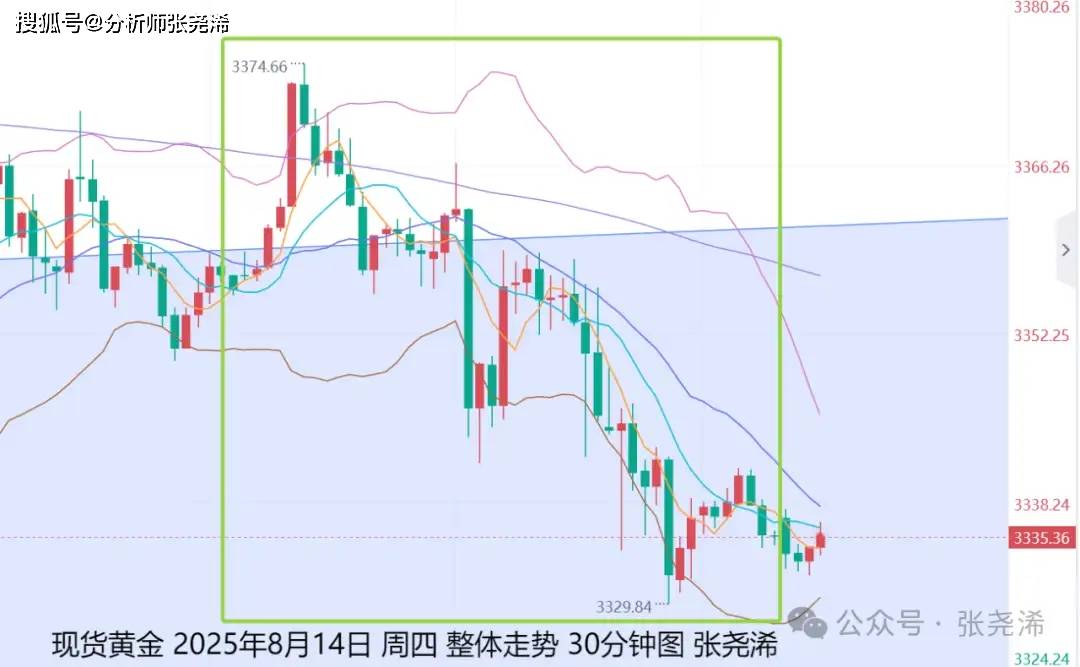
Core Viewpoint - The expectation for a significant interest rate cut in September has shifted to a reduction, leading to a short-term adjustment in gold prices, which are likely to remain within a consolidation range [1]. Market Performance - On August 14, gold opened at $3356.68 per ounce, reached a high of $3374.58, and then declined to a low of $3329.84, closing at $3335.26, with a daily fluctuation of $44.74 and a drop of $21.42, or 0.64% [3]. - The gold price is currently under pressure due to reduced favorable factors and a strengthening U.S. dollar index, which rebounded and recovered losses from earlier in the week [3]. Economic Indicators - Key economic data releases include July retail sales, industrial production, and initial consumer confidence index for August, which are generally expected to be favorable for gold prices [5]. - The U.S. July PPI increased by 0.9%, the largest monthly increase in three years, indicating potential inflationary pressures that could affect future interest rate decisions [5]. Federal Reserve Outlook - There is skepticism regarding the Federal Reserve's potential for a significant rate cut in September, with officials expressing that a large cut may not be appropriate given current economic conditions [5]. - The market's expectation for a substantial rate cut has diminished due to the higher-than-expected PPI and comments from Fed officials, leading to a decrease in rate cut bets [5]. Technical Analysis - Gold prices are expected to maintain a consolidation pattern until the September rate meeting, with a focus on the 100-day moving average as a support level [6]. - The weekly chart indicates a potential risk of a decline towards the 30-week moving average or around $3200, despite an overall upward trend [8]. - Daily analysis shows that gold has fallen below the 60-day moving average, with increased bearish momentum, while the focus remains on resistance levels around $3356 and $3373 [10].

金属涨跌互现 期铜收跌,因面临多重不确定性【8月14日LME收盘】
Wen Hua Cai Jing· 2025-08-15 00:38
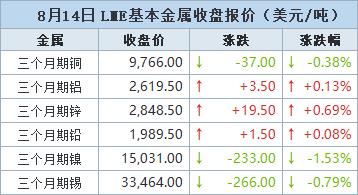
Group 1 - LME copper prices declined due to a stronger US dollar and investor caution regarding tariffs, the Russia-Ukraine situation, and US interest rates [1][4] - On August 14, LME three-month copper fell by $37, or 0.38%, closing at $9,766.00 per ton [1][2] - The strong dollar, influenced by high US producer price inflation, makes dollar-denominated commodities more expensive for buyers using other currencies [4] Group 2 - Other base metals showed mixed performance, with three-month aluminum up by $3.50 (0.13%), zinc up by $19.50 (0.69%), and lead up by $1.50 (0.08%), while tin and nickel saw declines [2] - Market analysts are closely watching upcoming events, including the Jackson Hole meeting and the FOMC's release of July meeting minutes, for potential market-moving information [4] - There is potential for market upside, but a triggering factor is needed to break the current trading range of $9,500 to $9,900 [4]