元宇宙

Search documents
CINNO Research:一季度国内消费级AI/AR眼镜市场销量达9.6万台 同比增长45%
Zhi Tong Cai Jing· 2025-05-20 00:30
Core Insights - The domestic consumer-grade AI/AR glasses market saw sales reach 96,000 units in Q1 2025, marking a 45% year-on-year growth, with screen-based AR glasses accounting for 80% of the market share and non-screen AI glasses making up 20% [1][2] Market Drivers - The growth is driven by three core factors: 1. The benchmark effect from overseas products like Ray-Ban Stories, which activated domestic demand through a "hardware + ecosystem" model [2] 2. Technological iterations leading to a shift in consumer preferences towards lightweight AI glasses with real-time translation and voice interaction capabilities [2] 3. National policy subsidies injecting vitality into the market, particularly for non-screen AI glasses priced under 1,000 yuan [2] Market Structure - The market is characterized by significant structural differentiation, with the Birdbath + Micro OLED solution holding 85% of the AR glasses market share, while non-screen AI glasses are emerging as market leaders due to their cost-effectiveness [3] Competitive Landscape - Leading brand Thunderbird Innovation holds a dominant 45% market share, showcasing its strength in "hardware + algorithm + ecosystem" vertical integration [4][5] - XREAL ranks second with an 18% market share, leveraging its self-developed X1 spatial computing chip for enhanced user experiences [7] - Starry Meizu, with a 14% market share, capitalizes on its smartphone heritage to offer competitive AR glasses [8] - VITURE targets the high-end gaming segment, despite a smaller market share, by delivering superior visual experiences [9] - Rokid is shifting focus towards AI + AR glasses, aiming to establish a strong presence in both consumer and industrial markets [10] Industry Trends - The AI/AR glasses market is witnessing a surge in cross-industry participation, with major consumer electronics brands like Xiaomi and Huawei entering the space, emphasizing ecosystem integration over immediate sales [10] - Internet giants such as Baidu and Alibaba are also accelerating their entry into the market with self-developed AI glasses, contributing to a diversified competitive landscape [10] Market Outlook - The AI/AR glasses market is on the brink of a breakthrough, transitioning from niche products to essential tools for productivity, reshaping human-computer interaction and becoming a key entry point in the metaverse era [11]
Q1’25 国内消费级AI/AR市场销量同比涨45%,结构性变革加速
CINNO Research· 2025-05-19 16:51
Core Viewpoint - The domestic consumer-grade AI/AR glasses market is experiencing significant growth, with sales reaching 96,000 units in Q1 2025, a year-on-year increase of 45%, indicating a shift from novelty to necessity in smart living hardware [2] Market Overview - The market for consumer-grade AI/AR glasses is characterized by a structural differentiation, with screen-based AR glasses accounting for 80% of the market share and non-screen AI glasses making up 20% [2] - The growth is driven by three main factors: the benchmark effect from overseas products, technological iterations leading to replacement demand, and government subsidies supporting market vitality [2] Key Drivers of Growth - Benchmark Effect: The success of Ray-Ban Stories smart glasses has activated domestic demand for AI glasses through its "hardware + ecosystem" model [2] - Technological Iteration: The Birdbath + Micro OLED solution holds 85% of the AR glasses market, but lack of innovation is pushing consumers towards lightweight AI glasses with real-time translation and voice interaction features [2] - Government Support: Subsidies are energizing the market, particularly for non-screen AI glasses priced under 1,000 yuan and screen-based AR glasses priced between 1,000 to 4,000 yuan [2] Competitive Landscape - Leading brand Ray-Ban Innovation holds a dominant 45% market share, showcasing strong vertical integration of hardware, algorithms, and ecosystem [4][6] - XREAL follows with an 18% market share, leveraging its self-developed X1 spatial computing chip for enhanced user experiences [8] - Starry Meizu ranks third with a 14% market share, utilizing its smartphone brand influence to penetrate the AR glasses market [9] Product Innovations - Ray-Ban Innovation's flagship products, including the V3 AI shooting glasses, have rapidly gained market share, achieving 80% in the AI glasses segment [7] - XREAL's XREAL One glasses provide immersive AR experiences, while Starry Meizu's products benefit from cross-device synergy with its Flyme AIOS operating system [8][9] Future Outlook - The AI/AR glasses market is on the brink of a breakthrough, transitioning from niche products to essential tools for productivity, reshaping human-computer interaction [15] - The next three years are expected to see a significant evolution in the market, with AI/AR glasses becoming a key component of smart living [15]


仗义的史玉柱,又被兄弟坑了5个亿
创业家· 2025-05-19 10:01
Core Viewpoint - The article discusses the recent financial troubles faced by Shi Yuzhu, a prominent entrepreneur, due to frozen shares linked to personal guarantees, raising concerns about the stability of his company, Giant Network [3][4][6]. Group 1: Financial Issues - Shi Yuzhu's company, Giant Investment, has a newly reported execution amount exceeding 490 million yuan, with the Beijing Financial Court involved [3]. - The total amount of frozen shares related to Shi Yuzhu has surpassed 3.9 billion yuan, indicating significant financial strain [14]. - Previous instances of share freezes occurred in 2021, highlighting a pattern of financial difficulties linked to personal guarantees [6][4]. Group 2: Company Operations and Strategy - Despite financial issues, Giant Network continues to focus on its core gaming business, particularly the "Journey" series, which remains a significant revenue source [26][28]. - The company has successfully launched new products, including the mini-program game "King of Journey," which attracted over 25 million new users and generated 600 million yuan in revenue [30]. - Shi Yuzhu's return to the gaming sector is marked by a strategic shift to enhance user experience and reduce reliance on high spending by players [31][32]. Group 3: Market Position and Future Outlook - Giant Network's revenue for 2024 was reported at 2.923 billion yuan, showing a slight decline of 0.05%, while net profit increased by 31.15% to 1.425 billion yuan [28]. - The company has shifted its focus from the metaverse to AI technologies, integrating AI tools to improve operational efficiency and game development [35][38]. - The ongoing challenges in the gaming market, including competition from mobile and MOBA games, pose risks to Giant Network's long-term growth potential [30][31].


仗义的史玉柱又被兄弟坑了5个亿!
商业洞察· 2025-05-19 08:54
Core Viewpoint - The article discusses the recent financial troubles of Shi Yuzhu, a prominent entrepreneur, due to frozen shares amounting to over 490 million yuan, raising concerns about the stability of his investment platform and associated companies [1][2][9]. Group 1: Financial Issues and Legal Troubles - Shi Yuzhu's company, Giant Investment, has been listed as a defendant in a court case with an execution amount exceeding 490 million yuan, indicating significant financial distress [1]. - Previous instances of share freezes have occurred, with a notable freeze of 114 million yuan due to similar issues related to personal guarantees [2][4]. - The total amount of frozen shares related to Shi Yuzhu has surpassed 3.9 billion yuan, highlighting ongoing financial challenges [9]. Group 2: Business Operations and Strategic Moves - Despite stepping back from frontline operations, Shi Yuzhu has been involved in significant capital operations, including a failed attempt to list Playtika, which he acquired for approximately 44 billion yuan [11]. - Giant Network has attempted to diversify its revenue streams by venturing into internet finance, achieving revenues of 3.13 billion yuan in 2017, but later exited the sector due to regulatory pressures [17][18]. - The company has focused on its flagship game "Zhengtu," which continues to be a major revenue source, generating 29.23 billion yuan in revenue, albeit with a slight decline [21]. Group 3: Market Position and Future Outlook - The "Zhengtu" series remains a cornerstone of Giant Network's business, with new user acquisition strategies contributing to its sustained popularity [23]. - The company has shifted its focus from the metaverse to AI technologies, enhancing game development efficiency and player experience through AI-driven features [30]. - The ongoing challenges in maintaining player engagement and addressing the concerns of non-paying players could impact future growth prospects for the "Zhengtu" franchise [24][25].

太热闹!厦门中山路,他们都来了……
Sou Hu Cai Jing· 2025-05-19 05:54
Core Viewpoint - The "Consumer Summer" event in Xiamen successfully attracted over 200,000 visitors, showcasing a blend of policy benefits, financial support, and corporate discounts to stimulate local consumption [3][6][31] Group 1: Event Highlights - The event featured over 100 enterprises and transformed five themed areas into immersive consumer experiences [1][3] - The "Quality Life" section presented a comprehensive layout by Jianfa Group, covering housing, automobiles, tourism, and food, enhancing the consumer experience [3][6] - Various interactive activities, including a digital interaction zone and a robot fun party, engaged visitors and created a vibrant atmosphere [20][22] Group 2: Product Showcases - Jianfa Group displayed multiple new car models, including luxury brands like Aston Martin and Porsche, attracting significant attention from attendees [5][24] - Traditional local brands, such as Yangjiang Oyster Sauce, showcased their products, emphasizing the cultural heritage and quality of local goods [9][13][15] Group 3: Youth Engagement - The event included creative workshops and art displays that appealed to young people, fostering a sense of community and cultural exchange [6][16] - Local artists and creators presented unique handmade products, drawing interest from attendees and promoting local craftsmanship [16][18] Group 4: Financial and Historical Context - The event also featured an exhibition by Xiamen Bank, highlighting its 110-year history and contributions to the city's development, enhancing the connection between finance and local culture [28][29] - The bank's historical display included significant milestones in financial innovation, reflecting the evolution of services that have impacted the community [28][29]


Meta、Google、亚马逊、Uber、Expedia、Doordash 1Q25业绩及展望交流会
2025-05-18 15:48
Summary of Earnings Call and Industry Insights Companies and Industries Involved - **Google** - **Meta** - **Amazon** - **Uber** - **DoorDash** - **Expedia** - **Booking** - **Airbnb** Key Points and Arguments Google - **Q1 2025 Financial Performance**: Google reported total revenue of $90.23 billion, meeting expectations with a year-over-year growth of 12%. Net profit was $34.54 billion, exceeding expectations by 40% and showing a 46% increase year-over-year, primarily due to a $8 billion adjustment in fair value of investments [3][4]. - **Advertising and Cloud Business**: Advertising revenue grew by 8.5%, with core search ads up 9.8%. YouTube ads increased by 10%, benefiting from performance advertising. Cloud revenue grew by 28%, with an operating margin of 17.8%, a record high [2][4]. - **AI Developments**: Google launched the Gamma 2.5 Pro model and related products, with active users exceeding 1.5 billion. The average query length in AI Mode is double that of traditional searches, contributing to a 7% increase in search ad prices [5][8]. Meta - **Q1 2025 Financial Performance**: Meta's revenue grew by 16% to $42.3 billion, with net profit increasing by 35% to $16.6 billion, surpassing market expectations. The company expects Q2 revenue growth of 9% to 16% [10][12]. - **AI Impact on Advertising**: AI technology improved user engagement across platforms, with user time on Facebook, Instagram, and Threads increasing by 7%, 6%, and 35% respectively. The introduction of generative ad models improved ad conversion rates by 5% [12][15]. - **Regional Performance**: North America saw the highest revenue growth at 23.6%, while Asia-Pacific growth slowed to 9% due to high previous year comparisons [13][14]. Amazon - **Q1 2025 Financial Performance**: Amazon's revenue met expectations, with operating profit exceeding forecasts. AWS revenue grew by 17%, with an operating margin of 39.5%, a record high [19][21]. - **Retail Business Insights**: The retail segment faced challenges from one-time factors affecting profit margins. However, improvements in fulfillment efficiency and advertising growth are expected to enhance retail margins [20][24]. Uber - **Q1 2025 Financial Performance**: Uber's revenue grew by 14%, with a 13% increase in U.S. business. The company reported a stable EBITDA, exceeding market expectations by 1% [30][32]. - **Market Resilience**: The ride-hailing industry demonstrated strong resilience against economic pressures, with both Uber and Lyft showing robust performance through differentiated competition and product innovation [32][33]. DoorDash - **Q1 2025 Financial Performance**: DoorDash's total order value increased by 20%, with revenue up 21%. The company plans to acquire UK-based Deliveroo to enhance scale and cash flow [22][25]. - **Membership Growth**: The company saw a doubling of international subscription service members year-over-year, indicating strong user engagement [22]. OTA Companies (Expedia, Booking, Airbnb) - **Q1 2025 Performance**: Expedia's performance fell short of expectations, while Booking and Airbnb met or slightly exceeded forecasts. Booking's adjusted profit was 30% above market expectations due to significant layoffs [36][41]. - **Market Dynamics**: The U.S. market showed weakened demand, impacting OTA companies significantly. However, Latin America experienced strong growth, with Expedia's growth nearing 20% in that region [37][39]. Other Important Insights - **Regulatory Risks**: Meta faces antitrust scrutiny, particularly regarding its acquisitions of WhatsApp and Instagram, although the likelihood of severe penalties appears low [48]. - **Tariff Implications**: Ongoing U.S. tariff policies may pose regulatory risks for tech companies like Meta and Google, particularly in European markets where they derive significant revenue [49]. - **Valuation Trends**: Current valuations for Google and Meta are at historical lows, with Google trading at 17 times GAAP PE for 2025, while Meta trades at 26 times [8][16]. This comprehensive overview highlights the financial performance, strategic initiatives, and market dynamics of the involved companies, providing insights into potential investment opportunities and risks.



肖钢:数字经济核心产业增势良好,增长速度保持在10%以上
2 1 Shi Ji Jing Ji Bao Dao· 2025-05-18 12:36
Group 1 - The core viewpoint of the article highlights the robust growth of China's digital economy in the first quarter of this year, with core industries experiencing over 10% growth [1] - The digital manufacturing sector saw a year-on-year increase of 11.5%, surpassing the growth rates of traditional industrial and high-tech manufacturing sectors [1] - Investment in the core industries of the digital economy also achieved double-digit growth, particularly in electronic information manufacturing and information services, which grew by 10.1% and 10.5% respectively [1] Group 2 - The eastern region of China leads in the digital economy, with A-share listed companies in this area contributing over 90% of the national revenue and net profit in the first quarter [2] - The digital finance sector is thriving, with many financial institutions integrating AI models like DeepSeek, enhancing the capabilities of small and medium-sized financial entities [2] - There is a trend of financial institutions being more strategic with their technology investments, focusing on cost-effectiveness while also accelerating the development of technology talent [2] Group 3 - Recommendations for the future of the digital economy and digital finance include promoting deeper integration with the real economy and fostering a cooperative ecosystem among technology, industry, and finance [3] - There is a need to establish a governance framework for generative AI applications in finance, focusing on risk management related to AI misuse [3] - Building a high-quality financial data market is essential, exploring theoretical and practical pathways for data ownership, pricing, valuation, and circulation [3]
元宇宙、AI齐上阵!2025上海信息消费节“消费扩界”
Guo Ji Jin Rong Bao· 2025-05-18 08:06
Group 1 - The 2025 Shanghai Information Consumption Festival opened with the theme "Digital Quality Breakthrough, Expanding Consumption" and features a "1+5+N" model focusing on new consumption ecosystems, scenarios, and experiences [1] - The festival includes various activities such as the main opening ceremony, information consumption treasure market, and the launch of the "Shanghai Manufacturing 2.0" internet marketing initiative, aimed at boosting industry and market confidence [4][5] - Yangpu District is positioning itself as a hub for digital economy, with software and information service industry revenue expected to exceed 300 billion yuan in 2024, accounting for about one-fifth of Shanghai's total [4][5] Group 2 - Shanghai's software and information service industry reported a revenue of over 380 billion yuan in Q1, a growth of 15.3%, making it one of the fastest-growing sectors in the city [6] - The Shanghai Economic and Information Commission is developing policies to promote high-quality growth in the software and information service industry, focusing on growth incentives, AI empowerment, and reducing costs for enterprises [6] - The festival will feature a "2025 Shanghai Information Consumption Treasure Market" with four main sections, integrating digital technology, culture, tourism, entertainment, education, and life services [17]

数码科技类新闻稿发布秘籍:用这些媒体平台,轻松引流!
Sou Hu Cai Jing· 2025-05-18 03:47
Group 1: Digital Technology News Release Strategies - In 2025, digital technology companies face unprecedented opportunities and challenges in news dissemination, with a potential traffic increase of 300% through effective strategies [1] - The "Tech F4" media alliance, consisting of 36Kr, Huxiu, Ifanr, and Geek Park, has become a core battlefield for digital technology news dissemination [1] - Key media channels have specific submission requirements that enhance visibility and engagement, such as 36Kr's product testing submission process which increases acceptance rates by 60% [1] Group 2: E-commerce Content Ecosystem - E-commerce platforms like JD, Tmall, and Pinduoduo are reshaping the communication-to-purchase loop for technology products, with an average conversion rate of 15 times higher than traditional media [3] - JD's "Exploration of Objects" column requires products to be listed on JD's self-operated platform, leading to significant sales boosts for brands [3] - Tmall's integration with live streaming has proven effective, with one brand achieving 50 million GMV through a collaboration with a popular influencer [3] Group 3: Video Platform Strategies - Video platforms such as Bilibili, Douyin, and Kuaishou are becoming essential for technology product promotion, with Bilibili's "Hardcore Digital" section achieving over 100 million views for certain products [4] - Douyin allows for custom AR filter submissions, enhancing user engagement and product demonstration [4] - The "3-second golden rule" is crucial for video submissions, as compelling content in the first three seconds significantly increases viewer retention [4] Group 4: Developer Community Engagement - Developer communities like CSDN and GitHub serve as critical platforms for technology product reputation building, with CSDN's submission requirements increasing acceptance rates by 90% [5] - GitHub's trending page requires a minimum of 100 stars per week for submissions, emphasizing the importance of community engagement [5] - The "technical disdain chain" in developer communities highlights the need for effective communication strategies to enhance technical recognition [5] Group 5: Cross-Industry Scenario-Based Communication - Platforms like Autohome and ZEALER are creating new traffic channels for technology products through scenario-based communication strategies [7] - Autohome's requirements for product compatibility with mainstream models facilitate entry into automotive supply chains [7] - Innovative cross-industry strategies, such as placing technology products in non-traditional contexts, can significantly increase shareability [7] Group 6: Global Technology Communication - International media platforms like TechCrunch and The Verge provide essential channels for Chinese companies to reach global markets [8] - Submissions to these platforms must focus on solving cross-border issues to gain traction with international audiences [8] - Emphasizing unique Chinese advantages rather than universal values is critical to avoid high rejection rates [8] Group 7: Private Domain Traffic Strategies - Establishing a robust private domain ecosystem through company blogs and KOL newsletters can significantly enhance the long-term value of technology communications [9] - The average long-term value of news releases from companies with a well-developed private domain system is 20 times that of ordinary communications [9] - Effective private domain strategies include designing multiple engagement hooks in news releases to drive sustained interest [9]

研判2025!中国综合性文化中心行业相关政策、投资规模及发展趋势分析:新技术催生数字演艺等新业态,为公众带来沉浸式文化体验[图]
Chan Ye Xin Xi Wang· 2025-05-18 00:05
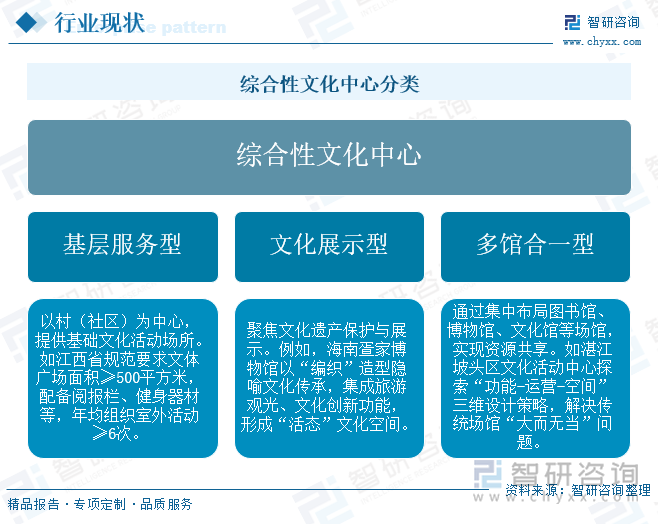
Core Insights - The Chinese comprehensive cultural center industry is experiencing robust growth, driven by increasing consumer demand for cultural and spiritual consumption, with an investment scale projected to reach 21.016 billion yuan in 2024, marking a year-on-year increase of 6.13% [1][12] - Technological innovations such as VR, AR, and AI are becoming key engines for industry upgrades, enhancing various aspects of the cultural experience and service delivery [1][12][21] Industry Overview - Comprehensive cultural centers serve as venues for public activities, integrating various functions such as education, cultural promotion, and community engagement [2] - They can be categorized into three types based on their functional positioning: grassroots service type, cultural display type, and multi-facility type [2] Industry Development History - The industry has evolved through four main stages: 1. The initial exploration phase (1978-2000) focused on single-function centers with low marketization [4] 2. The standardization phase (2001-2010) saw the introduction of standardized cultural facilities [4] 3. The digitalization and diversification phase (2011-2020) emphasized the integration of digital technologies [5] 4. The high-quality development phase (2021-present) aims for intelligent and scenario-based services [5] Industry Value Chain - The upstream of the industry includes venue construction, cultural activity equipment, cultural resources, technology, and funding support [7] - The midstream focuses on the operational services of cultural centers, while the downstream involves the visitors [7] Investment Scale - The market size of the comprehensive cultural center industry is steadily expanding, with significant growth in investment and technological integration [12] Key Center Operations - National-level cultural institutions like the National Library and National Museum lead the industry with extensive collections and digital initiatives [14][16] - Regional cultural centers leverage local characteristics and policies to create differentiated competitive advantages [14] Industry Development Trends 1. **Policy and Technology Integration**: Government policies are increasingly supporting the cultural industry, driving technological integration to enhance cultural experiences [21] 2. **Diverse Market Demand**: Rising living standards and cultural consumption needs are prompting cultural centers to innovate service models and diversify offerings [22] 3. **Sustainable Development**: The industry is moving towards green transformation, focusing on energy-efficient designs and promoting traditional culture [23]