
基建投资

Search documents
8月基建投资同比降幅边际收窄,继续关注中西部区域基建投资机会 | 投研报告
Zhong Guo Neng Yuan Wang· 2025-09-16 01:05
Group 1 - The core viewpoint of the report indicates a marginal narrowing of the year-on-year decline in infrastructure investment, with a recommendation to focus on investment opportunities in the central and western regions of China [2][3] - From January to August 2025, real estate development investment decreased by 12.9%, while narrow infrastructure and broad infrastructure investments increased by 2% and 5.4% respectively [2][3] - In August 2025, the year-on-year decline in real estate development investment was 19.9%, with narrow infrastructure and broad infrastructure investments declining by 5.9% and 6.4% respectively [2][3] Group 2 - The cumulative new special bonds issued from January to August 2025 reached 32,641.37 billion yuan, representing a year-on-year increase of 26.9% [2] - The report highlights that the issuance of special bonds is expected to accelerate in the second half of the year to support major engineering projects [2] - The real estate sector continues to show weakness, with a year-on-year decline in sales area of 4.7% from January to August 2025 [3] Group 3 - Cement production from January to August 2025 was 1.105 billion tons, a year-on-year decrease of 4.8% [4] - In August 2025, the average cement price increased to 349 yuan per ton, although it remains 38 yuan lower than the previous year [5] - The report notes that the demand for cement is expected to improve seasonally, which may lead to a gradual recovery in the profitability of cement companies [5] Group 4 - The production of flat glass from January to August 2025 was 64,818 million weight cases, down 4.5% year-on-year [6] - The report indicates that there is a potential for demand improvement in the glass market as inventory levels are being digested [6] - The overall operating rate of the flat glass industry was reported at 82.04% as of the end of August 2025 [6]
8月基建投资同比降幅边际收窄,继续关注中西部区域基建投资机会
Tianfeng Securities· 2025-09-15 14:35
Investment Rating - Industry rating is maintained at "Outperform the Market" [6] Core Insights - Infrastructure investment in August shows a narrowing year-on-year decline, with a focus on investment opportunities in the central and western regions [1] - Real estate sales area decreased by 4.7% year-on-year from January to August, with a significant drop of 11% in August alone [2] - Cement prices have started to rise after a prolonged period of decline, indicating potential recovery in profitability for cement companies [3] - The flat glass production showed a year-on-year decline of 4.5% from January to August, but the decline is narrowing, suggesting a potential improvement in demand [4] Summary by Sections Infrastructure Investment - From January to August, real estate development investment decreased by 12.9%, while narrow and broad infrastructure investments increased by 2% and 5.4% respectively [1] - Cumulative new special bonds reached 32,641.37 billion yuan, up 26.9% year-on-year, indicating strong support for infrastructure projects [1] Real Estate Market - New construction area decreased by 19.5% year-on-year from January to August, with a monthly decline of 19.8% in August [2] - Completion area saw a year-on-year decline of 17% from January to August, with a monthly drop of 21.2% in August [2] Cement Industry - Cement production from January to August was 1.105 billion tons, down 4.8% year-on-year, with August production at 148 million tons, a 6.2% decline [3] - The average cement price in August was 349 yuan per ton, showing a slight increase from earlier in the month [3] Glass Industry - Flat glass production from January to August was 64.818 million weight cases, down 4.5% year-on-year, with August production at 8.267 million weight cases, a 2% decline [4] - The market is showing signs of demand improvement as inventory levels decrease and production lines resume operations [4]




机械设备行业跟踪:宏观指标边际回暖,工程机械销量整体回升
Mai Gao Zheng Quan· 2025-09-15 11:26
Investment Rating - The industry is rated as outperforming the market, with a projected increase of over 5% relative to the benchmark index in the next six months [1][118]. Core Insights - The macroeconomic indicators are showing marginal recovery, leading to an overall rebound in engineering machinery sales [1]. - In the first seven months of 2025, excavator sales reached 137,658 units, representing a year-on-year increase of 17.8% [19][26]. - The report highlights a structural divergence in the sales of various types of cranes, with tower cranes and truck cranes experiencing declines due to the ongoing downturn in the real estate market, while crawler cranes are benefiting from strong demand in large-scale energy projects [54]. Summary by Sections 1. Macroeconomic Tracking - As of July 2025, China's manufacturing PMI recorded at 49.3%, indicating a contraction, while the production PMI was at 50.5%, signaling expansion [2][6]. - The Producer Price Index (PPI) decreased by 3.6% year-on-year, while the Consumer Price Index (CPI) showed a slight increase of 0.4% month-on-month [11][12]. - Fixed asset investment in China reached 288,229 billion yuan in the first seven months of 2025, growing by 1.6% year-on-year, with infrastructure investment up by 7.3% [14]. 2. Sales Overview of Chinese Engineering Machinery - In the first seven months of 2025, various machinery sales showed mixed results: - Excavators: 137,658 units (+17.8%) - Concrete machinery: 183,700 units (-2.14%) - Tower cranes: 3,181 units (-36.8%) - Crawler cranes: +13.1% - Truck cranes: +3.3% [19][27][30][38][48]. - The report indicates that the sales of forklifts reached 857,939 units, marking a 12% increase year-on-year [104][111]. 3. Investment Opportunities - The report emphasizes that domestic infrastructure investment remains resilient, with machinery related to construction, such as road rollers and pavers, expected to benefit in the long term [102]. - The government has increased the issuance of special bonds for local governments, which is anticipated to drive demand for engineering equipment [102].
2025年1-8月投资数据点评:固投持续走弱,基建投资承压
Shenwan Hongyuan Securities· 2025-09-15 08:43
Investment Rating - The industry investment rating is "Overweight" [2][26]. Core Viewpoints - Fixed asset investment has continued to weaken, with a cumulative year-on-year increase of only 0.5% for January to August 2025, a decrease of 1.1 percentage points compared to July 2025. Manufacturing investment also saw a year-on-year increase of 5.1%, reflecting a similar decline [4][12]. - Infrastructure investment is under pressure, with transportation, water conservancy, and public utility investments all showing declining growth rates. Infrastructure investment (including all categories) increased by 5.4% year-on-year, down 1.9 percentage points from July 2025. Excluding electricity, the growth rate was only 2.0% [5][12]. - Real estate investment remains low, with a year-on-year decrease of 12.9% for January to August 2025, and construction starts down by 19.5% [12][18]. Summary by Sections Fixed Asset Investment - The cumulative year-on-year growth rate for fixed asset investment is 0.5%, down 1.1 percentage points from the previous month. Manufacturing investment growth is also down to 5.1% [4][12]. Infrastructure Investment - Infrastructure investment (all categories) shows a year-on-year increase of 5.4%, with a decline of 1.9 percentage points from the previous month. Excluding electricity, the growth rate is only 2.0% [5][12]. - Specific sectors like transportation and public utilities are experiencing significant pressure, with transportation investment growing by only 2.7% year-on-year [5][12]. Real Estate Investment - Real estate investment has decreased by 12.9% year-on-year, with construction starts down by 19.5% and completions down by 17.0% [12][18]. - The current cycle is characterized by excessive supply clearance and difficulties in inventory replenishment, leading to a slow recovery in investment [12][18]. Investment Recommendations - The report suggests that the overall industry is weak, but regional investments may gain flexibility as national strategic layouts deepen. Recommended companies include China Chemical, China Energy Construction, China Railway, and China Railway Construction among state-owned enterprises, and Zhi Te New Materials and Honglu Steel Structure among private enterprises [18].


三季度经济发展趋势如何 国家统计局最新研判
Di Yi Cai Jing· 2025-09-15 04:38
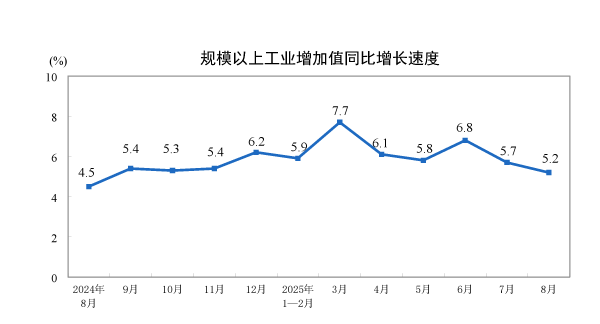
Economic Overview - In August, China's economy showed short-term fluctuations but demonstrated strong resilience and vitality despite a complex external environment and weak domestic demand [1] - The National Bureau of Statistics reported that the industrial added value above designated size grew by 5.2% year-on-year in August, a slight decrease of 0.5 percentage points from July [1] - Retail sales of consumer goods increased by 3.4% year-on-year in August, down 0.3 percentage points from July [1] - From January to August, fixed asset investment grew by 0.5% year-on-year, slowing down by 1.1 percentage points compared to the first seven months of the year [1] Industrial Development - The high-end development of industries is progressing positively, with technological and industrial innovations continuously merging [3] - From January to August, the added value of high-tech manufacturing industries increased by 9.5%, with integrated circuit manufacturing and aerospace equipment manufacturing growing by 22.3% and 14.6%, respectively [3] - The production of industrial robots and civilian drones surged by 29.9% and 53.7%, respectively, indicating steady progress in intelligent and green transformation [3] Consumer Market - The scale of commodity consumption continues to expand, with market sales steadily recovering due to various measures aimed at boosting consumption [5] - From January to August, retail sales of consumer goods increased by 4.6%, while service retail sales grew by 5.1% [6] - The implementation of policies such as trade-in programs has stimulated consumer demand, leading to significant growth in related product sales [6] Investment Trends - Fixed asset investment (excluding rural households) reached 326.111 billion yuan from January to August, with a year-on-year growth of 0.5% [9] - Manufacturing investment grew by 5.1% year-on-year, although this represents a decline of 1.1 percentage points compared to the previous seven months [10] - Infrastructure investment (excluding power, heat, gas, and water production and supply) increased by 2.0% year-on-year, but the growth rate slowed by 1.2 percentage points compared to the first seven months [10] Future Outlook - Despite external challenges, China's economy is expected to maintain a stable and progressive development trend, supported by macroeconomic policies and the construction of a unified national market [11] - The potential for high-quality development remains strong, with new growth drivers emerging and market vitality increasing [11]

前8个月投资增速有所回落,分析师:接下来基建投资或将提速
Sou Hu Cai Jing· 2025-09-15 03:40
Group 1: Fixed Asset Investment - National fixed asset investment from January to August increased by 0.5% year-on-year, a decline of 1.1 percentage points compared to January to July [1] - Infrastructure investment (excluding electricity, heat, gas, and water production and supply) grew by 2.0% year-on-year, down 1.2 percentage points from January to July [2] - Full-year infrastructure investment growth is expected to reach around 5.0%, an acceleration of 0.6 percentage points compared to the previous year [2] Group 2: Government Policies and Financing - The Central Political Bureau emphasized the need for sustained macro policies and the acceleration of government bond issuance to improve fund utilization efficiency [2] - There will be a large-scale issuance of new special bonds for local governments for project construction in the second half of the year [3] - The issuance scale of special long-term bonds to support "two heavy" investments may be increased, providing sufficient funding for infrastructure investment [5] Group 3: Real Estate Investment - Real estate development investment from January to August decreased by 12.9% year-on-year, with the decline expanding by 0.9 percentage points compared to January to July [4] - New commercial housing sales area was 57,304 million square meters, a year-on-year decrease of 4.7% [4] - The expected year-on-year decline in real estate investment is projected to be around -9.0%, narrowing by 1.6 percentage points compared to the previous year [6] Group 4: Manufacturing Investment - Manufacturing investment from January to August increased by 5.1% year-on-year, but this was a decline of 1.1 percentage points compared to the first seven months [7] - The external economic environment and "anti-involution" policies may further impact domestic manufacturing investment, with a projected full-year growth rate of around 5.5%, down 3.7 percentage points from the previous year [7][8] - Manufacturing investment is expected to continue its downward trend in the second half of the year [7]
天风证券:25H1建筑板块业绩承压 重视高股息及细分高景气赛道
智通财经网· 2025-09-13 10:00
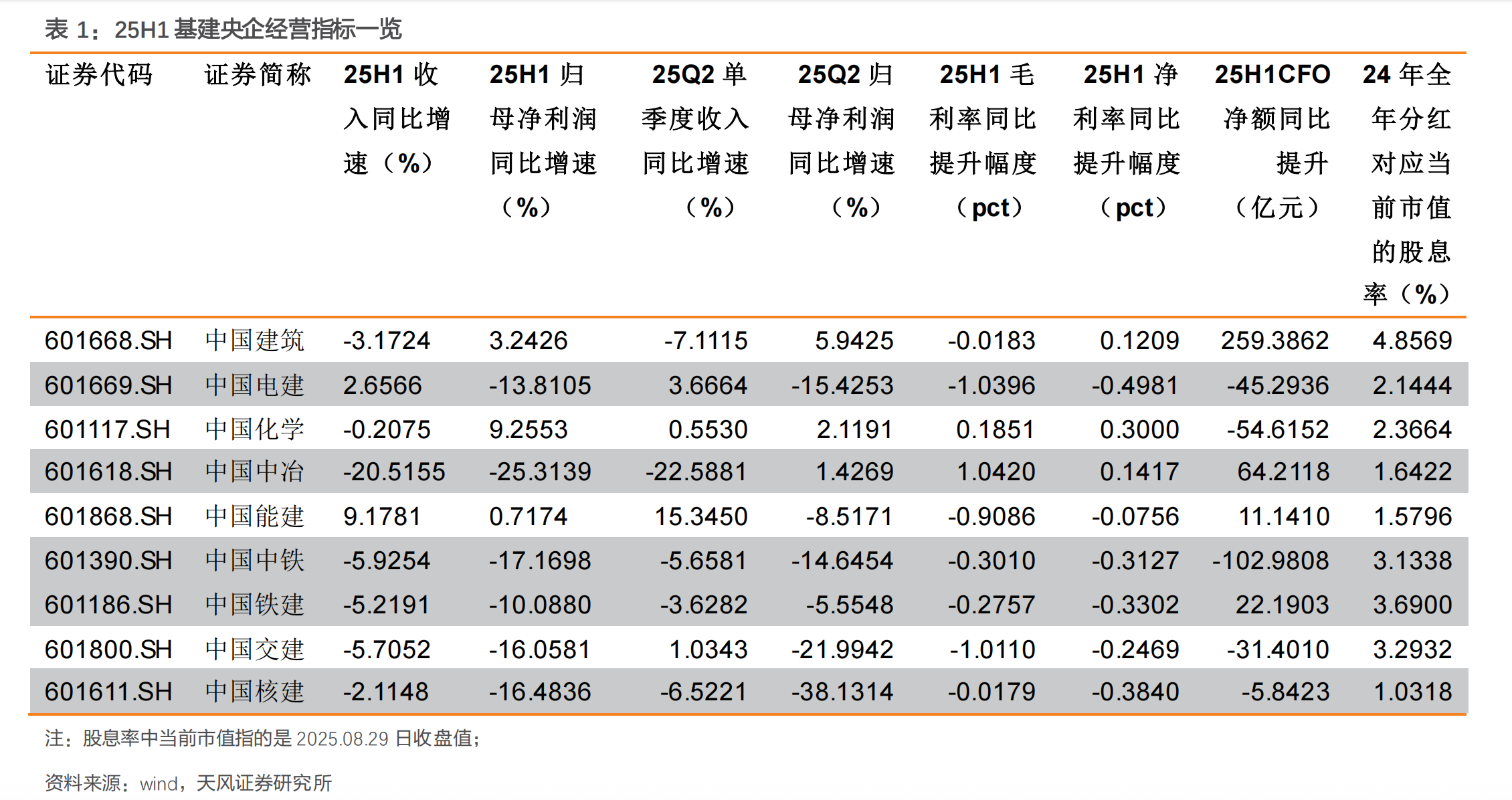
Core Viewpoint - The construction sector experienced revenue and profit declines in the first half of 2025, but there is optimism for a marginal recovery in the second half due to accelerated issuance of special bonds supporting infrastructure investment [1][2]. Group 1: Financial Performance - In H1 2025, the construction sector achieved revenue of 39,639 billion yuan, a year-on-year decline of 5.5%, and a net profit of 913 billion yuan, down 6.03% year-on-year [2]. - The gross profit margin decreased by 0.15 percentage points, while the expense ratio increased by 0.23 percentage points to 5.76% [3]. - The overall net profit margin stood at 2.87%, slightly down by 0.04 percentage points year-on-year [3]. Group 2: Subsector Performance - Subsector performance varied, with design consulting, steel structure, and chemical engineering showing better revenue growth than the overall sector, with growth rates of +3.06%, +2.84%, and -1.54% respectively [4]. - The chemical engineering sector saw positive net profit growth, with companies like Donghua Technology and China Chemical reporting increases of 14.6% and 9.3% respectively [4]. Group 3: Resilience of State-Owned Enterprises - Major state-owned enterprises in the construction sector demonstrated resilience, with companies like China State Construction, China Chemical, and China Energy achieving positive net profit growth in H1 2025 [5]. - The market share of new signed orders for the nine major state-owned enterprises increased from 35% in 2019 to 55.5% in H1 2025, indicating a potential for further market share growth [4][5].

基建8大巨头业绩比拼,集体面临盈利和回款双重压力
Di Yi Cai Jing· 2025-09-11 12:52
Core Insights - The construction industry is facing significant performance pressure due to deep adjustments in the real estate sector and a contraction in construction business [1][3] - Major state-owned construction enterprises are experiencing revenue and profit declines, with only a few companies showing positive growth [1][4] Industry Performance - In the first half of 2025, the CS construction sector achieved operating revenue of 39,619.05 billion yuan, a year-on-year decline of 5.52%, and a net profit attributable to shareholders of 912.76 billion yuan, down 6.03% [1] - The revenue growth rate has been continuously declining since 2022, with the first annual revenue decline expected in nearly a decade for the sector in 2024 [3] Major Companies' Performance - Among the eight major state-owned construction enterprises, only China Electric Power and China Energy Construction reported revenue growth, while only China Construction, China Chemical, and China Energy Construction saw net profit growth [1][4] - China Construction reported a total revenue of 11,083.07 billion yuan in the first half of 2025, a decrease of 3.17%, marking its first revenue decline in five years [7] New Contracts and Revenue - New signed contracts are crucial for construction companies, with China Construction signing contracts worth 2.5 trillion yuan, a slight increase of 0.9% year-on-year [4] - However, some companies like China Metallurgical Group and China Railway Construction experienced declines in new contracts, with decreases of 19.1% and 4.04% respectively [4][5] Cash Flow and Financial Health - The cash flow situation remains critical, with major construction companies reporting significant cash outflows and high accounts receivable [9][10] - As of mid-2025, the total accounts receivable for the eight major construction enterprises reached 15,796 billion yuan, indicating substantial financial pressure [10] Future Outlook - The construction sector is expected to face ongoing challenges, but there is potential for improvement in infrastructure investment driven by government initiatives [11] - The focus on urban renewal and major infrastructure projects may provide opportunities for growth, supported by fiscal policies [11]
高铁基建股普涨 中国中车涨3% 中国中冶涨近2%
Ge Long Hui· 2025-09-11 04:24
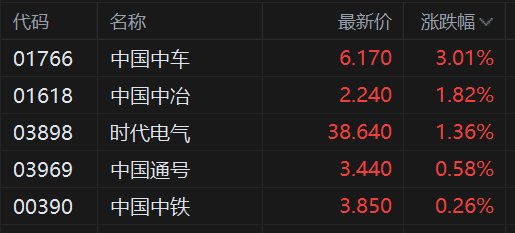
Group 1 - The core viewpoint of the articles highlights a general increase in Hong Kong's high-speed rail infrastructure stocks, driven by positive market sentiment and supportive government policies [1] - China CRRC saw a rise of 3%, China Metallurgical Group increased by nearly 2%, and Times Electric rose by 1.36%, indicating strong performance among key players in the sector [2] - A report from招商宏观 suggests that the upcoming fiscal spending on infrastructure is expected to rebound significantly, with a projected increase in growth rate to over 7% from a current -5% for the first seven months of the year [1] Group 2 - The recent positive developments in high-speed rail infrastructure stocks are attributed to the deepening interconnectivity in the Guangdong-Hong Kong-Macau Greater Bay Area, which is expected to boost cross-border high-speed rail demand [1] - Continuous promotion of new infrastructure projects and policies supporting equipment upgrades and smart transformation are also contributing factors to the sector's vitality [1]




股指 短线宽幅波动
Qi Huo Ri Bao· 2025-09-11 01:15
Market Overview - A-share market trading activity has decreased, with a slight decline in transaction volume in the Shanghai and Shenzhen markets, indicating that incremental capital has not yet formed a consistent expectation in the short term, leading to a wide fluctuation in the market [1][4] - The overall A-share market is experiencing significant fluctuations, with notable sector rotation. Benefiting from interest rate cut expectations and "anti-involution" policies, sectors such as electric power equipment and non-ferrous metals have seen substantial gains, while previously high-performing sectors like computers and communications have shown weakness [1] Economic Indicators - In August, China's exports increased by 4.4% year-on-year in USD terms, below the expected 5.9% and previous value of 7.2%. Imports grew by 1.3%, also below expectations [1] - The decline in exports to the US has intensified, with a drop of 33.1% in August, negatively impacting total exports by 5.1 percentage points, while exports to the EU and ASEAN exceeded previous values [1] Consumer Price Index (CPI) and Producer Price Index (PPI) - In August, China's CPI growth remained flat month-on-month, with a year-on-year decrease to -0.4%. The PPI growth shifted from a decline to flat, with a significant narrowing of the year-on-year decline [2] - Prices of pork and eggs have shown lower-than-seasonal increases, while some food prices continue to decline, affecting non-food items [2] Infrastructure and Real Estate - High-frequency data for August indicates a slight increase in the year-on-year growth rate of petroleum asphalt and cement shipments. The National Development and Reform Commission has allocated 300 billion yuan for the third batch of "two heavy" construction projects, which will support infrastructure growth [3] - In the real estate sector, first-tier city housing prices have declined more than those in second and third-tier cities, with sales of commercial housing in 30 cities in August still needing improvement [3] Consumer Behavior - The retail sales growth rate for social consumer goods in August is expected to moderate. The previous year's "old-for-new" subsidy funds have been gradually distributed, but this year faces a high base environment and increased consumer sensitivity to price changes [3] Global Economic Context - Recent expectations for overseas interest rate cuts have risen, with the US adding only 22,000 non-farm jobs in August, below the expected 75,000 and previous 79,000. The unemployment rate rose to 4.3%, the highest since November 2021 [4] - Following the employment data release, the dollar index and US bond yields fell, while gold, US stocks, and copper prices surged. Market sentiment has shifted towards recession, with an increased probability of the Federal Reserve cutting rates three times this year [4]