春季躁动行情

Search documents
市场以结构性行情为主
Xin Lang Cai Jing· 2025-12-28 22:35
(来源:南京晨报) 转自:南京晨报 投资策略上,成长行业仍是市场关注度较高,始终存在产业催化或事件推进影响的板块,且部分板块仍 处在企稳修复的初期阶段,后续仍存进一步改善的空间,其余低位的板块,如顺周期的消费、地产等板 块政策较为零星,难以形成合力,波段操作仍是最合适的方式,而反内卷或者供给侧约束逻辑相关的资 源和有色板块,短期持续上行后积累了一定的风险,若能出现像样的回调,其景气驱动下未来仍有上行 的机会。 晨报讯(南京晨报/爱南京记者 许崇静)近期A股市场表现如何?南京证券研究员周正峰表示,上周 (12月22日至26日),成长板块领衔反弹激活市场人气,主要指数走势均走出连阳的特征,显示市场情 绪有所好转,布局春季躁动行情的资金或已开始介入,且近期部分题材股如商业航天等持续受到催化而 走强同样对市场情绪有所助力。市场风格方面,成长及周期风格领涨,成长风格涨幅超4%,消费风格 成唯一下跌板块,稳定风格涨幅垫底。 从更长期限来看市场,在估值仍处于合理位置,企业盈利存在好转预期以及物价继续修复等背景下,明 年市场整体中枢有望继续震荡上行,当前市场更多呈现存量博弈下的结构性行情,利好催化叠加此前已 经经历一段时间的 ...
A股或迎接跨年“小躁动”行情
Mei Ri Jing Ji Xin Wen· 2025-12-28 21:55
Group 1 - The A-share market is experiencing a "small fluctuation" trend as it approaches the end of the year, with the Shanghai Composite Index recording eight consecutive days of gains [1] - Market liquidity is driving the current trend, with total trading volume exceeding 2 trillion yuan on the last Friday, indicating a significant increase in market activity [1] - Key sectors such as non-ferrous metals and lithium mining are benefiting from price increases, while themes like Hainan Free Trade Port and commercial aerospace remain active [1] Group 2 - Institutional buying power is expected to strengthen, with increased allocation of funds as external uncertainties ease, contributing to a positive cross-year market outlook [2] - The rebound of U.S. tech stocks, appreciation of the yuan, and rising prices of non-ferrous metals are identified as catalysts for the upcoming market rally [2] - The cross-year market is anticipated to show a clear characteristic of "growth leading, liquor sector consolidating," with a focus on sectors like snacks and dairy that are showing clear growth potential [3] Group 3 - The liquor sector is currently in a "bottoming out" phase, with demand expected to increase as the Spring Festival approaches, leading to a potential valuation recovery post-holiday [3] - Recent stabilization in prices from leading liquor companies and a decrease in inventory levels are early signs of recovery in the liquor market [3]


机构展望 | 机构资金踊跃布局 本轮“春季躁动”行情或已展开
Shang Hai Zheng Quan Bao· 2025-12-28 19:26
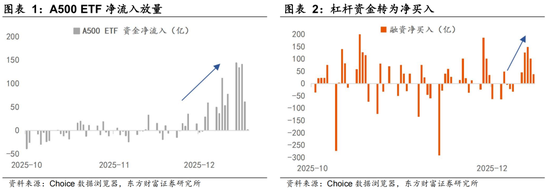
上周,A股市场延续强势表现,截至12月26日,沪指实现8连涨,追平年内连涨纪录,沪深两市成交额 重返2万亿元。2025年交易迎来最后三个交易日,券商策略展望报告一致认为,A股的强劲反弹在年末 关口有望延续。机构资金买入力量不断增强、人民币升值吸引外资流入,构成A股资金面边际改善的两 大主要因素。 机构资金买入力量有望增强 上周证券市场一个值得注意的现象是,中证A500ETF份额数快速上行,成为短期增量资金流入最快的方 向。 对此,华西证券分析称,中证A500ETF净申购成为年末A股重要的增量资金来源之一。根据统计,12月 至今,股票型ETF累计净申购908亿元,为今年4月以来净申购规模最高的月份。其中,增量资金主要来 源于规模居前的中证A500ETF产品的净申购,这反映出年末机构增量资金正在加速流入。 兴业证券分析称,短期来看,企业结汇需求释放的滞后效应,对岁末年初人民币汇率走强仍构成一定助 力,汇率市场与证券市场的"春季躁动"行情有望共振。展望2026年,弱美元为人民币升值提供良好外部 环境。 兴业证券回顾了2016年以来的四轮人民币升值周期,发现区间A股与港股大多实现上涨,即人民币升值 阶段中国资产往往表 ...
机构资金踊跃布局 本轮“春季躁动”行情或已展开
Shang Hai Zheng Quan Bao· 2025-12-28 19:10
上证指数日K线图 人民币资产吸引力不断提升 与此同时,近期人民币汇率的偏强运行,有利于吸引海外资金回流。机构看好外资,尤其是被动型配置 资金率先增加对中国资产的配置。 ■机构展望 机构资金踊跃布局 本轮"春季躁动"行情或已展开 ◎记者 汪友若 上周,A股市场延续强势表现,截至12月26日,沪指实现8连涨,追平年内连涨纪录,沪深两市成交额 重返2万亿元。2025年交易迎来最后三个交易日,券商策略展望报告一致认为,A股的强劲反弹在年末 关口有望延续。机构资金买入力量不断增强、人民币升值吸引外资流入,构成A股资金面边际改善的两 大主要因素。 机构资金买入力量有望增强 上周证券市场一个值得注意的现象是,中证A500ETF份额数快速上行,成为短期增量资金流入最快的方 向。 对此,华西证券分析称,中证A500ETF净申购成为年末A股重要的增量资金来源之一。根据统计,12月 至今,股票型ETF累计净申购908亿元,为今年4月以来净申购规模最高的月份。其中,增量资金主要来 源于规模居前的中证A500ETF产品的净申购,这反映出年末机构增量资金正在加速流入。 开源证券同样观察到,12月以来宽基ETF呈现大幅净流入态势,其中超过 ...


年末关口的强劲反弹能否延续?丨每周研选
Sou Hu Cai Jing· 2025-12-28 16:13
Core Viewpoint - The A-share market is experiencing a strong year-end rebound, with the Shanghai Composite Index achieving an eight-day consecutive rise, and trading volume in the Shanghai and Shenzhen markets returning to 2 trillion yuan, indicating a potential "spring rally" in the near future [4][6]. Group 1: Market Trends - The A-share market is showing signs of a "small rally" as it approaches the year-end, with significant trading volume and a notable rise in sectors such as non-ferrous metals, lithium mining, and commercial aerospace [8]. - The recent upward movement in the index is primarily driven by cyclical sectors, particularly non-ferrous metals, reflecting a recovery in market risk appetite [9]. - The current market environment is characterized by a "bottom consolidation" phase, preparing for a potential rally before the Spring Festival, rather than a full-blown upward trend [9]. Group 2: Capital Flow and Investment Strategies - Institutional buying power is expected to strengthen, driven by favorable policy expectations and a stable economic backdrop, with a notable increase in inflows into stock ETFs [10]. - The weak dollar and the appreciation of the RMB are enhancing the attractiveness of Chinese assets, leading to increased foreign investment [10]. - There is a strong willingness among various funds to enter the market, particularly as the new year approaches, indicating a potential continuation of the "spring rally" [11]. Group 3: Sector Focus and Investment Opportunities - High-growth sectors such as optical modules, PCB, and short-term supply-constrained areas like optical chips and high-speed copper cables are recommended for investment [12]. - The "price increase" narrative is acting as a catalyst for the current rally, with significant inflows into broad-based ETFs and a focus on sectors like chemicals and new energy materials [13]. - The consumption sector is also highlighted as a potential area for investment, given its relative underperformance this year and the supportive policy environment [16].
【十大券商一周策略】A股跨年行情已经启动,新的主线浮出水面
券商中国· 2025-12-28 14:59
Group 1 - The article highlights that among 360 industry/theme ETFs, 39 reached new highs in December, with established sectors like telecommunications and non-ferrous metals reflecting North American AI infrastructure and resource logic, while new sectors like commercial aerospace are gaining attention during market fluctuations [2] - The focus is on structural opportunities in a volatile market, with sectors like chemicals, engineering machinery, and new energy being prioritized due to their long-term ROE potential, alongside emerging themes like commercial aerospace [3] - The article emphasizes the importance of the RMB appreciation trend and its implications for investment strategies, particularly in brokerage and insurance sectors [3] Group 2 - The article discusses favorable conditions for the spring market rally, driven by liquidity and investor expectations, with a focus on the A500 ETF and potential market fluctuations at year-end and early next year [4] - It notes that the RMB's recent strength, driven by corporate settlement demand and a favorable external environment, could lead to a capital market rally, benefiting sectors reliant on imported materials and those with significant foreign currency liabilities [6] - The article identifies new investment themes emerging in the commodity market and manufacturing sectors, particularly in AI and global manufacturing recovery, recommending investments in industrial resources and equipment exports [8] Group 3 - The article indicates that the A-share market has entered a cross-year rally phase, supported by optimistic institutional investor sentiment and favorable policy expectations [9] - It suggests that the spring market is likely to exhibit structural characteristics with rapid sector rotation, encouraging investors to adopt a low-buying strategy [13][14] - The article highlights the potential for a continued upward trend in the market leading up to the Spring Festival, with a focus on technology themes and non-bank financial sectors [15]

机构带头冲击4000点——A股一周走势研判及事件提醒
Datayes· 2025-12-28 14:43
摘要 / 冲击4000点 春季躁动行情也许真的来了,兄弟姐妹萌,沪指八连阳了! 这 是 自 2024 年"9.24"行情以来的第三次(前两次分别为2024.9.27和2025.4.17)。 而且这周A股主力净买入1625.1亿元,规模创11个月以来最大,基本上就是过年 以来最大规模啊! 下周,站稳4000点吧! 周五没更,因为没有好段纸,上午盘中出现了一波小跳水,主要有两个传闻! 这段时间,机构资金酷酷买,除了异常的中证A500ETF,另一个是私募资金规模 扩张与加速补仓。 2025年11月,私募基金证券管理规模上升到70383亿元的水 平。信达证券认为,私募规模上台阶配合加速补仓,可能成为市场重要的增量资 金来源。 一个是说,最近基金搞a500etf年末充量,被窗口指导了。监管的指导意见是, 不允许拉短钱,需要拉长期持有的钱;背后的原因是担心市场一月份,A500撤资 带来市场下跌。 还有一个是路透消息,中国国有大行在即期市场大量买入美元以放缓人民币涨 势,同时在长端掉期进行回笼美元,以应对结汇压力。 不过我查了下,路透的消息是12月初的,周五没有。而彭博社当天确实报了监管 放缓人民币升值的信号,不过主要还是 ...

周末,全是利好!史诗级行情,刚刚宣布,暂停申购!
中国基金报· 2025-12-28 14:43
Key Points - The article discusses recent positive developments in the Chinese financial market, including government policies aimed at boosting fiscal spending and consumer support [3][4]. - The People's Bank of China emphasizes the need for a favorable policy environment to enhance long-term investments in the A-share market [5]. - The Shanghai Stock Exchange has introduced guidelines to support commercial rocket enterprises, indicating a focus on innovation in the aerospace sector [8][10]. - The market is experiencing a "small rally" with significant trading volume, particularly in sectors like metals and commercial aerospace [27]. Group 1: Government Policies - The Ministry of Finance plans to continue implementing a proactive fiscal policy in 2026, focusing on expanding fiscal spending and optimizing government bond tools [3]. - The government will support consumer goods through a subsidy program for replacing old products, aiming to stimulate consumption [4]. Group 2: Market Developments - The People's Bank of China reports on improving the investment environment for long-term funds in the A-share market, aiming for a healthy cycle between capital markets and the real economy [5]. - The Shanghai Stock Exchange has released guidelines for commercial rocket companies to facilitate their listing on the Sci-Tech Innovation Board, supporting the growth of the aerospace industry [8][10]. Group 3: Market Analysis by Securities Firms - CITIC Securities highlights the performance of ETFs, noting that sectors like telecommunications and aerospace are gaining traction due to their alignment with international infrastructure competition [15]. - Shenwan Hongyuan emphasizes the liquidity-driven nature of the current market rally, suggesting that the spring market conditions remain favorable [17]. - Guotai Junan identifies new investment themes emerging in commodity markets and the manufacturing sector, reflecting China's growing manufacturing advantages [19].

陈果:上证指数呈现一定程度春季躁动行情特征
Xin Lang Cai Jing· 2025-12-28 12:20
Core Viewpoint - The recent performance of the Shanghai Composite Index, characterized by an "eight consecutive days of gains," indicates a spring market rally, but there is a lack of consensus on the leading sectors for this rally [1][20] Group 1: Market Dynamics - The current market is experiencing high sector rotation intensity, suggesting that funds have not yet formed a clear consensus on the leading sectors [1][20] - The improvement in micro liquidity since late November has prompted a market layout period, although future market performance may not be consistently strong and could experience fluctuations [3][22] - The significant net inflow into the A500 ETF, amounting to 48.17 billion, has improved the micro liquidity environment and ignited bullish sentiment in the market [5][24] Group 2: Price Increase Opportunities - Three categories of price increase opportunities have been identified: 1. High demand and supply mismatch, particularly in the AI industry chain (e.g., storage, copper-clad laminate, semiconductor manufacturing) and energy storage chain (e.g., lithium iron phosphate, separators, lithium carbonate) [1][32] 2. Stable demand with supply disruptions, mainly in industrial metals (copper/aluminum), fertilizers, and some minor metals (e.g., cobalt, tin) [2][34] 3. Cost increases leading to price adjustments, primarily in chemicals (e.g., titanium dioxide, MDI), photovoltaics (modules, silicon wafers), and certain midstream manufacturing sectors [2][35] Group 3: Sector Focus - Key sectors to watch include insurance, non-ferrous metals, chemicals, computing power, semiconductor equipment, aviation, new energy, and machinery [3][22] - Specific themes of interest are robotics, autonomous driving, and commercial aerospace, which are expected to drive future market performance [3][22]
【兴证计算机】一文看懂全球商业航天标杆SpaceX
兴业计算机团队· 2025-12-28 11:16
Group 1 - The core viewpoint emphasizes the importance of increasing investment in the commercial aerospace sector, highlighting the potential for a spring market rally in 2026, with a recommendation to gradually increase positions in high-quality leading companies within this sector [1][2] - The report notes that the computer sector has seen a 16.89% increase since the beginning of 2025, ranking 16th out of 31 in the TMT sector, indicating a need for strategic positioning in high-growth areas [1] - The commercial aerospace industry is experiencing significant changes, including successful launches and IPO advancements, suggesting a growing market opportunity that should be closely monitored [2] Group 2 - The report provides a detailed analysis of SpaceX as a benchmark for global commercial aerospace, indicating its role in shaping industry standards and practices [2]