
CPI

Search documents
申万期货品种策略日报:国债-20250411
Shen Yin Wan Guo Qi Huo· 2025-04-11 02:26
Report Overview - The report is the Shenwan Futures Variety Strategy Daily Report - Treasury Bonds on April 11, 2025, provided by the Shenwan Futures Research Institute [1][2] 1. Report Industry Investment Rating - Not provided in the content 2. Report's Core View - Treasury bond futures prices showed mixed performance, with the 10 - year Treasury bond active bond yield falling to 1.6475%. The central bank's open - market operations led to a net withdrawal of 157.5 billion yuan, and short - term Shibor rates mostly declined, with funding rates dropping below 1.7%. The probability of the Fed's interest rate cut increased, causing short - term US Treasury yields to fall. Policy expectations for China's market are strengthening, and it is expected to continue supporting short - term Treasury bond futures prices. However, long - term Treasury bond futures prices may experience greater fluctuations [2][3] 3. Summary by Relevant Catalogs 3.1 Futures Market - **Price and Yield Changes**: On the previous trading day, Treasury bond futures prices showed mixed performance. For example, the T2506 contract rose 0.13%, and the corresponding CTD bond IRR of each Treasury bond futures main contract was at a low level, with no arbitrage opportunities. Short - term market interest rates generally declined, and key - term Treasury bond yields at home and abroad also changed. The 10Y Treasury bond yield in China decreased by 0.23bp to 1.65%, while the 10Y Treasury bond yields in the US, Germany, and Japan increased by 6bp, 3bp, and 1.6bp respectively [2] - **Trading Volume and Open Interest**: The trading volume and open interest of each contract also changed. For example, the open interest of T2506 increased by 3578 [2] - **Spread Changes**: The inter - period spreads of some contracts changed. For example, the inter - period spread of TS2506 decreased from - 0.096 to - 0.106 [2] 3.2 Macro and Market News - **Domestic Macro**: The central bank's open - market operations had a net withdrawal of 157.5 billion yuan on April 10. China's March CPI and PPI were affected by seasonal and international input factors, but core CPI increased by 0.5% year - on - year, showing positive price changes. There are expectations for the introduction of more macro - policies, including possible reserve requirement ratio cuts and interest rate cuts [3] - **International Macro**: The US imposed a 90 - day tariff suspension on some countries or regions. The US March CPI increased by 2.4% year - on - year, reaching a six - month low, and the probability of the Fed's interest rate cut increased. US Treasury bonds were sold off, and concerns about the sustainability of US debt increased [3] 3.3 Market Interest Rates - **Domestic Short - term Market Interest Rates**: SHIBOR overnight and 7 - day rates, DR001 and DR007, GC001 and GC007, FR001 and FR007 all declined to varying degrees on the previous trading day [2] - **US Treasury Yields**: US Treasury yields showed mixed performance. The 2 - year yield fell, while the 5 - year, 10 - year, and 30 - year yields rose [3]
2025年3月通胀数据点评:如何理解关税风暴下的CPI?
Tebon Securities· 2025-04-11 02:20
Group 1: CPI Analysis - In March 2025, the CPI year-on-year decline narrowed to -0.1%, improving by 0.6 percentage points from the previous month’s -0.7%[6] - The CPI month-on-month decreased by -0.4%, a decline of 0.2 percentage points compared to the previous month’s -0.2%[6] - The core CPI, excluding food and energy, rose by 0.5% year-on-year, reversing from a decline of -0.1% in the previous month[5] Group 2: Food and Energy Impact - Food prices fell by 1.4% year-on-year, with the decline narrowing by 1.9 percentage points from the previous month[5] - Key food items like beef, fresh vegetables, and eggs saw price drops of 10.8%, 6.8%, and 1.6% respectively, contributing to the overall CPI decline[5] - International oil prices decreased, contributing to a month-on-month CPI decline of approximately 0.12 percentage points[3] Group 3: PPI Insights - The PPI year-on-year decline was -2.5%, worsening from -2.2% in the previous month[26] - Month-on-month, the PPI decreased by -0.4%, a decline of 0.3 percentage points compared to the previous month[26] - The decline in PPI was influenced by falling prices in the oil and gas extraction industry, which dropped by 4.4%[10] Group 4: Economic Outlook - The 2025 CPI target growth rate is set at 2%, a reduction from the previous 3% target established since 2015[7] - The report suggests that the key to exiting the "low-price" environment is to boost core CPI, with real estate market stabilization being crucial[6] - The anticipated impact of tariff increases is expected to result in a 3% decline in export growth, correlating with a 0.20 percentage point drop in PPI and a 1.30 percentage point increase in CPI[15]
供需结构改善 物价走势平稳(锐财经)
Ren Min Ri Bao Hai Wai Ban· 2025-04-10 22:48
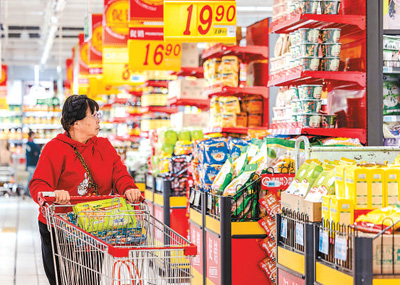
"CPI环比下降主要受季节性因素和油价下行影响。"董莉娟说,天气转暖,部分鲜活食品大量上市,食 品供应总体充足。3月份食品价格环比下降,影响CPI环比下降约0.24个百分点,占CPI总降幅六成。此 外,旅游淡季出行人数减少,出行类价格有所下降。其中,飞机票和旅游价格分别下降11.5%和5.9%, 合计影响CPI环比下降约0.13个百分点。 3月份CPI同比、环比有所下降,但提振消费需求等政策效应逐渐显现,加之春节错月影响消退,更多 方面显现出明显的积极变化。董莉娟介绍,从环比看,CPI环比降幅小于近十年同期平均水平0.2个百分 点。"以旧换新"等政策效应逐渐显现,扣除能源的工业消费品价格环比上涨0.5%,涨幅比上月扩大0.3 个百分点;从同比看,CPI同比降幅收窄,比上月收窄0.6个百分点。 "扣除食品和能源价格的核心CPI明显回升,同比由上月下降0.1%转为上涨0.5%。"董莉娟说,其中,服 务价格同比由上月下降0.4%转为上涨0.3%,对CPI的影响由上月下拉0.15个百分点转为上拉0.13个百分 点。 国家统计局4月10日发布的数据显示,3月份,全国居民消费价格指数(CPI)同比下降0.1%,全国工业 ...

2025年3月CPI和PPI数据点评:通胀面临内外部压力,政策进入集中发力期
Cai Xin Guo Ji· 2025-04-10 14:41
Group 1: CPI Analysis - In March, the Consumer Price Index (CPI) decreased by 0.4% month-on-month and 0.1% year-on-year, with the decline narrowing by 0.6 percentage points compared to the previous month[2] - The food price decline year-on-year shrank by 1.9 percentage points to -1.4%, reducing its downward impact on CPI by 0.35 percentage points[5] - Non-food prices increased by 0.2% year-on-year, up 0.3 percentage points from the previous month, contributing an additional 0.24 percentage points to CPI[6] Group 2: PPI Analysis - The Producer Price Index (PPI) fell by 2.5% year-on-year in March, with the decline expanding by 0.3 percentage points from the previous month[2] - The decline in production materials prices increased by 0.2 percentage points to -0.4%, with significant drops in the mining and raw materials sectors[7] - The PPI is expected to decrease by approximately 2.8% in April, continuing a trend of negative growth throughout the year[8] Group 3: Economic Outlook - The low inflation environment is expected to persist in the short term, with CPI likely to continue negative growth in the second and third quarters[9] - Domestic macroeconomic policies are anticipated to focus on stimulating consumption, stabilizing the real estate market, and supporting private enterprises[9] - The impact of external factors, such as global economic slowdown and trade pressures, is expected to further challenge domestic inflation recovery[9]
3月通胀点评:低通胀,冲击后或迎转机
CMS· 2025-04-10 14:38
CPI Analysis - March CPI year-on-year decreased by 0.1%, an improvement of 0.6 percentage points from the previous month[4] - Core CPI, excluding food and energy, increased to 0.5% year-on-year from -0.1% in the previous month[11] - Food CPI year-on-year was -1.4%, a narrowing of the decline by 1.9 percentage points compared to last month[10] PPI Analysis - March PPI year-on-year decreased by 2.5%, with a month-on-month decline of 0.4%[17] - Production materials prices fell by 2.8% year-on-year, with the largest drop in the mining industry, particularly coal and oil extraction[17] - Living materials prices decreased by 1.5% year-on-year, a further decline of 0.3 percentage points from the previous month[17] Future Outlook - April CPI is expected to see a slight year-on-year increase, primarily driven by food, services, and consumer goods[24] - The overall inflation target of 2% for the year remains distant, with new consumption policies anticipated to provide some support[24] - April PPI is likely to remain under pressure due to ongoing trade tensions and weak domestic demand, with a focus on expanding internal demand and stabilizing growth policies[25]
3月通胀点评:低通胀:冲击后或迎转机
CMS· 2025-04-10 13:35
Inflation Analysis - March CPI year-on-year decreased by 0.1%, improving by 0.6 percentage points from the previous month[5] - Core CPI, excluding food and energy, rose to 0.5% in March from -0.1% in February, indicating a recovery in consumer demand[10] - Food CPI year-on-year was -1.4%, but the decline narrowed by 1.9 percentage points compared to the previous month[9] PPI Trends - March PPI year-on-year fell by 2.5%, with production materials down by 2.8%, marking an increase in the decline by 0.3 percentage points from the previous month[16] - The coal mining and oil extraction sectors experienced the largest declines, with coal mining PPI down by 14.9% year-on-year[18] - Manufacturing and construction sectors showed seasonal demand expansion, but overall industrial demand remains weak, impacting PPI negatively[23] Future Outlook - April CPI is expected to see a slight year-on-year increase, primarily driven by food and service sectors, but seasonal factors may lead to a decline in food prices[22] - PPI is anticipated to remain under pressure due to ongoing trade tensions and weak domestic demand, with potential policy adjustments to stimulate growth[23]
核心CPI显著回升——3月物价数据解读【财通宏观•陈兴团队】
陈兴宏观研究· 2025-04-10 09:21
Core Viewpoint - The article discusses the recent trends in Consumer Price Index (CPI) and Producer Price Index (PPI), highlighting a recovery in CPI year-on-year growth and an expansion in the year-on-year decline of PPI, influenced by various seasonal and input factors [1][2][4]. CPI Analysis - In March, the CPI year-on-year decline narrowed to -0.1%, a decrease of 0.6 percentage points from the previous month, while the core CPI significantly rebounded to 0.5% [1][4]. - The main drag on the CPI was food prices, which fell by 1.4% month-on-month, contributing approximately 60% to the total CPI decline [6][4]. - Seasonal factors, such as warmer weather leading to increased fresh food supply, and a tourism off-season causing a drop in travel-related prices, were significant contributors to the CPI's month-on-month decline [1][6]. - Excluding food and energy, the core CPI showed improvement, with a year-on-year increase of 0.5%, indicating a potential positive impact from consumption-boosting policies [1][4]. PPI Analysis - The PPI year-on-year decline expanded to -2.5% in March, an increase of 0.3 percentage points from the previous month, with production materials experiencing a decline of -2.8% [9][10]. - Input factors, including falling international oil prices and weakened domestic demand, significantly influenced the PPI's month-on-month and year-on-year performance [2][10]. - Specific industries, such as coal mining and oil extraction, saw notable price declines, with coal mining prices dropping by 14.9% [9][10]. - Despite the overall decline, some high-tech industries showed price improvements, with educational and pharmaceutical equipment prices increasing by 7.6% and 6.1%, respectively [9][10].

关税反制,对国内通胀有多大影响?
一瑜中的· 2025-04-07 14:34
Core Viewpoint - The article discusses the impact of China's tariff retaliation against the U.S. on domestic inflation, particularly focusing on the effects on the Consumer Price Index (CPI) and Producer Price Index (PPI) [2][12]. Group 1: Import Structure from the U.S. - In 2024, China's total imports from the U.S. are projected to be $163.6 billion, accounting for 6.3% of total imports, a slight decrease from 6.4% in the previous year [4][13]. - The import structure consists of approximately 34% capital goods, 34% industrial supplies, and 31% consumer goods, with significant changes observed since 2018, particularly a decrease in automobile imports and an increase in food imports [4][13]. - An analysis of specific HS4 categories reveals two types of imports: those that are low in volume but highly dependent on the U.S. (e.g., high-protein sorghum) and those that are high in volume but have low dependency on the U.S. (e.g., crude oil) [4][13]. Group 2: Impact on CPI - Using the structural decomposition method, it is estimated that the 34% tariff could increase the CPI by approximately 0.09 percentage points if fully passed through [5][6][19]. - The cost transmission method suggests that the tariff could lead to a 2.2% increase in the import price index, which would translate to a CPI increase of about 0.19 percentage points [7][8][22]. - Historical experience indicates that similar tariffs in 2018 resulted in an average CPI increase of 0.11 percentage points, leading to an estimated increase of 0.28 percentage points for the current tariff scenario [10][25]. Group 3: Methodology for CPI Impact Assessment - The assessment of CPI impact involved three methods: structural decomposition, cost transmission, and historical experience, each yielding different estimates for the potential increase in CPI due to the tariffs [5][22][25]. - The structural decomposition method involved selecting significant import categories and matching them to CPI components, while the cost transmission method relied on historical correlations between import price indices and CPI [17][22]. - The historical experience method extrapolated from past tariff impacts, adjusting for the differences in the composition of goods affected by the tariffs [10][25].

宏观经济宏观周报:高频指标表现弱于季节性,但投资景气继续上升-2025-04-06
Guoxin Securities· 2025-04-06 04:12
Economic Growth Indicators - The Guosen High-frequency Macro Diffusion Index A turned negative, while Index B slightly declined, indicating a weak trend[1] - Investment sector sentiment continues to rise, while the real estate sector shows a decline[1] - Seasonal comparison shows Index B typically rises by an average of 0.17 weekly post-Spring Festival, but this week it fell by 0.14, underperforming historical averages[1] Asset Price Predictions - Current domestic interest rates are low, while the Shanghai Composite Index is high, suggesting a potential downward adjustment[1] - The predicted ten-year government bond yield for the week of April 11, 2025, is expected to rise, while the Shanghai Composite Index is anticipated to decline[1] - The deviation between predicted and actual ten-year government bond yields reached a historical high of 85 basis points, indicating significant divergence from the macroeconomic fundamentals[18] Price Tracking - Food and non-food prices both increased this week, with March CPI food prices expected to decline by approximately 1.5% month-on-month[2] - The overall CPI is projected to decrease by about 0.5% month-on-month, with a year-on-year recovery to -0.1%[2] - March PPI is expected to show a month-on-month decline of about 0.1%, remaining flat year-on-year at -2.2%[11]
美国“对等关税”影响分析
Minmetals Securities· 2025-04-03 08:14
Impact on U.S. CPI - The implementation of the "reciprocal tariffs" is expected to increase the U.S. Consumer Price Index (CPI) by approximately 3%[2] - In 2024, the total U.S. imports are projected to be $4.1 trillion, with the newly announced tariffs affecting about $2.5 trillion of imports[2] - The average tariff level on the $2.5 trillion of imports is estimated to reach 34%, while the overall tariff impact on total imports could be around 24%[2] Tariff Details - Tariffs on China will reach 54% when combined with previous tariffs, while tariffs on the EU will be set at 20%[8] - Specific tariffs include 34% on China, 31% on Switzerland, 36% on Thailand, and 46% on Vietnam, among others[8] - A basic tariff of 10% will be applied to all countries, exceeding market expectations[8] Negotiation and Actual Rates - The announced tariffs are considered a maximum limit, with potential for negotiation to lower actual rates[3] - If negotiations with key trading partners succeed, the effective tariff rate could drop to around 3%, leading to a minimal CPI impact of approximately 0.5%[3] - Under neutral scenarios, the actual impact on CPI is estimated to be between 1% and 1.8%[3] Market Outlook - The financial market may have already priced in the negative impacts of the tariffs, suggesting limited room for further declines[4] - The likelihood of significant additional tariff increases is low, as current rates have approached the maximum levels previously suggested by Trump[4] - China's potential domestic policies to stimulate demand may mitigate some negative impacts from U.S. tariffs[4]