
去美元化

Search documents
金价站上4800美元,A股贵金属板块应声拉升,哪些股票被疯狂“买买买”?
Hua Xia Shi Bao· 2026-01-21 11:35
Core Viewpoint - The global precious metals market has experienced a strong start in 2026, with gold prices reaching a historic high of $4800 per ounce, marking a cumulative increase of over 10% in January, significantly outperforming major global stock indices [2][3]. Group 1: Precious Metals Market Performance - Gold has entered a strong upward trend, starting from approximately $4330 per ounce at the beginning of the year and surpassing multiple key levels to achieve a $500 increase within just over 20 days [3]. - Silver prices have surged even more dramatically, with COMEX silver rising from around $70 per ounce to a recent high of $95.78 per ounce, reflecting an annual increase of over 30% [4]. Group 2: A-Share Market Reaction - The A-share precious metals sector saw explosive growth on January 21, with an overall increase of 9.24%, leading the market [5]. - Key stocks such as Zhaojin Mining, Sichuan Gold, Hunan Silver, and Western Gold reached their daily limit up, with significant trading volumes indicating high market interest [5][6]. Group 3: Factors Driving Price Increases - The rise in precious metal prices is attributed to multiple factors, including geopolitical conflicts, weakening U.S. dollar credit, and a global trend of central banks increasing gold purchases [7]. - The ongoing geopolitical tensions and the acceleration of de-dollarization are driving both central banks and investors to continue purchasing gold, reinforcing its value as an asset [7]. Group 4: Company Strategies and Market Outlook - Companies in the precious metals sector are accelerating asset consolidation and optimizing their business layouts to capitalize on the industry's upward momentum [6]. - Hunan Gold, a major gold producer, announced a significant asset restructuring plan to acquire subsidiaries that align with its core business, indicating strategic growth initiatives within the sector [6]. Group 5: Investor Sentiment and Future Trends - Long-term investors have seen substantial returns, with some reporting gains exceeding 80% due to consistent investments in gold ETFs [8]. - Experts suggest that gold is transitioning from a "marginal safe-haven asset" to a "strategic reserve asset," with its pricing increasingly tied to the credibility of the global monetary system [9].

OEXN:比特币深度回调与黄金溢价
Xin Lang Cai Jing· 2026-01-21 11:28
Core Viewpoint - The global financial markets are experiencing significant volatility due to turmoil in the bond market and trade policy uncertainties, with Bitcoin's drop below $89,000 being a test of its "digital gold" status under macroeconomic pressures [1][2]. Group 1: Bitcoin Market Dynamics - Bitcoin has retreated to approximately $88,403, nearing its year-to-date starting point of $87,586, indicating a potential technical correction [3]. - The "Fear and Greed Index" for the cryptocurrency market has plummeted from 61 (greed) to 31 (fear), reflecting a loss of confidence among short-term bulls due to geopolitical uncertainties [3]. - Major Bitcoin holder MicroStrategy (MSTR) saw its stock price drop by 7.8%, while cryptocurrency exchange Coinbase experienced a decline of 5.5% [4]. Group 2: Derivatives and Market Structure - The open interest in Bitcoin derivatives increased from $28.5 billion to $29.3 billion, suggesting that traders are hedging risks through inverse positions rather than simply reducing spot holdings [4]. - This shift in market structure indicates that Bitcoin prices may face significant downward pressure in the short term [4]. Group 3: Precious Metals Performance - In contrast to the struggling cryptocurrency market, traditional precious metals like gold have risen above $4,750, indicating a shift in capital flow towards safer assets during extreme risk conditions [4]. - Central banks' continued buying has supported gold's defensive premium amid global financial uncertainties and a trend towards de-dollarization [4]. Group 4: Future Outlook - The price performance of gold signals a warning about the accelerating instability of the global reserve currency system [5]. - For Bitcoin to regain upward momentum, it must effectively break through the critical resistance range of $100,000 to $103,000 [5]. - Investors are advised to carefully assess the risk-reward ratios of various safe-haven assets and consider diversified allocations to mitigate systemic volatility from geopolitical tensions [5].

摩根大通:欧洲不大可能大举抛售美债,下一阶段关键变量在技术面
Hua Er Jie Jian Wen· 2026-01-21 11:11
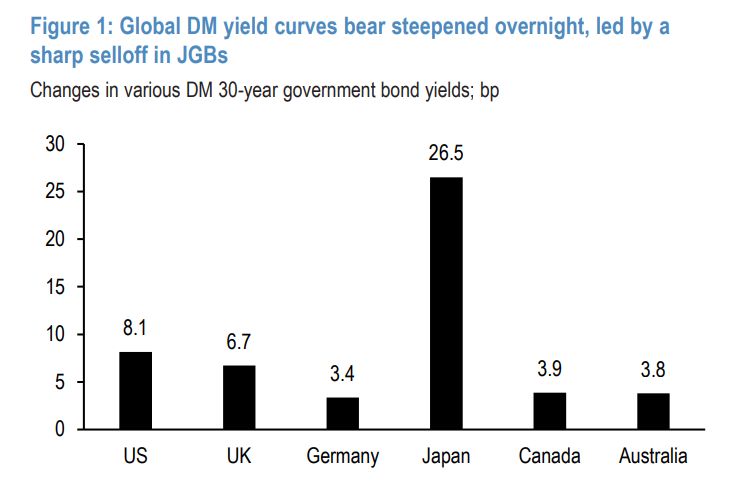
据追风交易台,1月20日,摩根大通在最新报告中发出了与市场恐慌情绪截然不同的声音。该行认为,尽管地缘政治紧张局势升级,但欧洲国家像 亚洲央行那样大规模抛售美债作为报复的可能性微乎其微。 这背后的关键逻辑在于美债持有者的结构性差异以及当前更为健康的投资者仓位。对于投资者而言,这意味着不必过度恐慌于"末日抛售"的情 景,但需要在战术上保持谨慎。摩根大通建议投资者此时应获利了结10年期/30年期美债收益率曲线的平坦化交易,并警惕5年期美债收益率已经 在这个关键点位出现的技术性破位。 欧洲手中美债多为"私产",政府难以强令抛售 全球债券市场正经历着剧烈的波动,一方面,日本政坛的突变导致日债收益率飙升,带动全球收益率曲线陡峭化;另一方面,特朗普总统关于格 陵兰岛的关税威胁引发了市场对"去美元化"和欧洲报复性抛售美债的恐慌。 市场目前最大的担忧源于特朗普总统周末的威胁:对任何反对美国接管格陵兰岛的国家征收10%的关税,并在6月1日逐步提高至25%。这种极端 的贸易保护主义言论让人回想起此前的"解放日"声明,市场参与者开始疯狂猜测欧洲国家是否会抛售其持有的巨额美债进行报复。 毕竟,数据显示欧洲国家总共持有3.8万亿美元的美 ...

——解构美国系列第十七篇:美国政府停摆:阴影逐步消散
EBSCN· 2026-01-21 11:07
2026 年 1 月 21 日 总量研究 美国政府停摆:阴影逐步消散 ——解构美国系列第十七篇 作者 分析师:赵格格 执业证书编号:S0930521010001 0755-23946159 zhaogege@ebscn.com 分析师:周欣平 执业证书编号:S0930525070005 010-57378026 zhouxinping@ebscn.com 相关研报 特朗普如何激活美国地产:现实与挑战—— 解构美国系列第十六篇(2025-12-27) 美国政府重新开门,市场为何"不买账"? ——解构美国系列第十五篇(2025-11-18) 美元指数突破 100 后,强势美元将维持多 久?——解构美国系列第十四篇(2025-11- 06) 减税法案顺利落地,可以对冲关税压力吗? ——解构美国系列第十三篇(2025-07-04) 近期美债收益率为何再次上行?——解构美 国系列第十二篇(2025-05-16) 特朗普释放和解信号,中国掌握谈判主导权 ——《大国博弈》系列第八十三篇(2025- 04-27) 关税互搏,中美经济韧性谁更强?——《大 国博弈》系列第八十二篇(2025-04-10) 特朗普升级全球关税战,对 ...
史诗级联动!波兰购金叠加丹麦弃美债,金价14天涨554美元,未来上看5400美元?|大宗风云
Hua Xia Shi Bao· 2026-01-21 11:00
Core Viewpoint - The international gold price has surged to a historic high of $4,883 per ounce, driven by geopolitical tensions and trade conflicts, particularly related to the Greenland dispute and U.S. tariffs on European countries [2][3][4]. Geopolitical Factors - The escalation of geopolitical risks, particularly the U.S. imposing tariffs on goods from eight European countries, has heightened market anxiety, contributing to the rise in gold prices [3][4]. - The relationship between the U.S. and Europe is deteriorating due to the Greenland issue, with potential for a significant trade war reminiscent of 2018 [3][4]. Economic Indicators - The U.S. economic indicators show a decline in the credibility of the Federal Reserve, with concerns over its independence and the impact of tariffs on inflation [6][7]. - Recent inflation data indicates a CPI of 2.7% year-on-year, with core CPI at 2.6%, both slightly below market expectations, suggesting a potential easing of inflationary pressures [6]. Central Bank Actions - Central banks globally are increasing their gold reserves, with Poland planning to purchase up to 150 tons of gold, which would elevate its status among the top ten countries in gold reserves [9][10]. - The World Gold Council reports that global central bank net gold purchases are expected to remain strong, with estimates of around 800-850 tons for the year, despite a decrease from previous highs [10]. Market Sentiment and Predictions - Analysts predict that gold prices may continue to rise, with some forecasting a target of $5,000 per ounce by 2026, driven by ongoing geopolitical tensions and economic uncertainties [10][11]. - The market is advised to adopt a defensive strategy, focusing on diversified investments to mitigate risks associated with potential volatility in gold prices [8][9].
1月21日金市晚评:金价距5000美元仅一步之遥 美元信用动摇成核心推手
Jin Tou Wang· 2026-01-21 10:37
摘要北京时间周三(1月21日)欧洲时段,美元指数震荡上行,交投于98.628附近,金价目前交投于 4725.49美元/盎司,涨幅2.06%,最高触及4887.82美元/盎司,最低触及4756.81美元/盎司。美国对格陵 兰岛的主权要求,使本已动荡不安的世界格局面临的风险更加巨大,加拿大武装部队已经模拟了美国对 加拿大的军事入侵、以及加拿大可能做出的回应。在此动荡的局势下,市场资金继续追捧黄金等避险资 产。 北京时间周三(1月21日)欧洲时段,美元指数震荡上行,交投于98.628附近,金价目前交投于4725.49 美元/盎司,涨幅2.06%,最高触及4887.82美元/盎司,最低触及4756.81美元/盎司。美国对格陵兰岛的主 权要求,使本已动荡不安的世界格局面临的风险更加巨大,加拿大武装部队已经模拟了美国对加拿大的 军事入侵、以及加拿大可能做出的回应。在此动荡的局势下,市场资金继续追捧黄金等避险资产。 今日黄金价格最新查询(2026年1月21日) | 名称 | 最新价 | 单位 | | --- | --- | --- | | 现货黄金 | 4860.56 | 美元/盎司 | | 黄金t+d | 1086.10 ...
2026年1月21日国际黄金晚盘行情预测
Jin Tou Wang· 2026-01-21 10:18
Group 1 - The core narrative driving the surge in gold prices is the combination of geopolitical tensions, financial instability, and political uncertainty, leading to a significant increase in safe-haven demand for gold, which rose over 2.5% to nearly $4885 per ounce, reaching a historical peak of $4861.28 [1][2] - The aggressive statements by Trump regarding Greenland have eroded trust between the US and Europe, prompting a shift in investment strategies towards gold as a safe haven, alongside a backdrop of a weak dollar and high global debt levels [2][3] - The current market dynamics are not solely driven by risk aversion but also by differentiated assessments of the fundamentals of various precious metals, with gold standing out as investors show less interest in silver and platinum [2][3] Group 2 - Technical analysis indicates a strong bullish trend for gold, with key support levels identified at $4690 and $4620, while a deeper correction could test $4550 and the psychological level of $4500, which is crucial for maintaining bullish control [4] - As long as the $4500 level holds, the bullish sentiment is unlikely to be shaken, with the $5000 mark seen as a reachable target due to strong safe-haven demand [4]
【环球财经】“去美元化交易”卷土重来,黄金避险属性持续凸显
Zhong Guo Jin Rong Xin Xi Wang· 2026-01-21 10:11
Group 1: Market Overview - The U.S. market has recently experienced a significant downturn in stocks, bonds, and currencies, driven by rising geopolitical tensions and concerns over U.S. asset allocations [1][2] - The S&P 500 index fell by 2.1%, erasing all gains since 2026, while the Dow Jones Industrial Average and Nasdaq also saw declines of 1.76% and 2.39%, respectively [2] - The Chicago Board Options Exchange Volatility Index surged by 26.67%, reaching its highest level since November 2025, indicating heightened investor fear [2] Group 2: Gold as an Investment - Gold prices have surged, with spot gold reaching a high of $4,888 per ounce, reflecting a shift in global capital market attitudes towards gold as a substitute for currency rather than just a safe-haven asset [1][6] - Analysts suggest that the traditional valuation models for gold are becoming ineffective, as institutional investors are increasingly reducing their exposure to U.S. debt in favor of gold [6][7] - The demand for gold is being driven by a combination of factors, including skepticism towards U.S. debt sustainability and geopolitical conflicts, which are prompting a "de-dollarization" trend [3][6] Group 3: U.S. Monetary Policy and Federal Reserve Independence - The independence of the Federal Reserve is under scrutiny, particularly in light of the upcoming Supreme Court case regarding the potential dismissal of a Fed governor, which could shift monetary policy from data-driven to politically influenced [4][5] - Concerns over the U.S. fiscal deficit and the potential for political interference in monetary policy could lead to a structural re-evaluation of global financial markets by 2026 [4][5] - Analysts emphasize the importance of monitoring the outcomes of the Supreme Court case and the nomination of the next Fed chair, as these developments could significantly impact market confidence in the U.S. dollar [5]
【招银研究|资本市场快评】海外股债汇“三杀”再现——“去美元”交易卷土重来
招商银行研究· 2026-01-21 10:10
Core Viewpoint - The article discusses the recent turmoil in the US stock, bond, and currency markets, highlighting the impact of geopolitical tensions and fiscal policies on financial conditions, particularly the concerns surrounding the de-dollarization trend and its potential effects on global markets [1][3][4]. Group 1: Market Reactions - On January 20, the US markets experienced significant declines, with the S&P 500 dropping over 2%, the 10-year US Treasury yield rising by 6 basis points to 4.3%, and the dollar depreciating while gold prices surged past $4,800, reaching a historical high [1]. - The overseas long-term bond market also faced pressure, with the 30-year US Treasury yield increasing by 8 basis points to over 4.9%, and the 30-year Japanese bond yield rising by 10 basis points above 3.5% [1]. Group 2: Causes of Market Turmoil - The ongoing geopolitical tensions, particularly regarding Greenland, have reignited fears of de-dollarization, leading to concerns about potential asset sell-offs by European investors, who currently hold approximately $17 trillion in assets, including $3.6 trillion in US Treasuries [3][4]. - Historical precedents indicate that similar market fears have previously led to significant sell-offs of US debt, particularly during the "reciprocal tariffs" period in April 2025, where both official and private sectors reduced their holdings of US Treasuries [4]. Group 3: Fiscal Policies and Their Implications - Japan's fiscal policy is shifting towards "undisciplined expansion," raising concerns about fiscal sustainability as the government plans to dissolve the House of Representatives and suspend food consumption taxes for two years [7]. - The Bank of Japan's tightening measures, in response to internal and external pressures, are expected to exacerbate risks in Japanese bonds and have spillover effects on overseas long-term bond markets [7]. Group 4: Market Outlook - The de-dollarization trend is viewed as a short-term disturbance rather than a long-term trend, with the potential for market conditions to stabilize if geopolitical tensions ease [8][9]. - In the stock market, while rising long-term bond yields and increased risk aversion may pressure US equities in the short term, the core support for US stock growth remains strong, driven by earnings growth and potential Federal Reserve rate cuts [10]. - For the bond market, US Treasury yields are expected to revert to a downward trend following short-term fluctuations, with a recommendation to focus on 2-5 year maturities due to their relative certainty compared to long-term bonds [10]. - The dollar is anticipated to fluctuate within a range of 96-101, influenced by mixed economic signals, while gold prices are expected to continue their upward trend amid ongoing geopolitical tensions and concerns over dollar credibility [11].

浦银安盛市场点评:三大股指小幅上涨 多元配置把握市场轮动机会
Jin Rong Jie· 2026-01-21 09:41
Core Viewpoint - The A-share market experienced a collective rise, with the Shanghai Composite Index increasing by 0.08%, the Shenzhen Component Index by 0.7%, and the ChiNext Index by 0.54%, while the STAR Market Composite Index rose by 2.32% [1] Market Performance - The total trading volume in the Shanghai and Shenzhen markets reached 2.62 trillion yuan [1] - The Hong Kong market also saw gains, with the Hang Seng Index up by 0.37% and the Hang Seng Tech Index up by 1.11% [1] Sector Highlights - Key sectors that performed well included gold, non-ferrous metals, natural gas, semiconductors, and CPO [1] Investment Strategy - According to Ping An Asset Management, focusing on long-term investment and asset allocation can help investors capture main trends and core assets in both A-shares and Hong Kong stocks [1] - The emphasis is on structural opportunities in technology growth, the transition between old and new economic drivers, and moderate inflation recovery [1] Manager Insights - Zhang Chuan, head of the FOF business at Ping An Asset Management, noted that the A-share market has shifted from liquidity-driven to profit-driven, with a focus on technology growth, particularly in the AI industry chain, and benefiting from cyclical and consumer sectors [1] - The valuation of Hong Kong stocks is expected to recover due to the influx of southbound funds and foreign capital, with a focus on technology, innovative pharmaceuticals, new consumption, and resource products [1] Strategic Asset Allocation - Gold is supported by "de-dollarization" and geopolitical dynamics, maintaining its strategic allocation value [1] - Utilizing diversified asset allocation through FOF and other flexible tools can help balance returns and risks, capturing structural opportunities in the first year of the 14th Five-Year Plan [1]