即时零售

Search documents
三巨头少赚200亿,1条视频看懂上半年外卖三国杀战绩
21世纪经济报道· 2025-08-30 10:19
Core Viewpoint - The intense competition among major food delivery platforms (JD.com, Meituan, and Alibaba) has led to significant profit declines, with a total estimated loss exceeding 20 billion yuan in the second quarter of 2025 due to aggressive subsidies and marketing strategies [1][3]. Group 1: Financial Performance - JD.com reported a net profit decline of 50.8% in Q2 2025, with a profit of 6.2 billion yuan [3][5]. - Meituan's adjusted net profit fell by 89% to 1.49 billion yuan, resulting in a loss of approximately 12.1 billion yuan compared to the previous year [3][9]. - Alibaba's net profit decreased by 18% to 33.51 billion yuan, but the impact from its food delivery business was less pronounced due to the late launch of significant subsidies [3][5]. Group 2: User Engagement and Marketing Expenses - Despite profit declines, all three platforms achieved record high monthly active users, with JD.com seeing over 40% growth in active users and shopping frequency [3][4]. - Meituan's monthly active users surpassed 500 million, with annual transaction frequency reaching a historical high [3][4]. - Marketing expenses surged significantly, with JD.com spending 27 billion yuan (up 127.6%), Meituan 22.5 billion yuan (up 51.8%), and Alibaba's sales and marketing expenses increasing by 21.3% [3][4]. Group 3: Strategic Responses - JD.com emphasized healthy growth in its food delivery business, achieving strategic goals through effective collaboration with its retail operations [5][6]. - Meituan's CEO highlighted the company's commitment to maintaining its market position through cash subsidies and innovative models to support merchants [5][6]. - Alibaba focused on investing in instant retail, achieving significant user engagement and order volume growth, particularly through its Taobao Flash Sale initiative [5][6]. Group 4: Market Reactions - Following the financial reports, JD.com and Meituan's stock prices fell, while Alibaba's stock rose by 12.9% due to its less impacted food delivery business and strong growth in AI-related products [6][7].





蒋凡首谈淘宝闪购战略:未来三年百万品牌门店入驻,实现1万亿交易增量(附战略谈话全文)
美股IPO· 2025-08-30 10:18
Core Viewpoint - The article discusses Alibaba's CEO Jiang Fan's insights on the Taobao Flash Purchase strategy, highlighting its significant growth and potential in the instant retail sector, which is seen as a crucial battleground for e-commerce in the future [3][4]. Group 1: Performance Metrics - In August, Taobao Flash Purchase achieved a peak daily order volume of 120 million, with a weekly average of 80 million orders, leading to a monthly active buyer count of 300 million, representing a 200% increase compared to April [4][12][13]. - The number of active delivery riders for Flash Purchase exceeded 2 million, tripling since April, indicating substantial growth in operational capacity [5][15]. - The Flash Purchase service has significantly boosted the overall user engagement on Taobao, with a 20% increase in daily active users (DAU) in August [19][4]. Group 2: Strategic Developments - Instant retail is viewed as a critical growth area for e-commerce, with companies competing fiercely to capture market share [4][10]. - Jiang Fan emphasized that the Flash Purchase model has created a synergistic effect with the broader e-commerce business, enhancing user activity and reducing marketing costs [5][21][22]. - The company plans to onboard one million brand stores over the next three years, aiming for an additional 1 trillion yuan in transaction volume through Flash Purchase and instant retail [31][30]. Group 3: Operational Efficiency - The company is focused on improving operational efficiency through user structure optimization, aiming to enhance the unit economic model (UE) as the proportion of returning customers increases [6][23]. - There is a strategic push to increase the share of high-value orders, including premium meal and retail orders, which is expected to improve overall average order value (AOV) [7][23]. - Significant investments in logistics during July and August are anticipated to lead to a reduction in logistics costs as order volumes stabilize [8][24]. Group 4: Non-Food Retail Development - The company has categorized non-food retail in instant retail into two models: near-field native and a combination of near and far-field models [27]. - The number of flash warehouses has surpassed 50,000, with a year-on-year order growth of over 360%, supported by Alibaba's supply chain [28]. - The integration of Tmall's offline stores into the Flash Purchase platform is expected to enhance the shopping experience and drive new business growth for brands [30].

投入还将继续!阿里即时零售三年剑指万亿元新蛋糕 蒋凡还是那个“关键先生”
Mei Ri Jing Ji Xin Wen· 2025-08-30 10:04
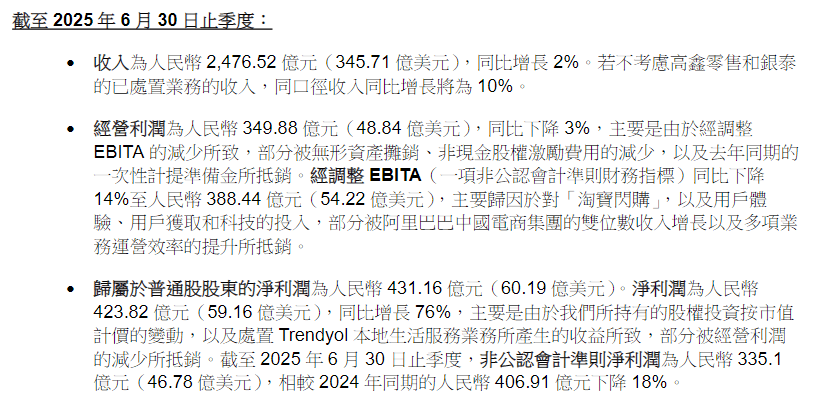
Core Insights - Alibaba Group reported its Q1 FY2026 financial results, showing a revenue of RMB 247.65 billion, a 2% year-on-year increase, and a net profit of RMB 42.38 billion, up 76% [1] - CEO Wu Yongming highlighted two strategic opportunities: the integration of AI and cloud services, and the fusion of shopping and lifestyle services [1] - The financial report structure has been simplified, with segments now including Alibaba China E-commerce Group, Alibaba International Digital Commerce Group, Cloud Intelligence Group, and Others [1][3] Financial Performance - Alibaba China E-commerce Group generated revenue of RMB 140.07 billion, a 10% year-on-year increase, and is the main revenue driver for the company [3] - The adjusted EBITA for Alibaba China E-commerce Group was RMB 38.39 billion, a 21% decrease year-on-year, primarily due to investments in "Taobao Flash Purchase" and user experience [3] - The Cloud Intelligence Group reported revenue of RMB 33.40 billion, a 26% year-on-year increase, with AI-related product revenue showing triple-digit growth for eight consecutive quarters [4] Strategic Developments - The company has made significant investments in AI and cloud infrastructure, committing RMB 380 billion over three years and RMB 50 billion in the consumer sector [5] - The integration of Taobao, Ele.me, and Fliggy into Alibaba China E-commerce Group aims to create a comprehensive business cluster covering both domestic and international markets [4] - The "Taobao Flash Purchase" service has seen substantial growth, with peak daily orders reaching 120 million and a 200% increase in monthly active buyers since April [8][11] Market Positioning - Alibaba aims to capture a significant share of the instant retail market, projecting an additional RMB 1 trillion in transaction volume from "Flash Purchase" and instant retail over the next three years [11][12] - The competitive landscape is intensifying, with Meituan also launching its instant retail service, indicating a fierce market battle ahead [13] - The company is focused on optimizing operational efficiency through the integration of its e-commerce platforms, leveraging existing supply chain capabilities [12]
节日消费助推即时零售火热,美团七夕非餐饮即时零售日订单超2700万
Ge Long Hui A P P· 2025-08-30 08:58
Core Insights - On August 29, during the Qixi Festival, Meituan's non-food instant retail order volume reached a record high of 27 million, driven by gift demand from the "Flash Purchase Gifts" campaign [1] - The overall gift consumption scale for Meituan's flash purchase service also hit a new peak, with flower sales breaking records and categories like digital electronics, beauty products, and jewelry seeing sales double [1] - Consumer spending per capita on categories such as home appliances and beauty products significantly increased compared to last year's Qixi Festival [1] Group 1 - The trend of gift-giving is diversifying and becoming more quality-oriented, moving from traditional gifts like flowers and chocolates to a broader range of products, leading to substantial sales growth in high-priced categories [1] - Instant retail is becoming an important growth driver for major brands and retailers, with over 500 beauty, electronics, fast-moving consumer goods, and liquor brands experiencing multiple-fold sales growth on the platform [1] - The dual increase in order volume and average transaction value indicates a robust market response to the evolving gift-giving landscape [1]

外卖大战与AI芯片:变轨中的阿里巴巴
36氪未来消费· 2025-08-30 08:17
Core Viewpoint - Alibaba has emerged as the biggest winner in the first quarter of the instant retail war, with Q2 revenue and profit exceeding market expectations, driven by improvements in various business segments [4][8]. Financial Performance - Alibaba's Q2 revenue grew by 10% year-on-year, surpassing the market expectation of 6%, while operating profit reached 35 billion yuan, only down 3% year-on-year [4]. - The net profit under non-standard accounting fell by 18%, but this was significantly better than JD's -49% and Meituan's -89% [4]. - The new Chinese e-commerce group reported an EBITA of 38.4 billion yuan, a year-on-year decline of 21%, indicating a significant investment in the instant retail segment [11]. Strategic Developments - The "user-first, AI-driven" strategy implemented over the past two years has shown significant results, with Taobao Flash Purchase achieving a monthly transaction user base of 300 million, a 200% increase compared to before April [4][15]. - Alibaba Cloud's AI revenue accounted for 20% of its overall revenue, with AI-related product revenue growing for eight consecutive quarters at triple-digit rates, leading to a 26% year-on-year revenue increase [4][18]. Market Reactions - Following the impressive Q2 results, Alibaba's stock price surged, with a pre-market increase of nearly 7% and a post-market rise of 13%, adding 260 billion yuan to its market capitalization [8][12]. - The market's positive feedback was attributed to the strong performance of Alibaba's cloud and AI segments, which alleviated concerns about the company's ability to sustain technological investments [18]. Competitive Landscape - The intense competition in the instant retail sector has led to significant losses for major players, with Alibaba spending 15.6 billion yuan in Q2, the highest among its competitors [12][13]. - Despite the high costs associated with entering the instant retail market, Alibaba's management remains confident in the long-term potential of this investment, viewing it as a strategic opportunity to enhance its e-commerce platform [16][20]. Future Outlook - Alibaba plans to continue investing heavily in its instant retail segment, with an additional 50 billion yuan allocated to support growth [13][20]. - The company is also focusing on AI and cloud computing, with significant capital expenditures expected to drive future growth and maintain its competitive edge in the market [18][19].
阿里蒋凡首谈淘宝闪购:不能离开规模谈效率
Tai Mei Ti A P P· 2025-08-30 07:31
Core Viewpoint - Alibaba is positioning itself in the competitive landscape of instant retail, emphasizing the historical opportunity presented by near-field e-commerce rather than merely focusing on the intense competition in the food delivery sector [2][4]. Group 1: Market Strategy - Alibaba's strategy encompasses a comprehensive layout of "B2C e-commerce + instant retail + food delivery + offline," which is seen as more diversified compared to competitors [2][4]. - The company is not prioritizing the development of offline retail formats, focusing instead on enhancing its existing business models [3][4]. Group 2: Performance Metrics - In August, Taobao Flash Purchase reached a peak daily order volume of 120 million, with a weekly average of 80 million, leading to a 200% increase in monthly active buyers compared to April [5][6]. - The platform's daily active riders exceeded 2 million, marking a threefold increase since April, indicating significant growth in operational capacity [5][6]. Group 3: Economic Impact - The integration of Taobao Flash Purchase with the broader e-commerce business has resulted in a 20% increase in daily active users for the Taobao app, enhancing overall user engagement and advertising revenue [5][6]. - The company anticipates that the Flash Purchase and instant retail segments will generate an additional 1 trillion yuan in transactions over the next three years, driven by the onboarding of one million brand stores [4][12]. Group 4: Operational Efficiency - Alibaba is focusing on improving operational efficiency through user structure optimization, order structure enhancement, and cost reduction in logistics, with expectations of halving losses in unit economics [6][8]. - The company is transitioning Tmall Supermarket from a traditional B2C model to a near-field Flash Purchase model, aiming for faster delivery while maintaining competitive pricing [10][11]. Group 5: Industry Dynamics - The shift from a single dominant player in the food delivery market to multiple platforms is seen as beneficial for both merchants and consumers, fostering competition and innovation [7][12]. - The emergence of instant retail is viewed as an opportunity for B2C e-commerce platforms to adapt and transform in response to changing consumer demands and market dynamics [11][12].
阿里市值一夜暴涨368亿美元!造AI芯传闻+业绩双重推动,AI产品连续8个季度三位数增长
量子位· 2025-08-30 04:42
Core Viewpoint - Alibaba is developing a new AI chip that is more powerful than the "Hanguang 800" and can serve a wider range of AI inference tasks [1][2] Financial Performance - In Q2 2025, Alibaba reported total revenue of 247.65 billion RMB, a year-on-year growth of only 2%, while net profit surged by 76% to 42.38 billion RMB, indicating a strategic transformation [12] - The cloud intelligence group's revenue reached 33.40 billion RMB, a 26% year-on-year increase, marking the highest growth rate in three years, driven by public cloud business growth [14] - AI-related product revenue has achieved triple-digit year-on-year growth for eight consecutive quarters, highlighting its significance as a growth engine [15][17] AI Strategy and Investments - Alibaba plans to invest over 380 billion RMB in cloud and AI infrastructure over the next three years, averaging more than 120 billion RMB annually, positioning itself among the top global tech companies in terms of investment scale [7][24][25] - The company emphasizes AI as a core driver across all business segments, integrating it into consumer experiences through personalized recommendations and virtual shopping assistants [28][29] New Chip Development and Business Model - The new AI chip will not be sold directly; instead, customers will rent computing power supported by these chips through Alibaba Cloud services, aligning with its cloud computing business model [8][9] - The shift to a domestic manufacturer for chip production reflects a strategic pivot in response to global supply chain changes [2][4] Market Impact and Future Outlook - Following the announcement, Alibaba's stock rose by 13.53%, increasing its market value by approximately 36.8 billion USD (about 260 billion RMB) [10] - The company is also focusing on instant retail, with significant investments in the "Taobao Flash Purchase" service, leading to a notable increase in active consumers [26][27]

美团-W(03690.HK):Q2利润低于预期 加大投入应对行业竞争
Ge Long Hui· 2025-08-30 04:13
Core Insights - The company reported Q2 2025 revenue of 91.8 billion yuan, a year-on-year increase of 11.7%, but operating profit dropped by 98.0% to 230 million yuan, with adjusted EBITDA down 81.5% to 2.78 billion yuan and adjusted net profit down 89.0% to 1.49 billion yuan, missing market expectations [1][2] Group 1: Financial Performance - The core local business revenue grew by 7.7% year-on-year to 65.3 billion yuan, but operating profit fell by 75.6% to 3.7 billion yuan, with an operating margin decline of 19.4 percentage points to 5.7%, significantly below market expectations [2] - Adjusted net profit for 2025-2027 was revised down to -4.5 billion, 38.5 billion, and 57.6 billion yuan, respectively, from previous estimates of 44.3 billion, 56.7 billion, and 69.1 billion yuan [5] Group 2: Market Competition - The industry is experiencing intensified competition, with major players like JD and Taobao increasing their market presence through aggressive subsidy programs, leading to significant pressure on the company's short-term profitability [2] - The company is responding to competition by increasing investments to maintain market share, with peak daily order volume exceeding 150 million in July [2] Group 3: Business Expansion and Strategy - The company's new business revenue grew by 22.8% year-on-year to 26.5 billion yuan, but operating losses expanded by 43.1% to 1.9 billion yuan, indicating challenges in profitability despite revenue growth [4] - The company is focusing on enhancing its rider ecosystem, with plans to roll out pension insurance subsidies nationwide and improve rider welfare through various initiatives [3][4] Group 4: Long-term Outlook - Despite short-term profitability pressures, the company is expected to have long-term profit recovery potential due to its strategic initiatives in instant retail and overseas expansion [5] - The company maintains a "buy" rating, with a target market value of 797 billion HKD, reflecting a potential upside of 28% from the current market value [5]
恋缩时代降临,品牌七夕如何“过情关”?
Xin Lang Cai Jing· 2025-08-30 01:29
Core Insights - The annual Qixi Festival marketing strategies are evolving as young people's perceptions of love change, leading to a shift towards virtual companionship and singlehood [1] - Brands are challenged to adapt their narratives beyond traditional romantic themes, focusing on new audience psychology [1] Group 1: Brand Marketing Strategies - This year's Qixi marketing highlights collaborations, such as the partnership between "Love and Producer" and Tmall, which integrates agricultural themes into romantic narratives [3] - "World Beyond" collaborates with MAC, featuring male characters as beauty customers, blending gaming with beauty marketing [4] - "Like a Kite" partners with Nayuki to create themed products, successfully engaging fans through offline experiences [6] Group 2: Consumer Engagement and Trends - Players are increasingly seeking diverse participation experiences, with events like "Critical Heartbeat Parties" and themed activities enhancing community engagement [14] - Social media campaigns, such as large-scale declarations of love for game characters, blur the lines between official and fan-driven content, amplifying brand reach [16] - The trend of Qixi becoming a "pan-relationship festival" reflects a broader audience, including friends and family, rather than just couples [37] Group 3: Competitive Landscape in Retail - The ongoing competition among delivery platforms intensifies during Qixi, with major players like Meituan and Taobao Flash Sale leading promotional efforts [18] - Meituan's "Mai Rui Mi" campaign offers zero-cost promotions, while Taobao Flash Sale emphasizes significant discounts and celebrity endorsements [22][26] - Tea brands are adopting a more cautious approach this year, focusing on strategic collaborations rather than large-scale promotions [27] Group 4: Luxury Brand Strategies - International luxury brands continue to express love and romance subtly during Qixi, with some attempting to integrate traditional craftsmanship into modern designs [38] - Despite some innovative approaches, luxury brands face criticism for their lack of differentiation and slow adaptation to market trends [42] - The emphasis on emotional resonance in marketing campaigns indicates a shift towards deeper narratives, although many brands still struggle with originality [43]

深夜狂飙近13%!阿里半年净赚423亿元,吴泳铭:创业心态再出发
Sou Hu Cai Jing· 2025-08-30 01:28
Core Insights - Alibaba's stock rose by 12.90% following the release of its Q1 FY2026 financial results, which showed a revenue of RMB 247.65 billion, a year-on-year increase of 2% [1] - Excluding disposed businesses, the revenue growth on a comparable basis was 10%, with a net profit of RMB 42.38 billion, reflecting a 76% year-on-year increase [1] Financial Performance - The Alibaba China e-commerce group's revenue reached RMB 140.07 billion, a 10% year-on-year increase, driven by the integration of Taotian Group, Ele.me, and Fliggy [3] - The "instant retail" business generated RMB 14.78 billion, up 12% from RMB 13.20 billion in the same quarter of the previous year [3][4] - Membership integration efforts led to a significant increase in 88VIP membership numbers, surpassing 53 million, with customer management revenue growing by 10% [4] Strategic Developments - Alibaba International Digital Commerce Group reported a 19% year-on-year revenue increase, nearing breakeven, with improvements in various business segments including Hema, Amap, and Alibaba Health [5] - The CEO emphasized two historical strategic opportunities: a technology platform centered on AI and cloud, and a consumer platform integrating shopping and lifestyle services [5][7] - Alibaba plans to adopt an entrepreneurial mindset over the next three years, focusing on driving strong business growth and enhancing competitive advantages [7] Market Position - Alibaba's management highlighted its leading position in the home delivery market, with a peak of 120 million daily orders for Taobao Flash Purchase since July [7] - The company aims to increase the proportion of high-value orders in the next phase of Taobao Flash Purchase, viewing it as a positive economic contributor to the overall platform [7]