
硬科技

Search documents
好戏连台 公募基金深耕科技创新
Shang Hai Zheng Quan Bao· 2025-09-01 19:06
Core Viewpoint - The Chinese public fund industry is aligning with national strategies to support technological innovation and sustainable development, with significant reforms and initiatives aimed at enhancing the capital market's role in financing these sectors [4][5][12]. Group 1: Public Fund Industry Developments - The China Securities Regulatory Commission has issued two key documents to guide the public fund industry, emphasizing the need for resources to focus on strategic areas such as technological innovation and green development [4]. - As of August 15, 2023, there are 316 public funds related to "technology innovation," with a total scale exceeding 450 billion yuan [5][7]. - The first batch of technology innovation bond ETFs raised 289.88 billion yuan on their first day, with total assets growing to 1,157.91 billion yuan by mid-August [6]. Group 2: Financing Innovations - The first two data center REITs attracted 6.9 billion yuan in funding and were fully subscribed on the first day, indicating strong market demand [8]. - Infrastructure REITs are becoming crucial financing tools for growth-oriented companies in the AI sector, allowing for significant capital influx to support expansion [8]. - Recent initiatives have successfully raised 31.83 billion yuan for industrial park REITs, enhancing financing channels for technology innovation [9]. Group 3: Research and Investment Capabilities - Public funds are enhancing their research capabilities to better support technology companies, with teams focusing on emerging sectors like AI and quantum computing [11]. - Companies are developing comprehensive industry databases to improve investment decision-making and identify trends in technology sectors [11]. - The emphasis on technology finance is seen as essential for fostering a virtuous cycle between technology, industry, and finance [12].


科创板上市公司半年报释放积极信号
Zheng Quan Ri Bao· 2025-09-01 16:41
Core Insights - The performance of companies listed on the Sci-Tech Innovation Board (STAR Market) in the first half of the year shows positive signals, with over 60% of the 589 companies reporting profits [1] - High-growth sectors such as artificial intelligence and innovative pharmaceuticals are demonstrating strong growth momentum [1] Group 1: Company Performance - Cambricon Technologies achieved significant growth, with revenue of 2.881 billion yuan, a year-on-year increase of 4347.82%, and a net profit of 1.038 billion yuan, marking a turnaround from losses [1] - BeiGene reported revenue of 17.518 billion yuan, a 46.03% increase year-on-year, and a net profit of 450 million yuan, also turning from losses to profits [1] - Orbbec achieved revenue of 435 million yuan, a 104.14% increase year-on-year, and a net profit of 60.19 million yuan, marking its first half-year profit [2] - Henan Shijia Photon Technology reported revenue of 993 million yuan, a 121.12% increase year-on-year, and a net profit of 217 million yuan, a significant increase of 1712.00% [2] - Shaanxi Yuanjie Semiconductor Technology saw revenue growth of 70.57% year-on-year, with net profit increasing by 330.31% and non-recurring net profit up by 379.16% [2] Group 2: Market Trends - The rapid development of many STAR Market companies is attributed to breakthroughs in core technologies and large-scale applications, which are gradually demonstrating profitability [3] - The focus on "hard technology" and the institutional design of the STAR Market have contributed to the emergence of numerous technology leaders [3]


A股“新股王”需要具备五方面特质
Guo Ji Jin Rong Bao· 2025-09-01 10:24
上周,寒武纪的股价一度超越贵州茅台,成为A股"新股王"。 其次,公司业绩必须出色,才能支撑其股票的"股王"地位。尽管题材、概念和市场预期可推动短线 炒作,使股价阶段性成为"新股王",但要长期守住这一位置,还需依靠优秀的业绩作为支撑。 什么样的上市公司适合成为A股的"新股王"呢?在笔者看来,至少需要具备以下几方面特质。 第四,公司会爱惜自身形象,避免做出损害形象的行为。例如,不会为配合市场炒作而推出高送转 方案,因为这可能导致股价下跌;也不会参与内幕交易或配合机构操纵价格,更不会做出违法违规行 为,一旦曝光,将面临监管处罚,损害公司形象并打压股价。此外,大股东等原始股东也不会大规模减 持股票,以免动摇投资者信心,导致股价下跌。 首先,公司所处行业应是国家宏观政策支持的重点领域,如新质生产力相关行业。关键在于突出科 技含量,上市公司需具备"硬科技"和全球领先的竞争优势,以在市场竞争中保持领先地位。 最后,公司的流通股本不宜过大。例如,将流通股本控制在20亿股或15亿股以内较为适宜。若流通 股本过大,炒高股价将消耗大量市场资金。若再争夺"股王"位置,对股市资金的损耗会更大,这必然会 给股市资金面带来压力,甚至可能导 ...

别藏了!各位医疗健康&生命科技领域的“创新狂人”们,出招吧
创业邦· 2025-09-01 10:24
Core Viewpoint - The article invites innovative individuals in the medical health and life sciences sector to showcase their groundbreaking ideas or products, emphasizing the importance of early-stage projects that can impress investors [2]. Group 1: Event Overview - The event aims to create a platform for early-stage medical technology innovators to present their ideas to over 200 top-tier investors [2]. - Participants will have the opportunity to be featured on the "2025 Notable Hard Technology Innovators" list, enhancing their visibility and credibility in the industry [2]. - The event will take place in Hangzhou on September 24-25, linking over 100 early-stage AI and hard technology companies with active investment institutions [6]. Group 2: Participation Criteria - Companies must be registered in China, operate independently, and have a demonstrable product or service, even if it is still in the PPT stage [3][4]. - The ideal participants are young, innovative, and possess strong technical skills, with a preference for those who have not previously engaged with venture capital [4]. - Focus areas include biotechnology, synthetic biology, medical solution platforms, and smart medical devices [5]. Group 3: Judging Panel - The judging panel consists of notable figures from various investment firms, including: - Li Fangli from Zijin Port Capital [10] - Liu Miao from SoftBank China [12] - Lu Gang from Chuangdong Investment [14] - Song Gao from Northern Light Venture Capital [18] - Sun Jingwei from Tengye Venture Capital [20] - Tian Tian from Yuyin Medical Fund [24]

瑞德智能(301135.SZ):通过参与创东方厚泽基金积极布局半导体等硬科技核心领域
Ge Long Hui· 2025-09-01 07:16
Core Viewpoint - The company is actively engaging in strategic investments aligned with national priorities, particularly in the semiconductor and hard technology sectors through the participation in the Chuangdong Houze Fund [1] Investment Focus - The fund has already made decisions to invest in several high-quality projects within the integrated circuit sector, focusing on upstream core areas of the semiconductor industry chain [1] - Current investments include a CPU chip design company specializing in RISC-V architecture, which is crucial for domestic CPU replacement and future expansion into specialized processors [1] - Another investment is in an advanced RF front-end module company, which is leading in 5G communication, low-orbit satellites, and IoT modules, already achieving mass production for branded smartphones [1] Future Outlook - The company recognizes the strategic importance of GPUs as key hardware for AI, intelligent computing, and graphics processing, and plans to continue leveraging the fund platform to explore investment opportunities in GPU, AI acceleration chips, and high-performance computing [1] - The company aims to identify quality projects that can synergize with its main business in critical IP, advanced processes, Chiplet advanced packaging, and key equipment and materials in the semiconductor industry [1] - Several semiconductor industry chain enterprises are currently under evaluation for potential investment, with plans to proceed in compliance with legal and regulatory standards and to inform the market upon meeting disclosure requirements [1]
中国经济“半年报”:奋楫笃?,稳中提质
EY· 2025-09-01 06:56
Economic Performance - In the first half of 2025, China's GDP reached RMB 66 trillion, with a year-on-year growth of 5.3%[9] - Final consumption expenditure contributed 52% to economic growth, indicating strong consumer resilience[4] Consumption and Retail - The total retail sales of consumer goods amounted to RMB 24.5 trillion, growing by 5.0% year-on-year[25] - The "trade-in" policy for five major categories drove sales of RMB 1.6 trillion, surpassing the total for the entire year of 2024[4] Foreign Trade - China's total goods trade reached RMB 21.8 trillion, with a year-on-year increase of 2.9%[32] - High-tech product exports grew by 12.5%, with industrial robots seeing a remarkable growth of 61.5%[32] Investment Trends - National fixed asset investment growth fell to 2.8% year-on-year, with real estate remaining a significant challenge[20] - Manufacturing and infrastructure investments are expected to improve marginally in the third quarter due to policy support[20] Policy Outlook - Fiscal expenditure reached RMB 18.8 trillion, an increase of 8.9%, setting a historical high[42] - The government plans to enhance consumption through policies focusing on service consumption and digitalization[42]
科创板去年业绩领跑A股 “硬科技”企业活力、韧性尽显
Zheng Quan Ri Bao· 2025-09-01 02:33
去年,在复杂多变的国内外环境下,科创板多数公司仍保持稳健经营,板块业绩领跑A股,展现了 我国"硬科技"企业的活力与韧性。 上交所数据显示,2022年,科创板公司营业收入达1.21万亿元,同比增长29%;归母净利润合计 1135.89亿元,同比增长6%,业绩跑赢A股平均水平。今年一季度科创板实现经营业绩"开门稳"。截至4 月底,除中芯国际、百济神州和诺诚健华3家多地上市红筹企业未披露一季报外,近六成科创板公司一 季度营收实现同比增长,超四成科创板公司一季度净利润实现同比增长。 派能科技董秘叶文举对《证券日报》记者表示,科创板公司"硬科技"底色持续彰显,整体业绩延续 了较快增长态势。 板块特色更加鲜明 从细分行业来看,去年以来,新能源领域中光伏、储能领域公司业绩持续稳定增长。行业人士认 为,在国家政策支持下,行业高景气度有望延续。 晶科能源相关人士对记者表示,受益于全球光伏装机量和组件出货量增加,光伏行业一体化组件头 部公司今年一季度业绩普遍同比增速较快。展望全年,预计拥有较大比例N型先进产能的头部一体化组 件企业的业绩将有较好表现。 科创板业绩稳定增长,持续吸引机构投资者的目光。据财通证券研报统计,自2019年 ...
科创板公司2022年业绩抢先看:七成营收增长 超八成实现盈利
Zheng Quan Ri Bao· 2025-09-01 02:33
Core Insights - The overall performance of companies listed on the Sci-Tech Innovation Board (STAR Market) in 2022 shows a growth trend, with total operating revenue exceeding 1 trillion yuan and net profit surpassing 100 billion yuan for the first time [1][2] Group 1: Overall Performance - As of February 28, 2023, 507 companies on the STAR Market disclosed their 2022 performance, with 504 providing performance forecasts, indicating a stable growth in revenue and profit [1][3] - The 504 companies collectively achieved operating revenue of 1.2 trillion yuan, a year-on-year increase of 29.3%, and net profit of 114.39 billion yuan, up 8.05% [3] Group 2: Industry Performance - The electric equipment and machinery sectors performed well, with 49 electric equipment companies reporting a combined net profit of 43.67 billion yuan, a year-on-year increase of 106.05% [4] - The machinery equipment sector saw 79 companies achieve a total net profit of 17.75 billion yuan, reflecting a year-on-year growth of 10.69% [4] Group 3: Key Companies - Companies like Shengmei Shanghai and Weisheng Information reported significant revenue and profit growth, with Shengmei Shanghai achieving 2.87 billion yuan in revenue, up 77.25%, and a net profit of 668 million yuan, up 151.08% [3] - The combined revenue of the two companies that disclosed annual reports reached 4.88 billion yuan, with a net profit of 1.07 billion yuan, marking a year-on-year growth of 41.50% and 75.85% respectively [3] Group 4: Sci-Tech 50 Index - The Sci-Tech 50 Index, which includes the 50 most representative stocks on the STAR Market, reported a total operating revenue of 600.02 billion yuan, a year-on-year increase of 43.20%, and a net profit of 68.61 billion yuan, up 36.24% [6][7] - The Sci-Tech 50 ETF has seen significant growth, with its shares reaching 87.4 billion, a 191% increase since the beginning of 2022, making it the third-largest broad-based index product in the domestic market [6]
科创综指优势突出,量化增强力求超额, 华宝科创板综指增强基金(024752)今日澎湃首发
Xin Lang Ji Jin· 2025-09-01 00:56
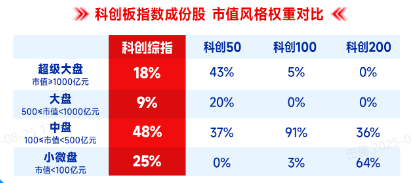
Core Viewpoint - The launch of the Huabao Science and Technology Board Index Enhanced Fund has garnered significant market attention amid a bullish trend in the A-share market, particularly in the technology sector driven by AI [1][2]. Group 1: Fund Overview - The Huabao Science and Technology Board Index Enhanced Fund (Class A 024752; Class C 024753) aims to track the Shanghai Stock Exchange Science and Technology Board Comprehensive Index while employing an index-enhanced quantitative investment strategy to achieve excess returns [1][5]. - The fund focuses on the characteristics of the Science and Technology Board, which is expected to attract investor interest due to its broad and balanced market capitalization coverage compared to other mainstream indices [1][5]. Group 2: Market Performance - From January 1, 2025, to August 28, 2025, the Science and Technology Board Comprehensive Index has outperformed other major A-share indices, with a return of 44.58%, compared to 37.99% for the Science and Technology 50 Index and 32.01% for the ChiNext Index [4][5]. - The data indicates that the Science and Technology Board Comprehensive Index has a significant advantage in capturing the current market trend focused on technology and AI [4][5]. Group 3: Index Composition - The Science and Technology Board Comprehensive Index includes 569 constituent stocks, covering 96% of the market capitalization of the Science and Technology Board, which allows for a comprehensive representation of various market segments, including large, mid, and small-cap stocks [5][6]. - The index has a diverse sector representation, with over 68% of its weight concentrated in electronics, pharmaceuticals, and computer industries, covering 16 first-level industries [10][13]. Group 4: Investment Strategy - The fund employs a dual strategy of "Beta" for index tracking and "Alpha" for quantitative stock selection, aiming to enhance returns through a multi-factor stock selection model [15][17]. - The investment team at Huabao Fund has extensive experience in quantitative investment strategies, which supports the fund's management and performance [17][20].
“all in AI”热情带动科创暴涨,华宝基金9月1日火速发行上证科创板综指增强基金
Jing Ji Guan Cha Wang· 2025-09-01 00:40
Core Insights - The "Hanwang" has become the new king of A-share IPOs, attracting significant market attention as AI trends influence the market dynamics [1] - The launch of the Huabao Science and Technology Board Index Enhanced Fund (Class A 024752; Class C 024753) is timely, aiming to capture the momentum in the market [1][10] Fund Overview - The Huabao Science and Technology Board Index Enhanced Fund will primarily use an index-enhanced quantitative investment strategy to seek excess returns while effectively tracking the underlying index [1][8] - The fund focuses on the "Shanghai Stock Exchange Science and Technology Board Comprehensive Index," which has a broader and more balanced market capitalization coverage compared to other mainstream indices [1][4] Market Performance - From January 1, 2025, to August 28, 2025, the Science and Technology Board Comprehensive Index has outperformed other major indices, with a return of 44.58% compared to 32.01% for the ChiNext Index [3][4] - The top ten constituent stocks of the Science and Technology Board Comprehensive Index include notable companies like Haiguang Information and Cambricon, with a combined weight of 20.97%, indicating a lower concentration of individual stocks [5] Investment Strategy - The fund manager, Yu Yinyou, emphasizes that the Science and Technology Board Comprehensive Index is a prime choice for investing in the Science and Technology Board, focusing on hard technology and covering various market capitalizations [4][8] - The fund employs a dual strategy of "Beta" from the index and "Alpha" from quantitative stock selection, aiming for a balanced approach to investment [8] Company Background - Huabao Fund is a leading player in China's public fund industry, with over 100 billion yuan in equity ETF management and a strong presence in hard technology ETF/index products [2][10] - The company has established a robust product matrix in the AI and technology sectors, with several successful ETF launches in 2023 [11]