自动驾驶

Search documents
Robotaxi 出行帝国,能再造特斯拉?
3 6 Ke· 2026-01-08 00:21
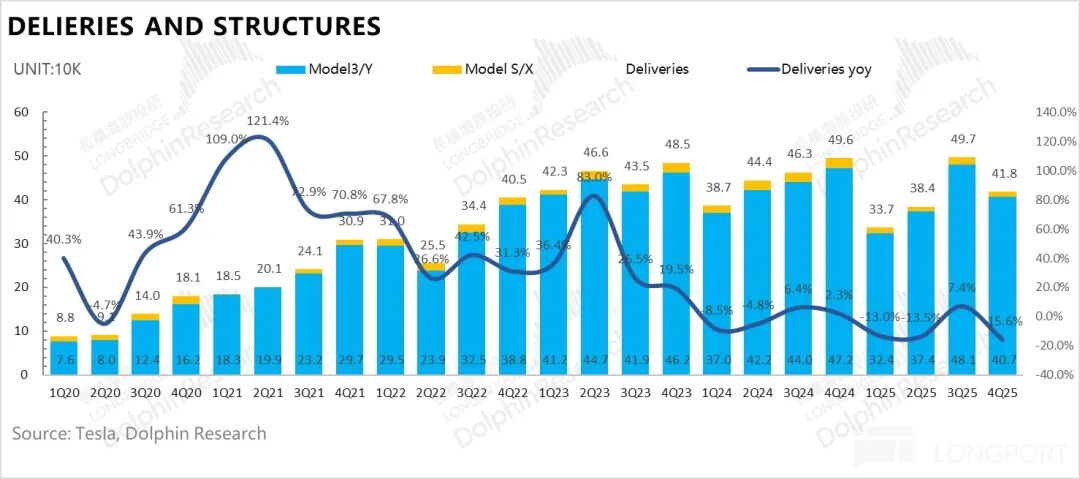
Group 1 - Tesla's Q4 2026 delivery data showed a disappointing result, with only 418,000 vehicles delivered, a 16% decrease quarter-over-quarter, and a total of 1.64 million vehicles for 2025, an 8.6% year-over-year decline, marking the second consecutive fiscal year of declining sales [1][3] - Despite the weak fundamentals, Tesla's stock price surged, nearing $500 before the Q4 delivery data release, indicating a disconnect between sales performance and stock valuation, driven by a shift in market perception from "automobile manufacturing" to "AI narrative" [3][5] - The Robotaxi business has transitioned from "concept validation" to "commercial rollout," with significant milestones achieved, including the removal of safety drivers from the Austin test fleet, which is seen as a key catalyst for stock price growth [5][6] Group 2 - Traditional ride-hailing platforms face a market cap ceiling due to limited growth potential in the shared mobility market, with Uber and Didi's combined market cap at $200 billion, representing only 14% of Tesla's current $1.5 trillion market cap [7][10] - The shared mobility market in China is constrained, with private car usage dominating the transportation landscape, accounting for approximately 85% of the market, while shared mobility's growth remains limited [10][11] - In the U.S., private cars also dominate, with ride-hailing and traditional taxi services comprising less than 2% of the total commuting market, indicating a low penetration rate for shared mobility [14][16] Group 3 - The cost structure of ride-hailing services does not provide a significant advantage over private car ownership, with costs being comparable in both China and the U.S., limiting the appeal of ride-hailing services [21][24] - The profitability of ride-hailing platforms is constrained by high driver payouts, with Uber retaining only about 30% of gross transaction value (GTV) after paying drivers, leading to low profit margins [27][30] - The introduction of Robotaxi could potentially transform the ride-hailing business model by eliminating driver costs, thus significantly lowering operational costs and improving profitability [31][33] Group 4 - Robotaxi's market growth is expected to be driven by cost advantages that could convert private car ownership into service consumption, although it may not significantly increase overall travel demand [33][34] - The operational cost of Robotaxi is projected to drop significantly, potentially reaching as low as $0.4-$0.6 per mile, which would be competitive against private car ownership costs [49][51] - The market potential for Robotaxi is substantial, with projections indicating that if pricing can undercut private car costs, it could capture a significant share of the transportation market, potentially reaching a market size of $420-485 billion by 2035 under optimistic scenarios [54][55] Group 5 - Revenue contributions from Robotaxi could vary significantly based on market penetration and pricing strategies, with estimates ranging from $58 billion under pessimistic assumptions to $2.2-2.6 trillion under more favorable conditions by 2035 [58][60]


陆家嘴财经早餐2026年1月7日星期三
Sou Hu Cai Jing· 2026-01-07 22:42
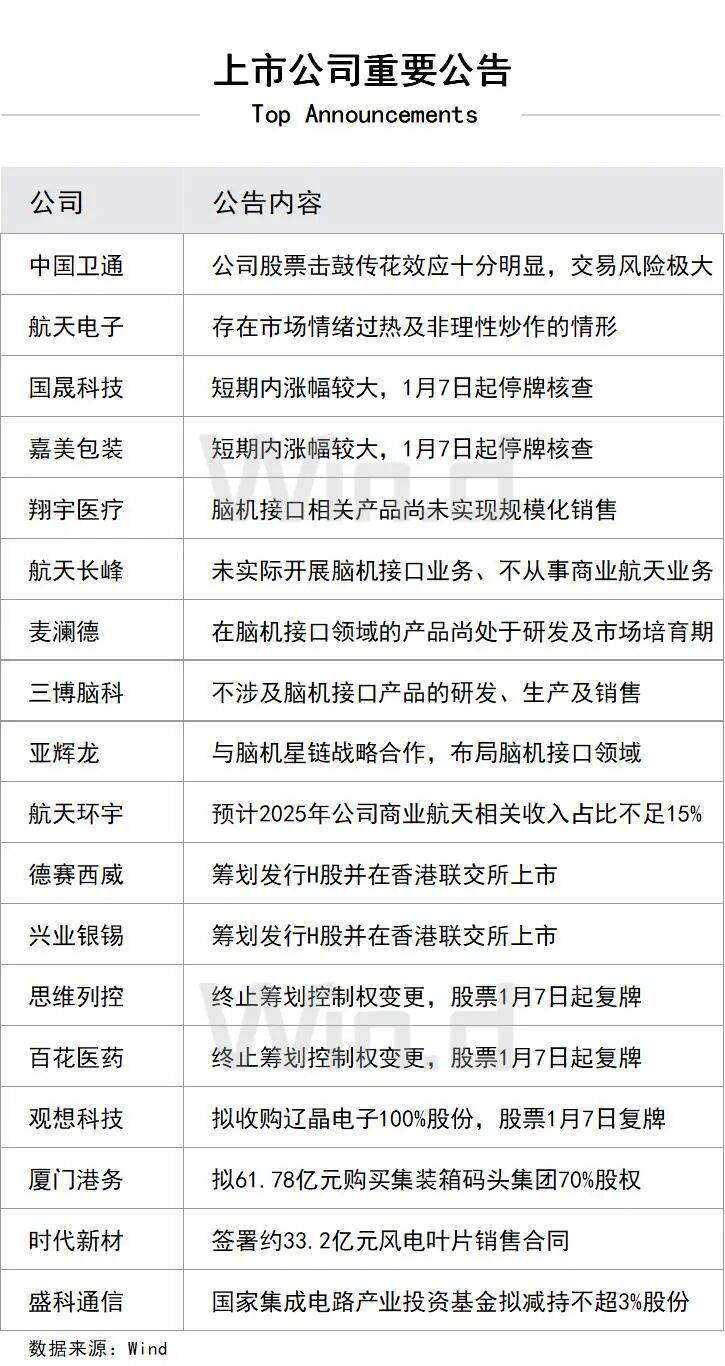
Group 1 - The Shanghai Composite Index achieved a record 13 consecutive days of gains, closing up 1.5% at 4083.67 points, marking a new high in over a decade [1] - The CES 2026 kicked off with NVIDIA's CEO announcing the full production of the new AI chip platform Vera Rubin, which boasts a fivefold increase in AI inference performance compared to Blackwell, with costs reduced to one-tenth [1] - Brain-computer interface unicorn Strong Brain Technology completed approximately 2 billion RMB financing, making it the second-largest financing in the field globally, following Neuralink [1] Group 2 - The People's Bank of China emphasized the flexible and efficient use of monetary policy tools to maintain ample liquidity and improve the structural monetary policy tool system [2] - The Ministry of Commerce announced a ban on the export of dual-use items to Japanese military users, with legal consequences for violations [2] - The Chinese government reiterated its stance on respecting the development paths chosen by other nations, particularly in response to the situation in Venezuela [3] Group 3 - The Chinese consumer sentiment market is rapidly growing, projected to rise from 1.63 trillion RMB in 2022 to 2.31 trillion RMB in 2024, and expected to exceed 4.5 trillion RMB by 2029 [3] - The Shanghai Municipal Development and Reform Commission and other departments proposed 20 measures to encourage foreign investment in domestic reinvestment [4] - The Hong Kong stock market saw a significant rise, with the Hang Seng Index up 1.38% and net inflows from southbound funds reaching 2.879 billion HKD [4] Group 4 - The Shanghai Stock Exchange reported that 42 companies went public in 2025, raising a total of 81.289 billion RMB, while the Shenzhen Stock Exchange had 48 companies raising 42.954 billion RMB [5] - Over 280 Hong Kong-listed companies have released their annual performance forecasts for 2025, with positive trends in the precious metals and innovative pharmaceuticals sectors [5] - QDII funds have recently shown premium risks, with over 20 funds issuing risk warnings due to high premiums [6] Group 5 - The aviation industry in China is expected to reach a record 770 million passenger trips in 2025, with international passenger transport increasing by 21.6% [10] - The first oil price adjustment of 2026 was "suspended," with no changes to domestic gasoline and diesel prices [11] - The automotive industry in China is projected to exceed 34 million units in production and sales in 2025, with new energy vehicles becoming the dominant market force [12]

财经观察:从三组数据看中国EV发展潜能
Huan Qiu Wang· 2026-01-07 22:39
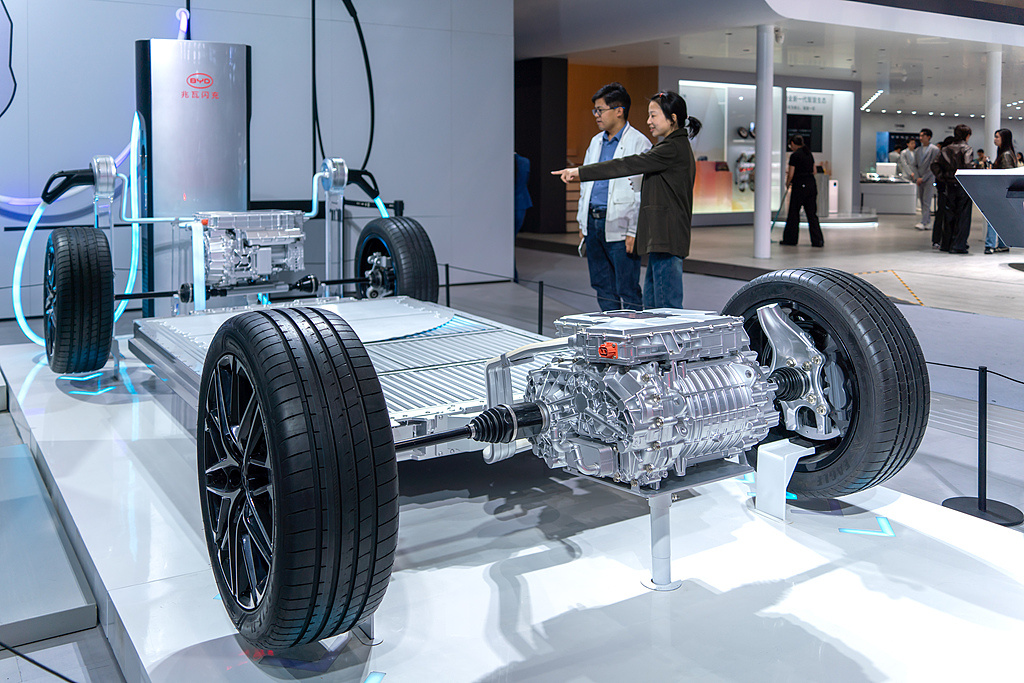
Core Viewpoint - BYD has surpassed Tesla to become the world's largest electric vehicle manufacturer, selling 2.26 million pure electric vehicles in 2025 compared to Tesla's 1.64 million, marking a significant shift in the global EV market dynamics [1] Group 1: R&D Investment and Workforce - BYD's revenue for the first three quarters of the year reached 566.27 billion yuan, with R&D expenses amounting to 43.75 billion yuan, representing 7.7% of its revenue [2] - The company has over 120,000 R&D personnel across 11 research institutes, with more than 50,000 recent graduates hired in the last three years, of which over 70% hold master's or doctoral degrees [4] - BYD's R&D investment has consistently ranked first among A-share listed companies, with a cumulative investment exceeding 220 billion yuan [4] Group 2: Competitive Landscape and Market Position - BYD's R&D investment is significantly higher than that of Tesla by 10.9 billion yuan, indicating a strong commitment to innovation [2] - The company has achieved a remarkable 145% year-on-year growth in overseas sales, reaching 1.049 million units in 2025, which accounts for over 22% of its total sales [9] - BYD's strong position in the battery supply chain, being the second-largest in global battery installations, gives it a competitive edge in the EV market [7] Group 3: Global Market Trends and Future Outlook - The global market share of Chinese new energy passenger vehicles reached 68.4% in 2025, with a peak of 73.7% in November, reflecting the impact of R&D investments over the past decade [6] - The geopolitical landscape poses challenges for Chinese automakers, with significant tariffs imposed by the U.S. and EU on Chinese electric vehicles, pushing companies to focus on developing markets in Southeast Asia, Latin America, Africa, and the Middle East [12] - Analysts suggest that BYD has the potential to surpass Toyota in global sales, with a projected growth space of approximately 1x, contingent on the speed of EV adoption over traditional fuel vehicles [12]

自动驾驶“有条件上路”正重构产业格局
Zheng Quan Ri Bao· 2026-01-07 17:10
Group 1 - The recent approval of the first batch of L3-level conditional autonomous driving vehicles marks a significant step towards commercialization in China, transitioning from technical validation to conditional road use [1] - The core breakthrough of "conditional road use" lies in balancing institutional innovation with risk control, clearly defining responsibility during system takeover between drivers and car manufacturers [1] - The launch of the "conditional road use" era is a natural outcome of industry development, with the penetration rate of L2-level assisted driving in new vehicles reaching 64%, indicating increasing consumer acceptance of intelligent driving [1] Group 2 - The entry into the "conditional road use" phase will unleash significant economic value and reshape the automotive industry ecosystem, benefiting upstream core component manufacturers and driving down costs through mass production [2] - Automotive companies will shift from hardware sales to a "hardware + software + service" profit model, leveraging services like OTA upgrades to extract long-term value [2] - The maturity of autonomous driving technology supports the transformation of automotive business models from one-time vehicle sales to full lifecycle service operations, positioning autonomous vehicles as "mobile intelligent terminals" [2]
Lucid、Nuro和优步联合发布一款自动驾驶出租车
Xin Lang Cai Jing· 2026-01-07 15:40
Core Insights - Lucid Group, Nuro, and Uber have jointly announced a production-intent autonomous taxi and have commenced supervised road testing, aiming to launch the service in the San Francisco Bay Area in late 2026 [1] Group 1 - The autonomous taxi is a collaborative effort between Lucid Group, Nuro, and Uber [1] - The service is expected to be operational in the San Francisco Bay Area by late 2026 [1] - The current phase involves supervised road testing of the autonomous taxi [1]


骏鼎达:公司目前正持续关注自动驾驶相关领域的市场机会
Zheng Quan Ri Bao Zhi Sheng· 2026-01-07 13:08
证券日报网讯 1月7日,骏鼎达在互动平台回答投资者提问时表示,公司目前正持续关注自动驾驶相关 领域的市场机会,积极对接下游客户需求。相关业务的市场拓展存在不确定性,敬请广大投资者理性投 资,注意投资风险。 (编辑 袁冠琳) ...
黄仁勋新年首场采访,谈了做CEO的秘诀
Di Yi Cai Jing Zi Xun· 2026-01-07 11:44
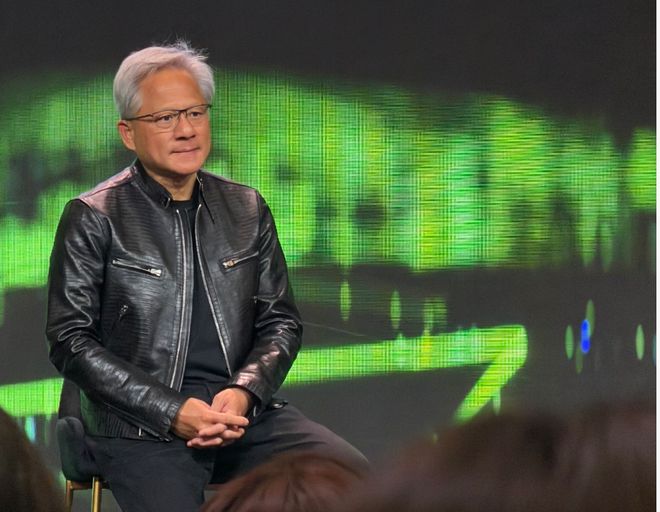
Core Insights - The demand for computing power is rapidly increasing, with predictions that global computing capacity needs to increase by 100 times in the coming years [2] - Nvidia's CEO Jensen Huang highlighted that model sizes are growing at a rate of 10 times per year, while inference model outputs are increasing by 5 times annually [2] - Both AMD and Nvidia are focusing on significant performance improvements in AI chips, with Nvidia aiming for a 1000 times performance increase in four years [2][3] Group 1: Computing Power Demand - AMD's CEO Lisa Su mentioned the ongoing need for more computing power during discussions at CES [2] - Nvidia's Huang emphasized the necessity for enhanced energy efficiency to support AI development, indicating that energy sources like natural gas and sustainable energy are crucial [5][6] - The rapid growth in AI-related investments, reaching $150 billion last year, reflects the industry's enthusiasm for AI technologies [5] Group 2: Chip Development and Performance - Nvidia's new architecture chips have achieved a throughput increase of 10 times compared to previous generations, while also reducing costs by 10 times [5][6] - Huang stated that achieving a 10 times performance increase annually is challenging, necessitating a shift from traditional chip manufacturing to a more integrated system design approach [7] - The collaboration with partners to build advanced components like HBM4 and optimized data center systems is part of Nvidia's strategy to enhance performance [7] Group 3: Storage and AI Infrastructure - Nvidia is focusing on revolutionizing storage systems to meet the unique demands of AI workloads, with the introduction of a new AI storage infrastructure supported by the BlueField-4 DPU [9] - Huang indicated that Nvidia is likely to become one of the largest storage companies, not by building storage itself, but through partnerships with major storage suppliers [9] Group 4: Ecosystem and Investment Strategy - Nvidia's investment strategy includes building new technologies and investing in ecosystem partners, including memory suppliers and system manufacturers [10][11] - The company is also exploring acquisitions to strengthen its position in the AI ecosystem, with a focus on enhancing its technological capabilities [11] Group 5: AI and Robotics - Nvidia is expanding its business into autonomous driving and robotics, with plans to deploy its DRIVE AV software in Mercedes-Benz vehicles [13] - Huang predicts that robots will achieve human-like capabilities this year, with advancements in motion and grasping technologies [14] - The company believes that the robotics revolution will create job opportunities, countering workforce shortages due to demographic changes [14]

宏观金融日报-20260107
Yi De Qi Huo· 2026-01-07 11:38
Report Industry Investment Rating No relevant content provided. Core Viewpoints - The stock index futures market showed a normal oscillation on Wednesday, with short - term oscillations not changing the upward trend. Attention should be paid to the central bank's liquidity management and the possible impact of annual report performance announcements. There are structured opportunities in the L3 level, and positive factors exist in domestic computing power, AI applications, etc. [5] - The bond market may maintain a short - term oscillatory pattern due to factors such as risk preference recovery, supply concerns, and inflation expectations. It is recommended to wait and see before the main trend becomes clear. [10] - The container shipping index 02 contract is expected to maintain a high - level oscillation in the short term. Spot enterprises without shipping contracts before the Spring Festival can hold long hedging positions, and attention can be paid to the positive arbitrage opportunity between EC2604 and EC2608. [12][13] Summary by Related Catalogs Current Affairs - The Venezuelan interim government will transfer 30 - 50 million barrels of oil to the US, and the funds will be supervised by Trump [1] - China's Ministry of Commerce prohibits the export of dual - use items to Japanese military users [2] - The Trump administration is discussing plans to acquire Greenland, including purchase, free association agreement, and military means [2] - The People's Bank of China clarifies key tasks in 2026, including strengthening counter - cyclical and cross - cyclical adjustments, using various monetary policy tools, and strengthening financial market supervision [2] - Fed officials have different views on interest rates. Richmond Fed President Barkin advocates "fine - tuning" based on data, and Fed Governor Milan expects more than 100 basis points of interest rate cuts this year [3][4] - The US Supreme Court may rule on Trump's global tariff policy on January 9 [4] - Multiple departments held a symposium on the power and energy storage battery industry, focusing on anti - involution measures [4] - China's Ministry of Commerce is conducting an anti - dumping investigation on imported dichlorodihydrosilane from Japan [4] Stock Index Futures - On Wednesday, the market oscillated. The Shanghai Composite Index rose 0.05%, and the trading volume of the Shanghai and Shenzhen stock markets was 285.41 billion yuan. The performance of index futures varied, with some rising and some falling. [5] - Structured opportunities are expected in the L3 level, and positive factors exist in domestic computing power, AI applications, etc. Attention should be paid to sectors such as domestic computing power & equipment, automotive & robotics, AI applications, and non - bank finance, as well as themes like controllable nuclear fusion and brain - computer interfaces. [5][6] Bond Futures - On Wednesday, the central bank conducted 28.6 billion yuan of 7 - day reverse repurchase operations, with a net withdrawal of 50.02 billion yuan. The money market was loose, and risk sentiment suppressed the bond market, especially the ultra - long end. [9] - The bond market has been volatile recently due to risk preference recovery and supply concerns. Although there are some favorable factors for bond funds, the bond market allocation rhythm may slow down. A January reserve requirement ratio cut is still possible. [10] Container Shipping Index - On Wednesday, the container shipping index 02 contract fluctuated. Some funds took profits, and shipping companies lowered online freight rates, causing the index to decline. If the cargo volume is lower than expected, the spot freight rate may turn around at the end of January. [12] - Before the Spring Festival, the marginal support logic remains. Spot enterprises without shipping contracts can hold long hedging positions, and attention can be paid to the positive arbitrage opportunity between EC2604 and EC2608. [13] Future 24 - Hour Key Data - Tonight (January 7): At 21:30, pay attention to the change in US ADP employment in December. The previous value was 199,000, and the forecast value is 212,000. From January 8 to 14, the Bloomberg Commodity Index will conduct an annual weight re - balancing. [15] - Tomorrow (January 8): At 21:15, focus on the change in US ADP employment in December (the previous value was - 32,000, and the forecast value is 48,000). At 23:00, pay attention to the US ISM non - manufacturing index in December (previous value 52.6, forecast value 52.3) and the final value of the month - on - month change in US durable goods orders in October (previous value - 2.2%, forecast value - 2.2%). [16]
【研选行业】2030年市场规模剑指115亿!EMB成智能网联汽车“必选项”,产业链迎来爆发前夜,核心产业链标的全面梳理
Xin Lang Cai Jing· 2026-01-07 11:01
Group 1 - The core viewpoint highlights the significant growth potential in the smart connected vehicle market, targeting a market size of 11.5 billion by 2030, with a critical period identified between 2025 and 2026 [1] - The solid-state battery sector is experiencing a global race for dominance, with key milestones set for equipment specification in 2026 and mass production in 2027, indicating three main investment themes [1] - A price increase of 60% by overseas giants has sparked a bullish trend in the storage chip market, confirming the ongoing prosperity cycle [1] - NVIDIA is intensifying its investment in autonomous driving, leading to a potential revaluation of the industry chain [1]
雷军:新一代SU7豪华高性能纯电轿车预计4月份上市;追觅“星空计划”首款概念车亮相CES2026,零百加速低于1.8秒丨汽车交通日报
创业邦· 2026-01-07 10:13
Group 1 - Amazon Web Services (AWS) partners with Aumovio to enhance safety and intelligence in autonomous vehicles, with plans to deploy new technologies in Aurora's self-driving truck fleet by 2027 [2] - Amazon's Ring launches a commercial mobile surveillance trailer priced at $5,000, designed for monitoring outdoor spaces, featuring 360-degree cameras and optional solar power [2] - Xiaomi's Lei Jun announces the upcoming launch of the new generation SU7 luxury high-performance electric sedan in April, featuring enhanced safety, advanced intelligent chassis, and improved driving experience [3] Group 2 - The Nebula Next 01 Concept from Chasing Technology showcases a zero to hundred km/h acceleration time of under 1.8 seconds and a drag coefficient of 0.185, highlighting its advanced aerodynamic design [4] - The Nebula Next 01 Concept utilizes aerospace-grade materials and innovative door designs, achieving high structural integrity and safety standards with a torsional stiffness exceeding 45,000 Nm/degree [4]