价值投资

Search documents
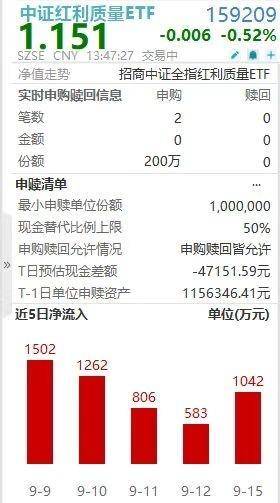
净流入六连阳!“月月评估分红”的中证红利质量ETF(159209)持续获资金青睐
Sou Hu Cai Jing· 2025-09-16 07:11
Group 1 - The core viewpoint of the news highlights the performance of the China Securities Dividend Quality ETF (159209), which experienced a slight decline of 0.52% while still attracting net inflows for six consecutive days [1][2] - The ETF is undergoing its third dividend distribution of the year, with a cash dividend of 0.003 CNY per share, reflecting its focus on stable dividend-paying companies with strong profitability [2] - The ETF tracks the CSI All Share Dividend Quality Index, which selects 50 companies known for stable dividends and high dividend yields, emphasizing a dual-factor screening mechanism of "low valuation" and "high quality" [2][3] Group 2 - The product design of the ETF features a cost structure of "0.15% + 0.05%", which is among the lowest in the market, providing a significant cost advantage for long-term holders [3] - The dividend distribution model employs a monthly assessment mechanism, enhancing cash flow for investors and improving the overall holding experience [3]

大盘价值的底层支撑:龙头集群与行业比较优势
Xin Lang Cai Jing· 2025-09-16 06:08
Core Viewpoint - The Shanghai Stock Exchange 50 Index (SSE 50) has become a core target in value investing due to its precise selection of quality constituent stocks and scientific industry allocation, providing a robust underlying support for returns amidst market volatility [1][2]. Group 1: Constituent Stock Quality - The top ten constituent stocks of the SSE 50 form a "leader matrix" covering multiple core sectors, representing the pricing power and profit resilience of China's core economic assets [1]. - Key sectors include food and beverage, finance, public utilities, resources, and pharmaceuticals, with leading companies establishing strong competitive moats [1][2]. - For instance, Kweichow Moutai, with a weight of 10.55% and a market capitalization exceeding 1.8 trillion, leverages brand scarcity and rigid consumption scenarios to maintain high profitability across economic cycles [1][4]. Group 2: Industry Allocation Advantages - The SSE 50 exhibits a strategic positioning in core sectors, emphasizing "economic foundation + consumption upgrade," which provides a comparative advantage over the CSI 300 and CSI 500 indices [2][7]. - In the financial sector, the SSE 50's allocation is significant, with a combined weight of 36.4% in banking and non-banking financial sectors, substantially higher than the CSI 300's 26.2% and CSI 500's 9.5% [7][8]. - Leading banks like Industrial and Commercial Bank of China and China Merchants Bank are noted for their superior asset quality management and interest margin control, contributing to a "double boost" effect on performance during economic recovery [7][8]. Group 3: Consumer Sector Focus - The food and beverage sector holds a weight of 13.6% in the SSE 50, significantly surpassing the CSI 300's 8.1% and CSI 500's 1.8%, focusing on high-end consumer leaders like Kweichow Moutai [8][9]. - The current TTM price-to-earnings ratio for the food and beverage index is 21.76, indicating it is at a historically low relative valuation, which, combined with a recovering consumption trend, suggests potential for valuation recovery [8][9]. - The food and beverage sector is positioned as a "stabilizer" for the SSE 50, with expectations for steady earnings growth and reasonable valuation recovery, contributing to ongoing cash flow and valuation elasticity [9].






认可长期投资价值 上市银行掀起增持潮
Shen Zhen Shang Bao· 2025-09-15 23:00
Group 1 - The core viewpoint is that several listed banks in China, including Everbright Bank and Nanjing Bank, have seen significant share buybacks by their major shareholders, indicating confidence in the banks' future development and long-term investment value [1][2] - Since September, a total of eight listed banks have experienced intensive share buybacks from shareholders or executives, reflecting a trend in the banking sector [1] - Everbright Bank's major shareholder, Everbright Group, plans to increase its stake in the bank by investing between 50 million to 100 million yuan, with a current buyback of 13.97 million shares, representing 0.02% of the total share capital [1] Group 2 - Nanjing Bank's major shareholder, Nanjing Zijin Investment Group, has increased its stake through its subsidiary, Zijin Trust, acquiring 56.78 million shares, which raised its total holding from 12.56% to 13.02% [1] - The rationale behind these buybacks is attributed to the shareholders' and management's confidence in the banks' future prospects and recognition of their long-term investment value [2] - Market analysts view the frequent buybacks by insiders as a positive signal, suggesting that they believe in the current value proposition of the banking sector [2]


白酒底部价值,大众品把握龙头
2025-09-15 14:57
Summary of Key Points from Conference Call Records Industry Overview Baijiu Industry - The baijiu sector has reached a bottom in fundamentals, with valuations at low levels and market expectations recovering. Demand-side pressures are dissipating, and seasonal catalysts are expected to boost interest in brands like Luzhou Laojiao and Zhenjiu Shede for short-term opportunities, while Moutai, Fenjiu, and Gujing Gongjiu are recommended for long-term investment [1][2][4] Beverage and Snack Industry - The beverage sector is favorable for leading companies such as Nongfu Spring and Dongpeng Beverage, while the snack sector shows good alignment between valuation and growth potential. Key products to watch for Q4 catalysts include Weijia and Yanjinpuzi, with Yili identified as a bottom-value recovery company [1][5] Whisky Industry - In 2024, whisky imports are expected to decline by approximately 40%, with high-aged whisky's share also decreasing. Instant consumption channels now account for over 30% of sales, with dining and home consumption being the primary scenarios [3][13] Beer Industry - Both Yanjing Beer and Zhujiang Beer have seen their valuations drop to attractive levels, with Yanjing at 23-24 times earnings and Zhujiang at 21 times, both reflecting 2025 valuation levels. These companies are noted for their growth potential driven by flagship products [19] Company-Specific Insights Zhenjiu Lid - Zhenjiu Lid has launched an equity payment plan to bind the interests of alliance merchants, with the first quarter's alliance contributing approximately 320 million yuan in revenue. The acupuncture business is projected to account for 5% of the company's total revenue in 2024 [6][8][7] Baijun Co., Ltd. - Baijun's major shareholder transferred 6% of shares to Homa's Liu Jianbo, which is expected to empower Baijun in business expansion and overseas market development. The shareholding structure remains stable, providing opportunities for deeper collaboration [12] Restaurant Chain Industry - The restaurant chain sector has shown signs of recovery since Q2 2025, with stable performance from leading companies like Lihua Bao and Baba Foods. The frozen food leader Anjins has also shown significant improvement in revenue [10][11] Zhujiang Beer - Zhujiang Beer is focusing on expanding its market share through its flagship product, Pure Draft 97, while also launching new products to maintain competitiveness. The company is developing its "15th Five-Year Plan" for future growth [15][17][18] H&H International Holdings - H&H International expects high single-digit revenue growth for the year, with EBITDA margins around 15%. The health supplement business is performing well, while the milk powder segment anticipates low double-digit growth [20] Jianhe Health - Jianhe Health's fundamentals are improving, driven by new consumer customer acquisition in China and profitability improvements in its overseas subsidiaries. The company is expected to see good performance in Q3 due to new orders [21][22] Additional Insights - The baijiu sector is currently viewed as a mid-to-long-term value investment opportunity, with market expectations warming up as demand-side pressures ease [2] - The innovative model of the Wan Shang Alliance is expected to have a significant impact on the company's financials, with a focus on long-term development and binding interests with distributors [9]


[9月15日]指数估值数据(为啥同一品种,收益率会有差别;自动止盈功能上线;月薪宝体验官福利来了)
银行螺丝钉· 2025-09-15 14:07
Core Viewpoint - The article discusses the current market trends, emphasizing the performance of growth versus value styles in investment, and highlights the importance of timing and strategy in achieving investment returns. Group 1: Market Performance - The overall market opened with a slight increase but closed with minimal fluctuations, maintaining a rating of 4.2 stars [1] - Large-cap stocks showed slight gains while small-cap stocks declined [2] - Growth styles, such as those represented by the ChiNext board, experienced an increase, whereas value styles remained relatively weak [3] Group 2: Investment Strategy - As growth styles have risen this year, valuations have gradually increased, prompting some fund managers to reduce their growth allocations and increase value style allocations [4] - The current trend of strong growth and weak value styles may be influenced by various factors [5] - Long-term investment strategies will continue to favor lower valuation styles for portfolio allocation [6] - Historical trends indicate that during last year's growth style decline, portfolios increased their growth style allocations, which is beneficial for long-term returns [7] Group 3: Investor Behavior - There is a notable disparity in returns among investors in the same asset class, influenced by their entry timing and purchase costs [10] - Investors entering during bull markets tend to have higher initial costs compared to those entering at market lows [15] - A significant portion of A-share accounts were opened during the major bull markets of 2007 and 2015, indicating a tendency for investors to enter the market during rising phases [18] - Strategies such as dollar-cost averaging during market downturns can help lower investment costs and lead to profitability without needing the market to return to previous highs [20][21] Group 4: Learning and Experience - The first round of investing through bear and bull markets is primarily about gaining experience, and investors should not overly focus on initial returns [28] - Historical market cycles provide valuable lessons, and understanding these cycles can help investors make informed decisions in future investments [30][33] - The article suggests that over the next 30 years, investors will likely experience multiple cycles of bull and bear markets, providing ample opportunities for undervalued purchases and overvalued sell-offs [38] Group 5: Product Features - The company has introduced an "automatic profit-taking" feature for its actively selected and index-enhanced portfolios, which will trigger profit-taking signals as the market moves out of undervaluation [40] - A live session is scheduled to discuss the financial performance of listed companies in A-shares and Hong Kong stocks, focusing on profit recovery in the first two quarters of the year [42]
主观私募业绩大分化!日斗投资居前!多位私募大佬旗下私募上榜!
Sou Hu Cai Jing· 2025-09-15 10:14
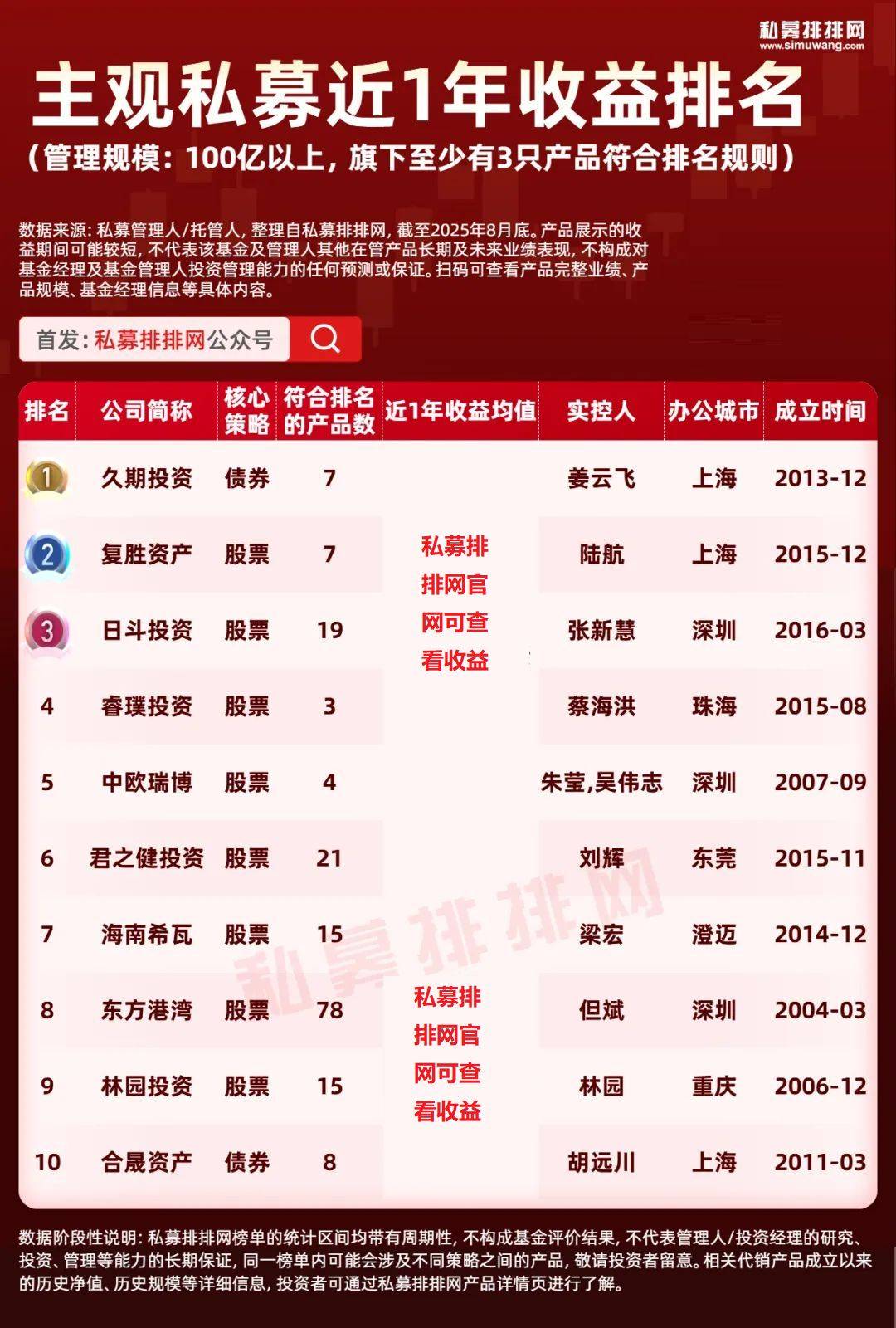
Core Insights - The article discusses the performance and ranking of subjective private equity funds in China, highlighting their reliance on active management and individual fund manager expertise rather than algorithmic strategies [1][2]. Group 1: Overview of Subjective Private Equity - As of August 2025, there are 5,423 subjective private equity firms, accounting for over 70% of the total in the securities investment category [1]. - In the past year, 294 firms have at least three products displayed on the private equity ranking platform, with 213 of them focusing on stock strategies [1]. Group 2: Performance Rankings - Among the 100 billion yuan and above category, the top three firms by average returns are: Jiuzhi Investment, Fusheng Asset, and Rido Investment, with average returns of ***%, ***%, and ***% respectively [2]. - The average return for the 100 billion yuan category is 32.50%, with a total of 186 products meeting ranking criteria [1][2]. Group 3: Notable Firms and Their Strategies - Rido Investment, established in March 2016, has quickly become a leading firm, achieving significant returns through a customer-centric value investment approach [4][5]. - The top firm in the 50-100 billion yuan category is Tongben Investment, with an average return of ***% [7][10]. Group 4: Performance in Smaller Categories - In the 20-50 billion yuan category, Haokun Shengfa Asset leads with an average return of ***%, while in the 10-20 billion yuan category, Nengjing Investment Holdings tops the list with an average return of ***% [11][15]. - The 5-10 billion yuan category sees Yijiu Private Fund at the top, achieving an average return of ***% [18][20]. Group 5: Emerging Trends and Insights - The article emphasizes the importance of fundamental research and value investment strategies among successful private equity firms, particularly in sectors like consumer goods and technology [10][14]. - The performance of these funds suggests a growing confidence in the Chinese stock market, with expectations of a bullish trend in the near future [5][6].
今年来基金经理十强都有谁?陆航、殷陶、王琛等领衔百亿!童驯、李佳佳等夺冠!
私募排排网· 2025-09-15 03:17
Core Insights - The article emphasizes that "buying a fund means buying the fund manager," highlighting the critical role of fund managers in determining fund performance [2] - As of the end of August, there are 2,831 fund managers with performance data, managing a total of 5,276 private fund products, with a combined management scale of approximately 465.47 billion yuan and an average return of 22.64% this year, significantly outperforming the market [2][3] Summary by Categories Fund Manager Education and Experience - Nearly 50% of the fund managers hold a master's degree, while 221 have a doctoral degree and 8 are postdoctoral [2] - 244 fund managers have over 20 years of experience, accounting for 38.1%, and only 62 have over 30 years of experience, representing 9.7% [2] Fund Size and Performance - Fund managers from private funds with a scale of 10-20 billion yuan have an average return of 24.99%, leading the performance [3] - Fund managers from private funds with over 100 billion yuan have an average return of 24.78%, while those managing between 50-100 billion yuan have an average return of 20.16% [3] Top Performing Fund Managers - The top three fund managers in the over 100 billion yuan category are Lu Hang from Fusheng Asset, Jiang Yunfei from Duration Investment, and Yin Tao from Stable Investment [6][10] - Lu Hang has 20 years of experience and focuses on growth stocks, with significant returns from new consumer stocks [10] - Yin Tao, with 12 years of experience, utilizes a self-created high-frequency trading method and artificial intelligence in his investment strategy [10] Performance Rankings by Fund Size - In the 50-100 billion yuan category, the top three fund managers are Tong Xun from Tongben Investment, Ni Fei from Kaishi Private Equity, and Zhang Xiangfang from Mingxi Capital [12] - In the 20-50 billion yuan category, Li Jiajia from Haokun Shengfa Asset leads, followed by Shi En from Yunqi Quantitative and Xu Shuang from Zige Investment [17] - In the 10-20 billion yuan category, He Zhenquan from Liangli Private Equity ranks first, with a focus on emerging industry trends [22] - In the 5-10 billion yuan category, Liu Xianglong from Fuyuan Capital tops the list, emphasizing value investment [27]
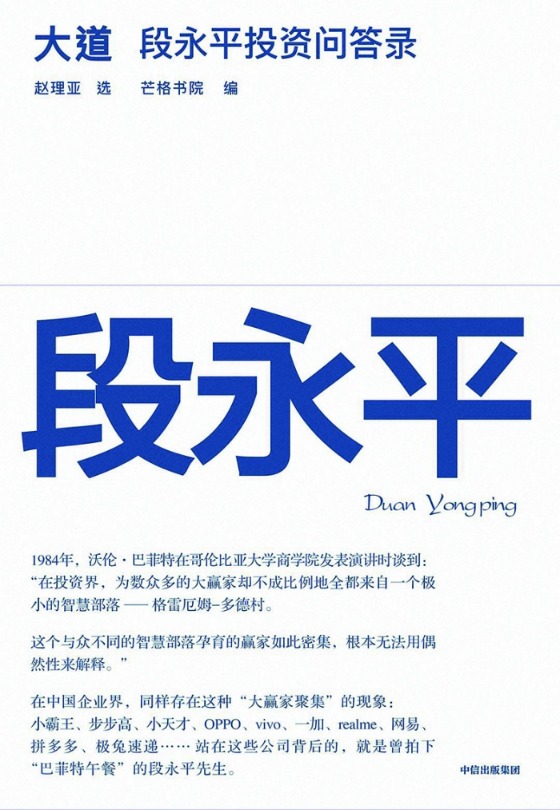
利润不过是水到渠成的结果——读《大道:段永平投资问答录》
Shang Hai Zheng Quan Bao· 2025-09-14 20:05
Core Insights - The article emphasizes the investment philosophy of Duan Yongping, highlighting his long-term approach to investing, which contrasts with the pursuit of quick profits [4][5][12] - Duan Yongping's investment principles include avoiding short selling, not borrowing money for investments, and only investing in companies that are well understood [6][8][12] Investment Philosophy - Duan Yongping believes that investing is akin to farming, requiring patience and a focus on long-term value rather than short-term gains [5][10] - He stresses the importance of understanding a company's future cash flows, which should guide investment decisions [5][9] Key Principles - The "不可为" (things not to do) list includes three main principles: do not short sell, do not borrow money, and do not invest in what is not understood [6][8][12] - Duan Yongping shares a personal experience of losing approximately $200 million from short selling Baidu, which he describes as a foolish act due to market unpredictability [7] Understanding Companies - A good company is characterized by a strong business model and a positive corporate culture, which together create a competitive advantage or "moat" [10][12] - The article discusses the distinction between core technology and core competitiveness, emphasizing that true value lies in the user experience rather than the technology itself [10] Valuation and Analysis - Valuation is described as an art that requires time and understanding of a company, rather than relying solely on historical metrics like price-to-earnings ratios [9][12] - Duan Yongping advocates for qualitative analysis over quantitative analysis, as the former is crucial for identifying truly profitable companies [9][12] Corporate Culture - The article highlights the importance of corporate culture, which should prioritize consumer needs over short-term profits, as exemplified by Apple's approach to product development [12][13] - Companies that focus on doing the right thing and maintaining a long-term vision are more likely to succeed sustainably [13]

股民吵翻了!老登VS小登!周末刷屏热榜!市场风格持续分化,该如何选择?
雪球· 2025-09-14 06:37
Group 1 - The article discusses the ongoing debate between different investment styles, particularly the contrast between "Old Deng" (value investors) and "Young Deng" (growth investors) [5][7] - A significant point of contention arose when Ling Peng, chairman of Wilderness Investment, questioned the market's forecast for Zhongji Xuchuang's net profit exceeding 25 billion yuan by 2027, arguing that such projections for component manufacturing companies are unrealistic [6] - The response from sell-side analysts highlighted the potential benefits for Zhongji Xuchuang as a leading company in the optical module sector, especially with the increasing importance of communication driven by AI advancements [6] Group 2 - The article notes a clear divergence in performance between value and growth investment styles, with the CSI Dividend Index down 0.92% this year, while the ChiNext Index surged by 41.04% [8] - The discussion reflects a broader sentiment among investors, with some expressing skepticism towards traditional value investments, while others emphasize the importance of maintaining a disciplined investment approach [10][12] - The debate also touches on the cyclical nature of markets, with some investors advocating for a cautious approach based on historical market cycles and the potential for significant losses during downturns [17]

A股热点轮番“表演”!什么样的公司,才能让股东富起来?
券商中国· 2025-09-13 23:36
Core Viewpoint - The article emphasizes the importance of evaluating the intrinsic value of companies rather than focusing solely on short-term performance, highlighting that sustainable growth and cash returns to shareholders are crucial for long-term investment success [2][3]. Group 1: Market Sentiment and Company Performance - Recent trends in the A-share market show a warming sentiment, with various hot topics emerging, leading to a focus on the question of "value" rather than just market direction [1]. - Companies often release positive earnings reports during periods of high market enthusiasm, which can serve as a window for major shareholders to reduce their stakes or raise funds [2]. Group 2: Long-term vs. Short-term Performance - Companies that fail to provide cash returns to shareholders are deemed "hollow," and investors should focus on companies with strong fundamentals, such as capital structure and business model [2][3]. - Historical examples illustrate that companies requiring continuous capital investment for growth, like AT&T, often fail to deliver shareholder value, while those with stable cash flows, like Thompson Publishing, succeed in enriching their shareholders [3]. Group 3: Risks of Short-term Focus - The article warns against the risks associated with short-term performance evaluations, citing past instances where high-growth stocks faced significant declines due to unsustainable growth expectations [5][6]. - High-growth stocks are particularly vulnerable to valuation drops if growth expectations are not met, leading to severe price corrections [6][7]. Group 4: Investment Strategy Recommendations - Investors are advised to focus on companies with a stable historical performance and a track record of consistent dividend payments, ideally over a 20-year period [7]. - Defensive investors should be cautious of high-growth stocks due to their inherent uncertainties and risks, suggesting that more stable, reasonably valued large companies may be better suited for the average investor [7].