制造业PMI

Search documents
格林大华期货早盘提示:瓶片-20251204
Ge Lin Qi Huo· 2025-12-04 02:02
Morning session notice 早盘提示 更多精彩内容请关注格林大华期货官方微信 格林大华期货研究院 证监许可【2011】1288 号 2025 年 12 月 4 日星期四 | 联系方式:15000295386 | | --- | | 板块 | 品种 | 多(空) | 推荐理由 | | --- | --- | --- | --- | | | | | 【行情复盘】 周三夜盘瓶片主力价格下跌16元至5692元/吨。华东水瓶级瓶片价格下跌15至5755 元/吨,华南瓶片价格下跌 20 至 5830 元/吨。持仓方面,多头持仓增加 29 手至 6.16 | | | | | 万手,空头持仓增加 473 手至 6.31 万手 | | | | | 【重要资讯】 | | | | | 33.22 万吨,环比+0.08 万吨。国内 1、供应和成本利润方面,国内聚酯瓶片产量为 | | | | | 聚酯瓶片产能利用率周均值为 72.7%,环比+0.1%;聚酯瓶片生产成本 5295 元,环 | | | | | 比+23 元/吨;聚酯瓶片周生产毛利为-154 元/吨,环比-25 元/吨。 | | | | | 2、2025 ...
格林大华期货早盘提示:纯苯-20251204
Ge Lin Qi Huo· 2025-12-04 01:39
Morning session notice 早盘提示 更多精彩内容请关注格林大华期货官方微信 联系方式:15000295386 | 板块 | 品种 | 多(空) | 推荐理由 【行情复盘】 | | --- | --- | --- | --- | | | | | 周三主力合约期货BZ2603价格下跌10元至5437元/吨,华东主流地区现货价格5325 | | | | | 元/吨(环比-10),山东地区现货价格 5238 元/吨(环比+7)。持仓方面,多头持 | | | | | 仓减少 177 手至 1.6 万手,空头持仓减少 466 至 1.91 万手。 | | | | | 【重要资讯】 | | | | | 1、供应方面,11 月国内纯苯产量 191.8 万吨,同比-0.93%。12 月计划内检修偏多。 | | | | | 10 月纯苯进口量 49.67 万吨,环比+14.1%。市场消息:华东某炼厂计划 1 月对 1000 | | | | | 万吨常减压以及一套重整检修,影响纯苯产能 60 万吨。 | | | | | 2、库存方面,2025 年 12 月 1 日,江苏纯苯港口样本商业库存总量:22.4 万吨, ...
内需外需均有改善,11月制造业PMI回升至49.2%
Hua Xia Shi Bao· 2025-12-02 12:36
Core Viewpoint - The manufacturing Purchasing Managers' Index (PMI) in November shows a slight recovery to 49.2%, indicating improvements in both domestic and overseas demand, although it remains in a contraction zone for the eighth consecutive month [2][5]. Economic Indicators - The November PMI reflects improvements in 11 sub-indices, including new orders and production expectations, with a composite PMI output index at 49.7%, suggesting overall economic stability [2][5]. - The new orders index increased by 0.4 percentage points to 49.2%, while the production index rose to the critical point of 50.0%, indicating a return to expansion after a contraction [5][6]. Policy Impact - Recent government policies, including the introduction of 500 billion yuan in new policy financial tools and an additional 500 billion yuan in special bonds, are expected to stimulate domestic market demand and infrastructure investment [5][8]. - The positive outcomes from recent US-China trade talks have also contributed to a marginal increase in export orders, with the new export orders index rising by 1.7 percentage points to 47.6%, marking the largest increase in six months [5][6]. Sector Performance - High-tech manufacturing sectors continue to show strong demand, with their PMIs remaining above the critical point for ten consecutive months, while traditional energy-intensive industries are still in contraction [6]. - Specific industries such as agricultural processing and non-ferrous metal smelting are experiencing active demand, whereas sectors like petroleum and chemical manufacturing are lagging [6][7]. Price Trends - The main raw material price index rose by 1.1 percentage points to 53.6%, indicating ongoing expansion since the implementation of "anti-involution" policies [7]. - The Producer Price Index (PPI) is expected to see a slight month-on-month increase, although year-on-year comparisons may still reflect a decline due to higher base effects from the previous year [7][8]. Future Outlook - The construction PMI is anticipated to rise into the expansion zone as the effects of the new policy financial tools and special bonds materialize [8]. - The overall industrial product prices remain subdued, influenced by weak consumer demand and declining real estate investments, with the long-term effects of "anti-involution" policies on prices still under observation [8].


美11月PMI公布沪银走势震荡
Jin Tou Wang· 2025-12-02 04:05
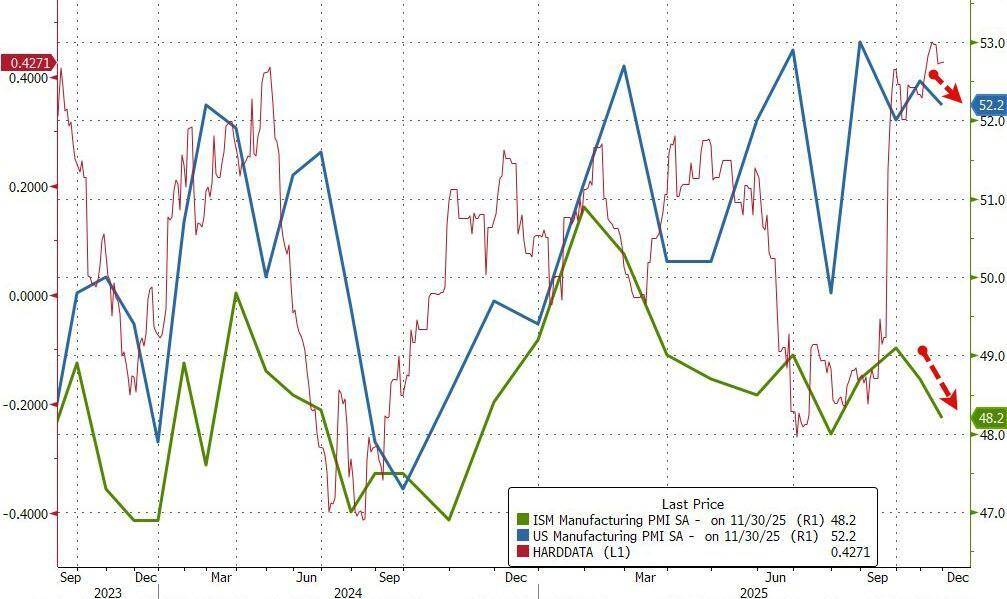
Group 1 - Silver futures are currently trading above 13433, with a recent increase of 2.93% from an opening price of 13303, reaching a high of 13787 and a low of 13303, indicating a short-term oscillating trend [1] - The U.S. November manufacturing PMI from S&P Global recorded a final value of 52.2, up from the previous 51.9, while the ISM manufacturing PMI was at 48.2, below market expectations of 49 and down from 48.7 [1] - Despite the expansion indicated by the manufacturing PMI, there are concerns about the health of the industry, as the growth is primarily driven by strong factory production, while the inflow of new orders has significantly slowed, suggesting a notable decrease in demand [1] Group 2 - The accumulation of unsold inventory has reached the highest level since 2007, indicating potential production cuts in the coming months due to the mismatch between production and sales [1] - Disappointing sales, intense competition, and rising input costs, often related to tariff policies, are squeezing corporate profit margins [2] - Recent trading in silver futures shows a potential for continued adjustments, with a focus on the 13000 level, where a drop below this threshold could lead to increased bearish activity [3]
美国 11 月 ISM 制造业 PMI 萎缩幅度创 4 个月最大,连续 9 个月收缩,对此你怎么看?
Sou Hu Cai Jing· 2025-12-02 03:52
网上又都是黄金5500,白银80,美元再跌10%之类的话题了,大家又要很兴奋的高喊要做多金银铜了,美国高盛的大卫所罗门、桥水的达利 欧、还有约翰·保尔森这几个老多头联合起来,通过这轮拔网线行动,打了一次现货供需差,赚了一大票,这种走势不洗,后面就要给散户和现 货商去送钱了!而这个市场,很多人都把现货和商品混为一谈,殊不知,一旦消费端通缩,上游的供需的关系立马就失去了核心预计,人类重 回金银本位就意味着下一代的持续通缩,对于大佬是好事,对于普通人而言,别谈自己的金银储备,因为这个市场,其实并不对普通人开放。 因此,我还是这个观点,美元会降息,但按当下的几个市场上的炒作热情和流动性冻结幅度,美元后面依然会紧张(证券化市场和银行市 场)!传统意义上,降息通常对于传统金融而言意味着货币宽松,但按美债这个规模,如果也要走日本模式,同时,我们也跟进的话,估计会 让全球掀起负利率竞赛或者加息大赛,引发金融巨震,因此,2026年对于世界金融的看法请改下观念,很多事情要从流动性和债务的角度去 看! 而影响市场情绪的另一重要依据就是美国的制造业经济和就业的复苏! 2025年11月美国ISM制造业PMI指数降至48.2,较上月下降 ...
恒指高开高走,收涨 174 点
Guodu Securities Hongkong· 2025-12-02 02:38
Market Overview - The Hang Seng Index opened high and closed up by 174 points, reaching 26,033 points, with a trading volume of 20.0884 billion HKD and a net inflow of 2.148 billion HKD from northbound trading [3][4]. Retail Sector - Hong Kong's retail sales in October increased by 6.9% year-on-year, surpassing market expectations of 4.7%, with total sales value estimated at 35.2 billion HKD [7]. - Online sales accounted for 14.6% of total retail sales in October, with an estimated value of 5.2 billion HKD, reflecting a year-on-year increase of 27.2% [7]. - Approximately 70% of retail members expect business in November to remain flat or grow in the low to mid-double digits, driven by tourism-related retail and promotional activities [8]. Gaming Sector - Macau's gaming revenue for November rose by 14.4% year-on-year, totaling 21.088 billion MOP, exceeding expectations [9]. Manufacturing Sector - China's manufacturing PMI fell to 49.9 in November, indicating a contraction, as new orders slowed and production ceased to expand [10]. Company News - Kaisa Group initiated a consent solicitation for multiple USD notes to allow for interest payments in shares instead of cash [12]. - ZhongAn Group reduced its stake in ZhongAn Technology by selling 37 million shares, raising approximately 76.96 million HKD for general working capital [13]. - BYD reported a 5.25% year-on-year decline in November vehicle sales, totaling approximately 480,200 units [14]. - Xpeng Motors announced a 156% year-on-year increase in cumulative deliveries for the first 11 months, with November deliveries reaching 36,728 units [15].
黄金早参|美制造业PMI持续萎缩,降息预期升温,金价上涨再获支撑
Sou Hu Cai Jing· 2025-12-02 01:48
Core Viewpoint - The article highlights the rising expectations for interest rate cuts due to weak manufacturing data and increased probability of Hassett's election, leading to fluctuations in gold prices [1]. Group 1: Economic Indicators - The ISM Manufacturing PMI for November in the U.S. is reported at 48.2, marking the largest contraction in four months and remaining below the neutral level of 50 for nine consecutive months [1]. - The new orders index has dropped to its fastest contraction rate since July, while backlogged orders have seen the largest decline in seven months [1]. Group 2: Market Reactions - Gold prices experienced volatility, initially rising above $4,290 before retreating to around $4,259, ultimately closing at $4,265 per ounce, reflecting a 0.24% increase [1]. - The China Gold ETF (518850) rose by 1.03%, and the Gold Stock ETF (159562) increased by 3.33% [1]. Group 3: Future Expectations - The probability of a 25 basis point rate cut by the Federal Reserve in December is at 87.6%, as indicated by CME's "Fed Watch" tool [1]. - Analysts note that the acceleration in the contraction of U.S. manufacturing, along with dovish signals from Federal Reserve officials, is likely to support gold and silver prices in the near future [1].
宝城期货国债期货早报(2025年12月2日)-20251202
Bao Cheng Qi Huo· 2025-12-02 01:15
1. Report Industry Investment Rating - No information provided 2. Core View of the Report - The short - term trend of Treasury bond futures is mainly oscillatory consolidation. The short - term expectation of interest rate cuts has declined, while the medium - to - long - term expectation of a loose monetary policy still exists. The macro data shows certain resilience but is still weak, indicating insufficient effective domestic demand. Future monetary policy is expected to be loose, which gives Treasury bond futures strong resilience. However, the difficulty of achieving the annual growth target is low, so there is not much need for a comprehensive interest rate cut in the short term, and the upward momentum of Treasury bond futures is insufficient [1][5] 3. Summary by Relevant Catalogs 3.1 Variety View Reference - Financial Futures Stock Index Sector - For the TL2603 variety, the short - term view is oscillatory, the medium - term view is oscillatory, and the intraday view is weak. The reference view is oscillatory consolidation, with the core logic being that the short - term expectation of interest rate cuts has declined, while the medium - to - long - term expectation of a loose policy still exists [1] 3.2 Main Variety Price Market Driving Logic - Financial Futures Stock Index Sector - For varieties TL, T, TF, and TS, the intraday view is weak, the medium - term view is oscillatory, and the reference view is oscillatory consolidation. The core logic is that Treasury bond futures oscillated and consolidated yesterday. The November manufacturing PMI released by the statistics bureau was 49.2%, an improvement from last month's 49.0% but still below the boom - bust line. The macro data shows strong resilience but is still weak, indicating insufficient effective domestic demand. Future monetary policy is expected to be loose, which gives Treasury bond futures strong resilience. The difficulty of achieving the annual growth target is low, so there is not much need for a comprehensive interest rate cut in the short term, and the upward momentum of Treasury bond futures is insufficient [5]
隔夜美股 | 三大指数收跌 苹果(AAPL.US)触及历史新高
智通财经网· 2025-12-01 22:21
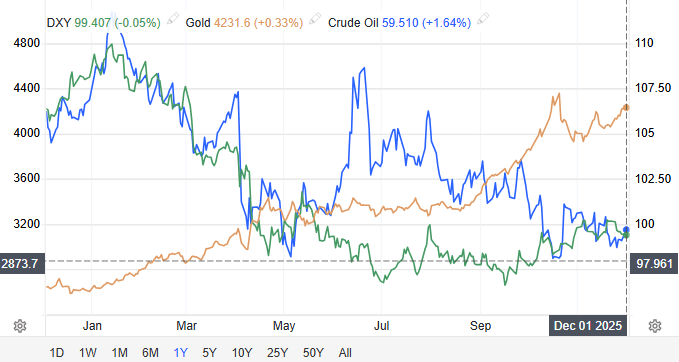
Market Overview - Major indices ended lower, breaking a five-day upward trend, with the Dow Jones down 427.09 points (0.90%) at 47289.33 points, the Nasdaq down 89.76 points (0.38%) at 23275.92 points, and the S&P 500 down 36.46 points (0.53%) at 6812.63 points [1] - Bitcoin fell over 4%, trading at 86635.71 USD, briefly dipping below the 84000 USD mark [2] - European markets also saw declines, with Germany's DAX30 down 235.66 points (0.99%) at 23592.59 points and the UK's FTSE 100 down 17.66 points (0.18%) at 9702.85 points [1] Commodities - Crude oil prices increased, with NYMEX light crude for January delivery up 0.77 USD (1.32%) at 59.32 USD per barrel, and Brent crude for February delivery up 0.79 USD (1.27%) at 63.17 USD per barrel [2] - Spot gold rose by 0.28% to 4232.12 USD, while silver prices have increased significantly, with expectations that silver's growth will surpass that of gold [3] Economic Indicators - The US ISM Manufacturing PMI for November fell to 48.2 from 48.7 in October, marking the ninth consecutive month of contraction in the manufacturing sector [3] - The manufacturing sector, which constitutes 10.1% of the US economy, is facing pressures from declining orders and rising raw material costs [3] Federal Reserve Insights - The Federal Reserve reported that the banking system maintains strong capital levels but is closely monitoring commercial real estate loans due to rising interest rates and tightening underwriting standards [4] - Bank of America adjusted its forecast, now predicting a 25 basis point rate cut in December, with further cuts expected in 2026 [5] Company News - Microsoft views Europe as a key region for its AI strategy, emphasizing the need for digital sovereignty and investment in technology [8] - Tesla's sales in Europe continue to decline, with a 58% drop in France and significant decreases in Denmark and Sweden, although Norway saw a 175% increase in registrations [8]

美国11月ISM制造业PMI萎缩幅度创四个月最大,就业进一步收缩,价格涨
Sou Hu Cai Jing· 2025-12-01 21:17
12月1日周一,美国供应管理协会(ISM)公布的数据显示,美国11月工厂活动萎缩幅度创四个月最大,新订单走弱,显示制造商仍难摆脱长期 低迷。 ISM数据公布后,美国10年期国债收益率回落至4.08%下方,日内涨幅收窄至不足7个基点,美国ISM制造业指数发布前还曾达到4.0923%。 11月新订单指数47.4,前值为49.4。客户需求整体依然乏力。11月订单以自7月以来最快的速度收缩,未完成订单积压量也创七个月以来最 大降幅。 就业指数44,前值为46。疲软的需求状况也解释了11月工厂就业的更大幅度收缩。 物价支付指数58.5,预期57.5,前值58。原材料支付价格指数在经历五个月下滑后首次回升,比一年前高出约8点。 生产指数在11月回升,以四个月来最快的速度扩张。尽管如此,今年以来的产出表现仍不稳定。 制造商原材料的供应商交货时间在四个月来首次加快。 制造商和客户的库存继续减少,但降幅较此前一个月有所放缓。 11个制造业行业在11月出现萎缩,其中服装、木材和纸制品以及纺织业跌幅居前。包括计算机和电子产品在内的仅四个行业报告增长,为一年 以来最少。 分析指出,ISM调查显示,美国制造业的困境仍受贸易政策不确定性 ...