
困境反转

Search documents
量化择时周报:突破震荡上轨后如何应对?-20250629
Tianfeng Securities· 2025-06-29 12:49
- The report defines a timing system signal based on the distance between the long-term moving average (120 days) and the short-term moving average (20 days) of the Wind All A Index, which is currently at 1.76%, indicating the market is still in a consolidation pattern[1][3][9] - The industry allocation model recommends mid-term allocation to sectors experiencing a turnaround, such as Hong Kong innovative drugs, new consumption, and Hong Kong finance, with the trend still intact[2][3][10] - The TWO BETA model continues to recommend the technology sector, with a focus on military and communication sectors[2][3][10] - The Wind All A Index's PE ratio is at the 65th percentile, indicating a medium level, while the PB ratio is at the 20th percentile, indicating a relatively low level[2][10] - The position management model suggests a 50% allocation to absolute return products based on the Wind All A Index[2][10] Model Backtest Results - Timing system signal: Moving average distance 1.76%[1][3][9] - Industry allocation model: Mid-term recommendation for turnaround sectors, Hong Kong innovative drugs, new consumption, and Hong Kong finance[2][3][10] - TWO BETA model: Recommendation for technology sector, focus on military and communication[2][3][10] - Wind All A Index PE ratio: 65th percentile[2][10] - Wind All A Index PB ratio: 20th percentile[2][10] - Position management model: 50% allocation to absolute return products[2][10]
房地产行业周报:5月房价环比走弱-20250622
Guotou Securities· 2025-06-22 14:10
重点监测 18 城合计成交二手房总套数为 2.5 万套,环比上周增长 1%; 2025 年累计成交总套数为 60.9 万套,累计同比增长 14.6%。 土地供应(6.9-6.15) 2025 年 06 月 22 日 房地产 5 月房价环比走弱 周观点:5 月统计局全国地产数据环比走弱 2025 年 5 月,全国房地产市场底部。单月开发投资同比降幅扩大至- 12.0%(前值-11.3%),1-5 月累计投资 3.62 万亿元,同比下降 10.7%。 新房销售端动能减弱,单月商品房销售面积同比下降 3.3%,降幅较 4 月扩大 1.2 个百分点;单月销售额同比下降 6.0%。价格方面,70 城 新房价格环比下跌 0.2%,跌幅扩大 0.1 个百分点;二手房环比下跌 0.5%,跌幅扩大 0.1 个百分点,仅三城二手房环比上涨(无锡、洛阳、 南充),一线城市全面转跌。 我们认为,5 月房地产数据呈现出销售面积降幅收窄,但房价下行压 力加大的市场特征,在房价,建议关注困境反转类房企:金地集团、 新城控股等;保持拿地强度的龙头招商蛇口、绿城中国、保利发展、 滨江集团等;多元经营稳健发展的地方国企浦东金桥、外高桥等。 销售 ...
量化择时周报:仍处震荡上沿,维持中性仓位-20250615
Tianfeng Securities· 2025-06-15 09:43
金融工程 | 金工定期报告 金融工程 证券研究报告 2025 年 06 月 15 日 量化择时周报:仍处震荡上沿,维持中性仓位 仍处震荡上沿,维持中性仓位 上周周报(20250608)认为:短期市场宏观不确定性增加和指数在震荡格局 上沿位置的压制下,风险偏好较难快速提升,继续维持中性仓位。最终 wind 全 A 全周表现先扬后抑,微跌 0.27%。市值维度上,上周代表小市值股票 的中证 2000 下跌 0.75%,中盘股中证 500 下跌 0.38%,沪深 300 下跌 0.25%, 上证 50 下跌 0.46%;上周中信一级行业中,表现较强行业包括有色金属、石 油石化,有色金属上涨 3.95%,食品饮料、计算机表现较弱,食品饮料下跌 4.42%。上周成交活跃度上,石油石化和非银金融资金流入明显。 市场处于震荡格局,核心观测是市场风险偏好的变化。宏观方面,中东战 争对全球的资本市场的风险偏好带来压力;同时本周即将迎来美联储议息 的关键窗口期,市场的风险偏好也会承压;之前预告的陆家嘴论坛的利好 也在本周迎来明牌,或将利好兑现;技术指标上,wind 全 A 指数虽然上周 小幅回落,但仍位于震荡格局的上沿,如果没有 ...
安奈儿能否借控制权变更东风完成蜕变
2 1 Shi Ji Jing Ji Bao Dao· 2025-06-11 19:59
Core Viewpoint - Anniel is actively planning a change in control, which may be a strategic decision by the founder after a four-year performance decline due to a sluggish market environment [1] Group 1: Company Situation - Anniel, known as the "first stock of children's clothing" in A-shares, has experienced a significant downturn since 2020, marking a turning point in its trajectory [1] - The company is seen as a "temporary dilemma" type according to Peter Lynch, where the market tends to assume that short-term issues will persist long-term [2] - Despite challenges, Anniel maintains its core brand value and market foundation, showcasing resilience in the face of industry reshuffling and changing consumer habits [3] Group 2: Strategic Initiatives - Anniel has introduced innovative products like the anti-virus and anti-bacterial "Anxin Yi" and the comfort-focused "Chao Shu Yi," aligning with market demands post-pandemic [2] - The launch of these products represents a strategic shift from traditional children's clothing to a more functional and technology-driven approach [2] - The upcoming change in control may present new opportunities for the company, potentially leading to a significant transformation under new leadership [3]

大摩闭门会-中国消费动态:“新旧、快慢” 有轮转吗?
2025-06-09 01:42
Summary of Conference Call Records Industry Overview - The overall consumer market in China is weak, with significant deflationary pressures. The 618 promotional event highlighted insufficient demand, and the growth rate for the Dragon Boat Festival did not show significant improvement, with per capita consumption down approximately 12% compared to pre-pandemic levels [1][4]. Key Insights and Arguments - **Stock Selection Strategy**: The strategy focuses on companies in distress reversal, emerging high-growth sectors, and those with reasonable valuations and excellent operations. Recommended stocks include dairy companies (Mengniu, Yili), jewelry (Chow Tai Fook), emerging consumption (Pop Mart, Giant Bio), sports brands (Yum China, Anta), and Bosideng [1][6]. - **Food Sector Performance**: The snack food category has seen significant revenue growth, benefiting from new channels and health awareness. For instance, Wei Long's konjac products have exceeded expectations [1][7]. - **Sports Sector Sales**: Sales in the sports sector were affected in April but improved in May due to promotional activities, although discounts deepened. Brands like Li Ning and Anta increased discounts, leading to higher inventory levels and decreased sales [1][11]. - **Lululemon's Growth**: Lululemon's China operations maintained over 30% growth, while high-end niche brands are growing rapidly, reflecting changes in consumer lifestyles [1][12]. - **Airline Industry Outlook**: The airline industry is expected to be one of the first to emerge from the deflation trap due to supply-side constraints and improved pricing power. The industry has seen a 5% year-on-year increase in ticket prices, indicating effective price control [1][20]. Additional Important Content - **Consumer Behavior**: The disparity between new and traditional consumption sectors is evident, with new consumption stocks in Hong Kong rising nearly 150% year-to-date, while traditional consumer stocks have only increased about 9% [2]. - **Market Dynamics**: The overall consumer market remains relatively weak, with no significant improvement observed. The increase in discount rates across various sectors indicates a need for price incentives to stimulate demand [3]. - **Future Expectations**: The next few months may see continued imbalance in the consumer market, with traditional sectors like liquor and beer remaining weak, while beverages and home appliances may perform better due to seasonal effects and government subsidies [5]. - **Jewelry Sector Trends**: The jewelry sector, particularly brands like Chow Tai Fook, is focusing on traditional gold craftsmanship, which has led to improved profit margins and sales performance [17]. - **Export Challenges**: Export companies, especially in textiles and footwear, face high uncertainty and volatility due to tariff fluctuations and low order visibility, which may impact overall economic conditions [24][25]. This summary encapsulates the key points from the conference call records, highlighting the current state of various sectors within the consumer market and the strategic recommendations for investment.
量化择时周报:步入震荡上沿,维持中性仓位-20250608
Tianfeng Securities· 2025-06-08 12:14
Quantitative Models and Construction Methods - **Model Name**: Timing System Model **Model Construction Idea**: This model uses the distance between the short-term moving average (20-day) and the long-term moving average (120-day) of the Wind All A Index to determine the overall market environment and identify market trends [1][9][12] **Model Construction Process**: 1. Calculate the 20-day moving average (short-term) and the 120-day moving average (long-term) of the Wind All A Index 2. Compute the difference between the two moving averages: $ \text{Difference} = \text{20-day MA} - \text{120-day MA} $ 3. Evaluate the absolute value of the difference. If the absolute value is less than 3%, the market is considered to be in a consolidation phase [1][9][12] **Model Evaluation**: The model effectively captures the market's consolidation phase and provides a clear signal for timing decisions [1][9][12] - **Model Name**: Industry Allocation Model **Model Construction Idea**: This model identifies industries with medium-term growth potential and recommends allocation based on sectoral trends and macroeconomic factors [2][3][10] **Model Construction Process**: 1. Analyze macroeconomic factors and market sentiment 2. Identify sectors with potential for recovery or growth, such as "distressed reversal" sectors 3. Recommend specific industries, such as innovative pharmaceuticals, automobiles, and new consumption in the Hong Kong market, as well as technology sectors like consumer electronics [2][3][10] **Model Evaluation**: The model provides actionable insights for medium-term industry allocation, focusing on sectors with growth potential [2][3][10] - **Model Name**: TWO BETA Model **Model Construction Idea**: This model focuses on identifying high-growth sectors, particularly in technology, and recommends allocation based on their performance trends [2][3][10] **Model Construction Process**: 1. Analyze the performance of high-beta sectors, such as technology and consumer electronics 2. Monitor the upward trend of specific industries, such as banking and gold stocks, to identify allocation opportunities [2][3][10] **Model Evaluation**: The model is effective in identifying high-growth sectors and provides a focused approach to sectoral allocation [2][3][10] - **Model Name**: Position Management Model **Model Construction Idea**: This model determines the recommended equity allocation based on valuation indicators and short-term market trends [2][10][12] **Model Construction Process**: 1. Evaluate the PE and PB valuation levels of the Wind All A Index 2. Assess the relative position of these indicators within their historical ranges 3. Combine valuation analysis with short-term market trend signals to recommend an equity allocation level (e.g., 50% for absolute return products) [2][10][12] **Model Evaluation**: The model provides a balanced approach to equity allocation, considering both valuation and market trends [2][10][12] Model Backtesting Results - **Timing System Model**: The moving average difference is 0.68%, with the absolute value remaining below 3%, indicating a consolidation phase [1][9][12] - **Position Management Model**: - PE valuation level: 60th percentile, indicating a medium level - PB valuation level: 20th percentile, indicating a relatively low level - Recommended equity allocation: 50% [2][10][12]
电力设备:首批建筑机器人固态电池成功交付 两部门发文推动绿电直连
Xin Lang Cai Jing· 2025-06-02 02:32
Lithium Battery Industry - BYD Energy signed the largest energy storage supply agreement in Latin America with Grenergy, totaling 6.5 GWh of cooperation [1] - The first batch of solid-state batteries for construction robots has been successfully mass-produced and delivered [1] - Zhuhai Guanyu has been designated by SAIC Volkswagen to develop and supply low-voltage lithium batteries for vehicles [1] - In Q1 2025, unit profitability of some companies in the lithium battery supply chain is expected to increase, with a potential supply-demand turning point in 2025, leading to a 2-3 year upward cycle in the industry [1] - The industry is viewed as a good medium-term investment opportunity, with potential improvements in performance and valuation [1] - Recommended companies include CATL and EVE Energy, with material companies such as Hunan Youneng, Wanrun New Energy, Shangtai Technology, and Zhongke Electric also suggested for attention [1] - Solid-state battery technology is highlighted as a promising theme, with companies like Yuyuan New Materials and Ruijitai New Materials recommended for focus [1] Energy Storage - The Yangtze River Delta has introduced paid auxiliary services for new energy storage, with deep peak shaving compensation at 0.16 yuan/kWh and automatic generation control (AGC) compensation at 3 yuan/MW [2] - A 300MW/600MWh energy storage project in Ningxia has opened bidding, with EPC pricing ranging from 0.549 to 0.633 yuan/Wh [2] - The large-scale storage sector is accelerating with increased shipments of solar storage and a rising overseas proportion, leading to accelerated performance releases for leading companies such as Sungrow Power Supply, Canadian Solar, and Kehua Data [2] - The household storage sector is seeing demand recovery in mature European markets and growth in Northeast Europe, enhancing market confidence for 2025 [2] Power Equipment - The National Energy Administration issued 216 million green certificates in April, a month-on-month increase of 23.94% [3] - The National Development and Reform Commission and the National Energy Administration are promoting the development of direct green electricity connections, benefiting the power grid sector amid rising domestic stimulus expectations [2][3] Wind Power - The Estonian government issued its first offshore wind farm construction permit to Saare Wind Energy, with a maximum installed capacity of 1.4 GW [4] - South Korea announced the launch of a 1.25 GW fixed-bottom offshore wind project tender in the first half of 2025 [4] - Key domestic projects in Q1 2025 have commenced, with several more set to start construction in Q2, indicating a well-paced domestic offshore wind construction rhythm and a significant increase in delivery volume expected in 2025 [4] - Recommended companies benefiting from domestic and international offshore wind demand include cable leaders like Zhongtian Technology and Dongfang Cable, as well as tower and single pile leaders like Dajin Heavy Industry and Tianjun Wind Power [4]

量化择时周报:继续等待缩量-20250525
Tianfeng Securities· 2025-05-25 10:44
Quantitative Models and Construction Methods 1. Model Name: Industry Allocation Model - **Model Construction Idea**: This model aims to identify and recommend industries with potential for medium-term outperformance based on specific market conditions and sectoral dynamics [2][3][9] - **Model Construction Process**: The model evaluates industries based on their recovery potential ("distressed reversal sectors") and ongoing trends. It recommends sectors such as Hong Kong-listed innovative pharmaceuticals, automobiles, and new consumption industries. Additionally, it highlights sectors like technology (e.g., consumer electronics) and those with upward momentum, such as banking and gold stocks [2][3][9] - **Model Evaluation**: The model is effective in identifying sectors with medium-term growth potential and aligns with current market trends [2][3][9] 2. Model Name: TWO BETA Model - **Model Construction Idea**: This model focuses on identifying sectors with high beta characteristics, particularly in the technology domain, to capture growth opportunities [2][3][9] - **Model Construction Process**: The TWO BETA model emphasizes technology-related sectors, such as consumer electronics, as key areas of focus. It also considers sectors with strong upward momentum, like banking and gold stocks [2][3][9] - **Model Evaluation**: The model is suitable for identifying high-growth sectors in a market environment characterized by volatility and selective sectoral strength [2][3][9] 3. Model Name: Timing System Signal - **Model Construction Idea**: This model uses moving average distances to assess market conditions and provide timing signals for market entry or exit [2][3][8] - **Model Construction Process**: - The model calculates the distance between the short-term moving average (20-day) and the long-term moving average (120-day) of the Wind All A Index - Current data: - 20-day moving average: 5063 - 120-day moving average: 5079 - Distance: -0.32% (short-term moving average below long-term moving average) - The absolute value of the distance is less than 3%, indicating a market in a consolidation phase [2][3][8] - **Model Evaluation**: The model provides a clear and quantitative framework for assessing market trends and timing decisions [2][3][8] 4. Model Name: Position Management Model - **Model Construction Idea**: This model determines optimal portfolio allocation based on valuation metrics and market trends [3][9] - **Model Construction Process**: - The model evaluates the Wind All A Index's valuation levels: - PE ratio: 60th percentile (moderate level) - PB ratio: 10th percentile (low level) - Based on these metrics and short-term market trends, the model recommends a portfolio allocation of 50% for absolute return products [3][9] - **Model Evaluation**: The model effectively balances valuation considerations with market dynamics to guide portfolio allocation [3][9] --- Backtesting Results of Models 1. Industry Allocation Model - Recommended sectors: Hong Kong-listed innovative pharmaceuticals, automobiles, new consumption, technology (e.g., consumer electronics), banking, and gold stocks [2][3][9] 2. TWO BETA Model - Focus sectors: Technology (e.g., consumer electronics), banking, and gold stocks [2][3][9] 3. Timing System Signal - Moving average distance: -0.32% (absolute value < 3%, indicating a consolidation phase) [2][3][8] 4. Position Management Model - Recommended portfolio allocation: 50% for absolute return products [3][9]
A股,再迎重磅利好!
Sou Hu Cai Jing· 2025-05-12 15:01
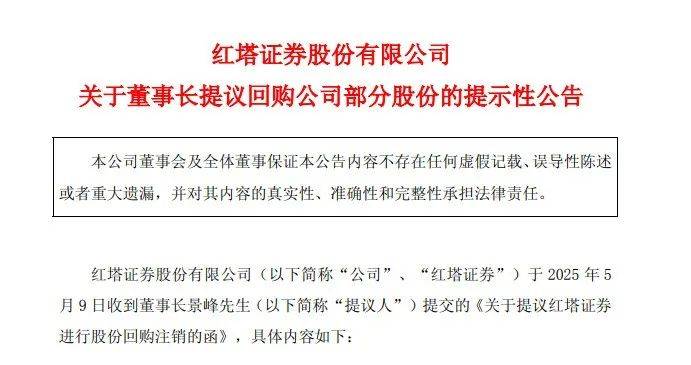
Group 1 - Hongta Securities announced a proposal for share buyback to optimize capital structure and enhance shareholder value [1] - As of May 11, 2023, 359 listed companies in A-share market have initiated buyback plans, with 265 companies specifically for stock repurchase, totaling a maximum buyback amount of 46.9 billion [1] - The State-owned Assets Supervision and Administration Commission supports central enterprises in increasing buyback efforts, leading to several securities firms, including Guotai Junan and Dongfang Securities, to propose buyback plans [4] Group 2 - The combined buyback amount from six major securities firms is estimated to reach 3.8 billion, with potential total buyback including Hongta Securities reaching up to 4 billion [4] - The People's Bank of China announced a combined usage of stock repurchase and loan increase tools with a total limit of 800 billion, enhancing the convenience and flexibility of these tools [4] - Analysts suggest that the buyback actions by securities firms signal strong confidence in their development, which can instill investor confidence in a volatile market [4] Group 3 - The current wave of buybacks is seen as a combination of policy guidance and market-driven behavior, which is expected to stabilize market confidence in the short term [5] - A series of financial policies, including interest rate cuts and increased liquidity, are contributing to the buyback trend, reinforcing the dual drive of policy and capital [5] - There are concerns regarding the sustainability of buyback funding, especially if economic pressures increase, which could lead to cash flow challenges for some firms [5] Group 4 - The A-share market is expected to experience a rotation of investment themes, with a focus on technology, consumption, and healthcare sectors in the short term [6][7] - Analysts highlight three main investment lines: TMT sector, low-cycle stocks under growth policies, and stable sectors like public utilities and transportation [6] - The overall performance of A-share companies is stabilizing, with improvements noted in both large and small-cap stocks [6]





货币与资本市场政策落地后市场或如何演绎?
ZHONGTAI SECURITIES· 2025-05-12 13:14
分析师:徐驰 执业证书编号:S0740519080003 分析师:张文宇 执业证书编号:S0740520120003 证券研究报告 信用业务周报 货币与资本市场政策落地后市场或如何演绎? 2025年5月12日 中泰证券研究所 请务必阅读正文之后的信息披露和重要声明 【市场回顾】 图表:市场表现回顾 2 数据来源:Wind,中泰证券研究所 【市场观察】一季报落地后市场或如何演绎? 3 • 一、5月货币与资本市场政策落地后市场或如何演绎? • 政策面上,上周三国新办会议延续"预期管理"思路,更加重视资本市场。在此次会议中,央行推出包 括数量型政策、价格型政策和结构型政策共三大类十项货币政策措施,三类政策呈现由大到小,从总 量到结构的特征。 • 金融监管总局提出八项举措全力巩固经济回升向好的基本面。八项政策围绕地产、二级市场和实体经 济融资各方面提出了政策支持,覆盖较为全面,或反映出监管部门工作更加重视经济发展,监管力度 或呈现阶段性宽松。 • 证监会提出三大举措持续稳定和活跃资本市场。证监会提出将全力巩固市场回稳向好势头、突出服务 新质生产力发展的重要着力点、大力推进中长期资金入市。新质生产力方面,会议提出三大方 ...