
套息交易

Search documents
余伟文再谈近期港元市场的动态:“弱方兑换保证”可能会再度被触发
news flash· 2025-07-11 06:42
Core Viewpoint - The current Hong Kong dollar (HKD) market dynamics indicate a significant interest rate spread between Hong Kong and the US, making carry trades still profitable and keeping the HKD close to the 7.85 level [1] Group 1: Market Conditions - The interest rate differential between Hong Kong and the US remains wide, which supports the profitability of carry trades [1] - The HKD is expected to remain near the 7.85 level due to supply and demand changes in HKD funds and other uncertainties, including US Federal Reserve monetary policy and global financial market conditions [1] Group 2: Potential Triggers - The "weak side convertibility guarantee" may be triggered again, with its extent and timing influenced by market conditions, particularly the supply and demand for funds [1] - As the HKD supply and demand approach balance, an upward adjustment in HKD interbank rates may become more apparent, indicating increased sensitivity of HKD interbank rates to market liquidity changes [1] Group 3: Future Expectations - Market participants should be prepared for potential upward adjustments in Hong Kong interest rates [1]
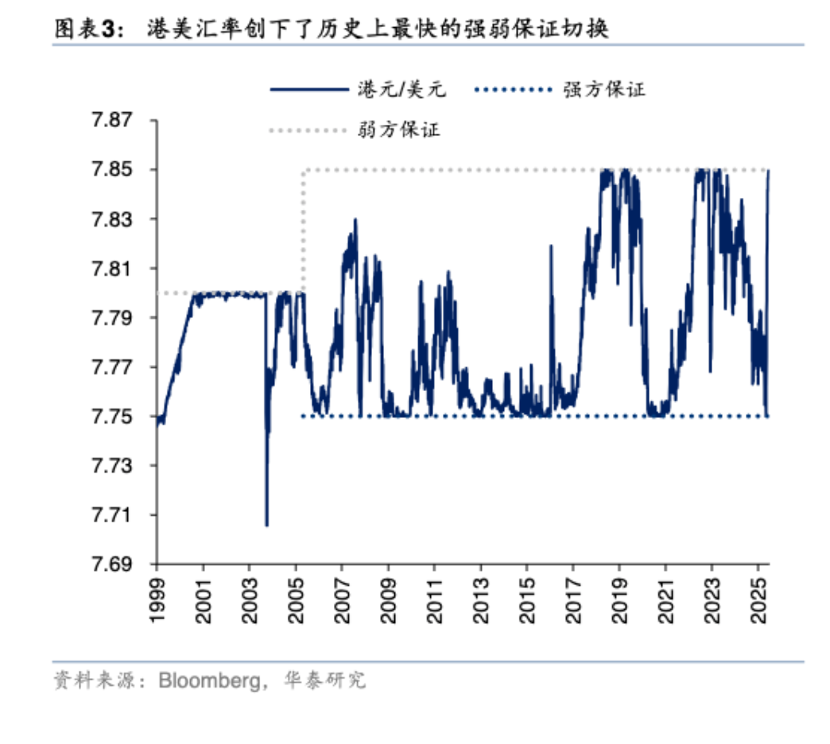
港元汇率快速转弱,香港金管局两周四度入市干预,港元创最快强弱保证切换
Di Yi Cai Jing· 2025-07-08 07:04
Core Viewpoint - The Hong Kong Monetary Authority (HKMA) has intervened in the currency market due to the Hong Kong dollar (HKD) reaching the weak end of its peg against the US dollar, leading to significant market reactions and liquidity changes [1][2][3]. Group 1: Currency Intervention - On July 4, 2025, HKMA bought HKD 29.634 billion in a single day, marking the largest intervention since 2017, as the HKD hit the weak end of the peg at 7.85 [1][2]. - Over two weeks, HKMA's total purchases reached HKD 590.72 billion, reducing the banking system's aggregate balance to HKD 1,145.41 billion [1][2]. - The rapid switch from strong to weak peg within two months is attributed to multiple factors, including widening interest rate differentials and seasonal liquidity demands [2][3]. Group 2: Market Dynamics - The interest rate differential between HKD and USD has widened significantly, with the overnight Hong Kong Interbank Offered Rate (HIBOR) at 0.02982% compared to the US Secured Overnight Financing Rate (SOFR) at 4.4%, creating a 4.37 percentage point gap [5]. - The demand for HKD has decreased due to the end of the dividend season and reduced funding needs, contributing to the currency's weakness [3][4]. Group 3: Future Outlook - Analysts suggest that the HKD may continue to face pressure towards the weak end of the peg, especially if the interest rate differential remains large and arbitrage trading persists [8][10]. - However, there are expectations that the HKD's volatility will have a diminishing impact on the Hong Kong stock market in the medium to long term, as liquidity conditions stabilize and investor sentiment improves [12].

上海证券2025年7月基金投资策略:美元走弱、市场重塑,该如何做资产配置
Shanghai Securities· 2025-07-04 11:19
Core Insights - The global economy is facing multiple challenges, revealing its vulnerabilities under the uncertainty of US policies. Issues such as regionalism, inflation, debt pressure, and structured risks in asset valuations are still unfolding. The continuous depreciation of the US dollar has made European and emerging markets more attractive to capital, while precious metals like gold have seen significant price increases, indicating a reshaping of the global market. In response to the current market environment, it is advised to focus on certainty and make asset allocations based on a high safety margin [1][16][21]. Market Overview - As of June 29, 2025, global equity assets performed well, with MSCI global returns at 4.01% and emerging markets at 6.15%, slightly outperforming developed markets. The domestic market also showed strong performance, with the CSI All Share Index yielding 3.13%, particularly driven by growth stocks which rose by 4.87% [7][13]. - The global economic pressure remains significant, with manufacturing PMI in some regions still below the expansion threshold, indicating risks of a peak in the global economic growth cycle. Concurrently, US stocks have seen valuations driven up by AI and buybacks, which has weakened corporate resilience [19][20]. Asset Allocation Strategy - **Equity Funds**: The strategy should focus on a "core + opportunities" approach, balancing safety and returns. Core allocations should prioritize high earnings certainty, high profits, and high dividends, while opportunity allocations should leverage policy implementation, confidence-driven investments, and technology empowerment [3][30]. - **Fixed Income Funds**: It is recommended to lower expectations while seeking stable returns. Mid to short-duration funds are seen as more cost-effective, as the market's excessive pursuit of long-duration bonds has diminished their risk-return profile [3][4]. - **QDII Funds**: Attention should be paid to marginal changes affecting expectations. For equity QDII, caution is advised regarding structured valuation risks, while for oil QDII, geopolitical factors are becoming increasingly significant. Gold QDII is expected to perform well in the medium to long term due to ongoing demand for safe-haven assets [4][37][40]. Domestic Economic Insights - The domestic economy has shown resilience, with a GDP growth of 5.4% in Q1 2025, driven by consumption and exports. Industrial value-added growth was steady at 5.8%, with significant contributions from sectors like new energy vehicles and robotics [21][28]. - Consumer spending has been robust, with retail sales in May growing by 6.4% year-on-year, supported by government subsidies and promotional activities. However, structural income disparities remain a challenge for sustained consumption growth [26][28]. Commodity Market Dynamics - Geopolitical issues and inflation have been influencing global commodity prices. The escalation of conflicts has pushed oil prices higher, while the depreciation of the dollar has led to fluctuations in gold prices. Future trading logic for oil and gold will likely continue to be driven by geopolitical and risk-averse sentiments [37][49]. - The long-term stability of oil prices will depend on global economic growth and demand, with current PMI data indicating potential declines in demand. The supply side, particularly OPEC+ production decisions, will also play a crucial role in short-term price movements [45][49].
港女港男,全球第三
吴晓波频道· 2025-07-01 15:34
Core Viewpoint - The article discusses the evolving landscape of Hong Kong's entertainment and financial sectors, highlighting the resilience and adaptability of its people in the face of changing economic conditions and opportunities. Group 1: Entertainment Industry - The trend of Hong Kong entertainers, including TVB stars, engaging in live streaming and promotional activities reflects a shift towards "re-employment" in the face of economic challenges [2][4][10]. - Notable figures like Wu Zhaoxu and Guo Jinan, despite their wealth, are actively participating in these new ventures, showcasing a blend of nostalgia and modernity in their approach [10][11]. - The "Lion Rock Spirit" embodies the hardworking and resilient nature of Hong Kong people, driving them to seize opportunities even in later stages of their careers [11][12]. Group 2: Financial Environment - According to the UBS Global Wealth Report, Hong Kong ranks third globally in terms of per capita wealth, with an average of 4.72 million HKD [8]. - The financial landscape in Hong Kong is characterized by high financial freedom, allowing investors to engage in various investment opportunities, including stocks and derivatives [17][18]. - The "Carry Trade" strategy, referred to as "港男港女" trading, capitalizes on the interest rate differentials between HKD and USD, providing significant profit opportunities for financial institutions [27][30]. Group 3: Digital Asset Market - Hong Kong is positioning itself as a global hub for digital assets, with government initiatives supporting the development of a compliant ecosystem for cryptocurrencies [46][50]. - The introduction of regulatory frameworks for digital currencies, including stablecoins, is set to create new investment avenues for local investors [49][50]. - The government's proactive stance in fostering a digital asset market contrasts with the restrictions in mainland China, highlighting Hong Kong's unique position in the financial landscape [45][49].

香港金管局:多重因素结合引致港汇触发弱方兑换保证
news flash· 2025-06-26 03:55
Core Viewpoint - The Hong Kong Monetary Authority (HKMA) has responded to media inquiries regarding the Hong Kong dollar triggering the "weak-side convertibility guarantee" under the linked exchange rate system, indicating that multiple factors have contributed to this situation [1] Group 1: Currency Exchange Mechanism - The Hong Kong dollar triggered the "weak-side convertibility guarantee" at a rate of 7.85 HKD to 1 USD during the New York trading session [1] - The HKMA sold a total of 9.42 billion HKD to the market in exchange for USD as a response to the triggering of the guarantee [1] - The banking system's aggregate balance is expected to decrease to 164.1 billion HKD on June 27 [1] Group 2: Market Conditions - The last occurrence of the "weak-side convertibility guarantee" was in May 2023, when the Hong Kong dollar had previously triggered the "strong-side convertibility guarantee," resulting in an inflow of 129.4 billion HKD [1] - The HKMA's Chief Executive, Eddie Yue, noted that the market had been experiencing ample liquidity, leading to a decrease in Hong Kong interest rates and an expansion of the interest rate differential between Hong Kong and the US [1] - Factors such as the nearing end of the dividend payout peak for listed companies, non-local companies converting HKD from IPOs or bond issuances back to their home currencies, and the completion of half-year funding needs have contributed to a reduced demand for the Hong Kong dollar [1]
0625:午后大金融爆发,三个大阳线意味着什么?
Sou Hu Cai Jing· 2025-06-25 15:41
Group 1 - The article discusses the recent developments in the A-share market, highlighting a significant upward trend over the past three days, suggesting that recent gains may outweigh efforts made over the previous two months [3][7] - The potential for a third wave rally in the A-share market is identified, with the current phase being a part of a larger upward trend that is expected to exceed the previous wave in both time and space [6] - The article emphasizes the importance of both internal fiscal policies and external monetary policies, with expectations for a potential interest rate cut by the Federal Reserve in September [6][7] Group 2 - Recent comments from several Federal Reserve officials indicate a consensus towards considering interest rate cuts, with some suggesting that action should be taken as early as July [8][9] - The article notes that the market's recent performance may not solely be attributed to geopolitical events but rather to underlying financial dynamics and policy expectations [7] - The Federal Reserve's current interest rate outlook suggests a gradual reduction in rates over the next year, which could diminish the dollar's interest rate advantage [11]
港元汇率“一路狂飙”直击弱方保证,港股红利还能行吗?
Sou Hu Cai Jing· 2025-06-25 11:45
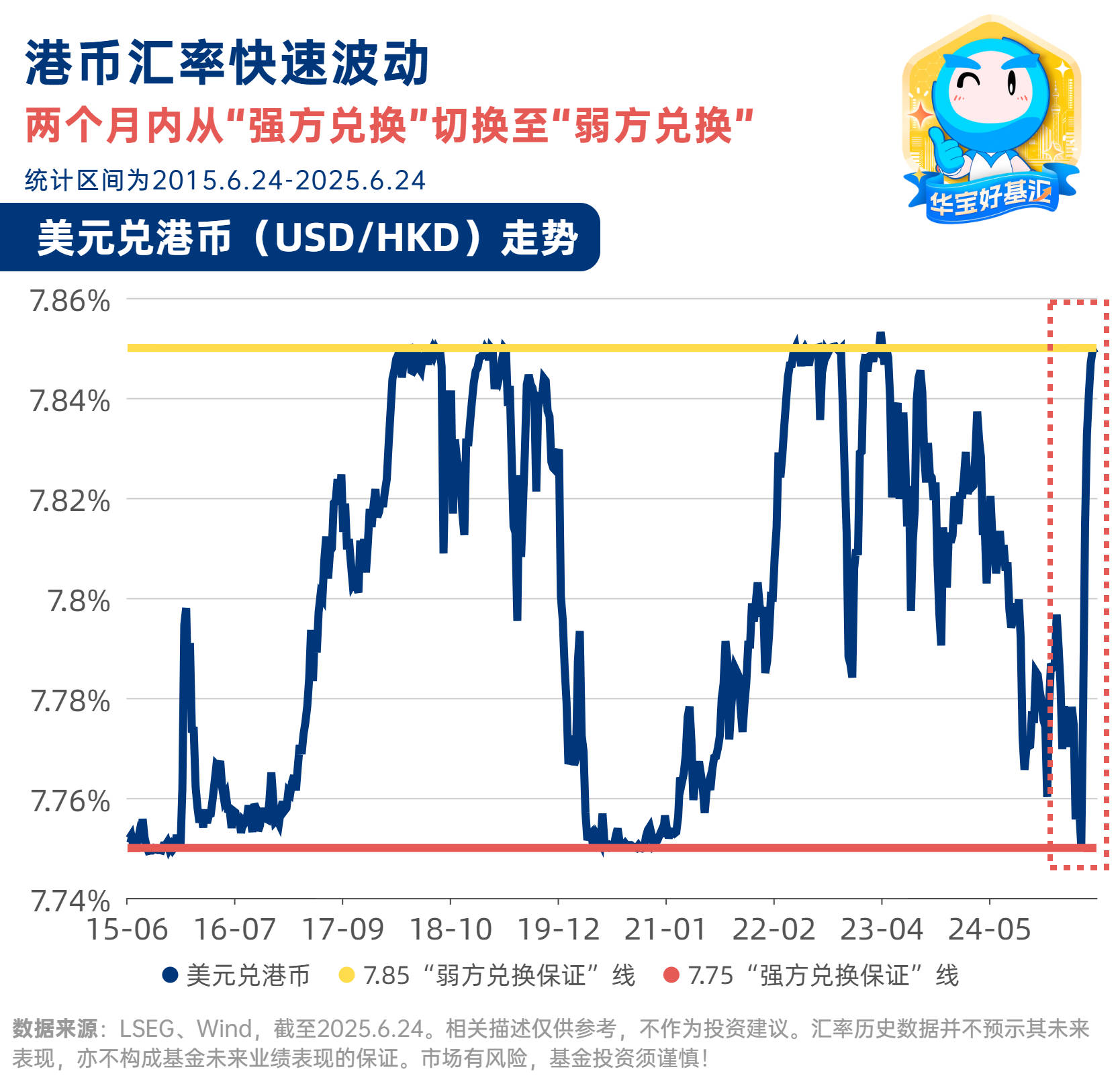
Core Viewpoint - The Hong Kong dollar (HKD) has recently experienced significant fluctuations, approaching the "weak side convertibility guarantee" of 7.85, with the Hong Kong Monetary Authority intervening to sell HKD to stabilize the currency [1][3]. Currency Fluctuation and Market Impact - The HKD's rapid movement between the strong and weak side convertibility guarantees has not been seen in the past decade, indicating heightened volatility in the currency market [1]. - The intervention by the Hong Kong Monetary Authority has led to an increase in HKD liquidity, resulting in a significant decline in HKD interest rates, which has widened the interest rate differential between HKD and USD, creating opportunities for carry trades [3][4]. Stock Market Performance - Despite concerns over liquidity in the Hong Kong stock market, the market has shown resilience, particularly in the dividend sector. The Hang Seng Index rose by 8.8% from May to June 24, while the S&P Hong Kong Low Volatility Dividend Index increased by 10% during the same period [3][4]. - Historical analysis shows that during previous periods of HKD weakness (2018-2019 and 2022-2023), the dividend sector outperformed the overall Hang Seng Index, highlighting its defensive characteristics [4][10]. Long-term Investment Value - The S&P Hong Kong Low Volatility Dividend Index has demonstrated strong performance during periods of market volatility, with a 17.2% increase over the past 12 months compared to a mere 2.1% rise in the Hang Seng Index [10]. - The current low interest rate environment, with the 10-year government bond yield dropping from over 2.5% to 1.7%, enhances the long-term investment appeal of Hong Kong dividend stocks, particularly for investors not subject to dividend tax [10][19]. Inflow of Capital - The influx of mainland capital has significantly supported the liquidity of the Hong Kong stock market, with net purchases from southbound funds reaching 676.08 billion HKD this year, nearing the total for the previous year [17][19]. - The financial sector has seen the largest increase in market value from southbound funds, with a rise of 370.1 billion HKD, indicating strong interest in dividend-paying stocks [19]. Future Outlook - The recent HKD fluctuations are viewed as a conflict between global monetary policy divergence and excess liquidity in Hong Kong. Analysts expect that the negative impact on the market from potential HKD tightening will be manageable [23]. - The overall market sentiment is improving due to strong economic fundamentals in China and ongoing inflows of southbound capital, suggesting a favorable environment for the Hong Kong stock market moving forward [23].
国际金融市场早知道:6月24日
Xin Hua Cai Jing· 2025-06-24 00:00
Market Insights - The Hong Kong Monetary Authority (HKMA) has noted the emergence of carry trade in the market, with the Hong Kong-US interest rate spread widening to 3% to 4%, pushing the Hong Kong dollar close to the weak end of its peg at 7.85 [1] - HKMA's Chief Executive emphasized the importance of stablecoins in payment applications over asset appreciation, indicating that expectations for high investment returns from stablecoins are unrealistic [1] - The Federal Reserve's Vice Chair Bowman suggested support for a potential interest rate cut as early as July if inflation continues to decline or if the labor market weakens [1] Economic Indicators - The U.S. June S&P Global Manufacturing PMI preliminary reading held steady at 52, the highest since February, exceeding market expectations [2] - The Eurozone's June composite PMI preliminary reading remained at 50.2, slightly below the expected 50.5, with the services PMI returning to the 50 mark while manufacturing PMI stayed at 49.4, marking 36 months without growth [2] - Germany's June composite PMI preliminary reading increased from 48.5 to 50.4, while France's composite PMI decreased from 49.3 to 48.5 [3] Global Market Dynamics - The Dow Jones Industrial Average rose by 0.89% to 42,581.78 points, the S&P 500 increased by 0.96% to 6,025.17 points, and the Nasdaq Composite climbed by 0.94% to 19,630.97 points [4] - U.S. crude oil futures fell by 8.95% to $67.23 per barrel, while Brent crude oil futures dropped by 8.37% to $69.16 per barrel [5] - The COMEX gold futures decreased by 0.04% to $3,384.40 per ounce, while silver futures rose by 0.09% to $36.05 per ounce [6] Regulatory Developments - The Thai Stock Exchange temporarily halved the daily price fluctuation limit for listed companies, effective until June 27 [7] - Central banks in India and Malaysia have reduced their derivative positions aimed at weakening their currencies, while South Korea's National Pension Fund has ended its five-month support for the Korean won [7]
余伟文:稳定币发行人牌照门槛较高 料初期仅批出少量牌照
智通财经网· 2025-06-23 06:10
Group 1: Stablecoin Regulation in Hong Kong - The "Stablecoin Regulation" in Hong Kong will take effect on August 1, with strict standards for issuers and high entry barriers, resulting in only a few institutions likely to receive licenses initially [1] - Licensed stablecoins must correspond to specific uses, particularly related to trade, especially cross-border trade, and Web 3.0 applications [1] - The Hong Kong Monetary Authority's (HKMA) stablecoin sandbox program is experimental, allowing industry participants to test application scenarios and share experiences, but does not guarantee licensing [1] - The regulation provides a comprehensive framework for issuers, ensuring that similar risks receive the same regulatory treatment, promoting healthy and sustainable industry development [1] Group 2: Cross-Border Wealth Management - Initially, only about 1.5% of southbound funds were directed towards fund products under the cross-border wealth management scheme, but this has increased to 40% as mechanisms improve and investor understanding grows [1] - The HKMA is actively promoting the cross-border wealth management 3.0 initiative to further enhance the sales process, with the current scheme being experimental within the Greater Bay Area [1] Group 3: Hong Kong Monetary Policy and Market Conditions - Low Hong Kong dollar interest rates are seen as beneficial, with continuous capital inflow since May, supported by a strong stock market and a vibrant new stock market [2] - The interest rate spread between the Hong Kong dollar and the US dollar has widened to 3-4%, potentially leading the HKMA to intervene if the situation persists post half-year settlement [2] - Hong Kong's strong foreign exchange reserves and high liquidity are viewed as buffers against current market conditions, with opportunities arising from international investors seeking diversified asset allocation [2]
东方财富策略陈果团队港股回调点评:港汇触及弱方保证,短期香港流动性边际收紧预期升温
Xin Lang Zheng Quan· 2025-06-19 12:07
Core Viewpoint - The Hong Kong dollar (HKD) has recently experienced significant fluctuations against the US dollar, triggering both the "strong-side convertibility guarantee" and the "weak-side convertibility guarantee" due to changes in liquidity and interest rates [1][2]. Group 1: Currency Exchange and Monetary Policy - On April 30, the HKD/USD exchange rate hit 7.75, activating the "strong-side convertibility guarantee" [2]. - From May 3 to 6, the Hong Kong Monetary Authority (HKMA) injected a total of 129.4 billion HKD into the market, leading to an expansion of HKD liquidity [2]. - The injection of HKD significantly lowered the HIBOR rates, with the 1-month HIBOR dropping from 3.65% in April to 0.67%, and overnight rates approaching 0% [2]. Group 2: Market Reactions and Expectations - The widening of the HKD-USD interest rate differential (HIBOR-SOFR) has prompted carry trades, resulting in a depreciation of the HKD, which is now approaching the "weak-side convertibility guarantee" at 7.85 [2]. - The HKMA is expected to tighten liquidity in the short term, which may alleviate the depreciation pressure on the HKD as HIBOR rates rise again [2]. - Historically, the HKD has touched the "weak-side convertibility guarantee" four times since 2017, leading to pressure on the Hang Seng Index and Hang Seng Tech Index during those periods [2].
