
红利资产

Search documents
越跌越买!加仓!12月2日红利ETF净流入超20亿元
Zhong Guo Ji Jin Bao· 2025-12-03 06:13
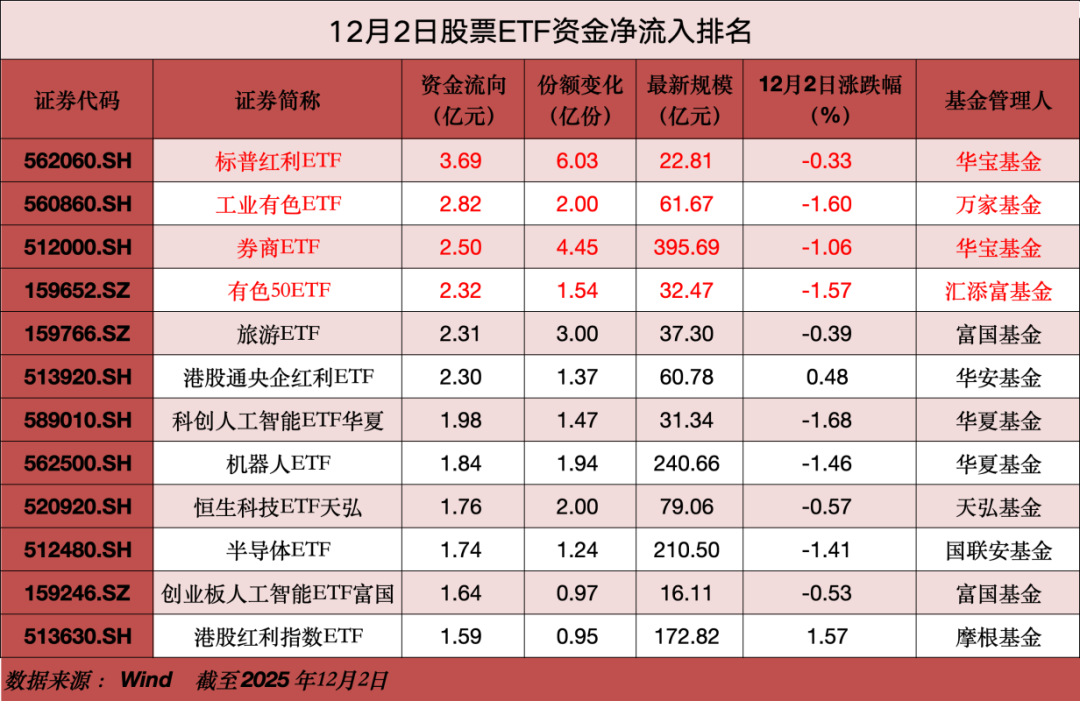
Market Overview - On December 2, A-shares experienced a collective decline, with the ChiNext Index down 0.69%, the Shenzhen Component Index down 0.68%, and the Shanghai Composite Index down 0.42% [1] - Despite market fluctuations, stock ETFs saw a relatively stable fund flow, with a net inflow of 1.619 billion yuan on the same day [1] ETF Fund Flows - Dividend ETFs, metal ETFs, and securities ETFs attracted significant inflows, while the CSI 300 ETF, defense industry ETF, and banking ETF experienced minor outflows [1] - The total scale of all stock ETFs in the market reached 4.55 trillion yuan as of December 2, with a net inflow of 1.619 billion yuan for the day [3] Dividend Sector Performance - The dividend sector showed notable inflows, totaling 2.02 billion yuan on December 2 [3] - Specific funds such as the E Fund's Hang Seng Dividend Low Volatility ETF saw a net inflow of 156 million yuan, reaching a record high of 6.406 billion yuan [3] - Other dividend ETFs, including those from Hua Bao, Hua An, and Morgan, also reported net inflows [3] Investment Insights - According to fund manager Huo Huaming from GF Fund, the increasing market volatility ahead of the Federal Reserve's December meeting and the growing number of growth-supporting policies in China are expected to support a rebound in Hong Kong stocks [3] - The Hang Seng Index is currently trading at approximately 12 times PE and 1.2 times PB, indicating relatively low valuations compared to major global markets [3] - Investors may consider shifting towards dividend stocks for defensive strategies amid uncertainties regarding the Federal Reserve's interest rate policies [3] ETF Inflows and Outflows - The top inflows on December 2 included the S&P Dividend ETF with 369 million yuan, Industrial Metal ETF with 282 million yuan, and Securities ETF with 250 million yuan [4] - Conversely, broad-based ETFs faced significant outflows, totaling 2.52 billion yuan, with the CSI 500 ETF and CSI 300 ETF leading the outflows at 570 million yuan and 342 million yuan, respectively [7][8]

越跌越买!加仓
Zhong Guo Ji Jin Bao· 2025-12-03 06:07
Group 1 - On December 2, the A-share market experienced a collective decline, with the ChiNext Index down 0.69%, the Shenzhen Component Index down 0.68%, and the Shanghai Composite Index down 0.42% [1] - Despite the market volatility, stock ETFs saw a relatively stable fund flow, with a net inflow of 16.19 billion yuan on the same day [1] - Dividend ETFs, non-ferrous metal ETFs, and securities ETFs attracted significant capital, while the CSI 300 ETF, defense industry ETF, and banking ETF experienced minor outflows [1] Group 2 - As of December 2, the total scale of 1,267 stock ETFs in the market reached 4.55 trillion yuan, with a net inflow of 16.19 billion yuan for the day [2] - The dividend sector saw a notable net inflow of 20.2 billion yuan, with the E Fund's Hang Seng Dividend Low Volatility ETF alone attracting 1.56 billion yuan, reaching a record high of 64.06 billion yuan [2] - Other dividend ETFs, including those from Hua Bao, Hua An, and Morgan, also reported net inflows [2] Group 3 - The non-ferrous metals, securities, pharmaceuticals, and Hang Seng Technology sectors also saw significant net inflows, amounting to 6.4 billion yuan, 5.7 billion yuan, 4 billion yuan, and 3.8 billion yuan respectively [3] - E Fund's ETFs reported a total scale of 807.68 billion yuan, with a net inflow of 5.1 billion yuan on the previous trading day, and a total increase of 207.03 billion yuan since 2025 [3] - Other notable inflows included the Hang Seng Technology ETF with 1.22 billion yuan, and various ETFs from Hua Xia, including the benchmark government bond ETF and the AI ETF, which saw inflows of 3.44 billion yuan and 1.98 billion yuan respectively [3] Group 4 - The broad-based ETFs experienced significant outflows, with a total net outflow of 25.2 billion yuan, primarily from the CSI 300 and CSI 500 index ETFs, each seeing outflows of 7 billion yuan [4] - Other sectors with notable outflows included defense industry, petrochemical, and banking, each exceeding 3 billion yuan in net outflows [4]
越跌越买!加仓
中国基金报· 2025-12-03 06:03
Core Viewpoint - On December 2, the A-share market experienced a collective decline, but the stock ETF market showed relative stability with a net inflow of 16.19 billion yuan, indicating a shift towards dividend assets as attractive investment options amid market volatility [2][4]. Group 1: ETF Market Performance - The total scale of all stock ETFs in the market reached 4.55 trillion yuan as of December 2, with a net inflow of 16.19 billion yuan on that day [4]. - The dividend sector saw significant inflows, totaling 20.2 billion yuan, with notable contributions from various ETFs, including the Everbright Fund's Hang Seng Dividend Low Volatility ETF, which had a net inflow of 1.56 billion yuan, reaching a historical high of 64.06 billion yuan [4][5]. - Other sectors such as non-ferrous metals, securities, pharmaceuticals, and Hang Seng Technology also attracted substantial inflows, amounting to 6.4 billion yuan, 5.7 billion yuan, 4 billion yuan, and 3.8 billion yuan respectively [5]. Group 2: Fund Manager Insights - Fund manager Huo Huaming from GF Fund highlighted that with the upcoming Federal Reserve meeting, market volatility is expected to increase, making dividend assets more appealing due to their defensive nature [4][5]. - The Hang Seng Index is currently trading at approximately 12 times PE and 1.2 times PB, which are considered low valuations compared to major global markets, further enhancing the attractiveness of dividend stocks [4]. Group 3: ETF Inflows and Outflows - The top inflowing ETFs on December 2 included the S&P Dividend ETF with a net inflow of 3.69 billion yuan and the Industrial Non-Ferrous ETF with 2.82 billion yuan [6]. - Conversely, the broad-based ETFs experienced significant outflows, with a total of 25.2 billion yuan leaving the market, primarily from the CSI 300 Index and the CSI 500 Index ETFs, which saw outflows of 7 billion yuan each [9][10].

港股科技,怎么投?
Xin Lang Cai Jing· 2025-12-02 10:37
Core Viewpoint - The Hang Seng Technology Index has experienced a correction, dropping 19.26% since October, but has shown signs of recovery recently with a PE ratio of 23.63x as of December 1, 2025 [1][8]. Summary of Key Points Reasons for Adjustment in Hong Kong Technology Sector - The divergence in expectations regarding the Federal Reserve's interest rate cuts has led to a decline in the probability of a rate cut in December, impacting the liquidity-sensitive growth sector, particularly Hong Kong technology stocks [1][3]. - The ongoing "AI bubble" discussions have heightened concerns over industry valuations, further exacerbating the adjustment in the Hong Kong technology sector [3]. - Geopolitical tensions have increased the geopolitical risk index, coupled with a year-end style shift where more funds are focusing on dividend assets, making Hong Kong technology stocks victims of market risk aversion [3]. Long-term Outlook for Hong Kong Technology - The expectation for a renewed strength in the Federal Reserve's rate cut predictions has risen, with the probability of a December rate cut increasing to 87.4%, which is likely to benefit Hong Kong technology stocks significantly [6][7]. - There is a clear expectation of performance improvement, supported by the release of new models and the latest financial reports, with Alibaba's cloud revenue showing a strong year-on-year growth of 34% and AI-related product revenue achieving triple-digit growth for nine consecutive quarters [6][8]. - Long-term industrial upgrades are seen as irreversible, highlighting the significant long-term allocation value of Hong Kong technology stocks as they represent important new economy enterprises [6][8]. Valuation Perspective - The PE ratio of the Hang Seng Hong Kong Stock Connect Technology Index stands at 26.12x, which is lower than other major global technology indices, indicating substantial upside potential in valuations [8]. Investment Strategy for Hong Kong Technology - The two main indices for Hong Kong technology stocks are the Hang Seng Technology Index and the Hang Seng Hong Kong Stock Connect Technology Theme Index, with the latter having a higher purity in technology by excluding sectors like pharmaceuticals [10]. - The Hang Seng Technology Index is more diversified, covering internet, new energy vehicles, and semiconductors, providing a more balanced sector distribution [10]. - Investment products such as the HuaAn Hang Seng Hong Kong Stock Connect Technology ETF and its related funds are recommended for exposure to Hong Kong technology, especially during the Federal Reserve's rate cut cycle, although dollar-cost averaging may be more suitable for ordinary investors due to current volatility [11].

AI泡沫要破了?李迅雷最新研判
Shang Hai Zheng Quan Bao· 2025-12-02 09:24
Core Insights - The key focus of the article is on the investment opportunities and strategic directions outlined for the upcoming "15th Five-Year Plan" in China, emphasizing technological self-reliance and consumption stimulation as primary highlights [1][3]. Group 1: Technological Development - The first major highlight of the "15th Five-Year Plan" is accelerating high-level technological self-reliance, with future industry output projected to reach approximately 11.7 trillion yuan in 2024, 13.4 trillion yuan in 2025, and 15.5 trillion yuan in 2026, reflecting a compound annual growth rate of 15% [3]. - The integration of "Artificial Intelligence+" is expected to achieve significant breakthroughs, with a goal for AI to be deeply integrated into six key areas by 2027 [3]. Group 2: Consumption and Demographics - The second highlight is the emphasis on boosting consumption and addressing the challenges of an aging population, advocating for the establishment of a supportive policy framework for childbirth and the development of the silver economy [5]. - The article suggests that increasing residents' income levels is crucial for economic transformation, recommending adjustments in income distribution and enhancing employment opportunities [5]. Group 3: Market Dynamics and Investment Strategies - The article discusses the rising risk appetite in capital markets as a driving force behind the current market uptrend, influenced by breakthroughs in AI and technology sectors, as well as policy support for the stock market [7]. - Four main asset allocation themes are identified: low-interest-rate assets, sectors benefiting from global geopolitical tensions, AI technology revolution, and new consumption trends related to younger demographics [8]. - The importance of diversified investment strategies is highlighted, especially in the context of increasing global market volatility, underscoring the need for cross-market and diversified asset allocation [8].
资金布局跨年行情!标普红利ETF(562060)盘中成交额突破1.68亿元创历史新高,近20个交易日吸金1.6亿元
Xin Lang Ji Jin· 2025-12-02 03:34
Core Insights - The S&P Dividend ETF (562060) has seen a slight increase of 0.16%, with the latest price at 0.614 yuan and a record trading volume of 1.68 billion yuan, leading its category with a turnover rate of 8.76% [1][4] - Over the past five trading days, the ETF has experienced net inflows on four occasions, totaling 20.2 million yuan, and over the last 20 days, it has attracted more than 160 million yuan [1][4] - The recent volatility in the technology growth sector has heightened the necessity for investors to allocate funds into dividend assets as a stabilizing force in their portfolios [1][4] Fund Performance - The S&P Dividend ETF and its linked funds (Class A 501029, Class C 005125) passively track the S&P China A-Share Dividend Opportunities Index (CSPSADRP), focusing on dividend stability and sustainable earnings [1][4] - The index is optimized semi-annually and is characterized as a rare "offensive" dividend strategy with low valuations, small market capitalization, and high dividends [1][4] - From 2005 to September 2025, the cumulative return of the S&P A-Share Dividend Total Return Index reached 2469.11%, with an annualized return of 17.73% [1][4]
多因素催化银行股涨幅居前,地产风险可控:华创金融红利资产月报(2025年11月)-20251201
Huachuang Securities· 2025-12-01 09:13
Investment Rating - The report maintains a "Buy" rating for the banking sector, highlighting that multiple factors are driving the rise in bank stocks, while real estate risks are deemed manageable [2]. Core Insights - The report emphasizes that the balance between supply and demand is crucial for economic recovery, with recent policies aimed at boosting consumer demand expected to enhance this balance [2]. - The M1 growth rate peaked and has started to decline, indicating a shift in deposit flows towards non-bank deposits due to a buoyant capital market [2]. - The exposure to real estate risks is decreasing, with a notable reduction in the balance of real estate development loans, suggesting that banks are adopting a more cautious approach [2][7]. - The report notes that the non-performing loan ratio for real estate has decreased, indicating improved risk management within the banking sector [7]. Monthly Market Performance - In November 2025, the banking sector saw a cumulative increase of 2.99%, outperforming the CSI 300 index by 5.4 percentage points, ranking second among 31 sectors [11]. - The report indicates that institutional investors have increased their holdings in bank stocks, driven by a stable fundamental outlook and expectations of valuation recovery [11]. - The valuation of state-owned banks has shown significant improvement, with the price-to-book (PB) ratio rising from approximately 0.76X at the beginning of the month to 0.78X by the end [13]. Banking Sector Fundamentals - The report tracks monthly data indicating that the banking sector's core revenue-generating capacity has strengthened, with asset quality remaining stable [8]. - The report highlights that the banking sector's current valuation is at a historically low level, with a price-to-earnings (PE) ratio of 6.53 and a PB ratio of 0.56 [11]. Investment Recommendations - The report suggests a diversified investment strategy focusing on banks with high dividend yields and strong asset quality, particularly smaller banks with solid provisioning coverage [7]. - It also recommends attention to low-valuation joint-stock banks with potential for return on equity (ROE) improvement, such as CITIC Bank and Industrial Bank [7]. - The report indicates that banks with robust customer bases and excellent risk control are likely to have greater valuation elasticity in the context of economic structural transformation [7].



港股收评:恒指涨0.67%、科指涨0.82%,有色金融、航运股走高,加密货币及新消费概念股走低
Sou Hu Cai Jing· 2025-12-01 08:49
Market Overview - The Hong Kong stock market showed a slight upward trend, with the Hang Seng Index rising by 0.67% to close at 26,033.26 points, and the Hang Seng Tech Index increasing by 0.82% to 5,644.76 points [1] - Major technology stocks mostly rose, with Alibaba up 2.24%, Tencent up 1.31%, and JD Group up 0.52%. However, Xiaomi fell by 1.76% and Meituan dropped by 2.88% [1] - The metals sector saw significant gains, with China Nonferrous Mining rising over 13% [1] - Cryptocurrency-related stocks generally declined, with New Fire Technology Holdings down over 9% [1] Company News - Meituan reported Q3 revenue of 95.5 billion yuan, a year-on-year increase of 2%, but its core local business operating profit turned negative, resulting in a loss of 14.1 billion yuan [2] - China Gas reported revenue of 34.481 billion HKD and a profit of 1.334 billion HKD for the six months ending September 30, 2025 [3] - Yingtong Holdings reported a revenue of 1.028 billion RMB, a year-on-year decrease of 3.42%, but net profit increased by 15.4% to 133 million RMB [3] - Jihai Resources reported a revenue of 450 million RMB, a year-on-year increase of 23.41%, with a net profit of 88.127 million RMB, up 2.98% [3] - Yuhua Education reported annual revenue of 2.497 billion RMB, a year-on-year increase of 5.4%, and a net profit of 930 million RMB, up 133.2% [3] - Huitai Textile reported mid-term revenue of 2.524 billion HKD, a year-on-year decrease of 6.72%, and a net profit of 79.322 million HKD, down 25.77% [3] - Huaxin Handbag International reported revenue of 432 million HKD, a year-on-year increase of 22.55%, and a profit of 48.262 million HKD, up 78.88% [4] Institutional Insights - GF Securities noted that the foundation for a bull market in Hong Kong stocks remains intact, but the evolution may present a "volatile upward, gradually rising" characteristic rather than a rapid increase [12] - Dongwu Securities indicated that short-term risk factors in Hong Kong stocks are decreasing, but a catalyst is needed for confirmation of a rebound [12] - Everbright Securities suggested that compared to previous bull markets, there is still significant room for index growth, but the duration of the bull market may be more important than the magnitude of the increase [12] - CICC highlighted that dividends have become a preferred choice in the current market environment, with the banking sector rebounding nearly 10% since the end of September [13]
红利主题ETF受资金追捧,份额创上市以来新高,港股央企红利ETF(513910)成交火爆
Mei Ri Jing Ji Xin Wen· 2025-12-01 07:34
Core Viewpoint - The continuous inflow of funds has led to record high shares for several dividend-themed ETFs, including the Hong Kong Central Enterprise Dividend ETF (513910), with the total scale of dividend-themed ETFs (A-shares and Hong Kong) reaching 188 billion yuan, an increase of nearly 70 billion yuan compared to the end of last year [1] Group 1 - The low interest rate environment has made traditional deposits and bonds less attractive, prompting funds to flow into other income-generating assets [1] - In contrast, during the interest rate hike cycle, dividend assets may face challenges, as evidenced by U.S. dividend stocks underperforming the broader market from 2022 to 2024 [1] - Increased market volatility has led investors to seek "safe havens," with dividend assets showing strength while technology sectors like the Sci-Tech Innovation Index and Sci-Tech 50 have experienced declines since October [1] Group 2 - The recent shift in risk appetite among investors has highlighted new income options, contributing to the record high shares of various ETFs, including the Hong Kong Central Enterprise Dividend ETF (513910) [1] - As of December 1, the trading volume of the Hong Kong Central Enterprise Dividend ETF exceeded 400 million yuan, with a one-year dividend yield of approximately 5.7%, significantly higher than the 10-year government bond yield of around 3.8% [1]
中金:港股震荡中红利成“避风港” 聚焦红利资产及三大结构机会
智通财经网· 2025-12-01 00:20
Core Viewpoint - The Hong Kong stock market has been experiencing volatility and lacks direction over the past two months, with dividend stocks emerging as a preferred choice in this uncertain environment [2][5]. Group 1: Market Overview - The market has been characterized by fluctuations, with high expectations and positions in the technology growth sector making investors sensitive to negative news, exacerbated by concerns over AI bubbles and the Federal Reserve's interest rate outlook [2][5]. - The banking sector has rebounded nearly 10% since the end of September, indicating a preference for dividend stocks amidst the market's indecision [2][5]. - The Hang Seng Index's optimistic target of 26,000 points remains valid despite recent fluctuations [2]. Group 2: Investment Themes - Dividend assets are seen as a hedge against weak domestic demand, with the Hong Kong stock dividend yield still attractive, although the selection of such assets is narrowing [46]. - The AI industry is expected to continue benefiting from domestic policy support, but faces challenges due to high valuations and expectations, necessitating new catalysts for growth [21][32]. - External demand is anticipated to drive a cyclical recovery in global manufacturing, although sustainability over the year remains uncertain [36][38]. Group 3: Sector Analysis - Traditional domestic demand sectors are undervalued but lack profit support, presenting potential trading opportunities if policy catalysts emerge, while caution is advised regarding "static valuation traps" [45]. - The external demand chain is expected to benefit from U.S. fiscal stimulus and interest rate cuts, with key indicators such as manufacturing PMI and existing home sales serving as timing signals [36][38]. - The AI sector's short-term focus should be on hardware domestic substitution, while long-term prospects hinge on application demand and profitability realization [21][33]. Group 4: Strategic Recommendations - Investors are encouraged to maintain a "barbell" strategy, combining dividend stocks with technology and internet sectors, while dynamically adjusting weights based on market conditions [18]. - The focus should be on sectors with strong cyclical characteristics, such as copper and aluminum, particularly in the first quarter, while traditional domestic consumption may continue to be hampered by fundamental weaknesses [18][46].
