
轻资产模式

Search documents
“坐月子”的生意经:轻资产大规模扩店,上半年营收超5亿元
中国基金报· 2025-08-21 12:09
Core Viewpoint - Saint Bella achieved a total revenue of 523 million yuan in the first half of 2025, representing a year-on-year growth of 35%, driven by its "partner store plan" and an increase in managed maternity centers [2]. Group 1: Business Expansion and Revenue Growth - The maternity center business serves as the cornerstone for growth and traffic entry for Saint Bella, with the number of managed centers increasing by 34 to a total of 53 [2]. - Revenue from managed maternity centers reached 73 million yuan, a significant year-on-year increase of 159.6% [2]. - The average contract value for postpartum recovery services across Saint Bella, Ai Yu, and Xiao Bella was 46,021 yuan, 21,456 yuan, and 20,168 yuan respectively, with year-on-year growth rates of 8.1%, 36.3%, and 4.8% [4]. Group 2: Service Diversification and Market Position - Saint Bella expanded its business into the family care industry through collaborations with brands like Yu Jia and Guang He Tang, achieving revenue of over 38.6 million yuan from family care services, a year-on-year increase of 41.7% [4]. - 93.8% of clients receiving postpartum care services also purchased additional services and products, indicating strong cross-selling potential [5]. - Guang He Tang, a women's health brand under Saint Bella, has maintained a market share of over 60% in the Tmall maternity nutrition category for three consecutive years [5]. Group 3: Financial Performance and Operational Efficiency - The company adopted a "light asset" model, primarily leasing stores in high-end hotels, resulting in a net profit of 327 million yuan in the first half of 2025, marking a significant turnaround [8]. - The total number of stores reached 113 globally, with membership increasing by 16,200, a year-on-year growth of 105.8% [8]. - Marketing and management expense ratios decreased to 12% and 22.1% respectively, reflecting improved operational efficiency [8]. Group 4: Industry Outlook - The postpartum care and recovery industry is projected to grow to 79.3 billion yuan by 2025, with a compound annual growth rate of 20.4% from 2025 to 2030 [6].


华住(HTHT):运营效率显著提升,业绩符合预期
Shenwan Hongyuan Securities· 2025-08-21 11:06
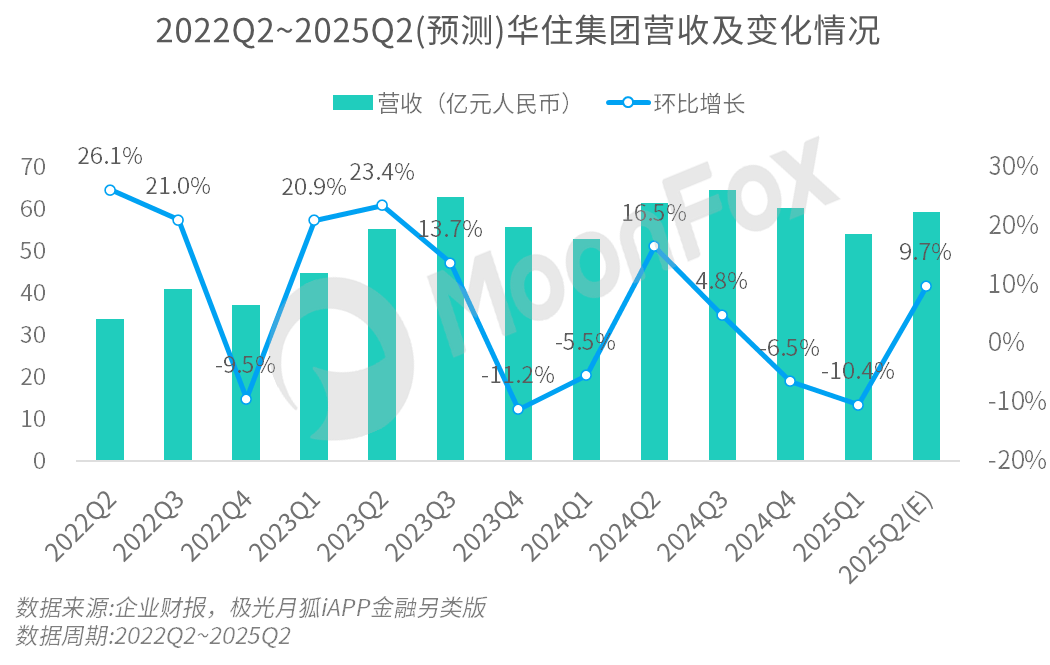
Investment Rating - The report maintains a "Buy" rating for the company [4][5]. Core Insights - The company reported its mid-year performance for 2025, which met expectations, with a revenue of RMB 6.4 billion in Q2, reflecting a year-on-year increase of 4.5% [4]. - The domestic segment generated RMB 5.1 billion in revenue, up 5.7% year-on-year, exceeding previous guidance [4]. - The company continues to benefit from its asset-light strategy, with management and franchise income growing by 22.8% to RMB 2.9 billion [4]. - The company has accelerated its asset-light transformation in overseas markets, with a significant improvement in operational data for its DH hotels [4]. Financial Data and Earnings Forecast - Revenue projections for the company are as follows: - 2023: RMB 21,882 million - 2024: RMB 23,891 million - 2025E: RMB 25,603 million - 2026E: RMB 26,794 million - 2027E: RMB 28,215 million - The expected net profit attributable to the parent company is projected to be: - 2025E: RMB 4,780 million - 2026E: RMB 5,727 million - 2027E: RMB 6,234 million - The company’s earnings per share (EPS) is forecasted to be RMB 1.54 in 2025E, RMB 1.84 in 2026E, and RMB 2.01 in 2027E [4][5]. Operational Efficiency - The company has 12,137 hotels in operation globally, with a total of 1,184,915 rooms as of Q2 2025 [4]. - The revenue from management and franchise hotels accounted for 45.4% of total revenue in H1 2025, up from 38.5% in the same period last year [4]. - The operating profit margin improved by 2.2 percentage points to 27.8% in Q2 2025, with operating profit increasing by 13.7% to RMB 1.8 billion [4]. Market Performance - The company’s domestic RevPAR (Revenue per Available Room) was RMB 235, down 3.7% year-on-year, while the overseas DH hotels saw a RevPAR of €88, up 7.3% year-on-year [4]. - The company plans to distribute a cash dividend of approximately $250 million for H1 2025, reflecting confidence in future cash flows and commitment to shareholder returns [4].

北美猪肉业务扭亏 万洲国际股价破顶
BambooWorks· 2025-08-20 08:23
Core Viewpoint - The meat market in China and the U.S. has shown divergent trends in the first half of the year, with WH Group successfully turning losses into profits through cost control in the U.S. breeding sector, leading to increased revenue and operating profit, and opening up the potential for valuation reassessment [1][3]. Financial Performance - WH Group reported a revenue increase of 8.9% year-on-year to $13.387 billion, with operating profit rising 10.4% to $1.259 billion, and a net profit attributable to shareholders of $788 million, up 0.5% year-on-year [3]. - The company proposed an interim dividend of HKD 0.20 per share, doubling from the same period last year [3]. - The biological fair value adjustment had a net impact of $62 million on profit, down from $96 million in the same period last year, indicating that the profit improvement was primarily driven by operational recovery rather than fair value changes [3]. Business Segment Analysis - The pork business was the main driver of performance growth, with revenue of $5.623 billion, up 14.1%, and operating profit of $255 million, a significant increase of 168.4% [5]. - North American pork business revenue surged 21% year-on-year to $3.279 billion, with operating profit of $163 million, recovering from a loss of $4 million in the same period last year [5]. - In China, pork business revenue increased 8.4% to $1.795 billion, with operating profit remaining flat at $28 million [5]. Market Price Trends - The average pig price in China was CNY 15.5 per kilogram, down 3.1% year-on-year, impacting companies like Decon Agriculture [6]. - In contrast, the average pig price in the U.S. was $1.5 per kilogram, up 8.7% year-on-year, with the average pork value at $2.17 per kilogram, an increase of 4.5% [6]. - The structural adjustments in North American breeding have allowed for a quicker recovery in overall pork segment profits due to declining feed costs [6]. Strategic Initiatives - WH Group has adopted a "light asset" model by partnering with Murphy Farms and VisionAg Hog Production to transfer some breeding assets, reducing capital burden and volatility sensitivity [7]. - The company has benefited from a global layout and integrated supply chain advantages, leading to improved performance in revenue, sales, and profitability [7]. Market Reaction and Valuation - Following the earnings report, WH Group's stock surged approximately 6.23%, reaching a historical high of HKD 8.36, with a year-to-date increase of 38.87% [8]. - The current market capitalization is around HKD 107.2 billion, surpassing the HKD 100 billion mark, with a price-to-earnings ratio of approximately 8.4, lower than Tyson Foods' 25.6 and Muyuan Foods' 10.42, indicating attractive valuation [8]. - Analysts have maintained "buy" ratings, with target prices adjusted upwards, reflecting confidence in the company's growth potential [8].

德康农牧(02419.HK):轻资产、低成本、高回报 实现高质量盈利
Ge Long Hui· 2025-08-19 18:38
Core Viewpoint - Dekang Agriculture and Animal Husbandry reported 1H25 results that met expectations, with significant revenue and profit growth driven by improved management efficiency and reduced pig costs [1][2]. Group 1: Financial Performance - Revenue increased by 24.3% year-on-year to 11.7 billion yuan, while net profit surged by 250.6% to 1.27 billion yuan, aligning with the company's performance forecast [1]. - The pig business showed strong growth, with revenue up 32.6% to 9.88 billion yuan and sales volume rising 27.1% to 5.1174 million heads [1]. - The average selling price of market pigs decreased by 1.3% to 15.02 yuan per kilogram [1]. Group 2: Business Segments - The poultry business experienced stable development, with revenue down 13.5% to 1.34 billion yuan, while yellow feather chicken sales increased by 7.2% to 43 million heads [1]. - The slaughtering and auxiliary products segment saw revenue growth of 16.1% to 480 million yuan, with slaughter volume increasing by 18.5% to 249,000 heads [1]. Group 3: Cost and Efficiency - The company maintained a leading cost advantage in the industry, with the complete cost of pig production estimated below 12.5 yuan per kilogram [2]. - The company achieved a PSY (pigs per sow per year) of 27, indicating industry-leading efficiency [2]. - The asset-liability ratio improved to 59.9%, down 14.3 percentage points from 1H24, reflecting effective profit release and a light asset model [2]. Group 4: Growth Strategy - The company adopted a light asset model through innovative pig breeding practices, resulting in lower capital expenditure and deeper partnerships with breeding farmers [3]. - The company is expected to continue generating excess profits due to its strong cost advantages in breeding technology and health management [3]. - Recent improvements in liquidity and growth narrative recognition have led to a potential valuation recovery, with an estimated market value of 2,623 yuan per head, indicating room for further valuation enhancement compared to industry leaders [3]. Group 5: Profit Forecast and Valuation - The company maintains profit forecasts for 2025 and 2026, with current stock prices reflecting P/E ratios of 10.9 and 6.4 times, respectively [3]. - A target price of 111 HKD is set, corresponding to P/E ratios of 14.5 and 8.5 for 2025 and 2026, suggesting a 33% upside potential from current prices [3].
华住韧性增长下核心业务承压,Q2以多元化探索寻突破
Sou Hu Cai Jing· 2025-08-18 11:34
Financial Performance Analysis - In Q1 2025, Huazhu Group's hotel revenue increased by 14.3% year-on-year to 22.5 billion yuan, while total revenue reached 5.395 billion yuan, a 2.2% increase [1] - The net profit attributable to shareholders was 894 million yuan, reflecting a year-on-year growth of 35.7%, indicating revenue and profit growth under a light asset model [1] - Revenue from leased and owned hotels was approximately 2.8 billion yuan, showing significant declines both year-on-year and quarter-on-quarter, while management and franchise income grew by 21% to 2.5 billion yuan, accounting for over 46% of total revenue [4] Business Development Insights - By the end of Q1 2025, Huazhu operated 11,685 hotels, with a net increase of 539 hotels during the quarter, emphasizing a steady expansion strategy focused on light asset operations [8] - The company is optimizing its hotel structure by increasing its presence in lower-tier cities, with 54% of upcoming hotels located in third-tier cities and below, while also expanding its mid-to-high-end market presence [8] - The membership system has grown to nearly 280 million members, contributing to a 65.1% year-on-year increase in room nights booked through the central reservation system, supporting a 76.2% occupancy rate [9] Business Trends Overview - In Q2, Huazhu launched a digital product for GOP (Gross Operating Profit) management aimed at franchisees, enhancing operational efficiency and cost reduction [10] - The company entered the new retail space by launching "Huazhu Club M3 Memory Pillow," leveraging its supply chain advantages to meet growing consumer demand in the sleep economy [11] Development Analysis and Forecast - The recovery of leisure travel in 2025 is expected to provide short-term growth momentum for Huazhu, with significant increases in guest numbers during holiday periods [12] - The hotel industry has seen rapid expansion since 2023, leading to increased competition and pricing pressures, with core performance indicators showing declines across multiple hotel groups [14] - Long-term strategies for Huazhu include enhancing competitiveness through mid-to-high-end market positioning, digital cost reduction, and deepening the membership ecosystem [14]
快手联手美团上线外卖入口,采用轻资产模式突围
Sou Hu Cai Jing· 2025-08-18 03:01
Core Viewpoint - Kuaishou is entering the food delivery market by launching an independent "takeout" section on its app, aiming to differentiate itself through a "Meituan supply chain + self-owned merchants" light asset model amid intense competition in the food delivery sector [2][3]. Company Strategy - Kuaishou's new takeout service relies on Meituan's merchant vouchers, requiring users to complete orders through Meituan's mini-program, with delivery handled by Meituan or third-party services [5][10]. - The company has previously explored local lifestyle services, partnering with various platforms and establishing a dedicated local lifestyle division in 2022 [6][8]. - Kuaishou's strategy includes a dual approach of leveraging Meituan's supply chain while also incorporating its own local merchants, with approximately 90% of products sourced from Meituan [10]. Market Context - The food delivery market is highly competitive, with major players like Meituan, Alibaba, and JD.com already established [2][9]. - Kuaishou's entry into this market comes as its core business faces growth challenges, particularly in live streaming and e-commerce, where GMV growth has significantly slowed [12][16]. Financial Performance - In 2024, Kuaishou reported revenue of 1268.98 billion yuan, an 11.83% year-on-year increase, with a net profit of 153.35 billion yuan, up 139.76% [13]. - The company's e-commerce GMV reached 1.39 trillion yuan in 2024, with growth rates dropping from 78% in 2021 to 17% in 2024, highlighting a stark contrast with Douyin's performance [16][17]. User Engagement - Kuaishou's daily active users reached 408 million by Q1 2025, with over 62% from new tier cities, providing a potential consumer base for its food delivery services [10]. - The number of users paying for local delivery services increased by over three times in Q2 2024, indicating a shift in user behavior towards food delivery [11]. Competitive Landscape - Kuaishou's cautious approach in the food delivery sector is influenced by the challenges faced by Douyin, which has struggled to establish a successful delivery model despite its initial efforts [9][20]. - The company aims to explore new growth avenues through its food delivery initiative, potentially alleviating pressures from declining growth in its core businesses [18].


德康农牧20250817
2025-08-18 01:00
Summary of Dekang Agriculture and Animal Husbandry Conference Call Company Overview - **Company**: Dekang Agriculture and Animal Husbandry - **Industry**: Agriculture and Animal Husbandry Key Financial Performance - **Revenue**: 11.695 billion CNY in H1 2025, up 24.3% YoY [2][3] - **Sales Volume**: 42.7033 million yellow feather chickens, up 7.2% YoY [2] - **Average Price**: Yellow feather chicken price down 19.1% to 30.5 CNY per chicken [2] - **Net Profit**: Adjusted net profit of 1.36 billion CNY, with net profit attributable to shareholders at 1.292 billion CNY [2][3] - **Cost Control**: Effective cost management offset the impact of falling pig prices [2] Operational Achievements - **Breeding Technology**: Significant advancements in breeding technology, precision nutrition, and disease prevention [4][5] - **Profitability from Breeding**: Self-developed breeding systems yield over 100 CNY per pig and 2,000 CNY per sow annually [2][4] - **Feed Cost Management**: Soybean meal usage reduced to below 3% [2][5] - **Production Efficiency**: Total cost decreased by 1.7 CNY/kg to 12.4 CNY/kg, with feed costs down by 0.9-1 CNY/kg [2][14] Business Segments Performance - **Household Appliances**: Revenue down 13.5% to 1.336 billion CNY due to weak dining consumption [2][7] - **Auxiliary Products**: Revenue up 16.1% to 485.1 million CNY, with slaughter volume up over 18% to 240,000 heads [2][8] Innovative Farming Model - **Family Farm Model**: Average income per household from the new family farm model reached 800,000 CNY, up 15.5% YoY [2][6] - **Training Initiatives**: Investment of 50 million CNY in a pig farming technology training center to empower farmers [2][6] Future Outlook and Challenges - **Market Uncertainty**: Acknowledgment of challenges including disease risks, price fluctuations, and policy guidance [9] - **Sustainable Development**: Commitment to rural revitalization and support for small farmers [9][10] - **Cost Reduction Potential**: Anticipation of further cost reductions in H2 2025 [2][14] Talent Development and Corporate Culture - **Employee Growth**: Addition of 500 employees focused on pig production, poultry farming, and slaughtering [35] - **Training Programs**: Extensive training initiatives for over 350,000 participants to enhance employee skills [8][35] ESG Initiatives - **Environmental Investments**: Ongoing investments in ESG initiatives, including ecological farming practices [11][12] Conclusion - **Long-term Growth Potential**: Strong confidence in Dekang's future growth driven by innovative farming models, effective cost management, and a focus on employee welfare [47]
南极电商的救赎,张玉祥要靠对标优衣库?
Guan Cha Zhe Wang· 2025-08-17 10:31
Core Insights - The article discusses the rise and fall of Nanji E-commerce, which initially thrived on a "brand authorization + platform distribution" model but has faced significant challenges as market conditions changed [1][10][12] - The company is attempting to shift its strategy towards "self-operated + light luxury" to improve brand perception and product quality, but early results indicate this transition is costly and not yet effective [1][3][10] Company Overview - Founded in 1998 by Zhang Yuxiang, Nanji E-commerce initially focused on the thermal underwear market and quickly gained market share through aggressive advertising and a dealer network [4][5] - The company transitioned to a light asset model in response to rising manufacturing costs and market pressures, focusing on brand management and authorization rather than production [5][12] Financial Performance - Nanji E-commerce experienced rapid growth from 2015 to 2020, with revenue soaring from 389 million to 4.172 billion yuan and net profit increasing from 172 million to 1.188 billion yuan [8] - However, by 2023, the company reported a net loss of 237 million yuan for 2024, with a projected profit of only 12 to 18 million yuan for the first half of the year, representing a decline of 76.89% to 84.60% year-over-year [1][10] Market Challenges - The company has faced significant quality control issues, with multiple products appearing on quality inspection blacklists since 2018, leading to a decline in brand reputation [12][13] - The shift in consumer perception towards "Nanji" as a low-quality brand has been exacerbated by the rise of new consumer brands that do not rely on traditional brand endorsements [12][13] Strategic Shift - In 2023, the company began investing heavily in self-operated product lines and launched a light luxury series, partnering with media companies to enhance brand visibility [1][3] - Industry experts suggest that a more effective strategy would involve focusing on product quality and reducing product categories to drive factory upgrades [3]


"三无公司"也敢上市?46个员工卖水,市值干到120亿,钟睒睒都服
Sou Hu Cai Jing· 2025-08-17 08:39
Core Insights - IFBH Limited, the parent company of IF coconut water, achieved a market capitalization of HKD 10 billion on its first day of trading, supported by only 46 employees [1][3] - The founder, Pongsak, transitioned from a textile heir to the beverage industry, investing heavily in technology and marketing to establish a strong brand presence [5][6][7] - The company's success is attributed to its "zero additives" marketing strategy and the growing consumer demand for natural products, particularly during the COVID-19 pandemic [9][14][16] Company Overview - IFBH Limited was founded by Pongsak, who chose to pursue the beverage sector instead of inheriting a family textile business [5][6] - The company initially struggled in the mainland market due to high pricing but later capitalized on the trend for natural products [11][12][14] - The company maintained a lean operational model with a small team, achieving high revenue per employee [3][18] Market Strategy - The company focused on a "light asset" model, relying on effective supply chain management and marketing to drive sales [18][27] - It leveraged social media and celebrity endorsements to enhance brand visibility and consumer engagement, resulting in significant sales spikes during promotional events [22][24] - The introduction of limited edition products and collaborations with popular brands helped create a social aspect around the product, appealing to younger consumers [24][26] Challenges and Risks - The company faces rising raw material costs due to climate impacts on coconut production, leading to a 70% increase in procurement prices [27] - Production capacity issues with their contract manufacturer have resulted in order fulfillment challenges, impacting customer satisfaction [29] - Increased competition from private label brands and other coconut water producers has pressured pricing and market share [31][33] - The company's heavy reliance on coconut water for revenue (95%) poses a risk, especially as new product launches have not performed well [33][35] - Recent consumer skepticism regarding imported products has affected brand trust, leading to a decline in market capitalization shortly after the IPO [35][37]

中信证券:周六福(06168)轻装快跑抢占行业发展先机 予“买入”评级 目标价44港元
智通财经网· 2025-08-14 14:51
Company Overview - Company was established in 2004 and has rapidly developed through a light-asset model and attractive franchise policies, maintaining a top 6 position in the Chinese jewelry market for seven consecutive years [2][3] - Revenue increased from 2.78 billion to 5.72 billion CNY from 2021 to 2024, with a CAGR of 27.1%, while net profit grew by 18.4% during the same period [2][3] - The average age of the management team is approximately 42 years, making it one of the youngest among national gold jewelry companies [2] Industry Analysis - The Chinese jewelry market is projected to reach 728 billion CNY in 2024, with a CAGR of 3.6% from 2019 to 2024 and an expected CAGR of 5.2% from 2024 to 2029 [3] - Consumer preferences are shifting towards lightweight and fashionable jewelry due to economic pressures, while maintaining high aesthetic standards [3] - E-commerce in the jewelry market is growing, with a market size of 42.4 billion CNY in 2024, representing a year-on-year growth of 13.7% and a CAGR of 16.9% from 2019 to 2024 [3] Competitive Advantages - The company employs a light-asset model that allows for rapid product iteration to meet the demands of a younger customer base, with 80% of online and 75% of offline customers being female aged 18-30 [3][4] - As of the end of 2024, the company operates 4,129 stores nationwide, ranking 6th among gold jewelry brands, with a strong presence in southern China [4] - Online sales accounted for 40% of total revenue in 2024, with a year-on-year growth of 31%, indicating a robust e-commerce strategy [5] Future Development - The company plans to enhance brand strength through a multi-brand matrix and aims to open up to five cultural theme stores by May 2025 [6] - The company has begun expanding into Southeast Asia, opening its first overseas store in Bangkok in September 2024, with plans for further expansion in the region [6] Investment Recommendations - The company is expected to achieve revenues of 6.48 billion, 7.32 billion, and 8.22 billion CNY for 2025-2027, with year-on-year growth rates of 13.3%, 12.9%, and 12.3% respectively [7] - Projected net profits for 2025-2027 are estimated at 800 million, 880 million, and 960 million CNY, with growth rates of 13.4%, 10.3%, and 8.8% respectively [7] - The company is assigned a target price of 44 HKD per share based on a 22x PE ratio for 2025, maintaining a "buy" rating [7]
