AI泡沫论

Search documents
半导体巨头,狂飙
Zhong Guo Ji Jin Bao· 2025-11-13 00:34
苏姿丰表示,投资算力是一场正确的"赌博",预计AMD未来3~5年公司年收入将增长35%,股价一度大涨10.94%。 美国三大股指收盘涨跌不一,道指续创收盘新高,中概股多数下跌。 国际贵金属期货普遍收涨。 道指续创收盘新高 美国三大股指收盘涨跌不一,道指涨0.68%,报48254.82点,续创收盘新高;标普500指数涨0.06%,报6850.92点;纳指跌0.26%,报23406.46点。 | 高盛集团涨3.55%,联合健康集团涨3.55%,思科涨3.14%,领涨道指成份股。 | | --- | 中概股多数下跌,纳斯达克中国金龙指数跌1.46%,万得中概科技龙头指数跌0.46%。 中概股多数下跌 | 8112.98 | | 昨收 | 8233.31 | 成交额 | 0.00 | | --- | --- | --- | --- | --- | --- | | -120.33 | -1.46% | 今开 | 8224.16 | 成交量 | 0 | | 上涨 | 0 | 곡물 | 0 | 下跌 | 0 | | 最高价 | 8227.64 | 市盈率 | 21.3 | 近20日 | -1.69% | | 最低价 | 8 ...

半导体巨头,狂飙!
Zhong Guo Ji Jin Bao· 2025-11-13 00:20
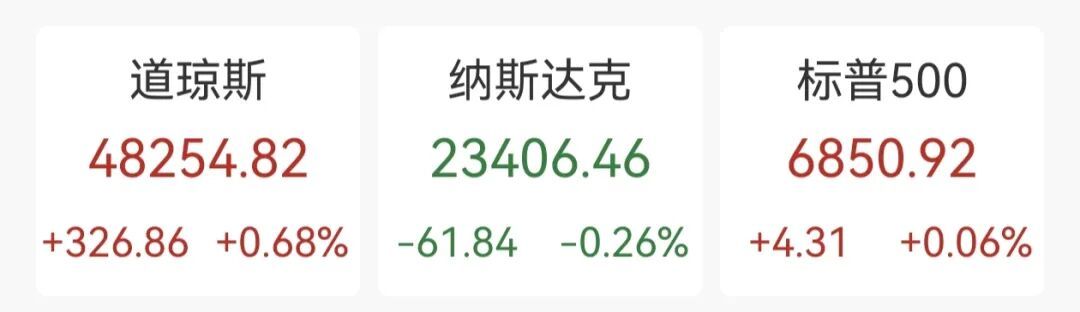
大家早上好!昨夜今晨,又有很多大事发生。 美国三大股指收盘涨跌不一,道指续创收盘新高,中概股多数下跌。 苏姿丰表示,投资算力是一场正确的"赌博",预计AMD未来3~5年公司年收入将增长35%,股价一度 大涨10.94%。 国际贵金属期货普遍收涨。 道指续创收盘新高 【导读】苏姿丰:投资算力是一场正确的"赌博",AMD一度大涨10.94% 中国基金报记者 郭玟君 美国三大股指收盘涨跌不一,道指涨0.68%,报48254.82点,续创收盘新高;标普500指数涨0.06%,报 6850.92点;纳指跌0.26%,报23406.46点。 | 道琼斯 | 纳斯达克 | 标普500 | | --- | --- | --- | | 48254.82 | 23406.46 | 6850.92 | | +326.86 +0.68% -61.84 -0.26% | | +4.31 +0.06% | 高盛集团涨3.55%,联合健康集团涨3.55%,思科涨3.14%,领涨道指成份股。 中概股多数下跌 中概股多数下跌,纳斯达克中国金龙指数跌1.46%,万得中概科技龙头指数跌0.46%。 苏姿丰预计年收入将大增35% AMD一度大涨10 ...

英伟达(NVDA.US)财报能否戳破“AI泡沫论”?花旗给予“买入”评级,直言AI需求远超供应
智通财经网· 2025-11-12 08:01
Core Viewpoint - Citigroup maintains a "Buy" rating on Nvidia (NVDA.US) and raises the target price from $210 to $220, anticipating strong performance in the upcoming earnings report on November 19, which is expected to exceed revenue expectations and provide an upward guidance [1] Group 1: Earnings Forecast - Citigroup predicts Nvidia's sales for the quarter ending in October will reach $57 billion, surpassing the market average expectation of approximately $55 billion [1] - For the January quarter, Nvidia's sales guidance is expected to be $62 billion, also above the market expectation of around $61 billion [1] Group 2: Market Dynamics - Citigroup's model assumes Nvidia's data center sales will grow by 24% and 12% in the October and January quarters, respectively, compared to market expectations of 19% and 15% [2] - The report argues against the prevailing "AI bubble" narrative, stating that the main issue in the AI chip market is supply constraints rather than lack of demand [2] - Due to limitations in CoWoS capacity, AI supply is expected to remain below demand until 2026, with a potential balance only occurring around 2027 [2]

【环球财经】“AI泡沫论”再起 美股多项指标亮“红灯”
Xin Hua Cai Jing· 2025-11-12 05:43
Core Viewpoint - Concerns about the overvaluation of AI concept stocks are rising, with notable figures like Michael Burry shorting Nvidia and SoftBank liquidating its Nvidia holdings, leading to a decline in tech stocks and a nearly 10% drop in Nvidia's share price since November [1][2] Group 1: Market Dynamics - The total market capitalization of major US tech companies, including Nvidia, Microsoft, and Amazon, has surpassed $20 trillion, with Nvidia's market cap increasing from $4 trillion to $5 trillion in less than four months [2] - The concentration of market capitalization among the top tech companies has reached historical highs, with these firms accounting for over 30% of the S&P 500 index [2] - Since the beginning of 2023, over $500 billion has flowed into the information technology sector, representing more than 36% of the incremental capital [2] Group 2: Analyst Insights - Analysts suggest that the current AI investment frenzy may be reminiscent of the 2000 internet bubble, indicating a collective irrational enthusiasm that could lead to significant asset price deviations from intrinsic values [2][3] - Goldman Sachs CEO David Solomon predicts a potential 10% to 20% market decline within the next 12 to 24 months, while JPMorgan CEO Jamie Dimon warns that many assets appear to be entering a bubble phase [3] Group 3: Profitability Concerns - Michael Burry highlights that many tech companies are extending the useful life of their assets to understate depreciation expenses, potentially inflating profit figures by approximately $176 billion from 2026 to 2028 [3][4] - The AI hype has led to concerns about the sustainability of profits, with OpenAI signing deals worth around $1 trillion for computing power, raising fears of an "AI circular trade" [4] Group 4: Investment Sentiment - Despite concerns, investors continue to increase their bets on AI-related stocks, with Deutsche Bank reporting ongoing capital inflows into popular tech sectors [6] - The proportion of stock investments in American households has reached historical highs, indicating extreme market enthusiasm and risk appetite [6] Group 5: Valuation Metrics - The "Buffett Indicator," which measures the total market capitalization of US stocks against GDP, is at historical highs, with a ratio of 223 as of November 11, indicating potential overvaluation [7] - The shift in valuation metrics from traditional earnings-based models to sales ratios and potential market size reflects a growing reliance on future expectations rather than current performance [7]



主观超越量化!但斌的东方港湾业绩再提升!远信、复胜、望正居百亿私募前3!
私募排排网· 2025-11-12 03:33
Core Viewpoint - Subjective private equity funds rely on human judgment for investment decisions, contrasting with quantitative funds that depend on models. This approach allows for early positioning in potential growth areas and the identification of undervalued quality assets [2]. Group 1: Market Performance - The A-share market has shown strong performance, with the Shanghai Composite Index reaching a nearly 10-year high and a year-to-date increase of approximately 18%, while the ChiNext Index has risen nearly 49% [2]. - Various sectors such as AI computing, robotics, semiconductors, new energy, non-ferrous metals, and gaming have performed well in this market environment [2]. Group 2: Subjective Private Equity Overview - As of October 2025, there are 5,339 subjective private equity firms, accounting for over 70% of the securities investment category. Among these, 350 firms have at least three products displayed on the private equity performance platform [2]. - The average return for 350 subjective private equity firms from January to October this year is higher than that of quantitative funds [3]. Group 3: Top Performing Firms - The top three firms in the 100 billion yuan category are Yuanxin, Fusheng, and Wangzheng, with a notable mention of Dan Bin's commentary on the AI bubble [4]. - In the 50-100 billion yuan category, the top firms include Tongben Investment, Ruiyang Investment, and Shengqi Asset [12]. - The top firms in the 20-50 billion yuan category are Beijing Xiyue Private Equity, Qiantu Investment, and Luyuan Private Equity [17]. Group 4: Notable Strategies and Insights - Yuanxin Investment, established in September 2014, focuses on growth logic and has a management team with an average of over 20 years of experience [11]. - Dongfang Port Bay, led by Dan Bin, has 80 products displayed, with a significant increase in returns in October, emphasizing a bullish stance on AI stocks [11]. - Shengqi Asset, founded by Zeng Wenkai, emphasizes value investing and has a strong focus on gold and copper investments due to macroeconomic conditions [15][16]. Group 5: Emerging Trends - The trend of subjective private equity funds focusing on technology and innovation continues, with firms like Jingyan Private Equity maintaining a strong emphasis on this direction [24]. - The long-term bullish outlook on gold is highlighted by firms like Luyuan Private Equity, which has been actively investing in this sector [20].
“大空头”狙击AI?算力硬件回调,创业板人工智能ETF下挫2.77%跌出布局机会?高盛:AI行情仍有上涨空间
Xin Lang Ji Jin· 2025-11-11 12:54
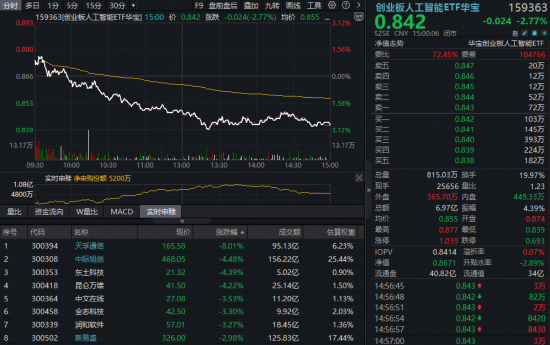
Core Viewpoint - The recent decline in computing hardware, particularly in optical modules, is attributed to concerns over an AI bubble and a temporary retreat in AI narratives overseas [3] Group 1: Market Performance - Tianfu Communication led the decline with an 8% drop, while Zhongji Xuchuang fell over 4%, and several other stocks like Xinyi Sheng and Ruijie Network dropped more than 2% [1] - The ChiNext AI ETF (159363), heavily invested in leading optical module companies, fell by 2.77% with a trading volume of 697 million yuan, losing its 20-day moving average [1] Group 2: AI Bubble Concerns - Michael Burry, a prominent short-seller, warned that large tech companies are extending the depreciation period of servers and computing devices to inflate their financial reports, a common method of profit manipulation [3] - Goldman Sachs strategists expressed concerns that the current enthusiasm for AI could mirror the internet bubble of the early 2000s, although they believe there is still room for growth in the AI market [3] Group 3: Policy and Industry Outlook - The national "14th Five-Year Plan" emphasizes accelerating breakthroughs in the new technological revolution and enhancing self-reliance in technology, with a focus on integrating AI into various sectors [3] - The AI industry is rapidly developing, driving explosive demand in the computing sector, with optimistic forecasts from companies like OpenAI in North America and Alibaba in China, which is investing 380 billion yuan in AI infrastructure [3] Group 4: Investment Recommendations - CITIC Securities believes the world is undergoing an AI industrial revolution, suggesting a long-term perspective on AI-driven computing demand and applications [4] - The demand for 800G optical modules is expected to grow rapidly, with significant increases in the shipment of 1.6T modules and the initiation of 3.2T module development [4] - Investors are advised to focus on the first ChiNext AI ETF (159363) and related funds, which have a significant allocation to leading optical module companies [4] Group 5: ETF Performance - As of October 31, the ChiNext AI ETF (159363) has a scale exceeding 3.5 billion yuan, with an average daily trading volume of over 700 million yuan, leading among seven ETFs tracking the ChiNext AI index [5]

全球股市立体投资策略周报 11 月第 1 期:港股卖空占比创4月以来新高-20251111
Haitong Securities International· 2025-11-11 08:04
Market Performance - The global market experienced a general decline, with MSCI Global down by 1.4%, MSCI Developed Markets down by 1.5%, and MSCI Emerging Markets down by 1.0%. However, the Chinese stock market rose against this trend, with the Hang Seng Index increasing by 1.3% [7][11][12]. - In the bond market, the UK 10Y government bond yield saw a significant increase of 6.6 basis points, while the US yield remained unchanged [7][12]. Trading Sentiment - The short-selling ratio in the Hong Kong stock market reached its highest level since April, at 16.9%, indicating a low investor sentiment historically [21][24]. - Trading volumes showed mixed results, with the Shanghai Composite Index's trading volume decreasing to 305.2 billion shares, while the Hang Seng Index's trading volume increased to 150 billion shares [21][35]. Earnings Expectations - Earnings expectations for the Hong Kong market were revised upward, with the Hang Seng Index's 2025 EPS forecast increased from 2065 to 2073. The financial sector saw the most significant upward revision [64][65]. - In the US, the S&P 500's 2025 EPS forecast was adjusted from 270 to 271, with the industrial sector experiencing the largest increase [64][65]. - European markets also saw upward revisions, with the Eurozone STOXX50's 2025 EPS forecast rising from 333 to 334, particularly in the energy sector [64][65]. Economic Outlook - The economic sentiment in Europe improved, with the economic surprise index showing a significant increase, supported by strong demand in the industrial sector [7][64]. - In contrast, the US economic surprise index declined due to uncertainties surrounding the Federal Reserve's interest rate decisions and the government shutdown [7][64]. Fund Flows - There was a notable inflow of funds into the Hong Kong stock market, with a total of 116 billion HKD entering the market recently, primarily through the Stock Connect program [59][63]. - The Federal Reserve's interest rate outlook for December has become more divided, with market expectations indicating a potential rate cut of 0.67 times by the end of the year [51][54].
哪来的泡沫?英伟达追加千万级晶圆订单,Meta、OpenAI 千亿投资力证
是说芯语· 2025-11-10 05:00
Core Viewpoint - The article emphasizes that the demand for AI chips, particularly GPUs, is surging, countering the prevailing "AI bubble" concerns, as evidenced by Nvidia's increased orders from TSMC to meet this demand [1][3][6]. Group 1: Nvidia's Actions - Nvidia has placed additional wafer orders with TSMC to satisfy the strong demand for its latest Blackwell GPUs, signaling a commitment to ramping up AI chip production [1][3]. - The annual GPU production for data centers by Nvidia is reported to be between 4 million to 5 million units, with the new orders expected to exceed this scale significantly [3]. - Nvidia's supply chain for AI chips is bolstered by increased HBM (High Bandwidth Memory) production from major manufacturers like SK Hynix, Samsung, and Micron, ensuring a robust supply for AI hardware [3][4]. Group 2: Broader Industry Trends - Other tech giants, such as Meta, are also heavily investing in AI, with plans to allocate $600 billion over the next three years for AI-related initiatives, including the construction of AI data centers [4]. - OpenAI is investing up to $500 billion in its Stargate project, seeking to expand tax incentives for AI infrastructure under the CHIPS Act to support its growth [5]. - The collective actions of these companies indicate that the growth in the AI sector is driven by genuine market demand and technological advancements rather than speculative bubbles [5][6].

法巴:预计12月美联储会再降息并结束缩表,恒指年内有望挑战28500点
Sou Hu Cai Jing· 2025-11-10 03:18
Core Viewpoint - The chief investment strategist of BNP Paribas Wealth Management in Hong Kong anticipates a rate cut by the Federal Reserve in December, which is expected to positively impact the AH stock market, with potential for the Hang Seng Index to challenge the 28,500 points mark by year-end [1] Market Outlook - The strategist believes that excessive market liquidity allows for further capital inflow into Hong Kong stocks, especially if technology companies report surprising earnings [1] - The anticipated demand for data centers driven by artificial intelligence development is expected to benefit companies with cloud business, making them highly explosive in growth potential [1] Sector Analysis - Chip stocks are expected to benefit from national policies, while gaming stocks are likely to continue receiving game approval licenses, making them worth noting [1] - Concerns regarding the AI bubble in the U.S. market are acknowledged, with high valuations being a point of worry; however, the valuation of the Hang Seng Tech Index components remains significantly lower compared to the NASDAQ [1] Valuation Comparison - The recent adjustments in the Hang Seng Tech Index have led to more reasonable valuations, enhancing the risk-return profile of Chinese technology stocks [1] - The expected earnings support indicates that price-to-earnings ratios are unlikely to surge suddenly, providing a more stable investment environment [1] Investor Behavior - Short-term consolidation in the U.S. market is anticipated, but there is an expectation of retail investors entering the market to buy at lower prices [1]
【笔记20251106— 特朗普完胜大空头】
债券笔记· 2025-11-06 13:26
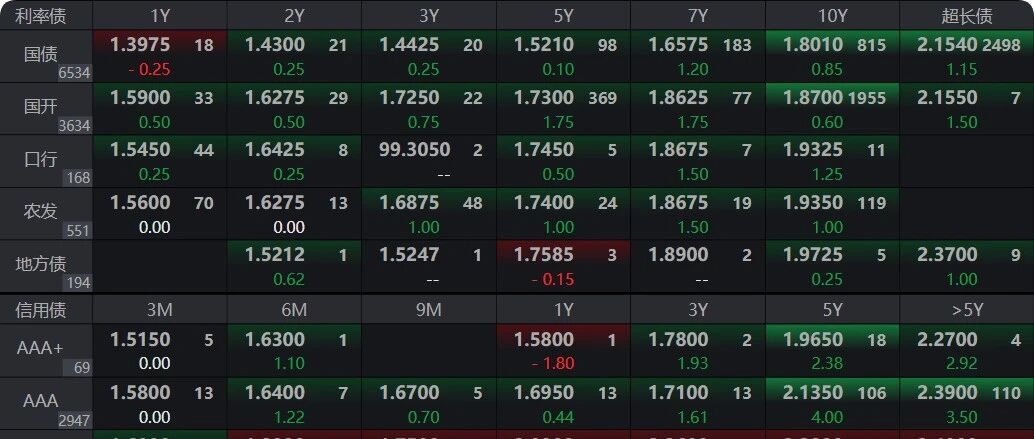
Core Viewpoint - The article emphasizes the unpredictability of investment opportunities and warns against assuming that past market behaviors will repeat, highlighting the psychological aspects of investing [1]. Market Overview - The market is currently experiencing a strong performance, with the stock index surpassing 4000 points, driven by a balanced and slightly loose funding environment [6][7]. - The central bank conducted a 7-day reverse repurchase operation of 928 billion yuan, with 3426 billion yuan maturing, resulting in a net withdrawal of 2498 billion yuan [3][6]. Interest Rates - The funding rates are stable, with DR001 around 1.32% and DR007 at approximately 1.43% [4]. - The 10-year government bond yield opened at 1.795% and fluctuated slightly, indicating cautious sentiment in the bond market [6][9]. Bond Market - The bond market shows a slight upward trend in long-term yields, with the 10-year government bond yield reaching 1.8010% [9]. - Various bond rates are reported, with 1-year government bonds at 1.3975% and 3-year bonds at 1.4425%, reflecting a mixed sentiment in the market [9].