
避险情绪

Search documents
研究所晨会观点精萃-20250702
Dong Hai Qi Huo· 2025-07-02 01:03
Report Industry Investment Ratings No relevant content provided. Core Views of the Report - Overseas, Powell's slightly dovish stance on interest - rate cuts and the uncertainty of US trade agreements have affected the global risk appetite; domestically, the increase in the manufacturing PMI in June and consumption - stimulating policies have improved the domestic market sentiment. Different asset classes have different short - term trends and corresponding investment suggestions [2]. - The domestic stock market is rising, driven by factors such as the improvement of economic data and policy stimulus. The short - term macro - upward drive has increased, and short - term cautious buying is recommended [3]. - Gold prices are supported by factors such as the US tax and spending bill and Powell's dovish stance. The market expects two interest rate cuts this year starting from September. Gold is expected to be strong in the short term [4]. - Due to the weakening of the US dollar, non - ferrous metals are showing a strong - oscillating trend. Different non - ferrous metals have different supply - demand situations and price trends [5]. - The oil price will continue to oscillate due to the game between summer demand and OPEC+ production increase prospects. Different energy - chemical products have different price trends based on their own supply - demand and cost factors [9]. - International crude oil premium and US biodiesel policy利好 are exhausted, and domestic oils and fats are under short - term pressure. Different agricultural products have different price trends based on their own supply - demand situations [14]. Summary by Related Catalogs Macro Finance - Overseas: Powell's statement is slightly dovish, but the labor market demand is better than expected. The US trade agreement is uncertain, and the global risk preference has cooled down. - Domestic: The manufacturing PMI in June is 49.7%, up 0.2 percentage points from the previous month. Consumption - stimulating policies have improved the domestic market sentiment. - Asset Suggestions: Stocks are expected to rebound in the short - term with cautious buying; bonds are at a high level and should be observed carefully; commodities in different sectors have different trends and corresponding investment suggestions [2]. Stock Index - The domestic stock market continues to rise, supported by sectors such as CSSC, biomedicine, and semiconductors. - Fundamental factors include the improvement of economic data and policy stimulus. The short - term macro - upward drive has increased, and short - term cautious buying is recommended [3]. Precious Metals - Gold prices rose on Tuesday. The US tax and spending bill and Powell's dovish stance support the gold price. The market expects two interest rate cuts this year starting from September. Gold is expected to be strong in the short term, and subsequent employment data should be focused on [4]. Non - Ferrous Metals and New Energy - Copper: US officials are seeking to reach a trade agreement by July 9. The supply is high, demand may weaken, and the inventory growth has slowed down. The price may fall in the future, and the negotiation results and tariff policies should be focused on. - Aluminum: The aluminum price rose due to the increase in copper prices. The LME inventory is increasing, and the domestic inventory has reached the inflection point of destocking. The warehouse receipts are decreasing. - Aluminum Alloy: It is in the off - season of demand, but the tight supply of scrap aluminum supports the price. The price is expected to be strong in the short term with limited upside. - Tin: The supply of tin ore is tight, and the demand is in the off - season. The price is expected to be strong in the short term but will be restricted in the medium term. - Carbonate Lithium: The supply is relatively loose, and one should wait for the opportunity after the rebound meets resistance. - Industrial Silicon: The price fell sharply, and the supply is unstable. It is expected to be in a weak - oscillating state, and one should observe. - Polysilicon: The fundamentals are loose, and it is recommended to short on rallies [5][6][7]. Energy and Chemicals - Crude Oil: The short - term oil price will continue to oscillate due to the game between summer demand and OPEC+ production increase prospects. - Asphalt: The price is oscillating strongly, following the oil price. The inventory is being destocked, and the situation in the peak - demand season should be focused on. - PX: The cost support is strong, but the downstream demand feedback is negative. It will follow the oil price and oscillate strongly. - PTA: The short - term basis has fallen, the demand is low, and the price may fall slightly later. - Ethylene Glycol: The price center has fallen, and the inventory at the port has decreased. The price will oscillate. - Short - Fiber: The inventory is being destocked slowly, and the price will oscillate weakly following the cost. - Methanol: The price is oscillating, affected by factors such as inventory and supply. The operation of Iranian devices should be focused on. - PP: The price is expected to oscillate weakly due to the increase in production and weak demand. - LLDPE: The price is expected to oscillate weakly due to the increase in production and weak demand in the off - season [9][10][12]. Agricultural Products - US Soybeans: The short - term CBOT soybeans may have weather - related premium support due to less rainfall and higher temperatures in the main production areas in the next two weeks. - Bean and Rapeseed Meal: The supply of soybean meal is loose, and the basis is expected to be weak. The stable price of US soybeans provides some support. - Bean and Rapeseed Oil: The supply of soybean oil is loose, and it may be under pressure following related oils and fats. The supply of rapeseed oil is expected to improve, and the high inventory at the port is being digested. - Palm Oil: The domestic inventory is increasing, and the price is expected to continue to weaken due to the exhaustion of利好 factors. - Corn: The spot price is strong, while the futures price is weak. After the seasonal substitution of wheat for feed consumption, the corn price is likely to rise. - Pig: The spot price has rebounded due to the reduction of group - farm slaughter at the end of the month. The supply is expected to increase in July, and the price has some resilience. Attention should be paid to the epidemic risk in North China [14][15][16].
金信期货日刊-20250702
Jin Xin Qi Huo· 2025-07-02 01:02
1. Report Industry Investment Ratings - No specific industry investment ratings are provided in the report. 2. Core Views of the Report - On July 1, 2025, the rise in gold prices was due to multiple factors. The dollar index dropped to its lowest since February 2022, and the 10 - year US Treasury yield declined, while geopolitical tensions in the Middle East and the Russia - Ukraine conflict increased market risk - aversion. However, the upcoming release of US June non - farm payroll data on Thursday could potentially suppress gold prices. So, it is recommended to try long positions with a light position [3][4]. - For A - shares, the three major indices opened lower and closed higher. The market is expected to continue to fluctuate and rise, as the tariff war is nearing its end [7][8]. - For gold in the long - term, the overall direction is still bullish, though it is currently undergoing adjustments due to the Fed's decision not to cut interest rates and the reduced expectation of rate cuts this year [12]. - For iron ore, supply has increased month - on - month, iron - water production has weakened seasonally, and ports are back in a state of inventory accumulation. Technically, it should be regarded as oscillating with a downward bias [15][16]. - For glass, it still awaits the effects of real - estate stimulus or major policy announcements. Technically, it should be considered as oscillating with a downward bias [20][21]. - For soybean oil, due to the long - term expectations of US biofuel policies and the uncertain Middle - East situation, short - term oil prices may oscillate or be strong. But considering the mid - term seasonal increase in production and inventory, when the price reaches the previous high pressure area of 8050 - 8000, short positions with a light position are recommended [24]. 3. Summaries by Related Catalogs 3.1 Gold - Market environment factors such as the drop in the dollar index and the decline in the 10 - year US Treasury yield, along with geopolitical tensions, led to the rise in gold prices on July 1, 2025. But the upcoming US non - farm payroll data may affect gold prices. It is advisable to try long positions with a light position [3][4]. - In the long - term, the overall trend of gold is bullish. Although it has adjusted due to the Fed's decision not to cut interest rates, it is likely to restart its upward trend after adjusting to an important support level [11][12]. 3.2 A - shares - The A - share market had a trend of opening lower and closing higher. With the tariff war approaching its end, the market is expected to continue to fluctuate and rise [7][8]. 3.3 Iron Ore - Supply has increased month - on - month, iron - water production has weakened seasonally, and ports are accumulating inventory. Technically, it is showing a downward - biased oscillation [15][16]. 3.4 Glass - The supply side has not seen significant cold - repair due to losses, factory inventories are high, and downstream demand is weak. It awaits real - estate stimulus or major policies. Technically, it is in a downward - biased oscillation [20][21]. 3.5 Soybean Oil - Due to long - term US biofuel policy expectations and the uncertain Middle - East situation, short - term oil prices may oscillate or be strong. But considering mid - term seasonal production and inventory increases, short positions with a light position are recommended when the price reaches 8050 - 8000 [24].
金价再触千元!2025年7月1日各大金店黄金价格多少钱一克?
Jin Tou Wang· 2025-07-01 07:46
7月1日国内黄金市场动态:品牌金店首饰金价重新上涨,整体价格又要超过千元了。具体来看,周生生 黄金在今日大涨15元/克,报价1000元/克,暂为最高价金店。上海中国黄金今日不仅没涨,反而还跌了 13元/克,报价956元/克,为最低价金店。今日品牌金店价差44元/克(1000元/克-956元/克),价差再次 拉大。 | 今日金店黄金回收价格一览(2025年7月1日) | | | | --- | --- | --- | | 回收报价 | 今日金价 | 单位 | | 黄金 | 757.30 | 元/克 | | 菜百黄金 | 752.90 | 元/克 | | 周生生黄金 | 751.60 | 元/克 | | 周大福黄金 | 755.00 | 元/克 | | 老凤祥黄金 | 760.50 | 元/克 | 说完首饰黄金价格,我们再来讲讲国际金价情况: 昨日现货黄金开局有下跌趋势,一度跌至了3247.11美元/盎司,后不断震荡上行。最终收报3302.71美 元/盎司,涨幅0.90%。今日金价仍保持回升,截至发稿,现货黄金暂报3327.89美元/盎司,涨幅0.76%。 昨日金价大幅回升,主要是美元指数出现大跌,创2022年2 ...


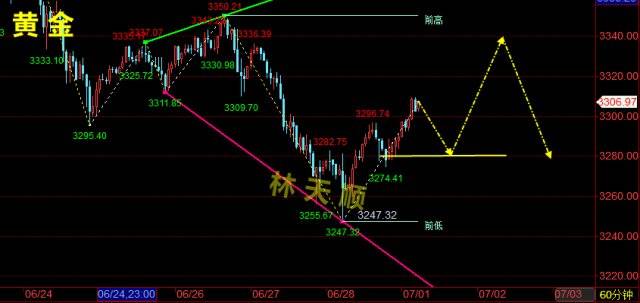
林天顺:7.1非农前夜黄金如何布阵?ADP数据联动交易法
Sou Hu Cai Jing· 2025-07-01 06:24
Economic Data and Events - Investors should closely monitor key economic data and events this week, including speeches from Federal Reserve officials, ISM manufacturing data, ADP employment report, and non-farm payroll data, as these will provide insights into the Fed's monetary policy path and influence gold prices [1] Gold Market Analysis - The international gold market experienced a downward trend last week due to a rapid decline in risk aversion, breaking below the critical level of 3300, resulting in a small bearish candle [1] - The weekly chart indicates that gold has fallen below the MA10 support, with the MACD indicator forming a death cross at high levels, suggesting potential further decline towards the MA20 [1] - The daily chart shows that bullish momentum has halted, with the moving averages in a tight range, and although the MACD has formed a death cross, it is near the zero line, indicating limited downside potential before a breakout [1] - Short-term trading strategy for gold suggests focusing on buying on dips around 3290, with a stop loss at 3282 and a target of 3320-3340 [1] Silver Market Analysis - The daily chart for silver shows a small candlestick with a notably low wick, resembling a potential doji pattern, indicating market indecision between buyers and sellers [3] - The support level at 35.12, corresponding to the 23.6% Fibonacci retracement from April to June, provides a solid technical base, while resistance above may limit short-term gains [3] - Domestic silver futures are trading above 8765, with a slight increase of 0.09%, indicating a bullish short-term outlook [4]
中东火药桶熄火,金价单周暴跌3%,投资者何去何从?
Sou Hu Cai Jing· 2025-07-01 03:41
Core Viewpoint - The recent volatility in the gold market is driven by complex international geopolitical events and market dynamics, leading to significant price fluctuations and investor uncertainty [1][3][5]. Group 1: Market Dynamics - Gold prices experienced a sharp decline from 777 CNY per gram to 764 CNY within a week, resulting in a loss of 2.8 million CNY for a trader holding 200 kg of gold bars [1]. - The initial surge in gold prices to 3450 USD was triggered by geopolitical tensions, specifically an Israeli airstrike on Iranian nuclear facilities, but a rapid de-escalation led to a subsequent drop below the critical support level of 3350 USD [1][5]. - The market saw a significant outflow from the largest gold ETF (GLD) in May, with North American funds selling 19 tons of gold, while central banks, including the People's Bank of China, continued to accumulate gold [3]. Group 2: Economic Indicators - The Federal Reserve's stance on interest rates has dampened market expectations for rate cuts, pushing traders to delay their predictions for rate reductions to October [5]. - U.S. consumer spending unexpectedly fell by 0.1% in May, while the core PCE price index rose by 2.7% year-on-year, creating a challenging economic environment for gold [5]. Group 3: Technical Analysis - Technical indicators showed a bearish trend, with gold prices breaking below 3350 USD, prompting algorithmic trading systems to issue sell signals [7]. - The New York Mercantile Exchange reported a significant increase in short positions, indicating a growing bearish sentiment among traders [7]. Group 4: Market Sentiment - There is a notable divide in market sentiment, with some analysts predicting further declines in gold prices, while others argue for continued central bank purchases as a long-term bullish indicator [9]. - Retail market behavior reflects this divide, with increased gold buyback activity at stores, while sales of gold products like gold beans surged by 80% [10]. Group 5: Investor Behavior - The volatility has led to a mix of panic and opportunism among investors, with some canceling orders while others seek to capitalize on lower prices [1][10]. - A trader expressed a long-term bullish outlook despite current market conditions, highlighting the cyclical nature of gold investments [12].
百利好早盘分析:美国政要发声 避险情绪助涨
Sou Hu Cai Jing· 2025-07-01 01:46
Group 1: Gold Market - Federal Reserve official Bostic reiterated expectations for a rate cut this year, briefly suppressing gold prices around $3295 [2] - Concerns arose after Treasury Secretary Mnuchin indicated plans to seek a successor for Fed Chair Powell, alongside Trump's comments reigniting focus on the trade war with China [2] - Analyst Mai Dong noted that the return of U.S.-China tariff issues shifted market focus, leading to a rebound in gold prices [2] - Technically, gold showed a bullish trend with support at $3250 and a key resistance level at $3320 [2] Group 2: Oil Market - Geopolitical tensions eased, reducing potential supply risks, with OPEC+ expected to maintain a production increase of 411,000 barrels per day in August [4] - Trump's call to lower oil prices and encourage shale oil production, combined with profit-taking during the Iran conflict, led to a rapid decrease in net long positions in oil [5] - Seasonal demand remains strong due to summer travel peaks in Europe and the U.S., with ongoing positive signals from tariff negotiations [5] - Technically, the oil market is in a range between $63.95 and $66.90, suggesting a strategy of buying low and selling high within this range [5] Group 3: Nasdaq and Dollar Index - The Nasdaq continued its upward trend but faced pressure from Trump's criticisms of China [7] - The U.S. dollar weakened, breaking below the previous low of 96.97, with a focus on potential pullbacks around 97.20 [8]

国际金价周内大幅下挫3%,现货黄金报3273美元创近四周新低
Sou Hu Cai Jing· 2025-06-30 05:43
Current Gold Price Dynamics - Spot gold price is reported at $3273 per ounce, with a weekly decline of nearly 3%, marking a four-week low, and it briefly fell below the $3250 level [1] - COMEX gold futures dropped to $3287.6 per ounce, with a weekly decline of 2.9% [1] Domestic Gold Prices - Retail gold prices for brands like Chow Tai Fook and Chow Sang Sang range from 989 to 996 RMB per gram, down approximately 4% from peak levels [2] - Wholesale market prices in Shenzhen's Shui Bei dropped to 756 RMB per gram, down over 4% from 792 RMB per gram at the beginning of May [3] - Recycling prices are around 750-772 RMB per gram, with daily recycling volume increasing by 20%, and some shops reporting daily recycling volumes of several kilograms [4] Reasons for Recent Gold Price Decline - Decreased risk aversion due to easing Middle East tensions (ceasefire between Israel and Iran) and progress in US-China trade negotiations, which weakened demand for gold as a safe haven [5] - Monetary policy pressure as Fed Chair Powell emphasized the need to observe the impact of tariffs on inflation, with a July rate cut probability dropping to 20%, leading to a stronger dollar that suppresses gold prices [6] - Technical selling pressure triggered by gold prices breaking below the critical support level of $3300, leading to programmatic stop-loss selling [6] - Capital flows shifting towards risk assets, with US stock markets reaching new highs (S&P and Nasdaq at historical peaks) [7] Future Price Predictions - Bearish outlook from Citibank, predicting gold prices may fall to $2500-$2700 in 2026 due to weak demand and delayed rate cuts [8] - Short-term support levels indicate that if prices fall below $3250, they may test the $3200 level, potentially reaching the $3120-$3180 range [9] Bullish Outlook - Bullish perspective from Goldman Sachs and Bank of America, with long-term targets of $4000, supported by central bank gold purchases (averaging over 1000 tons annually) and weakening dollar credit [10] - Key variables include geopolitical risks (compliance with ceasefire by Israel and potential blockade of the Strait of Hormuz) and policy shifts (potential early rate cuts by the Fed if unemployment exceeds 5% or inflation drops sharply) [10] Consumer and Investor Strategies - For consumers, it is advisable to focus on essential purchases in Shenzhen's Shui Bei wholesale market (where processing fees are only one-third of brand stores) or products priced by weight with low processing fees [11] - Wedding demand strategies include brands offering "1:1 exchange with no depreciation" for old gold jewelry, reducing costs by 40% [12] - Investment strategies suggest a cautious approach in the short term, observing support levels of $3200-$3250, and considering short positions if these levels are breached; a rebound to $3320-$3330 could be an opportunity for short positions [13] - For long-term investments, a dollar-cost averaging strategy in gold ETFs (like Huaan Gold ETF) is recommended, with allocation controlled at 5%-10% of assets, alongside diversified investments in government bonds and stable financial products to avoid an all-in approach on gold [14] Market Volatility - Increased volatility is noted, with the 30-day historical volatility of gold rising to 18.7% and implied volatility of options exceeding 25% [16] Summary - Current gold prices are under dual pressure from geopolitical easing and a hawkish Fed, with short-term potential declines to the $3200-$3250 range, but long-term bullish trends supported by central bank purchases and monetary system changes [17] - Investors are advised to balance the safe-haven attributes with volatility risks, prioritizing a "dollar-cost averaging + phased entry" strategy, while consumers should take advantage of price corrections to avoid brand premiums and focus on transparent processing fees [17] - The market's next direction will depend on the stability of the Middle East situation and signals from the Fed's September policy meeting, with close attention to core PCE inflation data and geopolitical events [17]
张尧浠:避险减弱降息升温、黄金走低下方空间有限
Sou Hu Cai Jing· 2025-06-29 23:46
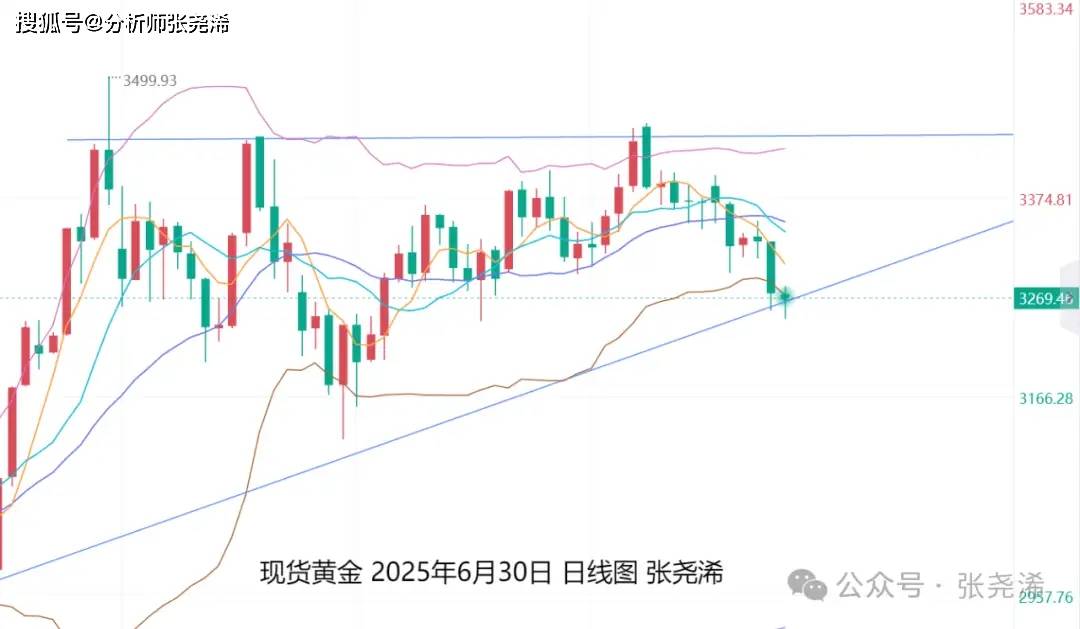
张尧浠:避险减弱降息升温、黄金走低下方空间有限 黄金市场上周:国际黄金再度回落走低收跌,并收线至5-10周均线下方,打破了近数周的震荡上趋势支撑,同时附图指标信号高位死叉看空发展,暗示后 市将有望继续走低进一步触及中轨线支撑或更低的目标。 具体走势上,金价自周初开于3389.20美元/盎司,变先行录得当周高点3395.88美元,之后遇阻回落,周二进一步走低一度触及3300美元下方,虽周三周四 止跌震荡回升,但多头力度未能持稳加强重返阻力上方,使得周五时段再度面临抛售压力,并跌破60日均线支撑,录得当周低点3256.07美元,最终有所 止跌回升,收于3273.18美元,周振幅139.81美元,收跌116.02美元,跌幅3.42%。 影响上,受周末地缘局势的升级而高开,但动力未能持续,其特朗普称伊以将实现全面停火,以及后续市场对于中东局势认为是在"表演"而避险情绪反应 减弱,再加上鲍威尔暗示他将抵制7月降息,称在考虑降息前需要更多时间,打压金价转回落连续走低; 虽然受到60日均线支撑附近的买盘推动,以及特朗普表示将在三四人中选出下任美联储主席,令市场普遍预期美联储将很快恢复其降息周期,有所止跌震 荡,但受到技术阻 ...
张津镭:避险退潮黄金崩盘!下周如何布局?
Sou Hu Cai Jing· 2025-06-28 03:31
本周末首先关注俄乌停火协议执行情况、伊朗与以色列是否再起摩擦,若冲突重新爆发,将直接刺激市 场避险情绪,下周开盘抬高黄金价格。其次,特朗普公开批评美联储主席鲍威尔,称"希望鲍威尔辞 职",并暗示可能提名更鸽派的人选。若周末有相关消息发酵,可能影响市场对美联储政策的预期。 可以说,现在近期市场在无避险事件下,黄金更加偏向回落,前期偏激涨势也需要修正。只要无上方说 的几个事情,那么下周一开盘自然还是以做空为主,上方3280为初步阻力,其次就是3300关口,只要这 里不破,周一开盘直接在其下方做空即可。目标依次看3230-3200一线。当然,止损还是带好,毕竟避 险来了涨势可不讲道理。 转自:黄金分析师张津镭 昨日金价继续走了一个跌势行情,亚盘开盘便开始回落,午盘反弹3203附近进场空单,随后金价一路回 落直接跌破3300关口,美盘刷新日内低点至3255美元,空单亦是于3260自动止盈离场,大赚40美金。最 终金价是收盘于3273美元,日线收于2连阴。 本周现货黄金延续跌势,累计下跌约2.8%,几日连续空单亦是赚的盆满钵满。一是美国核心PCE物价指 数同比上涨2.8%,高于预期,强化了市场对美联储可能再加息50个基 ...
关注美国关税政策动向,警惕避险情绪卷土重来,黄金转换位在哪?点击观看金十研究员文成直播分析
news flash· 2025-06-27 11:57
关注美国关税政策动向,警惕避险情绪卷土重来,黄金转换位在哪?点击观看金十研究员文成直播分析 相关链接 ...