
新能源汽车

Search documents
【行业研究】电解液:“一超两强”格局的稳固与挑战
Xin Lang Cai Jing· 2026-01-08 11:43
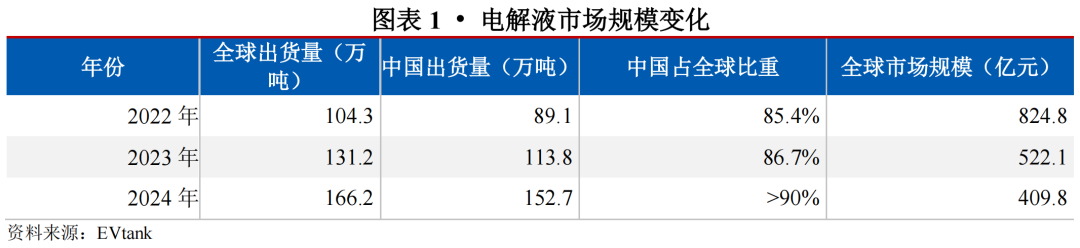
Core Viewpoint - The electrolyte industry is in the midstream of the new energy supply chain, currently experiencing a phase of expansion after destocking, with a focus on cost control as its core competitive advantage. The global market is dominated by China, with a highly concentrated domestic market characterized by a "one super, two strong" structure. Future trends indicate diversification, structural adjustments, and accelerated technological iterations driven by the rapid expansion of the new energy vehicle and energy storage industries [1][36]. Industry Overview - The electrolyte industry is positioned in the midstream of the new energy supply chain, with lithium salts and organic solvents upstream and battery cell manufacturers downstream. The industry is currently in the early stages of expansion following destocking. Compared to other lithium battery materials, the entry barriers in the electrolyte industry are relatively low [2][40]. - Electrolytes are a key component of lithium batteries, responsible for ion conduction, accounting for approximately 10-20% of the manufacturing cost. The main components include lithium salts, organic solvents, and additives, with lithium hexafluorophosphate (LiPF₆) being the mainstream lithium salt [2][37]. - From 2022 to 2024, global shipments of electrolytes are expected to continue growing due to increasing demand from lithium batteries, with Chinese companies' shipment share rising to over 90% by 2024. However, the significant decline in electrolyte prices has led to a contraction in the global market sales scale during this period [2][38]. Production Capacity and Market Dynamics - Between 2022 and 2024, the expansion rate of electrolyte production capacity is expected to exceed market demand growth, resulting in structural overcapacity in the industry. By 2024, China's electrolyte production capacity is projected to exceed 5 million tons, but the average capacity utilization rate is only between 25-35% [8][43]. - The pricing pressure on electrolytes is exacerbated by the strong bargaining power of downstream customers, such as battery manufacturers and automotive companies, leading to prolonged accounts receivable periods. Consequently, electrolyte prices are expected to decline continuously from 2022 to 2024, remaining below 20,000 yuan per ton from 2025 onwards [8][44]. Competitive Landscape - Cost control is the core of competition in the electrolyte industry. Chinese electrolyte companies dominate the global market, with a high concentration in the domestic market. The first-tier companies, including Tianqi Materials, BYD, and Xinzhou Bang, collectively hold about 60% market share [11][49]. - The first-tier companies leverage vertical integration to build competitive advantages, while second-tier companies focus on niche markets or specific regions for differentiated competition. The second-tier includes companies like Ruifeng New Materials and Kunlun New Materials, which face unique structural challenges [11][52]. - By 2024, the first-tier companies are expected to maintain a significant market share, while the second-tier companies are projected to grow their shipments by approximately 40% year-on-year in the first half of 2025, potentially encroaching on the first-tier's market share [11][52]. Financial Performance of Key Companies - In 2024, the total revenue of sample electrolyte companies is expected to decline, with a decrease in profit margins and overall revenue quality. Notably, Xinzhou Bang's revenue is projected to increase due to growth in its electronic information chemical business, while other sample companies are expected to see revenue declines [21][56]. - The asset structure of these companies shows a high proportion of accounts receivable, indicating significant capital occupation, while fixed assets remain high, suggesting potential depreciation pressures in the future [21][56]. - Operating cash flow for these companies is expected to decline in 2024, primarily due to decreased revenue and quality of revenue realization. Tianqi Materials is expected to maintain positive cash flow despite lower revenue quality, while other companies may face cash outflows [23][58]. Future Trends - The rapid expansion of new energy vehicles and energy storage industries is expected to drive diversification and structural adjustments in the electrolyte market. The demand for electrolytes is anticipated to grow, supported by the global electrification process and the explosion of the energy storage market [33][68]. - The rise of solid-state batteries presents structural challenges for the electrolyte industry. In the short term, the demand for gel electrolytes and composite solid-liquid electrolytes is expected to increase, while traditional liquid electrolytes may see stable or declining demand in the medium to long term [34][69].


兆威机电首次覆盖:微型传动系统龙头,人形机器人、XR、汽车电子打开成长空间(附下载)
Xin Lang Cai Jing· 2026-01-08 11:36
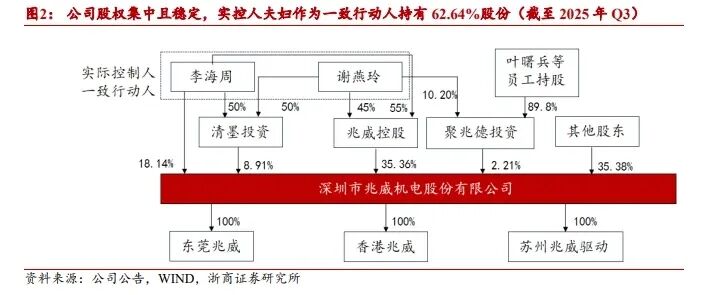
Core Viewpoint - The company is a leading player in the micro drive system industry, with a strong focus on expanding its downstream markets and a solid technical foundation established by its experienced management team [1][2][5]. Group 1: Company Overview - The company was founded in 2001 and went public in 2020, initially focusing on precision injection molding and components, later shifting to micro drive systems in 2010 [1][2]. - The company has expanded its product applications to various industries, including automotive electronics, communication devices, smartphones, medical care, service robots, industrial automation, smart homes, and AR & VR [1][5]. Group 2: Market Position and Strategy - Micro drive systems are core components in the industrial sector, characterized by their miniaturization, high precision, reliability, lightweight, and low noise, with significant market demand across various sectors [5][14]. - The company targets key industries undergoing intelligent upgrades, such as smart automotive, consumer technology, medical technology, and advanced manufacturing, to meet diverse application needs [5][14]. Group 3: Customer Base and Product Development - The company adopts a customized business model to develop micro drive systems based on client needs, enhancing user stickiness and building a strong customer base [6][15]. - It has established partnerships with renowned companies like Huawei, Bosch, BYD, Great Wall Motors, Vivo, OPPO, Xiaomi, iRobot, and others, enhancing its market competitiveness [6][15]. Group 4: Financial Performance - From 2017 to 2024, the company achieved a compound annual growth rate (CAGR) of 15.7% in revenue and 24.3% in net profit, with projected revenues of 1.525 billion yuan and net profits of 225 million yuan in 2024, reflecting year-on-year growth of 26.4% and 25.1% respectively [7][16]. - The company experienced a significant decline in its micro drive system business for smartphone camera modules in 2020 but has since rebounded due to successful expansions into automotive electronics and other sectors [7][16]. Group 5: Cost Structure and R&D Investment - The company's gross margin remains stable at around 30%, with raw material costs being a significant portion of total costs, making it sensitive to fluctuations in material prices [10][18]. - R&D expenses have increased significantly post-IPO, with a year-on-year growth of 86.7% in 2021, reflecting the company's commitment to enhancing its competitive edge through innovation and solution development [10][18].
证监会同意固德电材创业板IPO注册
智通财经网· 2026-01-08 10:15
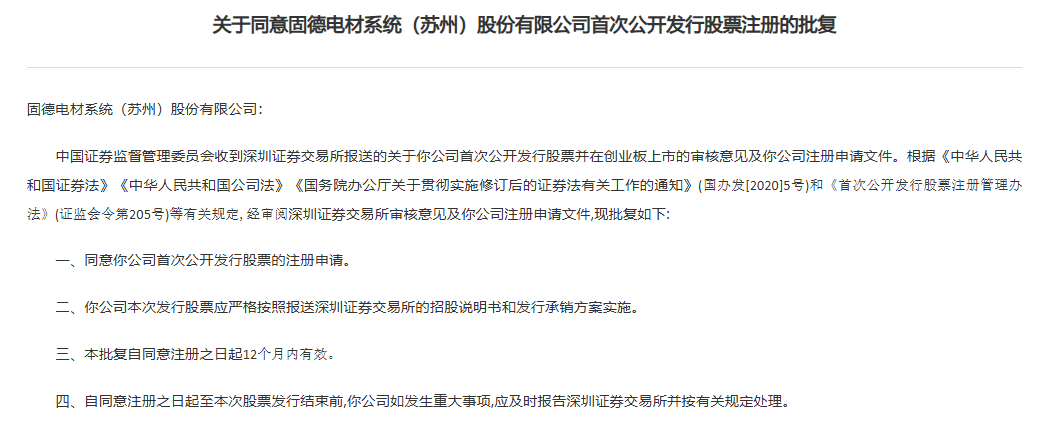
Group 1 - The core viewpoint of the news is that the China Securities Regulatory Commission has approved the initial public offering (IPO) registration of Gude Electric Materials System (Suzhou) Co., Ltd., which plans to raise 1.17571 billion yuan on the Shenzhen Stock Exchange's ChiNext board [1] Group 2 - Gude Electric Materials focuses on the research, development, production, and sales of thermal runaway protection components for new energy vehicle power batteries and electrical insulation products, providing customized solutions [3] - The company's main products include thermal runaway protection components for new energy vehicle power batteries and electrical insulation products, with sales of thermal runaway protection components continuously increasing, becoming the primary source of revenue growth during the reporting period [3]

TCL李东生:中韩两国在人工智能等新兴领域合作潜力巨大
Nan Fang Du Shi Bao· 2026-01-08 09:57
Group 1 - The core viewpoint of the article emphasizes the significant potential for cooperation between China and South Korea in emerging fields such as artificial intelligence, semiconductor displays, new energy vehicles, and biotechnology, as highlighted by TCL's founder and chairman, Li Dongsheng [2] - Li Dongsheng proposed three suggestions for deepening cooperation: 1) fully utilize the China-South Korea Free Trade Agreement to enhance bilateral economic cooperation; 2) leverage each country's industrial advantages to promote collaboration in technological innovation; 3) build industrial resilience and optimize regional supply chain layouts [2] - TCL Huaxing has become a core supply chain partner for major companies like Samsung, LG, and Hyundai, with plans to increase its share in Samsung's mobile supply chain to 15% and expand its role as a core supplier for Hyundai's in-vehicle displays [2] Group 2 - The China-South Korea Business Forum was co-hosted by the China Council for the Promotion of International Trade and the Korea Chamber of Commerce and Industry, with over 400 attendees from both countries, including key economic representatives from South Korea such as President Yoon Suk-yeol and leaders from major corporations [3]

汽车“自主五强”的2025年:增长之下现战略分野
Jing Ji Guan Cha Wang· 2026-01-08 09:50
Core Insights - The Chinese automotive market is experiencing significant growth in 2025, driven by the rise of new energy vehicles (NEVs), with domestic brands capturing nearly 70% of the passenger car market share [2] - The "Big Five" domestic automakers—BYD, Geely, Chery, Changan, and Great Wall—account for over half of the total passenger car sales, with a combined sales figure of 14.67 million units [2][3] - The competition among these companies has intensified, with each adopting distinct strategies for growth and market positioning [2] Group 1: Sales Performance - BYD remains the global leader in NEV sales, achieving 4.6024 million units in total sales, a year-on-year increase of 7.73%, with pure electric vehicle sales reaching approximately 2.257 million units, marking a 27.9% increase [3] - Geely is noted as the most aggressive player in 2025, with total sales exceeding 3.02 million units, a 39% increase, and NEV sales of 1.6878 million units, reflecting a 90% growth [5] - Changan and Chery have stable growth, with Changan's total sales reaching 2.913 million units, an 8.5% increase, and Chery's sales at 2.8064 million units, a 7.8% increase [4][6] Group 2: Strategic Developments - Geely is undergoing significant internal restructuring, merging with Zeekr Technology to enhance efficiency and resource allocation, aiming to save billions in R&D costs [8] - Chery has restructured its brand architecture to improve operational efficiency, establishing a domestic business group to streamline its operations and enhance competitiveness [8] - Capital markets are playing a crucial role in supporting long-term strategies, with Changan raising 6 billion yuan for new energy vehicle development and Chery successfully listing on the Hong Kong stock exchange to fund global expansion [9] Group 3: Technological Advancements - The competition has shifted from individual technological breakthroughs to a more systemic approach, with companies like BYD launching advanced platforms and intelligent driving systems [10] - Geely has introduced a unified intelligent driving solution and integrated its battery business into a safety system, enhancing its technological synergy [10] - Changan is advancing its "Beidou Tianzhu" plan, showcasing a comprehensive technology layout from solid-state batteries to advanced driving systems [10]



车市2025|从监管智驾到准许L3上路 十大事件解码多维博弈
Xin Jing Bao· 2026-01-08 08:45
Core Insights - The Chinese automotive market in 2025 is undergoing a multifaceted transformation driven by policy regulations, capital restructuring, technological breakthroughs, and safety standards, marking a significant shift from mere technological iterations to a comprehensive industry evolution [1] Regulatory Changes - The Ministry of Industry and Information Technology (MIIT) has mandated that automotive companies clarify system functionalities and safety responses, effectively ending the use of vague terms like "L2.999" and "quasi-L3" in marketing, promoting a focus on safety over flashy terminology [2] - A new regulation requires large enterprises to pay small and medium-sized suppliers within 60 days, significantly reducing the previous average payment period of 170-200 days, thus improving cash flow for smaller suppliers and enhancing the overall supply chain stability [3][4] Industry Restructuring - The establishment of the China Changan Automobile Group as a new state-owned enterprise marks a significant shift in the industry landscape, enhancing decision-making autonomy and financing capabilities, and allowing a concentrated focus on new energy and intelligent vehicles [5] - Dongfeng Group has accelerated its transformation by divesting inefficient fuel assets and focusing on high-end new energy brands, exemplifying a successful capital operation strategy in the traditional automotive sector [6][7] Safety and Quality Standards - New safety regulations for hidden door handles in vehicles emphasize that aesthetics should not compromise safety, requiring mechanical emergency functions to be retained in designs, thus addressing safety concerns in the industry [8] - A significant lawsuit against battery manufacturer Xinwanda highlights the critical importance of quality in the battery sector, as a major claim for 2.314 billion yuan has been filed due to quality issues, prompting a shift towards prioritizing quality over mere scale in the industry [12][13] Strategic Collaborations - A partnership between FAW Group and Leap Motor, involving a 3.74 billion yuan investment, illustrates a strategic collaboration aimed at leveraging each other's strengths in manufacturing and technology, potentially enhancing both companies' market positions [14]
易实精密(920221):2025Q3业绩稳中有升,加速推进全球化战略
Huaxin Securities· 2026-01-08 08:31
Investment Rating - The report maintains a "Buy" rating for the company [1] Core Insights - The company achieved a revenue of 86 million yuan in Q3 2025, representing a year-on-year increase of 8.12%, while the net profit attributable to shareholders was 14 million yuan, up 2.28% year-on-year [5][6] - The company is accelerating its globalization strategy by increasing investment in its wholly-owned subsidiary EC Precision (Germany) GmbH by up to 7.9 million euros [5][8] - The company focuses on the automotive precision metal parts sector, with a steady growth in its main business, including significant contributions from new energy vehicles and traditional fuel vehicles [6][7] Financial Performance - In H1 2025, the company reported a revenue of 166 million yuan, a 6.57% increase year-on-year, with new energy vehicles, general vehicles, and traditional fuel vehicles contributing 69 million, 38 million, and 43 million yuan respectively [6] - The gross margin for Q3 2025 was 31.62%, showing a slight decrease of 0.39 percentage points year-on-year [6] - The company forecasts revenues of 352 million, 429 million, and 508 million yuan for 2025, 2026, and 2027 respectively, with net profits projected at 57 million, 69 million, and 83 million yuan for the same years [11][13] Strategic Initiatives - The company is deepening its global strategy by establishing subsidiaries for surface treatment and forming a joint venture in Slovenia to meet local supply demands [8] - The company is focusing on developing new manufacturing processes for harmonic reducer flexible wheels to reduce production costs, which is expected to enhance its competitive edge [9][10] - The company has established strong relationships with leading global clients, ensuring a stable order flow and enhancing its market position [9]
2026仅1家目标销量翻倍,车企不再“放卫星”
凤凰网财经· 2026-01-08 08:09
Core Viewpoint - The Chinese automotive market, particularly in the new energy vehicle (NEV) sector, is transitioning from rapid growth to a more cautious approach, with manufacturers setting more conservative sales targets for 2026 compared to previous years [2]. Group 1: Sales Targets and Growth Rates - Traditional automakers are adopting more cautious growth targets, while new entrants, despite maintaining optimism, have reduced their aggressive growth ambitions [2]. - Among seven automotive manufacturers analyzed, only Leap Motor set a doubling sales target from 500,000 units in 2025 to 1 million in 2026 [2]. - Geely has the highest sales target for 2026 at 3.45 million units, representing a 14% growth from 2025, with a projected NEV sales target of 2.22 million units, up 32% from the previous year [5]. - Dongfeng aims for a total sales target of 3.25 million units in 2026, with an estimated growth rate exceeding 30% [5]. - Chery has set a target of 3.2 million units for 2026, reflecting a 14% increase from 2025 [6]. - Great Wall Motors has adjusted its 2026 sales target down to a minimum of 1.8 million units, a 36% increase from the previous year [6]. - NIO aims for a sales target of 456,000 to 489,000 units in 2026, maintaining a growth rate of 40%-50% [7]. Group 2: Market Dynamics and Strategies - The implementation of a halved purchase tax for NEVs and adjustments to subsidy policies are introducing new variables into the domestic automotive market [2]. - Dongfeng's new brand, Yipai Technology, plans to launch six new models by 2026, indicating a strategic focus on innovation [6]. - Xiaomi has set a sales target for 2026 that exceeds a 30% increase from last year's actual sales, with plans to upgrade its vehicle lineup [8]. - The new Xiaomi SU7 is expected to launch in April 2026, featuring advanced driving assistance hardware and improved range capabilities [8].



2025年我国召回乘用车超680万辆合资车成召回“主力” 新能源车召回数量下降
Zhong Guo Zhi Liang Xin Wen Wang· 2026-01-08 07:38
Core Insights - In 2025, China implemented 105 recalls for passenger vehicles, affecting approximately 6.825 million vehicles, with a notable decline in recalls for German brands and an increase for Japanese brands [1][2] Group 1: Recall Statistics - Japanese brands led in recall numbers with a total of 2.207 million vehicles recalled, marking a 27.3% increase year-on-year, accounting for over 30% of total recalls [1] - German brands had 1.28 million vehicles recalled, a significant decrease, while American brands recalled 1.399 million vehicles, experiencing a 60.5% drop [1] - Domestic brands recalled 566,000 vehicles, a 26.7% increase from 2024, with their market share surpassing 70% for the first time [1] Group 2: Major Recalls - Three recalls exceeded 500,000 vehicles: Dongfeng Honda and GAC Honda recalled approximately 1.367 million vehicles due to steering issues, Tesla recalled over 1.2 million vehicles for rearview camera and steering system failures, and Jaguar Land Rover recalled over 630,000 vehicles for engine and software issues [2] - The overall recall numbers for new energy vehicles decreased significantly, with over 2.1 million recalls in 2025, indicating improved quality control in the industry [2] Group 3: Quality Control and Investigations - In 2025, passive recalls reached 21 instances, with 12 involving domestic brands, highlighting the need for improved quality management systems among some manufacturers [4] - More than half of the battery-related recalls were initiated by the market regulatory authority, indicating a proactive approach to safety [4] - Japanese brands conducted all their recalls voluntarily, reflecting a mature corporate responsibility and transparency that can help rebuild consumer trust [4]


中力股份跌0.78%,成交额6449.75万元,近3日主力净流入-598.14万
Xin Lang Cai Jing· 2026-01-08 07:38
Core Viewpoint - The company focuses on the development and innovation of electric forklifts and other industrial vehicles, aiming to lead the industry transformation towards greener and smarter logistics solutions [2][3]. Company Overview - Zhejiang Zhongli Machinery Co., Ltd. is located in Anji County, Huzhou City, Zhejiang Province, established on September 20, 2007, and listed on December 24, 2024. The main business involves the research, production, and sales of electric forklifts and other industrial vehicles [8]. Business Performance - For the period from January to September 2025, the company achieved operating revenue of 5.243 billion yuan, representing a year-on-year growth of 8.62%, and a net profit attributable to shareholders of 685 million yuan, with a growth of 5.46% [9]. - The revenue composition includes 98.85% from forklifts and related parts, while other sources contribute 1.15% [9]. Product Development - The company has developed several milestone products, including the "Little King Kong," oil-to-electric forklifts, and the "搬马" (Moving Horse) robot series, which are designed to enhance automation and reduce manual handling [2][3]. - The company is transitioning from diesel forklifts to lithium battery forklifts and is advancing towards robotic handling solutions [3]. Market Position - As of the latest report, the company's overseas revenue accounts for 51.63%, benefiting from the depreciation of the RMB [4]. - The company operates in the machinery equipment sector, specifically in engineering machinery, and is involved in various concept sectors including new industrialization and robotics [9]. Shareholder Information - As of September 30, 2025, the number of shareholders is 18,200, a decrease of 9.15% from the previous period, with an average of 2,834 circulating shares per person, an increase of 10.07% [9].