
有效投资

Search documents
前三季度财政数据点评:中央财政是当前广义财政支出的重要增量
Bank of China Securities· 2025-10-20 01:06
Fiscal Data Overview - In September, total public fiscal revenue reached 15,678.0 billion yuan, a year-on-year increase of 2.6%, accelerating by 0.6 percentage points compared to August[5] - Tax revenue for September was 11,579.0 billion yuan, showing a year-on-year growth of 8.7%, an increase of 5.3 percentage points from August[5] - Non-tax revenue fell to 4,099.0 billion yuan, down 11.4% year-on-year, with the decline expanding by 7.6 percentage points from the previous month[5] Government Fund Revenue and Expenditure - For the first three quarters of 2025, government fund budget revenue totaled 30,717.0 billion yuan, a year-on-year decrease of 0.5%, with the decline narrowing by 0.9 percentage points[17] - In September, government fund expenditure was 12,322.0 billion yuan, a slight increase of 0.4% year-on-year[20] - Central government fund expenditure in September was 481.0 billion yuan, up 19.7% year-on-year, while local government fund expenditure fell by 0.3% to 11,841.0 billion yuan[20] Central Fiscal Contributions - The central fiscal budget is a significant contributor to overall fiscal expenditure, with a year-on-year growth of 3.3% in September, contributing 2.0 percentage points to the overall fiscal expenditure[22] - The central government plans to allocate 500 billion yuan from local government debt limits to support effective investment, increasing the total scale by 100 billion yuan compared to last year[22] Economic Risks - Risks include heightened overseas recession concerns and increased geopolitical uncertainties, which may impact fiscal policies and economic growth[22]
“决胜‘十四五’续写新篇章”系列主题新闻发布会举行第五场发布 多措并举扩内需 投资消费双丰收
Si Chuan Ri Bao· 2025-10-17 00:26
Key Achievements in Expanding Domestic Demand - Project investment in Sichuan has grown at an average annual rate of 10.5%, with total investment in provincial key projects exceeding 4 trillion yuan [1] - The consumption market in Sichuan has experienced an average annual growth of 7.4% over the past four years, surpassing the national average by 2 percentage points, and the total consumption volume has ranked fifth nationwide [2] - A total of 367,000 units of various types of affordable housing have been constructed and secured in the province, with 420 million square meters of commercial housing sold [2] Investment Expansion - Since the beginning of the 14th Five-Year Plan, Sichuan has focused on expanding effective investment as a key strategy for stabilizing growth, with significant investments in major infrastructure projects and technology initiatives [1] Consumption Development - Sichuan has implemented a "policy + activities + scenarios" three-pronged approach to boost consumption, introducing key policies and hosting major events like the China (Sichuan) International Panda Consumption Festival [2] - The province has innovatively created 120 new consumption scenarios to drive consumption as a main engine for economic growth [2] Housing Support - Sichuan has established a multi-tiered housing security system combining government guarantees and market allocation, increasing the supply of affordable housing to meet residents' needs [2] - During the 14th Five-Year Plan period, Sichuan has built 367,000 units of affordable housing and sold 420 million square meters of commercial housing, promoting a stable and healthy real estate market [2]
102项重大工程预计年底前全部完成规划目标
Yang Shi Wang· 2025-10-11 20:12
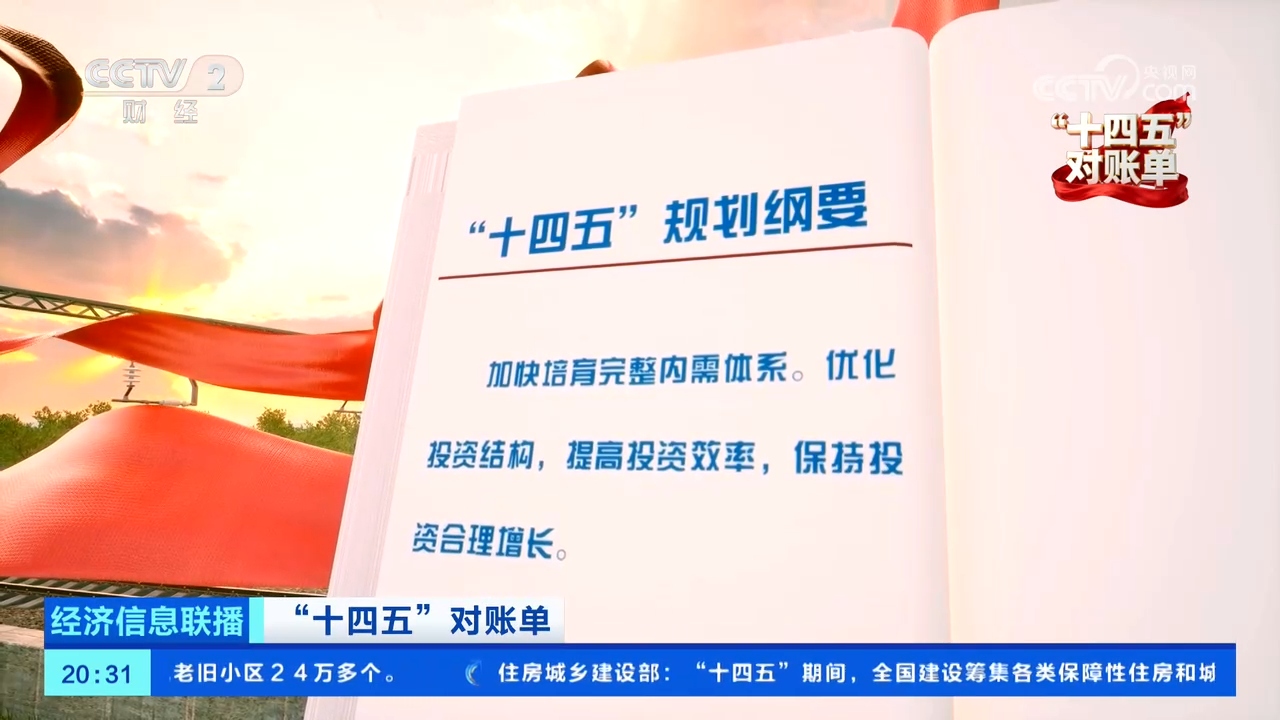
Group 1 - The core viewpoint emphasizes that investment plays a crucial role in driving economic growth, particularly during the "14th Five-Year Plan" period, where effective investment is expected to stimulate steady growth momentum [1][3] - The "14th Five-Year Plan" outlines the need to accelerate the cultivation of a complete domestic demand system, optimize investment structure, and maintain reasonable investment growth. Over the past four years, the average contribution rate of capital formation to China's economic growth has been 30.2% [3] - High-tech industry investment has consistently outpaced overall investment growth for several years, indicating a shift towards more advanced sectors [3] Group 2 - The plan promotes new infrastructure, new urbanization, and major projects in transportation and water conservancy that not only stimulate consumption but also enhance structural adjustments. By the end of the year, 102 major projects are expected to meet their planning goals [5] - Approximately 90% of county-level administrative centers have achieved access to highways within 30 minutes, and the high-speed rail coverage in cities with populations over 500,000 has reached 97% [5] - Investment in social and livelihood sectors has maintained rapid growth, with around 7.8 million units of affordable housing initiated over the past four years, effectively addressing housing issues for over 20 million people [5] Group 3 - Investment is leveraged to stimulate the overall economy, with policies aimed at enhancing domestic demand and attracting private capital into significant projects in nuclear power and railways [7] - The focus of investment has shifted towards improving quality of life, reflecting a broader strategy to direct resources towards beneficial outcomes for society [7]

更好服务实体经济 我国推出5000亿元新型政策性金融工具
Yang Shi Wang· 2025-10-07 00:04
Core Viewpoint - The establishment of new policy-based financial instruments aims to enhance financial services for the real economy and promote effective investment, with a total scale of 500 billion yuan allocated for project capital supplementation [1] Group 1 - The new policy-based financial instruments will focus on supporting technological innovation, promoting consumption, and stabilizing foreign trade [1] - The initiative is part of efforts to ensure stable and healthy economic development [1]
全市重点园区产业攻坚双月调度会召开
Nan Jing Ri Bao· 2025-09-12 02:13
Core Viewpoint - The city is focusing on enhancing the economic development of key industrial parks, emphasizing their role as the main support for economic growth and the need for urgent action to achieve high-quality development [1][2]. Group 1: Economic Development Strategy - The city aims to increase total economic output, enhance capabilities, attract projects, and expand investments in key industrial parks [2]. - There is a strong emphasis on collaboration between different sectors and parks to create a cohesive effort in driving industrial growth [2]. Group 2: Project and Investment Focus - The city is prioritizing the attraction of major projects and investments, particularly those valued over 100 million, to ensure a steady pipeline of development [2]. - A systematic approach is being adopted to manage projects, including reserving, signing, starting, and completing projects in a timely manner [2]. Group 3: Innovation and Collaboration - The city is promoting deep integration of technological and industrial innovation by fostering close cooperation with universities and research institutions [2]. - There is a focus on exploring models for the transformation of scientific achievements into practical applications within the industry [2]. Group 4: Management and Optimization - The city is committed to optimizing the management system of industrial parks and enhancing the incentive mechanisms for talent and leadership [3]. - Efforts are being made to create a comprehensive service system tailored to different types of enterprises and their development stages [2][3].
改善消费偏凉
Sou Hu Cai Jing· 2025-09-01 05:58
Group 1 - The article emphasizes the importance of effective investment during economic downturns to stimulate domestic demand and create job opportunities [1][2] - Government funding for public works and major infrastructure projects is highlighted as a means to generate immediate employment and related orders for raw materials and equipment [1] - Increased employment and improved corporate performance lead to higher income and consumption capacity for households, thereby boosting overall consumer spending [1] Group 2 - The resulting economic effects create a virtuous cycle that enhances market confidence and improves expectations [2] - The macroeconomic adjustments through effective government investment, although not typical competitive projects, contribute to a beneficial systemic connection that ultimately benefits the public [2] - The article suggests that this interconnectedness is a tangible aspect of economic life, rather than mere promotional rhetoric [2]
加快释放内需潜力 为经济平稳健康发展提供支撑
Zhong Guo Chan Ye Jing Ji Xin Xi Wang· 2025-08-25 00:09
Group 1: Economic Policy and Internal Demand - The central government emphasizes the need to effectively release internal demand potential and stimulate consumption to support economic growth [1][6] - In the first half of the year, internal demand contributed 68.8% to GDP growth, with final consumption expenditure accounting for 52% [2] - The government has implemented policies such as the "old for new" consumption program, which has led to significant increases in retail sales across various categories [2] Group 2: Service Consumption Growth - Service consumption has been growing rapidly, with projections indicating that by 2024, it will account for 46.1% of per capita consumption expenditure [3] - Households are increasingly spending more on services like home care, fitness, and tourism compared to goods, indicating a substantial growth potential in service consumption [3] - Strategies to activate consumer demand include creating immersive consumption experiences and issuing targeted consumption vouchers [3] Group 3: Investment Expansion - The government has allocated 800 billion yuan for "two heavy" construction projects and 735 billion yuan for central budget investments, which are expected to drive infrastructure investment growth [4] - Manufacturing investment has increased by 6.2% year-on-year, outpacing overall investment growth, supported by large-scale equipment updates [4][5] - There is a focus on optimizing investment structure to meet changing demand, particularly in education, healthcare, and quality housing [5] Group 4: Reform and Market Integration - The government aims to deepen reforms to address the challenges of insufficient internal demand, with policies focusing on stabilizing employment, enterprises, and market expectations [6][7] - Efforts will be made to enhance the consumption policy framework and expand effective investment, particularly in sectors like transportation, energy, and water resources [7] - The goal is to create a unified national market that facilitates efficient resource allocation and circulation [6][7]
中经评论:多措并举激发民间投资活力
Zhong Guo Jing Ji Wang· 2025-08-24 02:44
Group 1 - Jiangsu has removed market access barriers for private enterprises, encouraging their participation in competitive infrastructure sectors such as nuclear power, wind power, and energy storage [1] - Hubei has released an investment project list aimed at private capital, with an expected total investment of over 700 billion yuan in projects over the next three years [1] - From January to July this year, private project investment (excluding real estate development) grew by 3.9%, indicating strong resilience [1] Group 2 - The growth of private investment is closely linked to China's economic transformation and structural adjustment, reflecting the sensitivity of private capital to risk preferences and policy directions [2] - The orderly advancement of key projects, with a total of 800 billion yuan in "two重" construction project lists and 735 billion yuan in central budget investments, supports stable growth in private investment [2] - The recent Central Political Bureau meeting emphasized the need to effectively release domestic demand potential and stimulate private investment [2] Group 3 - There is significant potential for investment in human capital, as China's per capita capital stock still lags behind developed countries [3] - The National Development and Reform Commission has recently introduced over 3,200 new projects to private capital, with a total investment exceeding 3 trillion yuan [3] - To further stimulate private investment, it is essential to eliminate market barriers and optimize the business environment, thereby reducing institutional costs [3]
从国务院第九次全体会议看下半年经济工作重点
Jing Ji Guan Cha Wang· 2025-08-21 07:51
Core Viewpoint - The State Council emphasizes the need to consolidate and expand the economic recovery momentum and strive to achieve the annual economic and social development goals, with a focus on six key areas for the second half of the year [1] Group 1: Economic Policy Implementation - The government aims to enhance the effectiveness of macro policy implementation, assess policy impacts, and respond to market concerns to stabilize expectations [1] - There is a recognition of marginal economic slowdown in June and July, particularly in fixed asset investment and retail sales, necessitating timely responses to stabilize market expectations [1] Group 2: Domestic Circulation - Strengthening domestic circulation is identified as a key focus, leveraging its inherent stability and long-term growth potential to counter uncertainties in international circulation [2][3] Group 3: Consumer Potential - The government plans to stimulate consumption by removing restrictive measures in the consumption sector and fostering new growth points in service consumption and new consumption models [4] Group 4: Effective Investment - There is an emphasis on increasing effective investment, particularly in major projects that can boost domestic demand, create jobs, and support growth, with a focus on investments that serve the public [4] Group 5: Unified Market Construction - The meeting highlights the importance of advancing the construction of a unified national market to continuously release the benefits of a super-large-scale market [5] Group 6: Real Estate Market Stabilization - The government intends to take strong measures to stabilize the real estate market and promote urban renewal, addressing the need for improvement in housing demand [5]
加快释放内需潜力 政策效果将继续显现
Jing Ji Ri Bao· 2025-08-21 03:19
Group 1: Economic Policy and Internal Demand - The central government emphasizes the need to effectively release internal demand potential to support economic growth [1] - The contribution rate of internal demand to GDP growth reached 68.8% in the first half of the year, with final consumption expenditure contributing 52% [2] - Policies such as the consumption upgrade program have been implemented to stimulate consumer spending, with significant retail growth in various categories [2] Group 2: Service Consumption Growth - Service consumption has been growing rapidly, with the proportion of per capita service consumption expenditure reaching 46.1% in 2024, contributing 63% to overall consumption growth [3] - Households are increasingly spending on services like home care, fitness, and tourism, surpassing spending on goods [3] - Strategies to activate consumption demand include creating immersive consumption scenarios and issuing targeted consumption vouchers [3] Group 3: Investment Expansion - The government has allocated 800 billion yuan for key construction projects and 735 billion yuan for central budget investments this year [4] - Infrastructure investment in key sectors has seen rapid growth, with water management and information transmission investments increasing by 12.6% and 8.3%, respectively [4] - Manufacturing investment grew by 6.2% in the first seven months, driven by traditional industry upgrades and new equipment purchases [4] Group 4: Structural Optimization of Investment - There is a need to optimize investment structure to meet changing demands, focusing on areas like education, healthcare, and quality housing [5] - Major projects should lead and stimulate upstream and downstream industry development, while also adapting to consumer demand changes [5] - Recommendations include improving investment efficiency by aligning social welfare improvements with effective investment strategies [5] Group 5: Reform and Market Integration - The economy is recovering, but internal demand remains a significant constraint, necessitating continued policy focus on stabilizing employment and market expectations [6] - Effective release of internal demand requires precise policies and resource allocation, focusing on high-quality and efficient investment projects [6] - The government aims to deepen reforms to enhance market integration and address supply-demand mismatches [6][7]