
美联储降息周期

Search documents
金价长期看涨基础坚实有力
Zheng Quan Ri Bao· 2025-10-12 15:59
Group 1 - The core viewpoint of the article highlights the volatility of gold prices, which experienced significant fluctuations, reaching a peak of $4,059 per ounce before a notable pullback, and then rebounding to $4,017.85 per ounce as of October 12 [1][2] - The recent sharp decline in gold prices is attributed to multiple short-term pressures, including profit-taking by speculative investors and a temporary easing of geopolitical risks, although these factors are not expected to have lasting impacts on the core demand for gold [2][3] - The rapid rebound in gold prices after the pullback underscores the strength of long-term support factors, such as ongoing gold purchases by central banks, which provide a solid safety net for gold prices [3] Group 2 - Central banks' continuous gold buying behavior is a significant factor supporting gold prices, with China's gold reserves increasing for the 11th consecutive month, and global central banks collectively purchasing 166 tons of gold in Q2 2023 [3] - The initiation of a Federal Reserve rate-cutting cycle is expected to further support gold prices, as historical trends indicate that gold typically performs well during such periods [3] - There is a structural upgrade in investment demand for gold, with a shift from decorative purchases to asset allocation, as evidenced by a significant increase in gold ETF trading volume in China, which surged by 214.45% year-on-year [4]
多家银行公告,提示这类风险
Zheng Quan Shi Bao· 2025-10-11 23:51
Group 1: Gold Market Dynamics - International spot gold prices have surpassed $4000 per ounce, marking a historical high with an annual increase of over 53% [1][3] - The recent surge in gold prices is attributed to investor confidence in the Federal Reserve's interest rate cuts, a weakening dollar, and geopolitical uncertainties such as the U.S. government shutdown and the Russia-Ukraine conflict [3][4] - As of October 10, 2023, the London gold price was reported at $4017.845 per ounce, while silver reached $50.126 per ounce, reflecting annual increases of 53.11% and 73.53% respectively [3] Group 2: Bank Responses to Gold Price Volatility - Major banks, including China Construction Bank and Industrial and Commercial Bank of China, have issued risk warnings regarding gold trading, advising clients to manage their positions carefully due to increased market volatility [2][3] - ICBC has raised the minimum investment threshold for its gold accumulation business from 850 yuan to 1000 yuan, while maintaining the minimum for gram-based accumulation at 1 gram [2] - Banks are dynamically adjusting their gold-related services, including increasing investment thresholds and modifying margin levels in response to market fluctuations [3] Group 3: Fund Risk Rating Adjustments - Several banks have also adjusted the risk ratings of public fund products due to recent stock market volatility, with China CITIC Bank announcing changes effective October 15 [5][6] - The adjustments include raising the risk ratings of 15 products and lowering the ratings of 2 products, reflecting a proactive approach to investor protection and compliance with regulatory requirements [6][7] - The adjustments aim to ensure that the risk ratings align with the current market conditions and provide accurate information to investors, thereby reducing blind investment behaviors [7]


中金:美联储降息周期中的经济与市场前景
中金点睛· 2025-10-09 23:56
Core Viewpoint - The Federal Reserve's interest rate cut cycle is expected to transition through three phases: "fast-slow-fast," with significant implications for both domestic and international economic operations and asset performance [2][4][6]. Phase Summaries - **Phase 1 (2025Q4)**: Rapid rate cuts are anticipated due to the recent confirmation of rising inflation, with a focus on stabilizing growth over controlling inflation. The Fed may implement 3-4 consecutive rate cuts [2][4]. - **Phase 2 (2026H1)**: The pace of rate cuts is expected to slow as inflation continues to rise, necessitating a balance between growth and inflation risks. The Fed may halt balance sheet reduction to soothe financial markets [4][6]. - **Phase 3 (2026H2)**: Rate cuts may accelerate again, particularly with a potential change in Fed leadership towards a more dovish stance, and the impact of tariffs on inflation may diminish [4][6]. Economic Outlook - The U.S. economy is currently trending towards stagflation (declining growth with rising inflation), with a higher likelihood of stagflation than recession. However, a policy-driven recovery is anticipated at some point [8][10]. - A new market scenario of overheating (rising growth and inflation) could emerge if growth turns upward during inflationary periods [10][12]. Historical Context - An analysis of past Fed rate cut cycles indicates that the average time from the initiation of rate cuts to the growth upturn is approximately 12 months. The current cycle began in September 2024, suggesting a potential growth turning point is near [12][13]. - Key economic indicators follow a specific sequence during recovery phases, with housing data being a leading indicator, while employment data tends to lag behind growth indicators [13][14]. Market Implications - The current macroeconomic environment is conducive to a "loose trading" strategy, particularly in the context of U.S.-China liquidity resonance, which is expected to benefit various asset classes [17][18]. - October is projected to remain a favorable period for liquidity, with a continued focus on equities, particularly in China, as the market is expected to maintain a relatively high risk appetite [23][26]. Asset Allocation Recommendations - The company recommends an overweight position in A-shares, Hong Kong stocks, and gold, while maintaining a standard allocation in U.S. and Chinese bonds. The focus should be on sectors with lower valuations and higher technological content, such as the ChiNext and Hang Seng Tech [23][26]. - Given the anticipated dollar depreciation, various asset classes, including stocks, bonds, gold, and commodities, are expected to perform well [23][26].


多家银行下调美元存款利率,存美元还得“货比三家”
Sou Hu Cai Jing· 2025-10-09 23:08
Core Viewpoint - Multiple banks have lowered USD deposit interest rates following the Federal Reserve's recent interest rate cut, leading to significant differences in rates among banks, prompting consumers to compare options carefully to maximize returns [1][2][3]. Group 1: Interest Rate Changes - The Federal Reserve announced a 25 basis point rate cut, bringing the federal funds rate target range to 4.00%-4.25%, marking the first cut since December 2024 [1]. - Following the Fed's announcement, banks like HSBC and Standard Chartered quickly adjusted their USD deposit rates, with HSBC offering 3% for 1-year deposits and 3.5% for 6-month deposits [3]. - Chinese banks have also followed suit, with rates for 1-year USD deposits dropping from a previous high of 5.2% to around 3% [3]. Group 2: Rate Comparison and Consumer Behavior - Consumers are encouraged to compare rates among banks, as even a small difference can lead to significant interest earnings; for example, a 1-year deposit of $50,000 at 3.3% yields $150 more than at 3.0% [4]. - Some smaller banks are still offering competitive rates, such as a city commercial bank with a 6-month USD deposit rate of 3.7% [3]. Group 3: Market Trends and Future Expectations - The trend of declining USD deposit rates is expected to continue as the Fed enters a rate-cutting cycle, making it unlikely for rates to remain high [2][6]. - Analysts predict further rate cuts by the Fed in upcoming meetings, with potential cumulative cuts of up to 75 basis points by the end of the year [7]. - The average annualized yield for USD wealth management products has decreased from 4.52% in January to 3.79% in September, indicating a clear downward trend in returns [7].


专访富达基金:美联储降息周期下新兴市场资产吸引力凸现,中国股市长牛趋势不变
Di Yi Cai Jing Zi Xun· 2025-10-09 07:43
Core Viewpoint - The recent Federal Reserve interest rate cuts have led to a surge in asset prices across various markets, creating an optimistic sentiment, but concerns about the Fed's independence and ongoing trade policies remain [1][4]. Economic Outlook - The U.S. economy is currently in a stable phase, with corporate earnings expectations improving since April, projecting a growth of approximately 7% to 10% for Q3 [3]. - The labor market shows signs of weakness but remains balanced, contributing to a stable economic cycle, albeit with slower growth [3]. - The development of artificial intelligence (AI) is positively influencing the semiconductor and chip sectors, which are currently in an upward cycle [3]. Inflation and Trade Policies - U.S. inflation is moderate, and uncertainties surrounding trade tariffs have been decreasing as trade agreements have been reached, leading to lower tariffs than previously expected [4]. - The Fed's recent shift in focus from balancing labor market and inflation goals to prioritizing the labor market indicates a clear path towards further interest rate cuts [4]. Investment Strategies - For U.S. Treasury bonds, while the economic slowdown is not severe enough to trigger a recession, long-term inflation and interest rates are unlikely to decline significantly [5]. - The S&P 500 and Nasdaq indices have shown strong returns, driven primarily by earnings rather than valuation expansion, suggesting potential for further growth [5]. - The weakening dollar presents an opportunity for diversifying investments into non-U.S. assets, with the MSCI Asia-Pacific index outperforming the S&P 500 [6]. Emerging Markets - Emerging market assets, particularly in China and Korea, are becoming increasingly attractive due to favorable economic conditions and improving corporate earnings [6][7]. - China's market is highlighted for its improving fundamentals and attractive valuations compared to U.S. assets, with significant foreign investment interest [8][9]. - Korea's market is also seen as promising due to government reforms aimed at improving corporate governance and the presence of strong tech companies benefiting from the AI cycle [7]. Technology and AI Stocks - The recent rally in U.S. tech stocks, particularly in AI, is supported by the Fed's rate cuts, but concerns remain about high valuations and the profitability of many AI firms [10]. - There is a notable shift towards software applications in the AI sector, with increasing confidence in the profitability of software companies [10][11]. Precious Metals - Gold prices have surged due to the Fed's rate cuts and increased demand for safe-haven assets, with expectations for a structural bull market in precious metals [12][14]. - The relationship between gold and stocks is crucial for assessing investment flows, with a low correlation suggesting continued interest in gold as a hedge against risks [13]. Fixed Income Investments - The global fixed income market is increasingly influenced by fiscal rather than monetary policy, with concerns over sovereign debt leading to rising yields [15][16]. - Credit bonds are viewed as more attractive than government bonds due to low default rates and favorable economic conditions, with emerging market debt also offering appealing yields [17].

摩根大通:美国国债市场轻微转仓足以推动金价突破5000美元
Sou Hu Cai Jing· 2025-10-09 03:00
Core Viewpoint - Morgan Stanley's report indicates that during past Federal Reserve rate-cutting cycles, gold has generally recorded positive returns, with particularly strong performance in recent years [1] Group 1: Gold Market Insights - Gold typically sees price adjustments 2 to 3 months after the first rate cut, which often presents a good opportunity to increase holdings in gold [1] - A quarterly nominal increase in gold demand of $10 billion can lead to a price increase of approximately 3% per quarter [1] - A slight shift from the $29 trillion U.S. Treasury market to gold could be sufficient to push gold prices above $5,000 per ounce [1]
张尧浠:哈以停火打压金价有限、回撤走低仍是多头机会
Sou Hu Cai Jing· 2025-10-09 01:02
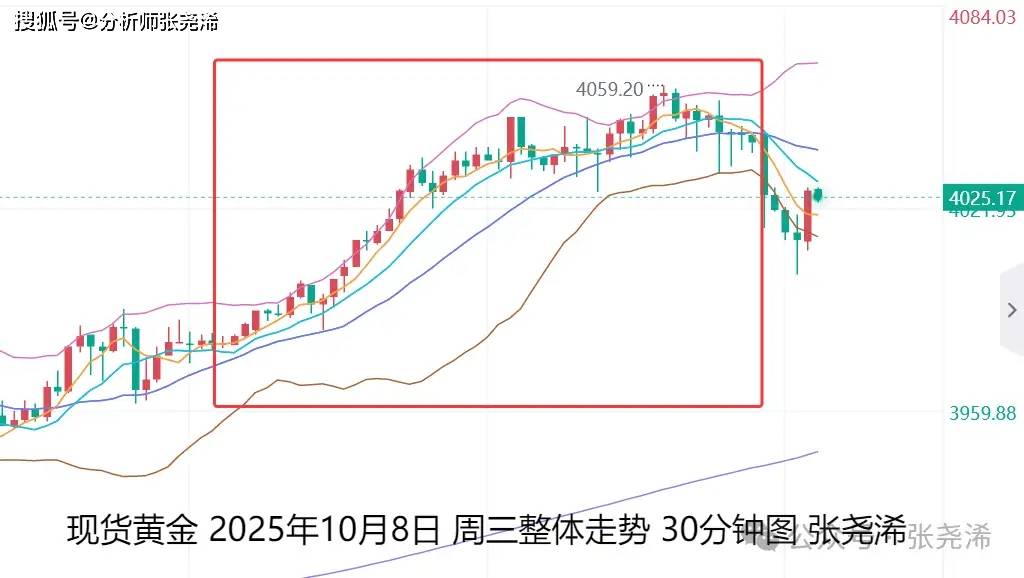
Core Viewpoint - The recent ceasefire agreement between Hamas and Israel has limited the downward pressure on gold prices, and any pullback is seen as a buying opportunity for bullish investors [1][3]. Market Performance - On October 8, gold prices opened at $3984.29 per ounce, reached a low of $3983.22, and then rose to a high of $4058.85 before closing at $4041.35, marking a daily increase of $57.06 or 1.43% [3]. - On October 9, gold prices initially fell by $40 due to reduced market risk appetite following the ceasefire, but this is viewed as a potential re-entry point for long positions [3][5]. Economic Indicators - The ongoing U.S. government shutdown is expected to impact the release of key economic data, likely showing a significant decline in October employment figures and GDP, which would be bullish for gold prices [5]. - The European Central Bank is anticipated to maintain interest rates, which could negatively affect the dollar and positively influence gold prices [6]. Technical Analysis - Gold prices have consistently rebounded from the mid-line support since last year, indicating a strong bullish trend, although there may be short-term pullback risks [8]. - Current trading strategies suggest monitoring support levels around $4000 or $3975 and resistance levels at $4050 or $4080 for gold [10]. Silver Market - For silver, support levels are noted at $48.40 or $48.00, with resistance levels at $49.60 or $50.30 [11].
多家银行下调美元存款利率, 存美元还得“货比三家”
Sou Hu Cai Jing· 2025-10-02 00:55
Core Viewpoint - The article discusses the impact of the Federal Reserve's recent interest rate cut on USD deposit rates in China, highlighting the significant differences in rates among various banks and the importance of comparing options for depositors [1][3]. Group 1: Interest Rate Changes - The Federal Reserve announced a 25 basis point cut in the federal funds rate, bringing it to a target range of 4.00%-4.25%, marking the first cut since December 2024 [1]. - Following the Fed's announcement, many banks, including HSBC and Standard Chartered, quickly adjusted their USD deposit rates, with HSBC offering 3% for 1-year deposits and Standard Chartered offering rates up to 3.8% for various terms [3]. - Chinese banks have also begun to lower their USD deposit rates, with some previously offering rates as high as 5.2% now reduced to around 3% [3]. Group 2: Rate Comparison and Consumer Behavior - Consumers are encouraged to compare rates among banks, as even a small difference can lead to significant interest earnings; for example, a 1-year deposit of $50,000 at 3.3% yields $150 more than at 3.0% [5]. - The article emphasizes the importance of careful selection in the current environment, as the high-interest window may be closing [7]. Group 3: Market Outlook and Predictions - The market anticipates a continued downward trend in USD deposit rates, with expectations of further rate cuts by the Federal Reserve in upcoming meetings [7]. - Analysts predict that the average annualized yield for USD financial products has dropped from 4.52% in January to 3.79% in September, indicating a clear downward trajectory [7].
黄金期货 前三季度大涨超47%
Zhong Guo Zheng Quan Bao· 2025-10-01 11:04
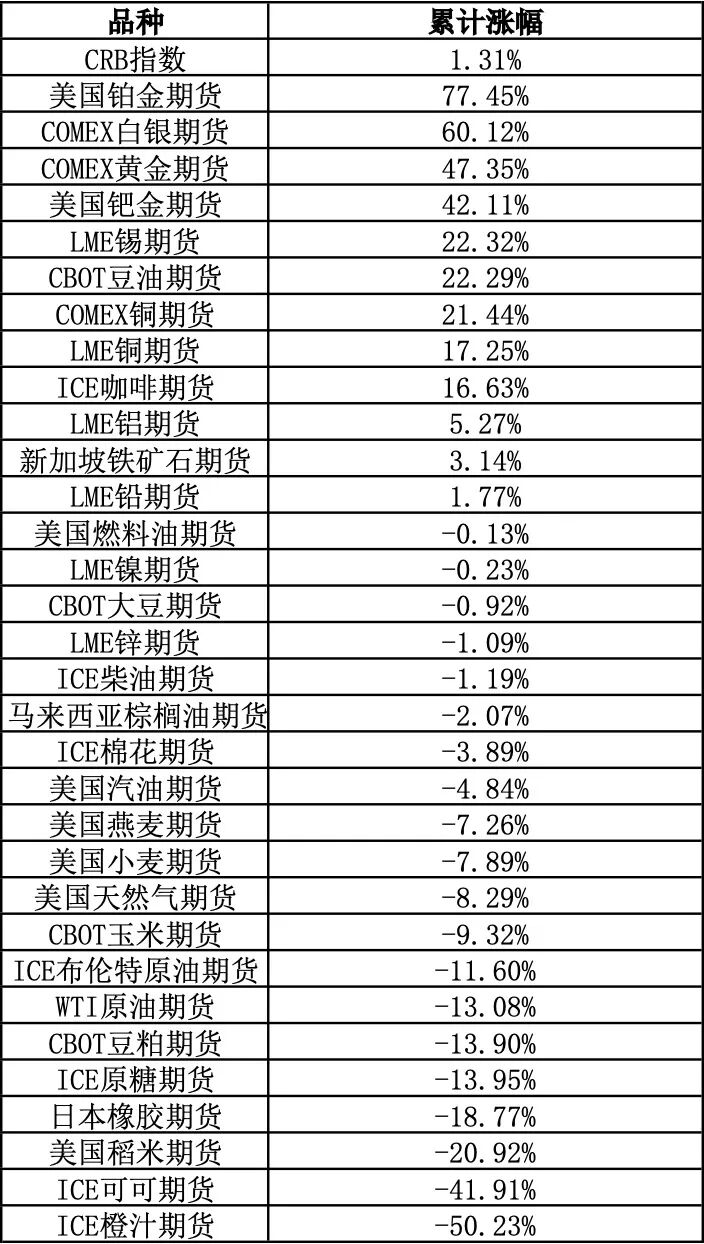
Core Insights - The global commodity futures market has shown significant divergence in performance during the first three quarters of the year, with the CRB price index closing at 300.6 points, reflecting a cumulative increase of 1.31% [1][3] - Precious metals, particularly U.S. platinum futures, have seen substantial gains, with platinum futures rising by 77.45%, leading the performance among other commodity futures [1][3] - The outlook for the fourth quarter suggests that the macro environment for commodities may stabilize due to the onset of a Federal Reserve rate-cutting cycle, although the divergence in commodity performance is expected to continue due to fundamental differences among various commodities [1][5] Commodity Performance - Among the 32 major global commodity futures, 12 commodities achieved positive returns in the first three quarters, representing 37.5% of the total [3] - Precious metals such as COMEX silver, COMEX gold, and U.S. palladium futures also recorded significant gains, with increases of 60.12%, 47.35%, and 42.11% respectively [3] - Conversely, several soft commodities experienced notable declines, with ICE orange juice futures dropping by 50.23%, and ICE cocoa futures down by 41.91% [4][5] Market Analysis - Analysts indicate that the recent surge in platinum prices is driven by both macroeconomic and supply-demand factors, with a projected supply-demand gap for platinum expected to reach a historically high level by 2025 [5] - The Federal Reserve's recent rate cuts are anticipated to continue, with expectations of two more cuts in the fourth quarter, which may support the prices of gold and other assets [5][6] - The outlook for oil prices suggests a potential decline due to increasing supply and seasonal demand drops, with Brent crude oil futures expected to trade between $59 and $74 per barrel [6] Sector-Specific Insights - In the copper market, the initiation of a preventive rate-cutting cycle by the Federal Reserve is expected to bolster overseas demand, while supply constraints due to mining accidents may support copper prices, projected to range between $9,800 and $11,000 per ton in the fourth quarter [7]
沪铜高位运行 关注后续需求表现【9月30日SHFE市场收盘评论】
Wen Hua Cai Jing· 2025-09-30 08:54
Core Viewpoint - Copper prices have reached their highest level since May of last year, driven by supply-side disruptions and improving manufacturing sentiment in China, although downstream demand remains subdued [1] Group 1: Market Performance - The night trading session for copper saw a high opening and a closing increase of 1.27%, with prices slightly retreating during the day [1] - The US dollar index is under pressure, contributing to a generally positive trend in precious metals and non-ferrous metals [1] Group 2: Economic Indicators - China's official manufacturing PMI rose by 0.4 percentage points in September, indicating continued improvement in manufacturing sentiment [1] - The Federal Reserve has initiated a rate-cutting cycle, and risks of a US government shutdown have increased, further pressuring the US dollar [1] Group 3: Supply and Demand Dynamics - The disruption at the Grasberg mine has been largely priced in, but copper prices have shifted to a higher trading range with strong support below [1] - Domestic refined copper social inventory has shown a significant increase due to high copper prices suppressing downstream demand and the end of pre-holiday stockpiling [1] - Despite being the traditional peak demand season, downstream performance in the copper market is weak, with low stocking sentiment among downstream enterprises due to high prices and short-term pricing periods [1] Group 4: Future Outlook - The Grasberg project's shutdown is expected to continue to lower the growth forecast for refined copper production in the coming years [1] - China's target for average growth in non-ferrous metal production has been adjusted down to 1.5% for the next two years, with expectations of continued production cuts in October [1] - The low social inventory levels suggest that copper prices are likely to maintain a volatile upward trend in the short term [1]