
通胀风险

Search documents
杰富瑞策略师:聚焦美联储会议 鲍威尔语气影响降息预期
Sou Hu Cai Jing· 2025-09-16 11:34
Core Viewpoint - The market's focus is on the upcoming Federal Reserve meeting, with particular attention to Jerome Powell's tone regarding inflation risks and uncertainties [1] Summary by Relevant Categories Federal Reserve Meeting - The Federal Reserve meeting is scheduled for Wednesday, and it is expected to be a significant event for market participants [1] Jerome Powell's Tone - The key factor will be Jerome Powell's emphasis on inflation risks or the uncertainty surrounding inflation outlook, which could influence market expectations for interest rate cuts [1]
铝产业链周报-20250915
Chang Jiang Qi Huo· 2025-09-15 02:58
Report Industry Investment Rating - Not provided in the report Core Viewpoints - The Guinea rainy season has affected bauxite mining and transportation, with a decline in bauxite shipments and uncertainties in the复产 of a large mine, supporting ore prices. The alumina production is in a high - stable state, and the electrolytic aluminum operating capacity is increasing steadily. Domestic downstream demand is entering the peak season, and the inventory inflection point is basically determined. The overall idea is to go long on dips, and consider the arbitrage strategy of going long on AD and short on AL [4]. Summary by Directory 01. Weekly Viewpoint - **Fundamental Analysis**: Guinea bauxite prices are stable at $75 per dry ton. Alumina operating capacity increased by 800,000 tons to 97.55 million tons, and national alumina inventory increased by 71,000 tons to 3.68 million tons. Electrolytic aluminum operating capacity increased by 10,000 tons to 44.409 million tons. The domestic aluminum downstream processing leading enterprises' operating rate rose by 1% to 61.7%. The inventory of aluminum ingots and aluminum rods decreased, and the demand for recycled cast aluminum alloy is recovering [4]. - **Strategy Recommendations**: For alumina, it is recommended to wait and see; for Shanghai aluminum, it is recommended to go long on dips; for cast aluminum alloy, it is recommended to go long on dips or go long on AD and short on AL [5]. 02. Macroeconomic Indicators - The report presents data on the US Treasury yield curve, inflation expectations, and the US dollar - RMB exchange rate, but no specific analysis is provided [7][8] 03. Bauxite - Domestic bauxite supply is tightening, with stable prices in Shanxi and Henan due to strengthened safety supervision and environmental inspections, as well as frequent rainfall. Guinea bauxite prices are stable, and the bauxite shipping volume is decreasing. From mid - to late September, major mining enterprises and alumina plants will start negotiations on the fourth - quarter long - term contract prices [11]. 04. Alumina - As of last Friday, the alumina construction capacity was 114.62 million tons (unchanged week - on - week), the operating capacity was 97.55 million tons (an increase of 800,000 tons week - on - week), and the operating rate was 85.1%. The domestic spot weighted price was 3,047.5 yuan per ton (a decrease of 53.5 yuan per ton week - on - week). The national alumina inventory was 3.68 million tons (an increase of 71,000 tons week - on - week). Some new production capacities are entering the stable production state, and some roasting furnaces will be under maintenance, but it will not affect the medium - term output [15]. 05. Alumina Important High - Frequency Data - The report presents data on alumina basis, inventory, north - south price difference, and shipping volume, but no specific analysis is provided [17][18][19] 06. Electrolytic Aluminum - As of last Friday, the electrolytic aluminum construction capacity was 45.232 million tons (unchanged week - on - week), and the operating capacity was 44.409 million tons (an increase of 10,000 tons week - on - week). The operating capacity is increasing steadily, with the resumption of production in Guizhou Anshun and the commissioning of Yunnan Aluminum Yixin's replacement capacity basically completed, and the remaining 50,000 - ton capacity of Baise Yinhai's technical renovation project continuing to resume production [22]. 07. Electrolytic Aluminum Important High - Frequency Data - The report presents data on electrolytic aluminum processing fees, aluminum prices, power coal prices, and aluminum import profits, but no specific analysis is provided [26] 08. Inventory - The report presents historical data on the social inventory of aluminum rods and ingots, Shanghai Futures Exchange aluminum futures inventory, and LME aluminum inventory, but no specific analysis is provided [28][29][30] 09. Casting Aluminum Alloy - The operating rate of leading recycled aluminum alloy enterprises rose by 1.8% to 55.3% week - on - week. Since September, downstream procurement sentiment has slightly improved, but industry operations are still restricted by factors such as insufficient raw material supply and policy uncertainties [33]. 10. Casting Aluminum Alloy Important High - Frequency Data - The report presents data on aluminum alloy prices, price differences, and import profits, but no specific analysis is provided [36][39][40] 11. Downstream Operating Rate - The operating rate of domestic aluminum downstream processing leading enterprises rose by 0.4% to 62.1% week - on - week. The operating rate of aluminum profile leading enterprises rose by 1% to 54%, with different performances in industrial and construction profiles. The operating rate of aluminum strip leading enterprises remained stable at 68.6%, with differentiated product performance [46]. 12. Downstream Operating Rate - The operating rate of domestic cable leading enterprises rose by 0.4% to 65.2% week - on - week, supported by existing orders. The operating rate of leading primary aluminum alloy enterprises rose by 1% to 57.6%, with different production performances between large and small enterprises [50].
9月12日上期所沪银期货仓单较上一日增加6382千克
Jin Tou Wang· 2025-09-12 09:51
Group 1: Silver Futures Market - The total silver futures warehouse receipts increased by 6,382 kilograms to 1,246,569 kilograms as of September 12 [1] - The main silver futures contract opened at 9,777 CNY/kg, reached a high of 10,065 CNY/kg, and closed at 10,035 CNY/kg, reflecting a 2.36% increase [1] - The increase in warehouse receipts was primarily driven by the Zhonggongmei Supply Chain, which contributed 6,227 kilograms [1] Group 2: U.S. Economic Outlook - The IMF indicated that the U.S. economy is showing signs of pressure, with weakening domestic demand and slowing job growth [2] - High tariffs imposed by the Trump administration are contributing to inflation risks, with the IMF suggesting that the Federal Reserve should be cautious in its monetary policy decisions [2] - The IMF noted that while inflation is gradually approaching the Fed's 2% target, tariff policies are adding upward pressure on prices, potentially affecting household living costs [2] Group 3: Federal Reserve Policy - The IMF believes there is still room for the Federal Reserve to lower interest rates, but any actions should be taken cautiously [3] - The Fed is advised to closely monitor economic data and adjust policies prudently to balance economic growth and price stability [3] - This "tightrope" policy approach presents challenges for the Fed and adds uncertainty to the future trajectory of the U.S. economy [3]
美银:美联储9月会议或现严重内部分歧
Sou Hu Cai Jing· 2025-09-04 19:32
Core Viewpoint - The Federal Reserve's interest rate decision in September is expected to show significant internal divisions among its members [1] Group 1: Dovish Members - Dovish members such as Waller, Bowman, Daly, and the likely confirmed nominee Milan may advocate for further rate cuts [1] Group 2: Hawkish Members - Hawkish members including Harmack, Bostic, Musalim, and Schmidt emphasize the risks associated with inflation [1] Group 3: Potential Outcomes - Even if a 25 basis point rate cut occurs in the September meeting, there may still be dissenting votes within the committee [1]
金荣中国:现货黄金小幅回吐隔夜涨幅,测试3550下方寻找支撑
Sou Hu Cai Jing· 2025-09-04 05:45
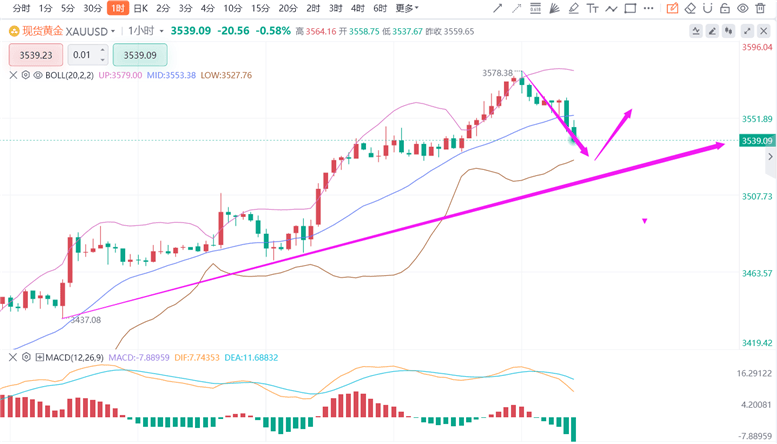
Fundamental Analysis - Gold prices have shown a strong upward trend, reaching a record high of $3578 per ounce, with a closing price of $3558.93, reflecting a 0.72% increase, driven by dovish comments from Federal Reserve officials and weak employment data [1][3] - The U.S. labor market is showing signs of weakness, with job vacancies decreasing by 176,000 to 7.181 million, the lowest since September 2024, and the vacancy rate dropping to 4.3%, indicating a slowdown in labor demand [1][3] - The number of unemployed individuals has surpassed job vacancies for the first time since April 2021, with only 0.99 job openings per unemployed person, highlighting a significant shift in the labor market dynamics [1][3] - The Federal Reserve is expected to adjust its monetary policy in response to the labor market's deterioration, with a 96% probability of a 25 basis point rate cut in the upcoming policy meeting [3][4] Economic Policies - The current economic challenges are attributed to the Trump administration's import tariffs and immigration policies, which have increased business costs and tightened labor supply [3][4] - Federal Reserve officials are increasingly signaling the need for rate cuts, with various members expressing the potential for multiple cuts in the next three to six months, depending on economic data [4][5] - The Fed's Beige Book indicates that while tariffs have led to price increases, businesses are hesitant to pass on these costs, complicating the balance between controlling inflation and maintaining strong employment [4][5] Market Sentiment - The rise in gold prices is seen as a reflection of global uncertainties, with investor concerns about the Fed's independence and dovish statements amplifying risk-averse sentiment [5] - The upcoming U.S. non-farm payroll report for August is anticipated to be a key focus for traders, as it may provide further insights into the labor market's health and influence gold prices [5] Technical Analysis - Gold prices recorded a significant bullish candle, closing near $3578.36, indicating potential for further upward movement, with traders eyeing the $3600 resistance level [7] - Short-term price action suggests a test of support around $3530, with potential for short-term buying opportunities if this level holds [7] Trading Strategies - Suggested long positions near $3530 with a stop loss at $3524 and targets around $3545/$3560 [8] - Suggested short positions between $3555-$3560 with a stop loss at $3565 and targets around $3530/$3500 [8]


雷恩称通胀风险偏向下行 欧洲央行降息之路仍未封闭
Jin Tou Wang· 2025-09-04 04:02
Group 1 - The European Central Bank (ECB) member Rehn refuted market speculation that there will be no further interest rate cuts in the coming months, indicating that current inflation risks are clearly "biased downwards" [1] - Rehn warned against complacency regarding price stability, despite the annual inflation rate meeting the ECB's 2% medium-term target for the past two months [1] - He highlighted several downward risks to be monitored, including falling energy prices, euro appreciation, and controlled service sector inflation [1] Group 2 - The euro to dollar exchange rate is currently experiencing a range-bound movement, with resistance at the August high of 1.1742 [2] - A breakthrough above this level could open up further upside potential, targeting 1.1788 and the high of 1.1830 from July 2025 [2] - The initial support level is at the 100-day simple moving average (SMA) of 1.1514, with further support at the August low of 1.1391 and the weekly bottom of 1.1210 [2]
张德盛:9.4黄金冲高回落今日看涨看跌,积存金行情走势分析操作
Sou Hu Cai Jing· 2025-09-04 02:58
Group 1 - The core viewpoint is that gold prices are experiencing a significant upward trend, driven by macroeconomic pressures and expectations of a Federal Reserve rate cut [2][3] - Spot gold reached a record high of $3578 per ounce, reflecting a 0.72% increase, with seven consecutive days of price rises [2] - Weak U.S. employment data has reinforced expectations for a rate cut by the Federal Reserve, contributing to the bullish sentiment in the gold market [2] Group 2 - The analysis suggests maintaining a bullish trend for gold but advises against chasing high prices, with key support and resistance levels identified [3] - Domestic gold prices in China have also surged, with Shanghai gold reaching around 825 and accumulated gold at approximately 814, indicating a strong upward trend [3] - The focus remains on upcoming economic data releases, particularly unemployment claims and ADP figures, which are expected to influence gold trading strategies [3]
海通期货:金银齐飞! 沪金破791创纪录
Jin Tou Wang· 2025-09-02 04:01
9月2日,沪金主力暂报806.06元/克,涨幅达1.43%,今日沪金主力开盘价799.54元/克,截至目前最高 809.98元/克,最低799.08元/克。 【宏观消息】 【黄金期货行情表现】 美联储看重的通胀指标创下2月以来最大升幅。美国上诉法院裁定特朗普全球关税多数不合法,但暂未 叫停实施。中国官方PMI显示制造业继续萎缩。华府将撤销三星电子和SK海力士在华事业使用美国技 术的豁免。阿里巴巴人工智能业务表现亮眼,ADR上周五大涨近13%。 美国7月消费支出创四个月来最大增幅,美联储看重的通胀指标核心个人消费支出价格指数创2月以来最 大同比升幅。此外,就业和通胀担忧拖累密歇根大学消费者信心降至三个月低点。 【机构观点】 8月29日夜盘,黄金和白银期货价格同步上涨。沪金主力合约AU2510上涨0.90%至791.28元/克,沪银主 力合约AG2510上涨1.93%至9566元/千克。 上周,黄金连续5天上涨,走出强势波段。截至周五收盘,COMEX黄金成功突破3500美元的关键点 位,并有望再创历史新高。本轮行情始于鲍威尔在全球央行会议上超预期释放鸽派信号,有效提振了贵 金属市场情绪。鲍威尔的讲话预示联储重启降 ...
机构:本周非农数据偏热的可能性更大
Sou Hu Cai Jing· 2025-09-01 15:16
Core Insights - The report from Monex Europe analysts suggests that if the non-farm payroll data released on Friday exceeds expectations, the US dollar may receive some support [1] - It is anticipated that the August data will indicate a relatively stable labor market, with a higher likelihood of stronger-than-expected data [1] - This situation could shift market focus back to inflation risks, as the August inflation data will be released before the Federal Reserve's September meeting [1] - If the Federal Reserve places greater emphasis on inflation risks, it may not implement interest rate cuts throughout the year, leading to an adjustment in market interest rate expectations and a strengthening of the US dollar [1]
机构看金市:9月1日
Sou Hu Cai Jing· 2025-09-01 08:00
转自:新华财经 •海通期货:通胀风险难以消退 支撑黄金长期牛市延续 •金瑞期货:避险情绪升温 贵金属价格大涨 新湖期货表示,黄金上涨一方面是受益于市场对美联储年内降息预期的回升,另一方面来自于市场对美 联储独立性的担忧使得美元指数承压。特朗普罢免美联储理事库克事件持续发酵,在上周五的听证上, 法官未能立即裁决,并要求库克的律师提交补充意见,详细阐述解职行为违法的理由。库克暂时继续留 任,她仍将参加9月的利率决策会议。短期来看,特朗普解雇美联储理事库克的决定是他上任以来对美 联储的第四次攻击,美联储的独立性堪忧,疲弱的美元将对金价形成一定支撑。中长期来看,央行购金 具有持续性,叠加全球货币的泛滥和去美元化趋势,将继续支撑金价中枢上行,后续黄金可能仍偏强。 关注本周美国8月非农就业数据。 资产战略国际(Asset Strategies International)总裁兼首席运营官Rich Checkan表示,目前投资者几乎确 信美联储将在9月的会议上降息,这有望成为金价进一步上涨的驱动。他认为,尽管金价突破3400美元 阻力位之后,获利回吐的时机可能已经成熟,但考虑到美国总统特朗普解雇美联储理事库存的事件让投 资 ...