
资产配置

Search documents
10 月市场展望:贵金属与港股成焦点?两类配置思路参考
Sou Hu Cai Jing· 2025-09-23 05:25
Core Insights - The market outlook for September and October is influenced by two main factors: the Federal Reserve's interest rate policy and the rotation of hot sectors in the A-share market [2][6] Group 1: Market Variables - The Federal Reserve's interest rate cut schedule is a critical factor, with the meeting on September 17 being a key date. If the rate cut exceeds expectations, it could benefit Hong Kong stocks and precious metal prices [2][3] - The A-share market is expected to see a "high-low rotation" trend, with funds shifting from previously high-performing sectors to lower-valued areas such as Hang Seng Technology and innovative pharmaceuticals [2][3] Group 2: Investment Strategies - "Multi-Asset Rotation" strategy focuses on conservative allocation suitable for risk-averse investors, with 30% in A-shares, 35% in precious metals, and 35% in overseas assets like Nasdaq and Nikkei [3][4] - "Investment Strategy Discussion (Liang Shan)" proposes a balanced offensive strategy, emphasizing A-shares as the main battlefield and allocating 10%-15% to Hong Kong stocks, particularly in technology and innovative pharmaceuticals [4][5] Group 3: Precious Metals Allocation - A small allocation of 5%-10% in precious metals through gold ETFs is recommended as a risk-hedging tool against geopolitical uncertainties [5]
给新入场的基金萌新手册
Sou Hu Cai Jing· 2025-09-23 04:46
Group 1 - The article emphasizes the importance of understanding the fundamentals of funds before investing, highlighting that many individuals jump into investments without proper knowledge, leading to potential losses [1][2] - It presents a metaphor comparing funds to a group dining experience where a professional chef (fund manager) prepares a meal (investment portfolio) using pooled resources from investors [3][4] - The core message is that investing in funds is about hiring a professional team to manage money rather than betting on individual stocks [5] Group 2 - The article categorizes funds into four main types based on risk and return: equity funds, mixed funds, bond funds, and money market funds, providing a clear framework for investors to identify suitable options [6][7] - Equity funds are described as high-risk, high-reward investments, suitable for those with a strong risk tolerance and a long investment horizon [8][10] - Mixed funds offer flexibility and balance, appealing to moderate risk-takers and those with limited investment experience [11][12] Group 3 - Bond funds are characterized as conservative investments, ideal for risk-averse individuals seeking stable cash flow [13][14] - Money market funds are presented as extremely low-risk options, suitable for all investors, especially beginners looking for a safe place to park their emergency funds [17][18] - The article also introduces specialized fund types like QDII funds for overseas investments and FOF funds that invest in a basket of other funds, catering to more advanced investors [19][21] Group 4 - The article concludes with three essential questions for investors to determine their investment strategy: investment goals, risk tolerance, and available funds, guiding them to make informed decisions [24][25][26] - It stresses that understanding fund categories and aligning them with personal financial situations can significantly enhance investment outcomes [27][29]
Riders on the Charts:每周大类资产配置图表精粹:资产配置快评2025年09月23日-20250923
Huachuang Securities· 2025-09-23 04:43
Group 1: Market Trends - Extreme short positions in the dollar suggest a potential short squeeze in the future, with speculative net short positions rising to 13,000 contracts, accounting for 33.5% of total positions, the highest since February 2021[4] - Japan's core CPI, excluding food and energy, has remained at 1.6% year-on-year for six consecutive months, indicating a cooling inflation pressure that may limit the Bank of Japan's rate hike space[7] - The 10-year Japanese government bond yield may trend down towards 1% as inflation levels continue to decline, flattening the yield curve[11] Group 2: Central Bank Actions - The Bank of Japan plans to gradually sell its ETF and real estate trust holdings, with an annual target of 330 billion yen for ETFs and 5 billion yen for real estate trusts, suggesting a selling timeline of over 100 years at the current pace[9] - The current equity risk premium (ERP) for the CSI 300 index is 4.5%, which is one standard deviation below the 16-year average, indicating potential for valuation uplift[17] Group 3: Economic Indicators - Since the beginning of the year, the U.S. labor supply has increasingly favored domestically born individuals, with 139 million domestic-born workers compared to 32.24 million foreign-born workers[15] - The forward arbitrage return on China's 10-year government bonds is currently at 23 basis points, which is 53 basis points higher than the level in December 2016[20] - The total return ratio of domestic stocks to bonds is 27.8, above the 16-year average, suggesting enhanced attractiveness of equity assets relative to fixed income[27]
黄金存量平衡下的风险与避险
2025-09-23 02:34
Summary of Key Points from Conference Call Industry Overview - The conference call discusses the gold market and its dynamics, particularly in relation to macroeconomic factors and central bank behaviors. The focus is on how these elements influence gold prices and investment strategies. Core Insights and Arguments 1. **Commodity Market Dynamics**: Agricultural and pig prices have declined due to oversupply, reflecting fundamental signals in the global commodity market, aligning with liquidity expectation trading judgments [1] 2. **Gold Price Sensitivity**: Gold prices are influenced by supply, inventory, consumption, and investment demand. A 25 basis point interest rate change can affect gold prices by approximately $40 to $50 per ounce [4][1] 3. **Investment Demand**: Investment demand is a crucial factor in determining the central price of gold, with private sector investments through ETFs significantly influenced by risk appetite. As of the end of 2024, the European and American markets accounted for over 90% of global ETF holdings, while China's share was 4% [6][7] 4. **Central Bank Purchases**: Central bank gold purchases have a significant impact on gold prices, with historical data showing a shift from net selling to net buying leading to high premiums. Major contributors to this trend include China, Russia, and India [11][10] 5. **ETF Role in Gold Market**: ETFs serve as a critical tool for reflecting risk-hedging behavior, with significant fluctuations in holdings during major uncertainty events. However, ETF funds typically do not remain in the market long-term, often exiting after the peak of uncertainty [9][8] 6. **Risk Hedging Function**: Gold is primarily viewed as a risk-hedging tool within asset allocation strategies, akin to insurance, protecting other assets from unexpected risk events [13][15] 7. **Economic Cycle Impact**: Future economic cycles will significantly influence gold prices. Continued Fed rate cuts amid recession risks may drive more investors toward gold, while an overheating economy could weaken this trend [14][20] 8. **Market Environment**: The current market is characterized as both promising and risky for gold, benefiting from factors like de-globalization, trade conflicts, inflation expectations, and potential stagflation risks [17][18] 9. **Oil Prices and Inflation**: Oil prices are currently low but could rise due to geopolitical risks, impacting inflation expectations and interest rate trading [19][20] Other Important Insights - **Weak Correlation with Other Assets**: The weak correlation of gold with other risk assets enhances its value in multi-asset portfolios, particularly in low-probability scenarios [15] - **Future Price Volatility**: The gold market is expected to experience volatility rather than consistent upward trends, influenced by macroeconomic indicators and policy changes [20] - **Long-term Investment Considerations**: Investors should focus on macro events and geopolitical risks rather than short-term price movements when considering gold investments [16]
陈锦泉、董承非、谢治宇 最新研判
Shang Hai Zheng Quan Bao· 2025-09-23 01:11
Core Viewpoint - The current market presents numerous investment opportunities despite structural characteristics, and asset allocation strategies are essential for capturing diverse returns while managing risks [1][4]. Group 1: Market Outlook - Investors maintain a positive outlook on equity assets, with the resilience of the Chinese economy becoming more evident this year, highlighting companies with sustainable profitability and competitiveness [2]. - The consensus is that in a low-interest-rate environment, equity assets remain attractive, and focusing on companies with core competitiveness is seen as the optimal solution for achieving excess returns [2]. - The current low risk-free return necessitates the inclusion of risk assets in investment portfolios to pursue higher returns [2]. Group 2: Asset Allocation Importance - The necessity of asset allocation is increasing as market volatility and the difficulty of obtaining returns grow, with professional investors emphasizing its importance [4]. - Asset allocation research can assist equity investment by identifying economic cycle stages and systemic risks through macro variables, and by optimizing asset styles under different economic growth and inflation scenarios [4]. Group 3: Investment Opportunities - Notable investment opportunities include the potential rebound of dollar assets and the continued upward space for assets represented by the renminbi [6]. - Gold is viewed as a strong tool for hedging portfolio risks due to its low correlation with the dollar, while copper is expected to perform well due to demand from new energy and AI, despite longer supply development times [6]. - In the current environment of low inflation and ample liquidity, a combination of stocks, bonds, and commodities, particularly gold, is favored for investment [6].
32万/平豪宅遭疯抢:揭秘中国新富阶层的财富密码与资产保卫战
Sou Hu Cai Jing· 2025-09-22 18:23
Core Insights - The recent sale of a luxury duplex in Shanghai for 32.68 million yuan per square meter reflects a significant shift in wealth allocation among China's new affluent class, amidst a slowing economy [1][3] - The overall average price of the project reached 20.5 million yuan per square meter, with a subscription rate of 190%, indicating a stark contrast to the sluggish ordinary housing market [3][9] Buyer Demographics - Three main buyer categories have been identified: 35% are internet entrepreneurs, including executives from short video platforms and cross-border e-commerce founders; 20% are owners of hidden champion manufacturing firms in the Yangtze River Delta; and 25% are financial professionals, including private equity fund managers and investment banking managing directors [4][5] Luxury Real Estate as an Asset Anchor - Luxury properties serve three core functions: as a preservation tool in an era of currency overproduction, as a risk isolation firewall, and as a means of accessing elite educational resources, which are seen as hard currency for social mobility [7][9] Shifts in Asset Allocation - The phenomenon at Jinling Huating indicates a paradigm shift in asset allocation among the wealthy, with the proportion of top-tier real estate in their portfolios rising from 15% to 25%, reflecting a move towards core asset strategies [9][10] - The hot sales of luxury properties suggest a growing demand for asset concealment, moving away from traditional luxury goods [9][10] Market Sentiment and Social Implications - The luxury real estate market acts as a barometer for the new economy's wealth generation capabilities and reflects a lack of confidence in traditional investment channels [10][11] - The phenomenon of luxury properties selling out rapidly raises questions about its impact on social mobility and wealth distribution in the context of China's common prosperity policy [10][11]


宏观投资,必读10篇!(申万宏观·赵伟团队)
赵伟宏观探索· 2025-09-22 16:03
Core Viewpoint - The article emphasizes the importance of macroeconomic trends and their impact on various asset classes, highlighting key insights on gold, currency exchange rates, and bond markets throughout 2025 [2]. Group 1: Gold Market Insights - The analysis on January 2, 2025, indicates a bullish outlook on gold, suggesting that the acceleration of U.S. Treasury bond maturities may lead global central banks to increase gold purchases [3]. - The article notes that investment demand for gold in Europe and the U.S. is expected to accelerate in the latter half of the year [3]. Group 2: Currency and Exchange Rate Analysis - On January 16, 2025, the article discusses the resilience of the Chinese yuan, attributing it to the central bank's counter-cyclical adjustments and domestic economic strength, despite widespread expectations of depreciation [4]. - The article also highlights the potential for a stronger yuan supported by pending settlement funds [4]. Group 3: Policy and Market Opportunities - The analysis from February 9, 2025, points out the market opportunities arising from the "fermentation period" of policies, focusing on proactive fiscal measures and specific industry policies [5]. - On May 11, 2025, the article suggests that trade negotiations and financial pressures may prompt the Federal Reserve to adopt a more dovish stance, which could positively influence market sentiment [6]. Group 4: Bond Market Dynamics - The March 17, 2025, analysis warns against a linear bullish mindset in the bond market, indicating that asset allocation strategies may need to be reconsidered as the market undergoes rebalancing [5]. - The article discusses the distance of long-term bond yields from 2% to 1%, emphasizing the need for a nuanced approach to bond investments [5]. Group 5: U.S. Dollar and Global Currency Trends - The article from April 20, 2025, raises concerns about the sustainability of U.S. debt and the potential weakening of the dollar's safe-haven status, which may lead to capital flows towards the euro and other assets [6]. - On July 8, 2025, it is noted that while a weaker dollar and "de-dollarization" are distinct concepts, the anticipated interest rate cuts could support a temporary strengthening of the dollar index [7]. Group 6: Market Sentiment and Investment Behavior - The August 16, 2025, analysis highlights a shift in market focus towards the U.S. labor market, with inflation pressures easing, suggesting a potential return of capital to the U.S. [8]. - The article also indicates that despite a recent consolidation in A-shares, investor sentiment remains bullish, with a continued possibility of a "stock-gold seesaw" effect [11].

“杀”疯了,金价再创新高!
Guo Ji Jin Rong Bao· 2025-09-22 13:40
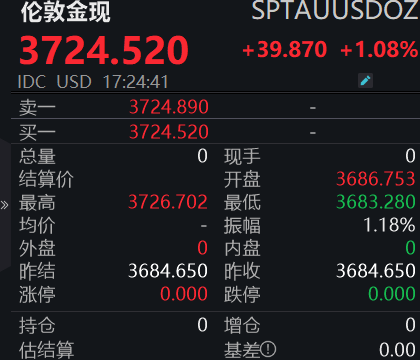
Core Viewpoint - Gold prices have surged recently, with London gold breaking the $3,720 per ounce mark and COMEX gold futures reaching $3,756.9 per ounce, both hitting historical highs [1][3]. Group 1: Price Movements - As of the latest report, London gold reached $3,720 per ounce, increasing over 1%, with an intraday high of $3,726.702 per ounce [1]. - COMEX gold futures rose nearly 1.4%, closing at $3,756.9 per ounce, with a peak of $3,761.2 per ounce during the trading session [1][2]. Group 2: Factors Driving Price Increase - The rise in gold prices is attributed to the Federal Reserve's "preventive rate cut" policy, concerns over stagflation risks, and worries about the Fed's independence [3][4]. - A decline in the U.S. dollar index and issues surrounding the security of cryptocurrencies, particularly the drop in Bitcoin prices, have also contributed to the upward momentum in gold prices [3]. Group 3: Market Analysis and Future Outlook - Analysts suggest that the market's expectation of a rate cut by the Federal Reserve has bolstered gold prices, especially following a dovish shift from Fed Chair Powell [3][5]. - The ongoing geopolitical tensions and economic pressures in regions like Europe and the Middle East have heightened risk aversion, further supporting gold's price increase [3][4]. - Looking ahead, analysts believe that the long-term upward trend for gold is likely to continue, with potential targets of $3,800 and even $4,000 per ounce by year-end [5].
陈锦泉、董承非、谢治宇,最新研判
Shang Hai Zheng Quan Bao· 2025-09-22 13:27
Core Viewpoint - Current market conditions present numerous investment opportunities despite a year of recovery, emphasizing the importance of asset allocation strategies to capture diverse returns while managing volatility risks [2] Group 1: Low-Interest Rate Environment - The low-interest rate environment challenges traditional investment logic, making it difficult to manage risks and achieve stable long-term returns [2] - There is a consensus among investors regarding the attractiveness of equity assets, driven by China's economic resilience and the emergence of companies with sustainable profitability [2] - The focus on companies with core competitiveness remains the optimal solution for achieving excess returns in a liquidity-rich environment [2] Group 2: Market Dynamics and Asset Allocation - The current low-risk-free rate necessitates the inclusion of risk assets in investment portfolios to pursue higher returns [3] - Equity assets are viewed as having the best value proposition among risk assets, despite a decrease in attractiveness compared to the previous year [3] - The importance of asset allocation is increasing as market volatility and the difficulty of obtaining returns grow [5] Group 3: Investment Opportunities - Potential investment opportunities include a rebound in dollar assets and continued upward potential for assets represented by the renminbi [6] - Gold is considered a strong tool for hedging portfolio risks due to its low correlation with the dollar, while copper is expected to perform well due to demand from new energy and AI [6] - In a low inflation and ample liquidity environment, a diversified approach involving stocks, bonds, and commodities, particularly gold, is favored [7]

Gold price today, Tuesday, September 23, 2025: New highs for gold after reports China wants custodian role
Yahoo Finance· 2025-09-22 11:59
Core Insights - Gold futures opened at $3,781.20 per ounce, marking a 1.1% increase from the previous close of $3,740.70, reaching a new high for the precious metal [1][2] - The rise in gold prices is attributed to China's move to become a custodian of foreign sovereign gold reserves, with the People's Bank of China increasing its own gold reserves for 10 consecutive months [2][3] - Over the past month, gold futures have increased by 12.9%, and over the past year, the price has risen by 44% [3] Price Trends - The current opening price of gold futures is up 2.7% from the opening price of $3,681.40 one week ago [3] - The increase in gold prices is part of a broader trend, with significant appreciation noted over the past year [3][10] Investment Considerations - Experts recommend holding 5% to 15% of net worth in gold, with some advising up to 20% for risk-tolerant investors [7] - The allocation strategy should consider existing gold assets, including jewelry, to avoid unnecessary transactions [9] - Historical trends indicate that gold has experienced both up and down cycles, impacting overall investment returns [11][12] Market Outlook - Analysts are bullish on gold, with Goldman Sachs predicting a price of $3,700 per troy ounce by year-end 2025, representing a 40% increase from the beginning of the year [13] - Rising demand from central banks and geopolitical uncertainties are key factors driving the increase in gold prices [13]