扩内需

Search documents
发票藏“红包” 你抽到了吗?
Ren Min Ri Bao Hai Wai Ban· 2026-01-14 01:56
Core Viewpoint - The Chinese government is launching a pilot program for prize-linked invoices in approximately 50 cities to stimulate consumer spending and enhance economic activity, with a focus on increasing the issuance of value-added tax (VAT) invoices [2][5][9]. Group 1: Policy Implementation - The pilot program will allow cities to set a minimum invoice amount for eligibility (not less than 100 yuan) and determine the prize amounts, with individual prizes capped at 800 yuan, for a duration of six months [2][5]. - Previous local initiatives have shown success in promoting consumer engagement through prize-linked invoices, with notable examples from Guangdong and Jiangsu provinces [3][4]. Group 2: Economic Impact - The initiative aims to boost consumer confidence and spending by creating excitement around the possibility of winning prizes through everyday purchases, thereby converting potential demand into actual purchasing power [5][9]. - The program is expected to have a broader impact on various sectors, including retail, dining, and tourism, aligning with the government's goal of enhancing domestic consumption [9][10]. Group 3: Tax Compliance and Invoice Issuance - The prize-linked invoice system is designed to increase the issuance of VAT invoices, which are essential for tax compliance and can help reduce tax evasion practices among businesses [6][8]. - Data from previous local programs indicate a significant increase in invoice issuance, with Guangdong reporting a 70% rise in invoice volume and a 90% increase in invoice value during promotional periods [7][8]. Group 4: Funding and Support - The central government will provide financial support to pilot cities, with funding limits based on city size, ensuring that resources are allocated effectively to maximize consumer engagement [10][11]. - The program encourages local governments to tailor their strategies based on local consumption patterns and to ensure that prize distribution is both equitable and impactful [11].
六大经济部委释放2026关键信号 两大市场要稳,这些产业要飞
2 1 Shi Ji Jing Ji Bao Dao· 2026-01-13 23:16
Group 1: Economic Policy Signals - The Chinese government is focusing on four key policy signals for 2026: stabilizing growth, expanding domestic demand, supporting technological innovation, and stabilizing the real estate and stock markets [1][2] - Various ministries are actively promoting early policy implementation to ensure a smooth start to 2026, including the early issuance of project lists and investment plans [1][2] Group 2: Fiscal and Monetary Policy - The 2026 fiscal policy will continue to be proactive, with an expanded fiscal spending plan and optimized government bond tools to enhance effectiveness [2][3] - The People's Bank of China will maintain a moderately loose monetary policy, with expectations of a 25-50 basis point reduction in the reserve requirement ratio and a 10-20 basis point decrease in the 7-day reverse repo rate [3][4] Group 3: Consumption and Investment - Measures to boost consumption include optimizing the trade-in policy for consumer goods and expanding service consumption, while investment will be supported through various government funding initiatives [5][6] - The government plans to implement a consumption upgrade policy, providing subsidies for trade-ins of automobiles, home appliances, and digital products [6] Group 4: Real Estate Market Stability - The 2026 strategy includes stabilizing the real estate market through targeted policies, such as controlling new supply and utilizing existing housing stock for affordable housing [11][12] - Major cities are expected to further relax housing purchase restrictions and lower mortgage costs to stimulate housing demand [12] Group 5: Emerging Industries Development - The government aims to enhance technological innovation capabilities and support the growth of emerging industries such as integrated circuits, new materials, and biomedicine [8][9] - A new venture capital fund has been established to attract investment in high-tech sectors, with an expected total investment scale exceeding one trillion yuan [9] Group 6: Innovation-Driven Growth - The focus for 2026 will be on building an innovation-driven growth model, emphasizing the integration of short-term policies with long-term structural reforms [10]
六大经济部委释放2026关键信号
2 1 Shi Ji Jing Ji Bao Dao· 2026-01-13 23:16
Core Viewpoint - The Chinese government is focusing on stabilizing economic growth, expanding domestic demand, supporting technological innovation, and stabilizing the real estate and stock markets as it prepares for the economic goals of 2026, the first year of the 14th Five-Year Plan [1][2]. Economic Policy Initiatives - Various ministries are implementing proactive macroeconomic policies, including enhancing economic monitoring, improving policy tools, and ensuring effective fiscal and monetary policy coordination [2]. - The fiscal policy for 2026 will be more active, with an expanded fiscal spending plan and optimized government bond tools to enhance local financial capabilities [2][3]. - The People's Bank of China will maintain a moderately loose monetary policy, focusing on high-quality economic development and reasonable price recovery, with expectations of a 25-50 basis point reduction in the reserve requirement ratio [2][3]. GDP and Fiscal Projections - The GDP growth target for 2026 is expected to remain around 5%, with a fiscal deficit rate holding steady at 4% and an increase in special bonds to 4.8 trillion yuan [3][4]. - The broad deficit scale is projected to rise from 11.86 trillion yuan in 2025 to approximately 12.45 trillion yuan in 2026, corresponding to a broad deficit rate increase from 8.4% to 8.5% [3]. Consumer and Investment Stimulus - The government aims to boost consumption through practical measures, including optimizing the trade-in policy for consumer goods and expanding service consumption [5][6]. - Investment will be supported through various government funding initiatives, including the issuance of special bonds and increased central budget investments [5][6]. Real Estate and Stock Market Stability - Policies will focus on stabilizing the real estate market through targeted measures, including optimizing housing purchase policies and promoting the use of existing housing for social needs [12]. - The central bank will work on mitigating financial risks in key areas and enhancing market confidence through specific monetary policy tools [13]. Emerging Industry Development - There is a strong emphasis on fostering new and emerging industries, including integrated circuits, new materials, and artificial intelligence, with significant investments planned in these sectors [8][9]. - The establishment of the National Venture Capital Guiding Fund aims to attract substantial investment in high-tech fields, with an expected total investment scale exceeding one trillion yuan [9]. Innovation-Driven Growth - The focus for 2026 will be on building an innovation-driven growth model, enhancing the modern industrial system, and promoting technological self-reliance [10].
发票藏“红包”,你抽到了吗?
Ren Min Ri Bao Hai Wai Ban· 2026-01-13 22:49
Core Viewpoint - The Chinese government is launching a pilot program to promote consumer spending through a lottery system based on invoices, aiming to stimulate demand and enhance consumption across approximately 50 cities [4][11]. Group 1: Policy Implementation - The Ministry of Finance, Ministry of Commerce, and State Taxation Administration have confirmed the support for around 50 cities to conduct a pilot program for prize invoices, with a minimum invoice amount of 100 yuan and a maximum prize of 800 yuan per invoice [4][11]. - The pilot program will last for six months, allowing cities to determine the specifics of the lottery, including the prize structure and winning invoice amounts [4][11]. Group 2: Historical Context - The concept of prize invoices is not new in China, having been implemented in various forms since 2016, aimed at enhancing tax compliance and consumer engagement [5][6]. - Previous initiatives in provinces like Guangdong and Jiangsu have shown positive results, with significant increases in invoice issuance and consumer participation [6][8]. Group 3: Economic Impact - The introduction of prize invoices is expected to boost consumer spending by creating excitement around shopping experiences, thereby converting potential demand into actual purchases [7][11]. - The program is designed to cover essential consumer activities such as shopping, dining, and entertainment, directly impacting daily life and consumption patterns [11][12]. Group 4: Tax Compliance and Benefits - The initiative is anticipated to improve the issuance of value-added tax (VAT) invoices, which are crucial for tax deductions and compliance [8][9]. - By encouraging consumers to request invoices, the program aims to enhance tax compliance among businesses and reduce tax evasion, ultimately benefiting the national economy [9][10]. Group 5: Funding and Support - Central government funding will support the pilot cities, with allocations based on city size, ensuring that financial resources are effectively utilized to maximize consumer engagement [12][13]. - The funding structure includes up to 3 billion yuan for super-large cities, 2 billion yuan for large cities, and 1 billion yuan for smaller cities, promoting targeted spending in sectors with high consumer potential [12][13].

行业协会:紧扣扩内需政策导向,作好行业枢纽
Xin Lang Cai Jing· 2026-01-13 20:53
Core Viewpoint - The Shenzhen Mountaineering and Outdoor Sports Association emphasizes its role in connecting government, enterprises, and the market since its establishment in 2003, focusing on activating consumer potential through product innovation, scene expansion, and public participation during the 14th Five-Year Plan period [1] Group 1: Consumer Activation Strategies - The association aims to create public IPs like Shenzhen Ten Peaks and Kunpeng Trail to stimulate chain consumption, including equipment purchases, event participation, and cultural tourism [1] - It promotes the integration of outdoor sports into daily life by bringing sports events into scenic areas, streets, and business districts [1] - The association targets youth outdoor education and senior health hiking to broaden the consumer base [1] Group 2: Future Development Plans - For the 15th Five-Year Plan, the association has outlined three core strategies: optimizing the industry ecosystem, enhancing sustainable development, and cultivating new growth areas [3] - It plans to improve industry standards and promote digital transformation in outdoor events, training, and equipment sales [3] - The association aims to integrate ecological protection into outdoor activities and promote green equipment development [3] Group 3: Collaborative Initiatives - The association seeks to focus on personalized, quality, and intelligent consumption trends by organizing cross-border events and creating a mountain-sea symbiotic sports culture season [2] - It intends to leverage Shenzhen's proximity to Hong Kong to create a cross-city outdoor consumption corridor, benefiting a wider audience [2] - The association will assist the government in implementing consumer promotion policies, such as outdoor product exchanges through sports points [2]
六大部委释放四大关键信号,这些产业要飞
21世纪经济报道· 2026-01-13 13:35
Core Viewpoint - The article emphasizes the proactive measures taken by various Chinese government departments to ensure stable economic growth in 2026, marking the beginning of the "14th Five-Year Plan" period. Key policies focus on stabilizing growth, expanding domestic demand, supporting technological innovation, and maintaining stability in the real estate and stock markets [1][3]. Group 1: Economic Policy Measures - The National Development and Reform Commission (NDRC) and other ministries are implementing policies to strengthen economic monitoring, improve policy tools, and manage expectations to ensure a smooth start to 2026 [3]. - The fiscal policy for 2026 will be more proactive, with an expanded fiscal spending plan and optimized government bond tools to enhance financial efficiency [3]. - The People's Bank of China (PBOC) will continue a moderately loose monetary policy, focusing on high-quality economic development and reasonable price recovery, while maintaining liquidity and promoting balanced credit growth [3][4]. Group 2: GDP and Fiscal Projections - The GDP growth target for 2026 is expected to remain around 5%, with a fiscal deficit rate holding steady at 4% and an increase in special bonds to 4.8 trillion yuan [4]. - The broad deficit scale is projected to rise from 11.86 trillion yuan in 2025 to approximately 12.45 trillion yuan in 2026, with a corresponding increase in the broad deficit rate from 8.4% to 8.5% [4]. Group 3: Consumer and Investment Stimulus - The NDRC emphasizes the need for practical measures to boost consumption, including optimizing the trade-in policy for consumer goods and enhancing service consumption [7]. - Investment strategies will focus on stabilizing and increasing effective investment, particularly in new infrastructure and technology sectors, with significant government funding allocated for major projects [8][9]. Group 4: Emerging Industries Development - The Ministry of Industry and Information Technology aims to enhance technological innovation capabilities and support the growth of emerging industries such as integrated circuits, new materials, and biomedicine [11][12]. - The establishment of the National Venture Capital Guiding Fund, with an initial investment of 100 billion yuan, aims to attract further investment in key technology sectors [12]. Group 5: Real Estate and Stock Market Stability - The housing and urban-rural development meeting outlines strategies to stabilize the real estate market through targeted policies, including optimizing housing purchase restrictions and supporting demand for housing [15]. - The PBOC is focused on mitigating financial risks in key areas and has established mechanisms to provide liquidity support to non-bank institutions, enhancing market stability [16][17].

展望2026年资本市场:结构性机遇点亮投资新航程
Zhong Guo Jing Ji Wang· 2026-01-13 06:04
Group 1: Capital Market Overview - The year 2026 is seen as a critical year for the "14th Five-Year Plan," with the capital market at a pivotal point for policy reform and industrial transformation [1] - The capital market is expected to exhibit structural characteristics such as "technology-driven leadership, breakthroughs in green sectors, and coordinated consumer investment" [1] - By the end of 2025, various long-term funds held approximately 23 trillion yuan in A-share market value, a 36% increase from the beginning of the year [1] Group 2: Market Dynamics and Economic Indicators - The focus on adjusting the structure of listed companies aims to attract long-term funds like insurance and pension funds to enhance market liquidity [2] - A significant reduction in market volatility was noted, with the number of trading days where the index fell more than 1% being the lowest in recent bull markets [2] - The nominal GDP is projected to rise from 4.0% in 2025 to 4.5% in 2026, indicating an improvement in corporate profitability [2] Group 3: Technology and AI Focus - A consensus among nearly 60 experts indicates that technology, particularly AI and its related industries, will be the core focus of the capital market in 2026 [3] - The application of AI across various industries is expected to drive significant capital expenditure from major companies [3] - The potential for domestic replacement in AI hardware and models is anticipated to be a key investment theme for the next five years [3] Group 4: Green Transition and Energy Sector - The construction of a new energy system is identified as a core engine for the "dual carbon" transition, emphasizing clean energy sources like solar, wind, and hydrogen [5] - The dual carbon goals present systemic opportunities in clean energy and related sectors, with a shift from demonstration to large-scale application [5] - The demand for new technologies and equipment in traditional industrial energy-saving transformations and the electric vehicle supply chain is expected to grow [5] Group 5: Policy and Consumer Investment - The 2025 Central Economic Work Conference prioritized domestic demand, shifting the policy focus from merely stimulating consumption to enhancing income and optimizing supply [7] - Structural opportunities in consumer spending are anticipated, particularly in sectors like healthcare, tourism, and sports, driven by policies aimed at increasing residents' income [7] - Investment strategies will focus on optimizing project efficiency and structure, with significant attention on rural revitalization and urban renewal initiatives [7]
1月资产配置月度报告:跨年行情多点开花,外需韧性超预期
Sou Hu Cai Jing· 2026-01-13 02:57
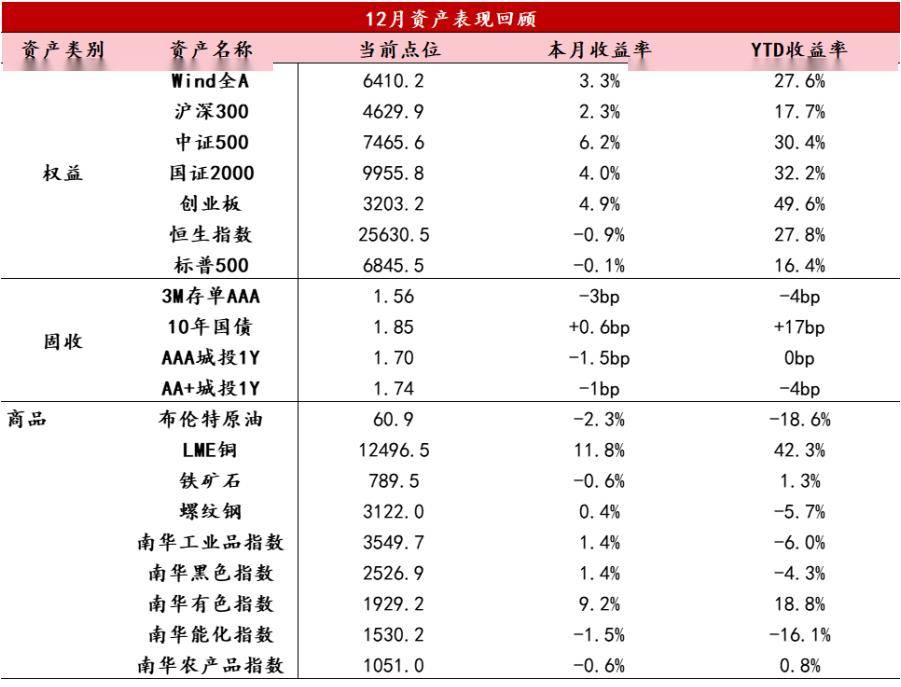
Stock Market Overview - In December, the Federal Reserve's interest rate cut was implemented as expected, leading to fluctuations in future rate cut expectations, while the Nasdaq index experienced volatility [1] - The A-share market showed overall fluctuations, with the Shanghai Composite Index achieving 11 consecutive gains by the end of the month, driven by a positive tone from the Central Economic Work Conference and a declining US dollar index [1] - The Wind All A index recorded a +3.3% increase for the month, with 60% of the Shenwan first-level industries rising, particularly strong performances in defense and military (+17.22%) and non-ferrous metals (+13.68%) [1] Bond Market Overview - The bond market continued to experience wide fluctuations in December, with increased yield volatility and a steeper curve [2] - Despite relatively ample liquidity and the central bank's resumption of bond purchases providing some support, concerns over long-term bond supply and other factors kept the market in a weak oscillation pattern [2] - The 10-year government bond yield ended the month at 1.85%, reflecting an N-shaped trend throughout December [2] Commodity Market Overview - The commodity market showed a bullish atmosphere in December, with precious metals and non-ferrous sectors being the strongest performers [3] - Gold prices fluctuated, with London gold closing at $4318.25 per ounce, up 2.36% from the previous month, while copper prices also saw significant increases [3] - The oil market experienced a downward trend, with Brent crude oil closing at $60.91 per barrel, down 2.26% for the month [3] Macroeconomic Performance - In November, China's exports demonstrated strong resilience, growing by 5.9% year-on-year, driven by a significant increase in machinery and high-tech product exports [5] - However, domestic consumption remained weak, with retail sales growth slowing to 0.3% year-on-year, indicating structural constraints on internal demand [5] - Fixed asset investment continued to decline, with real estate investment adjustments dragging down overall figures, highlighting the challenges in achieving self-sustaining growth [5] Policy Outlook - The Central Economic Work Conference set the tone for macroeconomic policy in 2026, focusing on addressing the structural imbalance of "strong supply and weak demand" [9] - The strategic shift will prioritize investment in human capital and social welfare, aiming to enhance income levels and consumer demand [9] - Fiscal policy is expected to maintain a more active stance, with a nominal deficit rate targeted around 4.0%, while monetary policy will shift focus from total volume to price stability [10][11] Asset Allocation Analysis - In December, net buying in the stock market rebounded to over 2.5 trillion yuan, with significant inflows into equity ETFs [14] - The manufacturing PMI showed a seasonal rebound, indicating improved trade conditions and proactive inventory preparations by companies [15] - Looking ahead to 2026, the market is expected to experience structural trends, with a focus on sectors that demonstrate sustainable performance and profitability [16]
开局“十五五” 实干启新程
Xin Lang Cai Jing· 2026-01-12 16:57
Core Viewpoint - The article emphasizes the importance of expanding domestic demand and stabilizing growth as a fundamental strategy for China's economic development, highlighting the collaborative efforts of various provinces to enhance investment and consumption, thereby laying a solid foundation for the "14th Five-Year Plan" period [4][13]. Investment and Consumption - Domestic demand is identified as the primary driving force for economic growth, with a focus on expanding effective investment and releasing consumption potential [4]. - Provinces are actively pursuing major project construction, with Hunan Province planning 2,676 central investment and provincial key construction projects, achieving over 530 billion yuan in cumulative investment by 2025 [5]. - By 2026, various regions aim to stabilize and enhance investment quality, with Hunan proposing a "project planning" initiative to accelerate the construction of key infrastructure projects [5][6]. Consumer Market Development - The article discusses the optimization of consumption policies, with provinces like Jiangsu focusing on expanding service consumption and promoting new consumption hotspots such as the silver economy and AI-driven consumption [6]. - Hunan is set to implement policies to promote service consumption and enhance the effectiveness of consumption upgrade initiatives [6][7]. Private Investment - Private investment is highlighted as a crucial support for growth and employment, with provinces like Fujian and Zhejiang implementing reforms to create a favorable environment for private enterprises [7]. - By 2026, regions will enhance policy incentives to stimulate private investment, focusing on reducing entry barriers and operational costs for private enterprises [7][8]. Technological Innovation and Industry Upgrade - The cultivation of new productive forces through technological innovation is emphasized as a key support for high-quality development [8]. - Provinces are encouraged to balance traditional industry upgrades with the development of emerging industries, with initiatives in places like Hunan and Jiangsu focusing on AI and digital economy advancements [9][10]. Regional Coordination and Collaboration - The article underscores the importance of regional cooperation in driving industrial upgrades, with various regions collaborating on emerging industry chains [11]. - Efforts to facilitate the flow of resources and promote open cooperation are highlighted, with provinces like Fujian and Yunnan working on cross-regional resource optimization and trade partnerships [12]. Conclusion - The development blueprint outlined by various provinces aligns with national strategic deployments while showcasing regional strengths, aiming to contribute significantly to China's modernization efforts by 2026 [13].

评论员观察|坚持内需主导,熨平消费三道“褶”
Sou Hu Cai Jing· 2026-01-12 10:16
Core Viewpoint - The article emphasizes that understanding and addressing the "wrinkles" in consumer demand is crucial for expanding economic growth in China, highlighting the need for a systematic approach to unlock potential opportunities [1][11]. Group 1: Economic Context - China's manufacturing value-added accounts for nearly 30% of the global total, with a variety of consumer goods reaching 230 million types, yet final consumption has not matched this production capacity [3]. - In the first three quarters of 2025, final consumption expenditure contributed 53.5% to economic growth, which, while improved, still lags behind the over 60% contribution rate seen in developed countries [3]. - The central economic work conference identified the prominent contradiction of "strong supply but weak demand," making the promotion of domestic demand a top priority for economic work [3]. Group 2: Consumer Demand and Income - The first wrinkle in consumption is related to "expected income," as despite per capita GDP reaching $13,000, consumer spending has not increased proportionately [6]. - In 2024, RMB deposits increased by 17.99 trillion yuan, and by 24.73 trillion yuan in the first 11 months of 2025, indicating a rising tendency for residents to save rather than spend [6]. - The need to enhance human capital investment is urgent, as the proportion of skilled workers in China is only 30%, compared to 40% in Japan and 50% in Germany, highlighting a significant gap in advanced manufacturing and strategic emerging industries [6]. Group 3: Supply and Demand Dynamics - The second wrinkle in consumption is the "supply-demand contradiction," illustrated by the rapid sell-out of a high-quality down jacket priced at 499 yuan, indicating that demand exists but quality supply must keep pace with consumption upgrades [8]. - The service consumption sector is growing rapidly, yet issues such as inconsistent quality and lack of standardization remain prevalent, particularly in elder care and childcare services [8]. Group 4: Environmental Constraints - The third wrinkle is "environmental constraints," where systemic issues such as cumbersome processes deter consumer spending, as seen in ticket purchasing and vehicle registration [9]. - Recent measures to remove unreasonable restrictions in consumption, such as easing purchase limits in the automotive and housing sectors, aim to enhance consumer confidence and convenience [9]. - Creating a vibrant consumption ecosystem, as demonstrated by the success of local markets that blend cultural elements with shopping experiences, can significantly boost consumer willingness to spend [9].