经济复苏

Search documents
【老丁投资笔记】2026年1月展望:市场明年的机会在哪里,1月还会继续涨价吗?
Sou Hu Cai Jing· 2025-12-31 12:41
Group 1 - The emergence of a new main theme in the market is commercial aerospace, which has gained traction recently [1] - Overall market sentiment is optimistic, with expectations for the index to rise from 4000 to 4500 by the end of next year, indicating a cautious but positive outlook [1] - There are differing views on market structure, with some investors favoring high-valuation stocks driven by AI, while others believe that blue-chip sectors like consumption and insurance may perform better due to high valuations without earnings support [1] Group 2 - Macroeconomic policies are expected to remain stagnant until after the upcoming Two Sessions, as this year marks the conclusion of the 15th Five-Year Plan [2] - The market is anticipated to react significantly once the Producer Price Index (PPI) turns positive, which is a key indicator for capital markets [2] - A rational approach to the market is advised, focusing on both valuation and trend rationality [2] Group 3 - The divergence in investor opinions reflects a critical point, with a tendency to favor trend rationality, as historical tech revolutions often lead to extreme valuations [3] - While there is optimism for current tech companies, caution is advised as many may not survive the eventual downturn following a tech revolution [3] - The conclusion of tech revolutions is often accompanied by macroeconomic events and data changes, indicating that it is premature to declare an end to the current phase [3] Group 4 - The focus for the upcoming year should be on the re-evolution of technology across various sectors, with a need for detailed market analysis and clear judgments [4]


德国经济年终观察:欧洲经济火车头的“繁荣不再”与“艰难复苏”
Xin Hua Cai Jing· 2025-12-31 08:35
Group 1 - The core viewpoint of the articles highlights the ongoing economic challenges faced by Germany, characterized by low growth, low investment, and low confidence, leading to a "new normal" for the economy [2][3][4] - Germany's GDP has experienced consecutive negative growth in 2023 and 2024, marking the worst performance in nearly 20 years, with expectations for only 0.1% growth in 2025 [2][3] - The manufacturing sector, particularly in automotive and chemical industries, is seeing a significant reduction in investment plans, with a notable decline in investment expectations reported at negative 9.2 points [3][4] Group 2 - The U.S. tariff policies have severely impacted Germany's export model, with exports to the U.S. dropping significantly, averaging a decline of 7.8% in the first three quarters of 2025 compared to previous years [5][6] - The new German federal government's fiscal expansion, including a special fund of €500 billion for infrastructure, is seen as a potential driver for economic recovery, with projections suggesting it could contribute up to 0.8 percentage points to GDP growth by 2026 [7][8] - Despite the potential benefits of fiscal spending, concerns remain regarding the long-term debt burden, with a projected budget gap of €172 billion from 2027 to 2029, and revised growth forecasts for 2026 ranging from 0.7% to 1.3% [8]
外媒热议中国2025年经济亮点
Huan Qiu Shi Bao· 2025-12-31 05:13
Group 1: Economic Resilience and Trade - In 2025, China's goods trade maintained growth for ten consecutive months despite high tariffs imposed by the US, with a predicted export growth rate of 8% for the year [1][2] - China achieved a record annual trade surplus of $1 trillion in November 2025, offsetting declines in exports to specific markets by expanding into Europe, Latin America, and Africa [1] - China's export products have become more innovative, enhancing its role in stabilizing global supply chains amid rising protectionism [2] Group 2: Artificial Intelligence and Technological Advancements - 2025 marked a pivotal year for artificial intelligence, with China's DeepSeek releasing the R1 model, challenging the dominance of US AI companies [3][4] - China is recognized as a leader in the open-source AI sector, with its models gaining traction globally, significantly impacting the competitive landscape [4] - The advancements in AI are part of a broader trend of China's technological capabilities extending into robotics and deep-sea science [3] Group 3: Stock Market Performance - The total market capitalization of A-shares surpassed 100 trillion yuan for the first time in 2025, with significant returns exceeding initial predictions [5][6] - High expectations for the Chinese stock market are driven by a slow bull market and increased foreign investment interest, particularly following the emergence of DeepSeek [5][6] - Analysts predict a 38% increase in the Chinese stock market by the end of 2027, reflecting strong investor confidence [5] Group 4: Soft Power and Global Influence - China ranked second in the global soft power index, surpassing the UK, with cultural products like the toy brand Labubu gaining international popularity [7][8] - The success of Chinese lifestyle brands and cultural products in global markets indicates a shift towards China leading global trends rather than merely following them [7][8] - The rise of Chinese media and entertainment on international platforms showcases the growing influence of Chinese culture [7] Group 5: Consumer Spending and Economic Growth - International organizations have raised China's GDP growth forecast for 2025 to 5%, highlighting its role as a key contributor to global economic growth [9] - Consumer spending's contribution to economic growth significantly increased from 29.7% at the end of 2024 to 56.6% by the third quarter of 2025, driven by both durable goods and service consumption [9] - The outlook for 2026 remains positive, with expectations that consumer spending will continue to support economic growth [9]
金融期货早班车-20251231
Zhao Shang Qi Huo· 2025-12-31 01:57
1. Report's Investment Rating - No investment rating information is provided in the report. 2. Core Views - In the medium to long term, maintain a bullish view on the economy, and suggest buying long - term contracts of various varieties on dips as stock index long - position substitution offers certain outperformance [3] - In the medium to long term, with a rising risk appetite and economic recovery expectations, it is recommended to hedge T and TL contracts on rallies [3] 3. Summary by Directory 3.1 Stock Index Futures and Spot Market Performance - On December 30th, most of the four major A - share stock indexes rose, with the Shanghai Composite Index flat at 3965.12 points, the Shenzhen Component Index up 0.49% at 13604.07 points, the ChiNext Index up 0.63% at 3242.9 points, and the STAR 50 Index up 1.01% at 1359.87 points. Market trading volume was 21,615 billion yuan, an increase of 38 billion yuan from the previous day [2] - In terms of industry sectors, the top gainers were petroleum and petrochemicals (+2.63%), automobiles (+1.35%), and non - ferrous metals (+1.31%); the top losers were commerce and retail (-1.56%), real estate (-1.22%), and public utilities (-1.14%) [2] - In terms of market strength, IC > IF > IH > IM, and the number of rising/flat/falling stocks was 1,837/148/3,473 respectively. In the Shanghai and Shenzhen stock markets, institutional, main, large - scale, and retail investors had net inflows of - 94, - 144, - 14, and 253 billion yuan respectively, with changes of +117, +128, - 101, and - 144 billion yuan respectively [2] - The basis of IM, IC, IF, and IH next - month contracts was 77.3, 41.54, 21.28, and 3.15 points respectively, with annualized basis yields of - 7.71%, - 4.22%, - 3.47%, and - 0.79% respectively, and three - year historical quantiles of 54%, 57%, 31%, and 41% respectively [2] 3.2 Treasury Bond Futures and Spot Market Performance - On December 30th, interest - rate bonds showed mixed performance. Among the active contracts, TS rose 0.01%, TF fell 0.01%, T fell 0.02%, and TL rose 0.17% [3] - For the current active 2603 contract: the CTD bond of the 2 - year Treasury bond futures was 250017.IB, with a yield change of +1 bps, a corresponding net basis of 0.017, and an IRR of 1.61%; the CTD bond of the 5 - year Treasury bond futures was 2500801.IB, with a yield change of +1.25 bps, a corresponding net basis of - 0.031, and an IRR of 1.83%; the CTD bond of the 10 - year Treasury bond futures was 250018.IB, with a yield change of +0.95 bps, a corresponding net basis of 0.056, and an IRR of 1.43%; the CTD bond of the 30 - year Treasury bond futures was 210005.IB, with a yield change of +0 bps, a corresponding net basis of - 0.065, and an IRR of 1.94% [3] - In terms of the money market, the central bank injected 312.5 billion yuan and withdrew 59.3 billion yuan, resulting in a net injection of 253.2 billion yuan [3] 3.3 Economic Data - High - frequency data shows that the prosperity levels of manufacturing, real estate, imports and exports, and social activities are currently lower than in previous periods, while the infrastructure prosperity level is similar to that of previous periods [11]
环球战略集团(08007)发布年度业绩,股东应占亏损1871.5万港元 同比增加19.69%
Zhi Tong Cai Jing· 2025-12-31 01:31
Core Viewpoint - The company reported a revenue of HKD 360 million for the fiscal year ending September 30, 2025, representing a year-on-year increase of 62.68%. However, it also recorded a loss attributable to shareholders of HKD 18.715 million, which is a 19.69% increase compared to the previous year, with a loss per share of HKD 0.2525 [1] Financial Performance - Revenue reached HKD 360 million, marking a significant increase of 62.68% year-on-year [1] - The loss attributable to shareholders was HKD 18.715 million, which is an increase of 19.69% year-on-year [1] - Loss per share was reported at HKD 0.2525 [1] Future Outlook - Management believes that the economy will recover in an orderly manner in the coming year, which is expected to positively impact the company's two core businesses [1]
银河证券:2026年1月十大金股出炉
Xin Lang Cai Jing· 2025-12-31 01:11
Group 1 - The A-share and Hong Kong stock markets showed a growth style leading the rally in December, with the ChiNext and North Star 50 indices rising over 5% [1] - The core drivers for the cyclical sector include economic recovery expectations and the revaluation of strategic resources, particularly benefiting from global manufacturing recovery and resource security themes [1][2] - The growth style focuses on technological self-reliance and new productivity, with capital concentrating on sectors like defense, communication, and AI-related high-end manufacturing [1][2] Group 2 - In January, the A-share market will enter a critical data verification period, influenced by policy effects, macro data, corporate performance, and liquidity changes, leading to potential increased volatility [2] - Key sectors such as defense, 6G, and satellite internet will require performance or order validation to digest previous gains, while commercial aerospace and AI computing sectors may still present active opportunities [2] - Strategic resource segments, especially rare metals like antimony, tungsten, and rare earths, are being revalued by the market due to their essential role in advanced technology breakthroughs [2] Group 3 - The company has excellent asset allocation in mineral resources, with a projected CAGR of 24% for copper production and 12% for gold production from 2020 to 2024, leading in growth among major copper/gold mining companies [6] - The company has successfully completed several significant acquisitions, contributing to production and profit, with ongoing projects expected to support sustainable growth in copper and gold businesses [6][8] - The company has effectively controlled costs, with production costs for copper and gold remaining competitive, positioning it within the top 20% globally [7] Group 4 - The company is benefiting from a stable coal production capacity of 48 million tons/year and has seen an increase in profitability due to low extraction costs and high long-term contracts [18] - The company is expanding its electrolytic aluminum capacity, with a projected increase to 121,000 tons/year by the end of 2025, supported by cost advantages from proximity to coal sources [19] - The company is actively promoting clean energy transition, with significant growth in renewable energy installations, aiming for 700,000 kW by the end of the 14th Five-Year Plan [19] Group 5 - The company is a leading supplier of air conditioning refrigeration valves, with rapid growth in automotive and humanoid robot businesses, actively developing new growth curves [47] - The company achieved a revenue of 240.29 billion yuan in the first three quarters of 2025, with a year-on-year increase of 16.86%, and a net profit of 32.42 billion yuan, up 40.85% [47] - The company is focusing on the development of robotic components, with plans for overseas mass production to strengthen its position in the global supply chain [49]



2026,欧洲经济押注德国“万亿计划”
Huan Qiu Shi Bao· 2025-12-30 22:51
德国《奥格斯堡汇报》报道称,2026年欧元区将由21个国家组成:保加利亚将于1月1日加入欧元区。尽 管面临更严峻的贸易壁垒挑战,例如美国加征关税,欧元区经济的表现仍比预期更为强劲。北欧联合银 行首席策略师扬·冯·盖里希认为,欧洲"私人消费存在超预期上行潜力"。芬兰OP波赫约拉银行首席经济 学家雷约·海斯卡宁则预言"欧洲北部将重现活力"。但TAC Economics首席经济学家莉娅·多法斯表示,经 济学家们不确定"财政刺激能否转化为持久的国内经济增长势头"。TD Securities分析师詹姆斯·罗西特预 测,地缘政治不确定性与扩张性财政政策之间将出现"拉锯战"。 【环球时报驻德国特约记者 青木 环球时报驻英国特约记者 纪双城】英国《金融时报》12月28日公布的 一项调查显示,欧洲对2026年经济复苏的希望主要寄托于德国高达1万亿欧元的债务融资计划,该计划 旨在加大基础设施和国防投入。然而,对于柏林的财政刺激计划究竟将带来"欧洲复兴",还是会在根深 蒂固的结构性弱点和地缘政治摩擦中效果逐渐消退,接受调查的88位经济学家意见不一。 《金融时报》称,一些"乐观派"预计德国的财政刺激将强化欧洲的经济韧性。荷兰银行首席 ...
市场静待美联储会议纪要,美股指期货、美元、美债持平,在岸人民币破7,现货白银反弹近4%
Hua Er Jie Jian Wen· 2025-12-30 08:42
Core Market Trends - Major global stock markets are in a narrow consolidation phase as investors await the Federal Reserve's December monetary policy meeting minutes [1] - US stock index futures are mostly flat, with the Dow and S&P 500 up by 0.01% and the Nasdaq down by 0.02% [2] - European indices show mixed results, with the Euro Stoxx 50 and DAX down by 0.1%, while the UK FTSE 100 is up by 0.1% [2] Metal Market Performance - The metal market shows a mixed trend, with gold, silver, platinum, copper, and nickel rising, while palladium hit a limit down [1] - Silver rebounded by nearly 4% to $75.14 per ounce, recovering from a previous drop of 9% [3][12] - Gold increased by approximately 1% to $4365.33 per ounce, following a drop of over 4% in the previous trading session [3][15] - Copper prices rose nearly 3%, supported by expectations of increased supply chain pressures [3][18] Currency and Bond Market - The onshore RMB has surpassed the 7.0 mark against the USD, reaching its highest level since May 17, 2023, driven by capital inflows and economic recovery expectations [3][9] - The 10-year US Treasury yield remains stable at 4.11% [3] Oil and Cryptocurrency - WTI crude oil prices are stable at $58 per barrel, as traders assess geopolitical risks and supply-demand fundamentals [3][21] - Bitcoin and Ethereum saw slight increases, with Bitcoin up by 0.1% to $87319.51 and Ethereum up by 0.3% to $2943.17 [3]

有色金属“王者归来”:一场结构性牛市,还是情绪交易?
Sou Hu Cai Jing· 2025-12-30 08:10
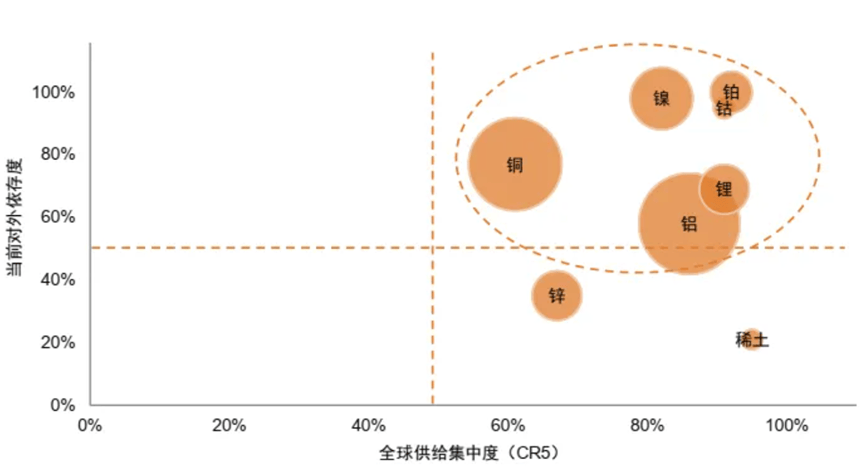
Group 1 - The core viewpoint of the article is that the significant rise of the China Nonferrous Metals Index (H11059.CSI) by approximately 90% this year is driven by improvements in supply-demand structure, changes in the global macro environment, and elevated national strategic priorities [1][2] - Nonferrous metals, which include copper, aluminum, zinc, nickel, tin, and rare earths, possess notable industrial, strategic, and scarcity attributes, making them essential in the current economic landscape [3] - The current uptrend in nonferrous metals is not merely a cyclical phenomenon but is also influenced by structural themes such as high external dependence on strategic minerals, with many resources having over 50% reliance on imports, raising security risks [5][6] Group 2 - The sustainability of the current market trend is questioned, with a focus on which metals are worth monitoring and how ordinary investors can participate more rationally [6] - The article highlights that the demand for nonferrous metals is closely tied to macroeconomic conditions, industrial investment, and high-end manufacturing, with a cyclical pattern of price-capital expenditure-supply-demand rebalancing [6][12] - The Chinese government has initiated a new round of strategic mineral exploration and has implemented reforms to activate mining companies, indicating a strong commitment to resource security and development [9][11] Group 3 - The article identifies two major drivers for the nonferrous market in 2025: the real demand from AI and high-tech industries, which will increase the consumption of copper, aluminum, and rare earths, and the ongoing accumulation of gold reserves by central banks, which enhances gold's attractiveness [12][17] - Economic recovery in China is anticipated by 2026, which may boost demand for industrial nonferrous metals, while global resource distribution and tightening policies in key resource countries are expected to keep supply tight [12][13] - The article discusses the macroeconomic environment, indicating that a loose monetary policy and rising demand for safe-haven assets will likely support nonferrous metal prices [17][19] Group 4 - The article predicts a mid-term bull market for the nonferrous industry driven by a triple resonance of monetary policy, demand, and supply [16][17] - The article emphasizes the preference for the Industrial Nonferrous Metals Index (H11059.CSI) due to its clear index positioning, strong manufacturing attributes, and solid industrial value, which is expected to outperform broader indices [20][21] - The index has shown impressive long-term returns, with a nearly 102.8% return over the past five years, indicating strong profitability and growth potential among leading companies in the sector [26][28] Group 5 - Ordinary investors are advised to avoid chasing hot stocks and instead consider index-based and leading company investments, with specific recommendations for ETFs that align with the Industrial Nonferrous Metals Index [30]
有色金属“王者归来”:一场结构性牛市,还是情绪交易?
老徐抓AI趋势· 2025-12-30 07:56
Group 1 - The core viewpoint of the article is that the recent surge in the CSI Industrial Nonferrous Index is driven by improvements in supply-demand structure, changes in the global macro environment, and elevated national strategic priorities, indicating potential sustainability in this market trend [1][10] - The article emphasizes that nonferrous metals are a typical cyclical industry, with prices determined by supply and demand, and are closely tied to macroeconomic conditions and industrial investment [1][11] - The current rise in nonferrous metals is not only cyclical but also influenced by structural themes such as national strategic security, new technology cycles, economic recovery, and changes in global liquidity [1][10] Group 2 - China's strategic mineral resources face two significant issues: high dependence on foreign sources and lack of cost competitiveness in domestic resources [3][4] - The article outlines several national policies aimed at enhancing resource security and promoting high-quality development in the copper, aluminum, and gold industries, with specific targets for resource growth and production capacity [8][9] - Investment in the nonferrous mining sector is projected to reach 208.9 billion yuan in 2024, marking a ten-year high, with significant increases in fixed investment expected in the coming years [9] Group 3 - The article identifies two major drivers for the nonferrous market in 2025: the real demand for metals driven by AI and the increasing gold reserves held by central banks amid a trend towards de-dollarization [11][12] - Economic recovery in China is anticipated to boost demand for industrial nonferrous metals, while global supply constraints and domestic capacity controls are expected to keep supply tight [12][13] - The article highlights the importance of inventory depletion in supporting prices, with specific examples of lithium and aluminum inventory trends [14] Group 4 - The macroeconomic environment is characterized by a potential easing of monetary policy, with expectations of multiple interest rate cuts by the Federal Reserve in 2026, which could enhance the attractiveness of nonferrous metals [15][16] - The article predicts a mid-term bull market for nonferrous metals driven by a combination of monetary easing, demand growth from emerging sectors, and supply-side constraints [18][20] - The industrial nonferrous index is favored for its clear focus on manufacturing and strong performance compared to broader indices, with significant historical returns and robust profitability metrics [21][25][27] Group 5 - Ordinary investors are advised to consider specific ETFs and mutual funds that focus on the industrial nonferrous sector, emphasizing a strategy of index-based and leading company investments [31][33]