绿电

Search documents
阳光电源(300274):业绩表现亮眼 储能业务高增
Xin Lang Cai Jing· 2025-08-27 00:41
Core Insights - The company reported strong revenue and profit growth for the first half of 2025, with total revenue reaching 43.533 billion yuan, a year-on-year increase of 40.34%, and net profit attributable to shareholders at 7.735 billion yuan, up 55.97% [1][2] Revenue and Profit Summary - In Q2 2025, the company achieved revenue of 24.497 billion yuan, reflecting a 33.09% year-on-year growth, and net profit of 3.908 billion yuan, which is a 36.53% increase [1] - The company plans to distribute a cash dividend of 9.50 yuan per 10 shares to all shareholders [1] Business Segment Performance - The inverter business generated revenue of 15.327 billion yuan, a 17.1% increase year-on-year, while the energy storage business saw revenue of 17.803 billion yuan, marking a significant growth of 127.8% [2] - The gross margin for the energy storage segment was 39.92%, slightly down by 0.16 percentage points compared to the previous year, indicating stable profitability [2] Market Outlook - The company expects to ship between 40-50 GWh of energy storage systems in 2025, with strong demand anticipated in domestic and international markets, including Europe, the US, and Australia [3] - The company maintains a leading position in the photovoltaic inverter market, with revenue from this segment accounting for 35.21% of total revenue [4] Strategic Initiatives - The company is actively expanding its presence in global markets, having established over 20 branches and more than 60 representative offices worldwide [4] - The company has launched two new inverter products, enhancing its competitive edge in the market [4] Future Growth Potential - The company is developing AIDC power solutions, aiming to launch products by 2026, which are expected to cater to the growing demand for green electricity in data centers [5] - The company has revised its net profit forecasts for 2025, 2026, and 2027 to 14.796 billion yuan, 16.744 billion yuan, and 18.874 billion yuan respectively, reflecting confidence in sustained profitability [5]

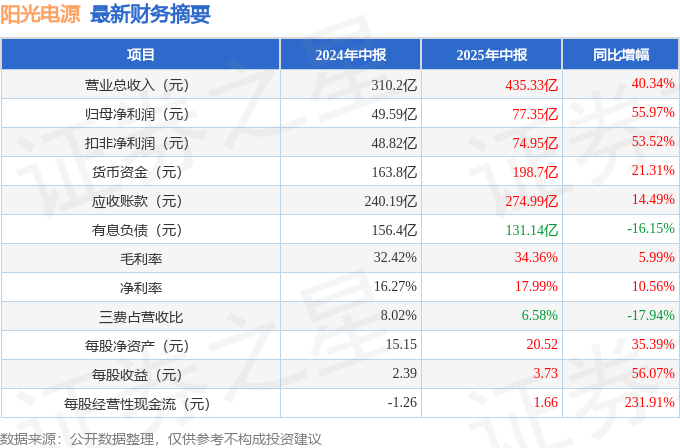
阳光电源2025年中报简析:营收净利润同比双双增长,盈利能力上升
Zheng Quan Zhi Xing· 2025-08-26 22:39
Core Viewpoint - The recent financial report of Sunshine Power (300274) shows significant growth in revenue and net profit for the first half of 2025, indicating strong operational performance and profitability improvements. Financial Performance - Total revenue reached 43.533 billion yuan, a year-on-year increase of 40.34% [1] - Net profit attributable to shareholders was 7.735 billion yuan, up 55.97% year-on-year [1] - In Q2 alone, total revenue was 24.497 billion yuan, reflecting a 33.09% increase compared to the same quarter last year [1] - Q2 net profit was 3.908 billion yuan, a 36.53% year-on-year increase [1] - Gross margin improved to 34.36%, up 5.99% year-on-year, while net margin increased to 17.99%, up 10.56% year-on-year [1] Cost and Expenses - Operating costs increased by 36.31%, attributed to growth in business scale [2] - Management expenses rose by 59.29%, mainly due to higher personnel salaries and depreciation [2] - Financial expenses decreased significantly by 239.86%, due to substantial foreign exchange gains [2] - Tax expenses increased by 70.55%, reflecting a significant rise in total profit [2] - R&D expenses grew by 37.08%, driven by increased investment in R&D projects and higher salaries for R&D personnel [2] Cash Flow and Financial Health - Net cash flow from operating activities surged by 231.91%, due to increased sales collections [2] - Net cash flow from investing activities rose by 158.96%, attributed to a significant recovery of financial products [2] - Net cash flow from financing activities decreased by 245.37%, due to increased payments for supply chain financing [3] - The net increase in cash and cash equivalents was up 114.88%, driven by higher operating cash flow [4] Investment Metrics - The company's return on invested capital (ROIC) was 25.44%, indicating strong capital returns [5] - The net profit margin was 14.47%, suggesting high added value in products or services [5] - The company has a healthy cash position, with cash assets being robust [5] Market Position and Future Outlook - Analysts expect the company's performance in 2025 to reach 14.12 billion yuan, with an average earnings per share of 6.81 yuan [5] - The company is actively engaging in the AIDC power sector, leveraging its technological capabilities and planning to launch products in the near future [7][8]

阳光电源:目前已成立AIDC事业部
Zheng Quan Ri Bao Zhi Sheng· 2025-08-26 09:40
Core Viewpoint - The company, Sunshine Power, announced its confidence in developing green energy solutions for data centers, leveraging its technological expertise in power conversion and AI integration [1] Group 1: Technological Capabilities - The company has significant technological reserves and innovative results in power supply and electronic power conversion technology, which synergize well with AIDC power [1] - The establishment of the AIDC division indicates the company's commitment to advancing its technological capabilities in this area [1] Group 2: Market Opportunities - With the rapid construction of artificial intelligence and data centers, there is a growing demand for green energy solutions, positioning the company favorably in the market [1] - Although the company currently lacks relevant customers, initial engagements have been promising, and it is optimistic about future opportunities [1] Group 3: Future Developments - The company is actively developing products within the AIDC division, aiming to launch offerings by next year [1]
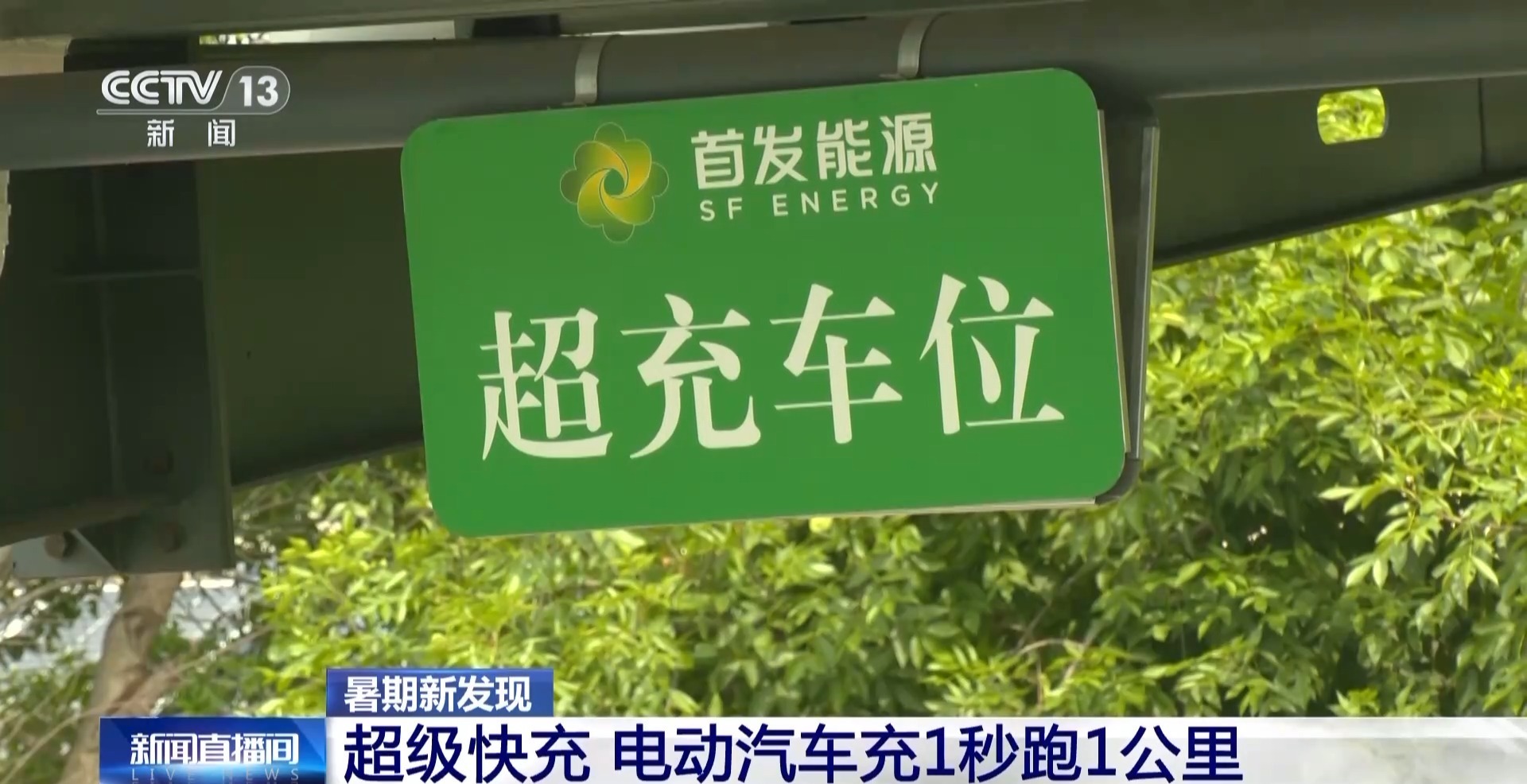
充1秒能跑1公里 有新能源车主用上了超级快充
Yang Shi Xin Wen Ke Hu Duan· 2025-08-26 01:07
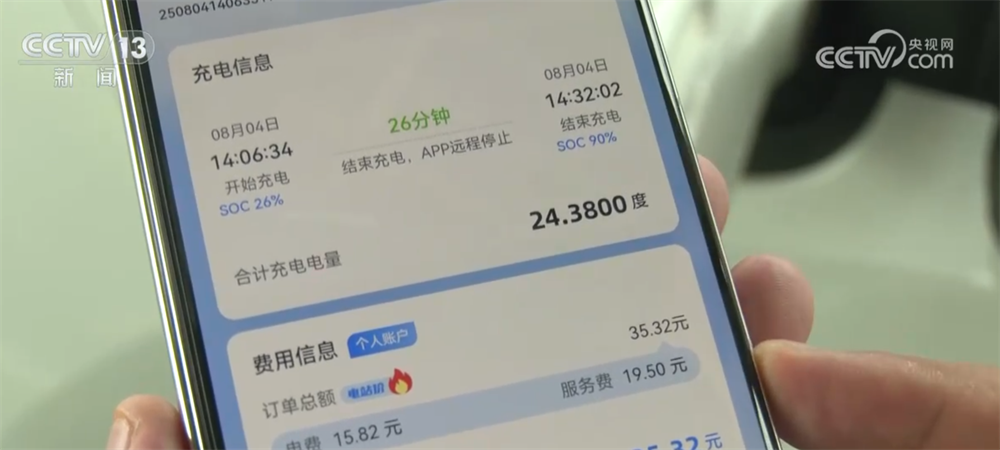
Group 1: Super Fast Charging Technology - The introduction of super fast charging stations allows electric vehicle owners to charge their batteries to 80% in just half an hour [1][7] - Newer electric vehicles can achieve a range of 1 kilometer with just 1 second of charging, and 10 minutes of charging can provide a range of 500 to 600 kilometers [3] - Solar panels installed at charging stations can generate 1.15 million kilowatt-hours of green electricity annually, meeting both the charging station's energy needs and the service area's daily electricity requirements [5] Group 2: Infrastructure Development - The government aims to have over 100,000 high-power charging facilities with a charging power of over 250 kilowatts nationwide by the end of 2027 [7] - Some regions are piloting mobile charging stations that can be booked for on-site fast charging services, shifting the focus from "finding a charging station" to "charging stations finding users" [9] Group 3: Cycling Innovations - A new bicycle assist device allows cyclists to tackle steep hills with ease, transforming a regular bicycle into an electric bicycle with various modes [9] - The assist mode enables a range of 50 to 70 kilometers, while the cruise mode allows for 20 to 30 kilometers of automatic travel without pedaling [11] - The device incorporates seven patented technologies and has seen a significant increase in sales during the summer cycling season [13]
国电电力(600795):经营性利润稳健增长,未来三年分红比例拟提升至60%以上
Guohai Securities· 2025-08-25 06:04
Investment Rating - The investment rating for Guodian Power (600795) is "Buy" (maintained) [1][11] Core Views - The company is expected to increase its dividend payout ratio to over 60% in the next three years, with a proposed cash dividend of no less than 0.22 CNY per share (including tax) [4][10] - Despite a decline in revenue and net profit in the first half of 2025, the company has shown strong operational profit growth, particularly in non-recurring profit adjustments [7][10] Financial Performance Summary - In H1 2025, the company's revenue was 77.65 billion CNY, down 9.5% year-on-year, while the net profit attributable to shareholders was 3.69 billion CNY, down 45.1% year-on-year [4][10] - In Q2 2025, the revenue was 37.84 billion CNY, a decrease of 6.0% year-on-year, and the net profit attributable to shareholders was 1.88 billion CNY, down 62% year-on-year [4][10] - The company reported a significant increase in non-recurring net profit in Q2 2025, primarily due to a 4.6 billion CNY investment gain from the transfer of Guodian Investment Inner Mongolia Energy Company [7][10] Revenue and Profit Forecast - The forecast for revenue from 2025 to 2027 is 177.9 billion CNY, 185.7 billion CNY, and 186.9 billion CNY respectively, with corresponding net profits of 7.14 billion CNY, 7.63 billion CNY, and 8.24 billion CNY [9][10] - The expected diluted earnings per share (EPS) for 2025, 2026, and 2027 are 0.40 CNY, 0.43 CNY, and 0.46 CNY respectively [9][10] Market Performance - As of August 22, 2025, the current stock price is 4.79 CNY, with a 52-week price range of 4.07 CNY to 6.02 CNY [3][11] - The company's market capitalization is approximately 85.43 billion CNY [3]

充1秒能跑1公里 有新能源车主用上了“超级快充”
Yang Shi Xin Wen Ke Hu Duan· 2025-08-25 05:04
Group 1: Super Fast Charging Technology - The introduction of super fast charging stations allows electric vehicle owners to charge their batteries to 80% in just half an hour [2] - Newer electric vehicles can travel 1 kilometer with just 1 second of charging, and 10 minutes of charging can provide a range of 500 to 600 kilometers [2] - Solar panels installed at charging stations can generate 1.15 million kilowatt-hours of green electricity annually, meeting both the charging station's energy needs and the service area's daily electricity requirements [2] - The government aims to have over 100,000 high-power charging facilities with a charging power of over 250 kilowatts by the end of 2027 [2] - Mobile charging stations are being piloted to provide on-demand fast charging services, shifting the focus from "finding a charging station" to "charging stations finding users" [2] Group 2: Cycling Innovations - A new cycling device transforms traditional bicycles into electric bikes, making uphill rides easier [3] - The device offers an assist mode that allows for a range of 50 to 70 kilometers [4] - In cruise mode, the bicycle can operate at a constant speed for 20 to 30 kilometers without pedaling, while a workout mode increases resistance for greater exercise intensity [5] - The device incorporates seven patented technologies and has seen a significant increase in sales during the summer cycling season [5]
充1秒跑1公里、自行车秒变“电动车” 从新发现透视中国“科技发展实力”
Yang Shi Wang· 2025-08-25 03:10
Group 1: Electric Vehicle Charging Infrastructure - The introduction of supercharging stations across the country is alleviating charging anxiety for electric vehicle owners, with some stations allowing an 80% charge in just 30 minutes [1] - A supercharging station in Beijing features solar panels that generate 1.15 million kilowatt-hours of green electricity annually, meeting both the charging station's and the service area's energy needs [3] - The National Development and Reform Commission and the National Energy Administration aim to have over 100,000 high-power charging facilities (over 250 kW) by the end of 2027, with pilot mobile charging stations being tested to provide on-demand charging services [6] Group 2: Cycling Innovations - A new micro-motor for bicycles allows for easier uphill riding, significantly reducing the effort required by cyclists [7] - The micro-motor can provide a range of 50 to 70 kilometers in assist mode and can transform a regular bicycle into an electric bike with a cruising range of 20 to 30 kilometers [9] - The device also features a workout mode that adds resistance for increased exercise intensity while allowing for energy recovery to recharge the battery [11] - This compact device integrates seven patented technologies and has seen a significant increase in sales during the summer cycling season [13]
隆基绿能上半年营收328亿:扣非后净亏33亿高瓴套现6亿浮亏超80亿
Xin Lang Cai Jing· 2025-08-23 03:06
Core Viewpoint - Longi Green Energy Technology Co., Ltd. reported a revenue of 32.8 billion yuan for the first half of 2025, a decrease from 38.53 billion yuan in the same period last year, indicating challenges in the photovoltaic industry due to falling product prices [1] Financial Performance - Revenue for H1 2025: 32.8 billion yuan, down from 38.53 billion yuan year-on-year [1] - Government subsidies accounted for 465 million yuan in H1 2025 [1] - Net loss for H1 2025: 2.569 billion yuan, improved from a net loss of 5.23 billion yuan in the same period last year [1] - Non-recurring net loss for H1 2025: 3.3 billion yuan, compared to 5.264 billion yuan in H1 2024 [1] - Asset-liability ratio: 60.72% [1] - Interest-bearing debt ratio: 21.45% [1] Business Operations - Longi Green Energy's product segments include monocrystalline silicon wafers, battery modules, distributed photovoltaic solutions, global green photovoltaic building solutions, ground photovoltaic solutions, and green hydrogen equipment [1] - Silicon wafer shipment volume for H1 2025: 52.08 GW (of which 24.72 GW for external sales) [1] - Battery module shipment volume for H1 2025: 41.85 GW (with 39.57 GW for modules) [1] Shareholding Structure - As of June 30, 2025, major shareholders include: - Li Zhenguo: 14.08% - Hong Kong Central Clearing Limited: 5.62% - Hillhouse Capital's HHLR Management Limited: 5.43% [1] - The shareholding structure remained relatively stable compared to March 31, 2025 [1] Hillhouse Capital's Actions - Hillhouse Capital reduced its stake in Longi Green Energy to below 5% by selling 37,557,175 shares at an average price between 14.88 yuan and 16.62 yuan per share, realizing 583 million yuan in cash [5] - The reduction in shareholding allows Hillhouse more flexibility for future divestments [5] - Despite the reduction, Hillhouse's investment in Longi Green Energy has resulted in a significant unrealized loss of at least 8 billion yuan [6]

行业周报:7月规上发电量+3.1%,甘肃正式出台136号文落地实施方案-20250819
Great Wall Securities· 2025-08-19 03:52
Investment Rating - The investment rating for the industry is "Overweight" [4] Core Views - The industrial power generation volume in July increased by 3.1% year-on-year, indicating a recovery in power production [3] - The implementation of Gansu's "Document 136" has established a market-oriented pricing mechanism for renewable energy, with a stock price of 0.3078 yuan/kWh [3][42] - The overall valuation of the public utility sector has slightly decreased, with the industry index PE (TTM) at 17.38 times, down from 17.51 times the previous week [25] Market Performance - The public utility sector index fell by 0.55% during the week of August 11-15, underperforming compared to the Shanghai Composite Index by 2.24 percentage points [2][13] - The individual stock performance showed significant gains for companies like Fuan Energy (+28.72%) and Hongtong Gas (+15.80%), while companies like Huayin Power (-9.44%) and Xinzhu Co. (-8.79%) faced declines [31][31] Industry Dynamics - The total industrial power generation for July reached 926.7 billion kWh, with a notable increase in thermal and solar power generation [37] - Gansu's new pricing mechanism for renewable energy projects aims to stabilize the market and improve project profitability [38][42] - The implementation of demand response subsidies in Guangzhou aims to enhance the efficiency of power supply and demand management [46] Key Data Tracking - As of August 15, the price of Shanxi mixed coal (5500) was 695 yuan/ton, reflecting a week-on-week increase of 2.51% [53] - The trading volume of green certificates for wind and solar power reached 14.22 and 12.26 thousand respectively during the week of August 11-17 [56] - The national CEA trading volume for the week was 93.0 million tons, with an average transaction price of 72.30 yuan/ton [58]
公用事业行业跟踪周报:继续推荐长江电力在高股息资产中的配置价值-20250818
Soochow Securities· 2025-08-18 09:04
Investment Rating - The report maintains an "Overweight" rating for the utility sector, specifically recommending investment in Changjiang Electric for its high dividend asset allocation value [1]. Core Insights - Changjiang Electric has announced a shareholder dividend return plan for the next five years (2026-2030), committing to a minimum cash dividend of 70% of the annual net profit attributable to shareholders [3]. - The report highlights a decrease in electricity prices, with the average grid purchase price in July 2025 down 3% year-on-year and 1.4% month-on-month [36]. - The report tracks key industry data, including a 3.7% year-on-year increase in total electricity consumption in H1 2025, with total consumption reaching 4.84 trillion kWh [12]. Summary by Sections 1. Market Review - The SW Utility Index fell by 0.55% during the week of August 11-15, 2025, underperforming compared to the ChiNext Index [8]. - Notable stock performances included a 28.7% increase for Fuan Energy and a 9.4% decrease for Huayin Electric [11]. 2. Electricity Sector Tracking 2.1. Electricity Consumption - Total electricity consumption in H1 2025 was 4.84 trillion kWh, reflecting a 3.7% year-on-year increase, with growth in all sectors [12]. 2.2. Power Generation - Total power generation in H1 2025 reached 4.54 trillion kWh, a 0.8% year-on-year increase, with declines in thermal and hydro power generation [21]. 2.3. Electricity Prices - The average grid purchase price in July 2025 was 382 RMB/MWh, down 3% year-on-year [36]. 2.4. Thermal Power - As of August 15, 2025, the price of thermal coal at Qinhuangdao was 698 RMB/ton, down 16.51% year-on-year but up 16 RMB/ton week-on-week [45]. 2.5. Hydropower - The water level at the Three Gorges Reservoir was 160.34 meters as of August 15, 2025, with inflow and outflow rates showing a year-on-year decrease [57]. 2.6. Nuclear Power - In 2024, 11 new nuclear units were approved, indicating a continued positive trend in nuclear power development [72]. 3. Investment Recommendations - The report suggests focusing on high-dividend stocks like Changjiang Electric, as well as opportunities in green energy, photovoltaic assets, and thermal power investments [3].