
芯片研发

Search documents
小鹏汽车CEO何小鹏:政策法规决定智驾出海进程
Zhong Guo Jing Ying Bao· 2025-07-05 13:44
Core Viewpoint - Xiaopeng Motors has developed its own chip, the "Turing" chip, which boasts an effective computing power of 2250 TOPS for the entire vehicle and 800+ TOPS for the intelligent cockpit AI, significantly surpassing industry competitors by 26 times [1][4]. Chip Development and Strategy - Xiaopeng Motors began chip development in 2020, with the Turing chip expected to be successfully produced by 2024 and integrated into the G7 model [1]. - The G7 Max 702 long-range version is priced at 205,800 RMB, which was perceived as high compared to its performance capabilities [1]. - Despite developing its own chip, Xiaopeng Motors will continue to collaborate with Nvidia and other global partners for chip and software solutions [1][4]. Market Position and Future Outlook - The domestic chip industry has rapidly developed due to supportive policies, market expansion, and technological innovation, with many Chinese automakers, including Xiaopeng, entering chip development [4]. - Xiaopeng Motors aims to leverage its chip technology not only in automotive applications but also in flying cars and robotics, emphasizing the importance of self-developed chips for maximizing capabilities [5]. - The company plans to invest nearly 5 billion RMB in AI by 2025, indicating a strong commitment to technological advancement [4]. Global Expansion and Regulatory Challenges - Xiaopeng Motors has expanded its market presence to 46 countries and regions, with overseas sales expected to exceed 18,701 units in the first half of 2025, a 217% year-on-year increase [10]. - The company is set to initiate its global smart driving strategy next year, anticipating regulatory changes in Europe that may allow for advanced autonomous driving features [10]. - The founder emphasizes the importance of integrating humanistic values into corporate development, which is seen as a future trend in global markets [11].


小米北京南京上线月租金1999元青年公寓;多家车企“截胡”小米YU7订单;特斯拉中国Model 3长续航版涨价丨邦早报
创业邦· 2025-07-02 00:11
New Energy Vehicles Delivery Overview - BYD delivered 383,000 vehicles in June, a year-on-year increase of 11.98% [2] - NIO delivered 24,925 vehicles in June, a year-on-year increase of 17.5% [2] - Leap Motor delivered 48,000 vehicles, a year-on-year increase of 138.65% [2] - Li Auto delivered 36,000 vehicles, a year-on-year decrease of 24.06% [2] - Xpeng delivered 35,000 vehicles, a year-on-year increase of 224.44% [2] - Xiaomi delivered over 25,000 units, maintaining over 20,000 units for eight consecutive months [2] - Seres sold 46,086 new energy vehicles in June, a year-on-year increase of 4.44% [2] - Great Wall Motors sold 110,700 units in June, a year-on-year increase of 12.86% [2] - Zeekr sold 16,702 units, a year-on-year decrease of 17% [2] - Lynk & Co sold 26,310 units, a year-on-year increase of 8% [2] - GAC Aion sold 27,848 units in June [2] - Deep Blue delivered 29,893 vehicles in June, a year-on-year increase of 79% [2] - Avita sold 10,153 vehicles in June, a year-on-year increase of 117% [3] - Lantu delivered 10,053 vehicles in June, a year-on-year increase of 83% [3] Xiaomi's New Initiatives - Xiaomi launched youth apartments in Beijing and Nanjing with a monthly rent of 1,999 yuan, prioritizing fresh graduates [3] - Xiaomi's YU7 model received high demand, prompting other car manufacturers to offer compensation for customers who switch to their brands [6] Tesla Management Restructuring - Tesla adjusted its management structure, with Elon Musk taking over sales in Europe and North America, while Zhu Xiaotong oversees global manufacturing [6] NIO's Chip Development - NIO's self-developed 5nm automotive-grade chip, NX9031, has reached its design performance targets, marking a significant milestone in its chip development efforts [6] New Company Establishments - Chongqing Qianli Zhijia Technology Co., Ltd. was established with a registered capital of 10.5 million yuan, focusing on smart vehicle equipment and AI hardware [9] Investment and Financing Activities - Tianyan Pharmaceutical announced a strategic investment of up to $25 million from Sanofi to support the development of its SAFEbody® antibody projects [18] - Figma filed for an IPO in the US, seeking to trade under the ticker "FIG" [18] - Lingchuan Technology completed a multi-hundred million yuan Series A financing round to expand its AI chip development [18]





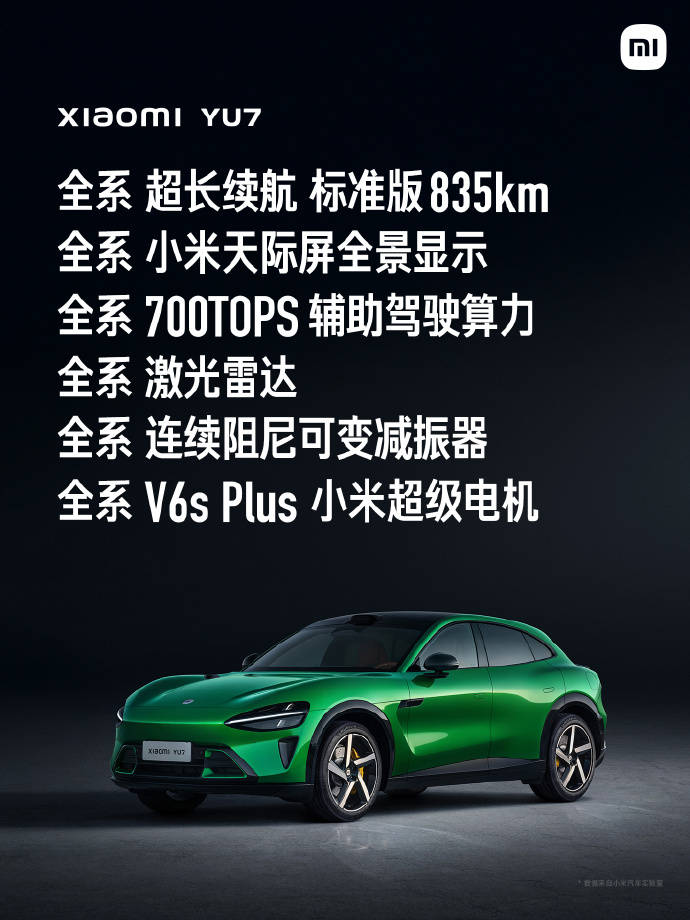
雷军宣布小米首款SUV车型YU7价格:标准版25.35万,Pro版27.99万,Max版32.99万
Sou Hu Cai Jing· 2025-06-26 13:50
Group 1 - Xiaomi officially launched its first SUV model, YU7, with a starting price of 253,500 yuan for the standard version, 279,900 yuan for the Pro version, and 329,900 yuan for the Max version [1][3] - The YU7 is available in nine color options, including Gem Green, Lava Orange, Titanium Metal, Shadow Blue, Flowing Gold Pink, Danxia Purple, Deep Sea Blue, Cambrian Gray, and Pearl White [3] - Xiaomi's CEO Lei Jun emphasized the importance of safety in electric vehicles, stating that the YU7 outperforms competitors like Model Y and Cayenne in various space metrics [5] Group 2 - The YU7 has undergone extensive testing over 539 days, covering 2.65 million kilometers across 296 cities, including extreme conditions [5] - Xiaomi reported a 47% year-on-year revenue growth in Q1 2025, with total revenue reaching 111.3 billion yuan, and the company has maintained a position among the top three global smartphone manufacturers for 19 consecutive quarters [5] - The company plans to invest an additional 200 billion yuan in research and development over the next five years, aiming for significant advancements by its 20th anniversary [5]
小米申请“XRING O2”商标,玄戒O2芯片或在研发中
Guan Cha Zhe Wang· 2025-06-25 02:41
Group 1 - Xiaomi has applied for the trademark "XRING O2," indicating potential development of its second-generation flagship chip, "玄戒O2" [1] - The first-generation flagship SoC, "玄戒O1," was launched in May 2023, utilizing a 3nm process with ARM's latest CPU and GPU architectures [1] - Xiaomi's president, Lu Weibing, stated that flagship chips are challenging to develop and will primarily be used in flagship products, emphasizing the importance of chip capabilities for long-term differentiation [1] Group 2 - A Xiaomi store in Shanghai reported limited availability of the Xiaomi 15S Pro, which features the "玄戒O1" chip, with only two units in stock for the second batch [2] - Recent U.S. export controls on EDA tools to China may impact domestic chip design firms, as they may not receive further updates after existing contracts expire [2] - Despite the export restrictions, existing EDA/IP tools can still be used, but firms may face challenges in maintenance and support [2]

卢伟冰回应“小米大家电三年进前三”:目标时间为2030年
新华网财经· 2025-06-19 09:36
Core Viewpoint - Xiaomi's performance during the "618" shopping festival, with total payments exceeding 35.5 billion yuan, indicates strong competitiveness in the consumer electronics sector and the successful implementation of its "human-vehicle-home ecosystem" strategy [1]. Group 1: Sales Performance - Xiaomi achieved a record-breaking total payment amount of over 35.5 billion yuan during the "618" shopping festival, reflecting its robust market presence [1]. - The company’s sales performance is seen as a sign of its competitive strength in the consumer electronics market [1]. Group 2: New Product Launches - During the live stream on June 18, Xiaomi revealed seven new products across various categories, including smartphones, tablets, and home appliances [6]. - The Xiaomi YU7, the company's first pure electric SUV, is set to be released at the end of June, featuring advanced specifications such as a dual-motor system and high-level intelligent driving assistance [6]. - The Xiaomi Pad 7S Pro was introduced, featuring a lightweight design, a 12.5-inch high-resolution screen, and a self-developed 3nm chip [7][9]. - Two new Redmi products were announced: the Redmi K80 Supreme Edition, which targets high-end performance, and the Redmi K Pad, a compact flagship tablet [11]. Group 3: Research and Development - Xiaomi plans to increase its R&D investment to 200 billion yuan by 2025, focusing on chip development, smart home technology, and AI applications [13]. - The company aims to position its tablet products to compete directly with Apple's iPad, with expectations of entering the top three in global tablet sales by 2025 [13]. Group 4: Market Strategy and Goals - Xiaomi's offline sales account for 30% to 40% of total sales, with a total of 15,000 retail stores established [13]. - The company clarified its goal to be among the top three in the major appliance sector by 2030, responding to comments from competitors [15]. - Upcoming product launches include the Xiaomi MIX Flip 2 foldable phone and the first AI glasses, scheduled for a late June event [16].
航宇微:玉龙910芯片研制开发工作持续推进中
news flash· 2025-06-16 01:05
Core Viewpoint - The company is actively progressing in the development of the Yulong 910 chip, with further updates to be provided through official announcements [1] Group 1 - The Yulong 910 chip development is ongoing, indicating the company's commitment to advancing its technology [1]

中国首创!这一基础性国家标准获批立项
Shen Zhen Shang Bao· 2025-06-15 16:58
Group 1 - The core viewpoint of the news is the approval of the national standard for "Ultra-Wideband Horn Measurement Antenna," which is a foundational standard in the field of precision measurement of radio frequency and microwave parameters in China [1][2] - The standard is based on the key technology developed by Professor Shi Xinrong's team at the Guangdong Provincial Metrology Institute, which has previously won the second prize of the Guangdong Provincial Science and Technology Progress Award in 2023 [1] - The implementation of this standard is expected to save over 100 million yuan in operational costs annually, contributing to the high-quality development of China's 5G/B5G technology industry [1] Group 2 - The ultra-wideband horn measurement antenna is an important standard instrument in the field of precision measurement of radio frequency and microwave parameters, characterized by a wide frequency band, high efficiency, and strong beam directionality [2] - The establishment of this standard aims to address traditional design defects such as impedance mismatch and higher-order mode resonance, which have long been monopolized by Western countries, hindering the development of related industries in China [2] - The standard will scientifically quantify and specify key technical indicators such as frequency band, gain, flatness, standing wave ratio, and radiation pattern, effectively solving the long-standing technical challenges of "unable to measure or measure inaccurately" in radio frequency parameters [2]
董明珠卸任,格力芯片公司换帅
新华网财经· 2025-06-12 12:50
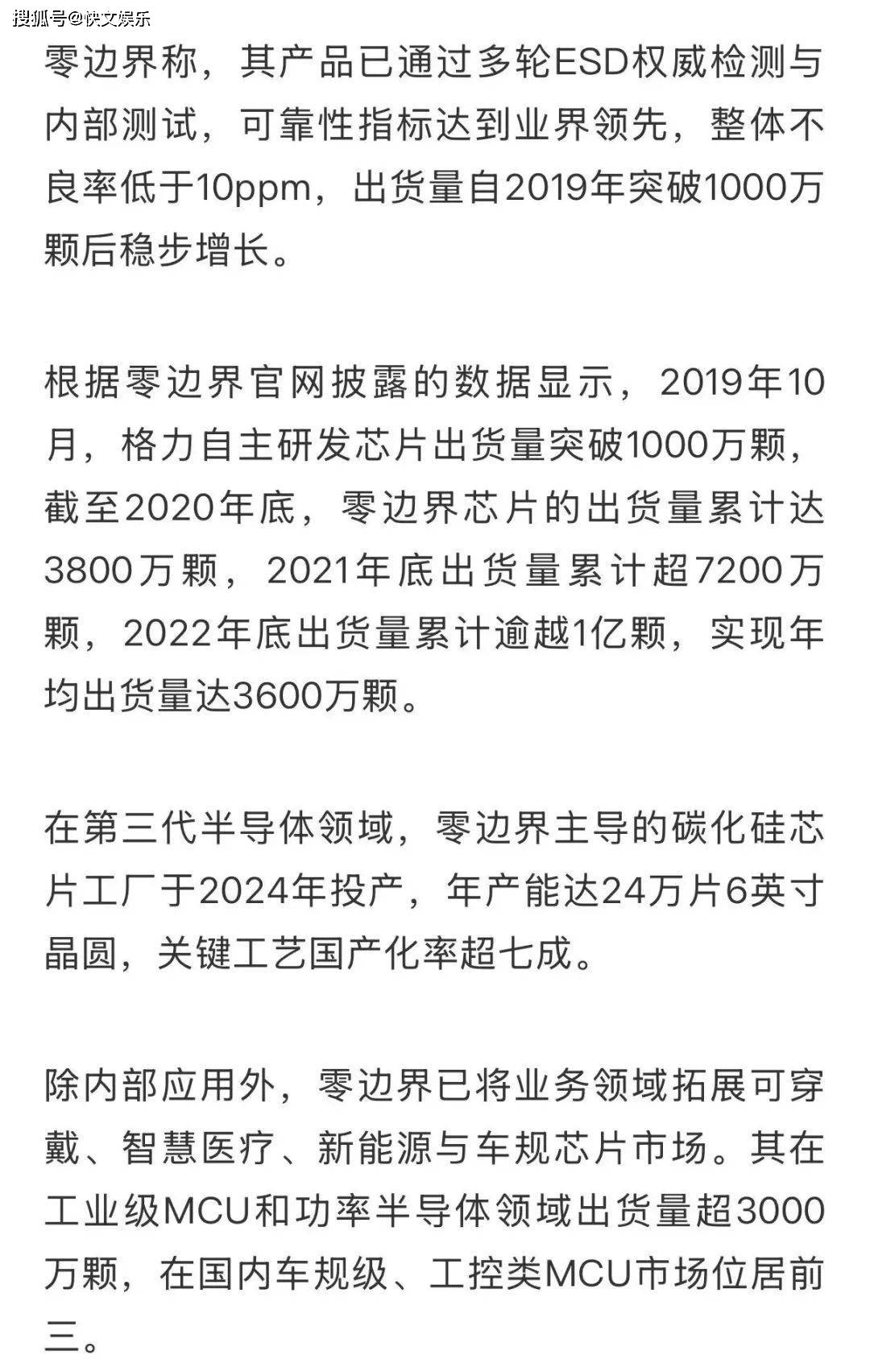
Core Viewpoint - The recent management changes at Zhuhai Zero Boundary Integrated Circuit Co., Ltd. indicate a strategic shift as Dong Mingzhu steps down and Li Shaobin takes over as the legal representative and chairman, reflecting ongoing developments in Gree Electric's chip business [1][5]. Company Dynamics - Zhuhai Zero Boundary was established in August 2018 and is fully owned by Gree Electric, focusing on integrated circuit chip design, sales, and electronic products [3]. - The company has evolved from custom R&D to a comprehensive service provider specializing in industrial-grade 32-bit MCUs, AloT SoC chips, and power devices, achieving cumulative shipments of over 100 million chips by the end of 2022, with an average annual shipment of 36 million chips [3]. - In 2024, Gree Electric plans to launch a SiC chip factory, aiming to become the second-largest globally and the largest in Asia for fully automated compound chip production [3]. Management Changes - Li Shaobin, who has a master's degree and is a senior engineer, has held various positions within Gree Electric, including assistant to the president and chief engineer, indicating a continuity of leadership within the company's technical and operational framework [2][3]. - Dong Mingzhu's gradual exit from legal representative roles across Gree's subsidiaries suggests a potential shift in management strategy, although the specific reasons for these changes have not been disclosed [5]. Product Development - Gree Electric has been involved in the chip sector since 2015, with an initial production capacity planned at 240,000 pieces per year, focusing on power semiconductor products and integrated circuit chips [4]. - Approximately 30% of Gree's chip products are self-developed and are being applied in various self-operated businesses, including home and commercial air conditioning systems [4].


董明珠卸任,格力芯片公司换帅,格力真的在造芯片,可惜不太给力
Sou Hu Cai Jing· 2025-06-12 08:50
Core Viewpoint - The news highlights the significant changes in Gree Electric's leadership and its ambitious venture into the semiconductor industry, particularly under the leadership of Dong Mingzhu, who has faced both praise and criticism for her bold decisions in this high-tech field [1][4][6]. Group 1: Leadership Changes - Dong Mingzhu has stepped down from her position at Gree Semiconductor, sparking discussions about the company's future direction in chip manufacturing [1]. - Li Shaobin has been appointed as the new legal representative and chairman of Gree Semiconductor, bringing a strong engineering background to the role [3]. Group 2: Semiconductor Business Performance - Gree Electric's semiconductor business reported revenues of 15 billion yuan in 2024, marking a 50% year-on-year increase, with a net profit of 3.5 billion yuan, up 75% [2]. - The semiconductor division has become the second-largest profit source for Gree Electric, following air conditioning, contributing 10.9% to the total net profit [2]. Group 3: Challenges and Future Prospects - The semiconductor industry is characterized by long investment cycles and high entry barriers, which have led to skepticism about Gree's ability to achieve immediate economic benefits from its chip initiatives [6][8]. - Despite the challenges, Gree has made substantial investments in R&D, establishing advanced laboratories and collaborating with universities and research institutions, indicating a commitment to long-term growth in this sector [6][8].
人民日报头版刊文:任正非称芯片问题其实没必要担心
news flash· 2025-06-09 23:45
Core Viewpoint - Huawei's CEO Ren Zhengfei emphasized the importance of research and development (R&D) investment, stating that the company invests 180 billion yuan annually, with 60 billion yuan allocated to basic theoretical research and 120 billion yuan focused on product development [1] R&D Investment - The company invests 180 billion yuan in R&D each year, with approximately 60 billion yuan dedicated to basic theoretical research that is not subject to performance assessment [1] - About 120 billion yuan is allocated to product development, which is subject to performance evaluation [1] Chip and Software Strategy - Ren Zhengfei indicated that there is no need to worry about chip issues, as methods like stacking and clustering can yield results comparable to the most advanced levels [1] - In terms of software, he mentioned that a multitude of open-source software solutions will meet societal needs in the future [1]