
避险资产

Search documents
8月1日“关税大限”前夕,对冲基金押注黄金,多仓创4月以来最高
凤凰网财经· 2025-07-26 09:58
Core Viewpoint - The article highlights the increasing bullish sentiment towards gold among hedge funds, driven by rising risk aversion due to trade tensions and economic uncertainty, with gold prices experiencing a significant increase this year. Group 1: Hedge Fund Activity - Hedge funds have raised their bullish bets on gold to the highest level since April, with net long positions increasing by 19% to 170,868 contracts as of the week ending July 22, marking a 16-week high [1] - The ongoing trade war has led to market volatility, prompting investors to seek safe-haven assets like gold, which has contributed to a 27% increase in gold prices year-to-date [1] Group 2: Central Bank Support - The rise in bullish positions for gold is also supported by continuous purchases from global central banks, providing additional support for gold prices [2] - Despite potential easing of trade tensions that may reduce demand for safe-haven assets, strong central bank buying remains a solid fundamental support for gold prices [2]

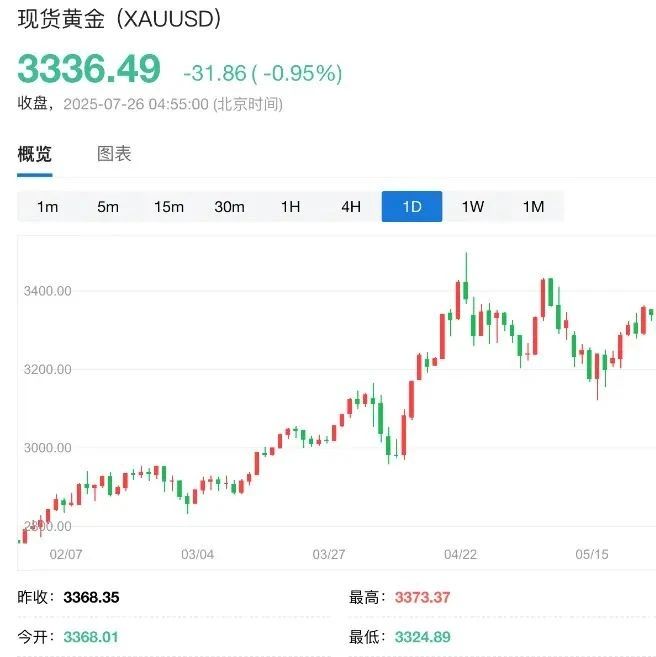
DLSM外汇平台:黄金回吐至3350关口 贸易乐观与数据强劲谁主导?
Sou Hu Cai Jing· 2025-07-25 12:44
Core Viewpoint - The recent decline in gold prices to the 3350 level is attributed to two main factors: optimistic expectations regarding international trade and strong economic data [1][3][5]. Group 1: International Trade Impact - Recent trade negotiations among major economies, particularly between China and the U.S., have alleviated concerns about escalating trade tensions, leading to a more optimistic market sentiment [3][4]. - The recovery of China's economy has contributed to positive global economic recovery expectations, resulting in increased risk appetite among investors [3][4]. - As market sentiment becomes more optimistic, funds tend to flow towards risk assets rather than safe-haven assets like gold, contributing to the price decline [3][5]. Group 2: Economic Data Performance - Strong economic data from major economies, including positive U.S. non-farm payroll figures and signs of recovery in manufacturing and services, have bolstered confidence in global economic recovery [4][5]. - Economic performance in other regions, such as China's robust export and manufacturing data and the EU's gradual economic recovery, has further enhanced market risk appetite, diminishing gold's appeal as a safe-haven asset [4][5]. - Despite strong economic indicators, gold maintains some support due to ongoing uncertainties in the global economy, such as unresolved supply chain issues and geopolitical risks [5][6]. Group 3: Investor Psychology - Investor sentiment plays a crucial role in gold price fluctuations, with a shift towards risk assets occurring as confidence in economic recovery grows [5][6]. - The perception of gold as a safe-haven asset diminishes when economic recovery signals emerge, leading to a withdrawal of funds from gold [5][6]. - The interplay of market sentiment and economic data is reflected in the recent price adjustments of gold, indicating a temporary market reaction rather than a loss of value [6][7]. Group 4: Future Outlook - The future trajectory of gold prices will be influenced by the interplay of trade dynamics, economic data, investor sentiment, and policy expectations [7]. - Despite the current price retreat, gold's safe-haven attributes remain relevant due to ongoing geopolitical risks and uneven global economic recovery [7].
领峰环球一文浅析美联储掌门人变换风波的影响,共探后市黄金机遇
Sou Hu Cai Jing· 2025-07-25 10:02
Core Viewpoint - The ongoing pressure from President Trump on Federal Reserve Chairman Powell to lower interest rates has significant implications for the U.S. economy and international gold prices, drawing attention from global markets [1]. Impact on International Gold Prices - The uncertainty surrounding Federal Reserve policies typically increases the appeal of gold as a safe-haven asset, especially amid inflation, currency devaluation, and political instability [2]. - The potential removal of Powell due to political pressure or significant adjustments in monetary policy could lead to drastic fluctuations in gold prices, particularly in a complex global economic landscape [2]. - If Trump successfully influences the Fed to lower interest rates, gold prices may rise due to heightened economic growth concerns; conversely, if Powell maintains current policies, the gold market may enter a period of adjustment with reduced short-term volatility [2]. Market Volatility and Investor Strategies - Regardless of future developments, the volatility in the gold market remains a critical factor that investors must monitor closely, adjusting their strategies as necessary [3]. - Investors are advised to pay close attention to changes in Federal Reserve policies, as any major adjustments could directly impact the gold market [5]. - Flexibility in responding to gold market fluctuations is essential, particularly during periods of policy changes and increased global economic uncertainty [6]. - Selecting a reliable trading platform is crucial in a turbulent market environment, with companies like Lingfeng Global providing robust technical support and real-time market analysis [7].
避险黄金下滑,贸易乐观情绪提振风险偏好,炒黄金去什么平台规避市场风波?
Sou Hu Cai Jing· 2025-07-25 09:43
Group 1 - Gold prices fell for the second consecutive day due to signs of easing global trade tensions, reducing demand for safe-haven assets. As of 01:45 PM EST, spot gold decreased by 0.5% to $3,370.69 per ounce, while U.S. gold futures closed down 0.7% at $3,373.5 [1][3] - Market optimism regarding trade agreements, particularly between the U.S. and Japan, and potentially with the EU, has contributed to the decline in gold prices. A potential 15% baseline tariff on EU goods is being discussed, which may include exemptions [3] - The U.S. labor market remains stable despite a decline in hiring, as indicated by a surprising drop in initial jobless claims. Silver, palladium, and platinum also saw price declines, with silver down 0.7% to $39.02 per ounce, palladium down 3.5% to $1,234 per ounce, and platinum down 0.5% to $1,405.15 per ounce [4] Group 2 - The Federal Reserve is expected to maintain interest rates during the upcoming meeting on July 29-30, while the market is still processing expectations for a potential rate cut in September. Gold typically performs well in low-interest-rate environments [3] - The importance of reliable information sources for gold investors is emphasized, as timely and comprehensive data can aid in making informed trading decisions amidst market volatility [4]
7月24日金价降了!各大金店现在多少钱一克?
Sou Hu Cai Jing· 2025-07-25 01:52
Core Viewpoint - The recent decline in gold prices has prompted consumers to consider buying opportunities, with prices for gold jewelry from brands like Chow Tai Fook and Chow Sang Sang dropping to around 1015 CNY per gram, down from approximately 1020 CNY per gram [1] Group 1: Price Movement and Market Sentiment - The recent price adjustment in gold is attributed to multiple factors, including a shift in market sentiment, with international spot gold dropping over 1% from a five-week high of 3438 USD per ounce, and New York gold futures falling below 3400 USD [3] - The Shanghai Gold Exchange's Au999 price fell to 780 CNY per gram, with a daily drop of 8.5 CNY, indicating a significant market reaction following a period of concentrated buying [3] Group 2: Macroeconomic Influences - Changes in the macroeconomic environment, such as the US and Japan reaching an auto tariff agreement reducing tariffs from 27.5% to 15%, have injected stability into the global economy, leading funds that previously sought refuge in gold to shift towards riskier assets like stocks [5] - The US dollar index rebounded to 93.86, and US Treasury yields rose to 4.384%, increasing the opportunity cost of holding gold and diminishing its attractiveness as an investment [5] Group 3: Long-term Value and Investment Strategy - Despite the short-term price correction, the long-term value of gold remains strong, with global central bank gold purchases increasing by 59% year-on-year in the first half of 2025, particularly from major economies like China and India [5] - Geopolitical risks, such as conflicts in the Middle East and the Russia-Ukraine situation, continue to exist, which could trigger renewed demand for gold as a safe haven [5] - For ordinary investors, the current price drop presents a valuable opportunity to consider gold investments, with recommendations to buy in batches to avoid purchasing at peak prices [6] Group 4: Price Correlation with the Dollar - Gold prices typically exhibit a negative correlation with the US dollar, where a stronger dollar often leads to lower gold prices and vice versa; however, this relationship is not absolute, as both can rise during extreme crises [6]
张尧浠:贸易局势缓和、金价维持震荡回踩支撑看涨
Sou Hu Cai Jing· 2025-07-25 00:54
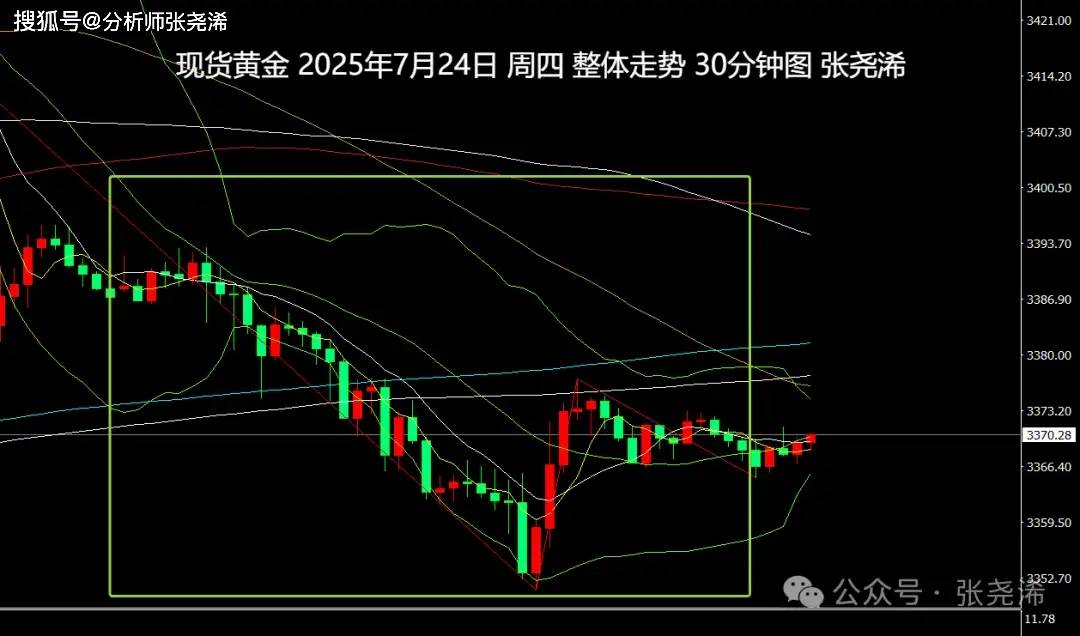
Core Viewpoint - The article discusses the recent fluctuations in gold prices, indicating a potential upward trend despite temporary declines due to easing trade tensions and market dynamics [1][5]. Price Movements - On July 24, gold opened at $3388.15 per ounce, reached a high of $3393.15, and then fell to a low of $3351.30, closing at $3368.39, marking a daily decline of $19.76 or 0.58% [3]. - The price is expected to remain within a range, with strong support below, suggesting limited downside potential [5][9]. Market Influences - The easing of trade tensions, particularly between the U.S. and Japan, and progress in U.S.-EU trade agreements have reduced demand for safe-haven assets like gold, impacting its price [5]. - The outlook for interest rate cuts in the U.S. is anticipated to support gold prices, as comments from U.S. Treasury officials and President Trump suggest a significant reduction in rates may be forthcoming [5]. Technical Analysis - Gold is currently in a consolidation phase within a triangular pattern, indicating that while there may be short-term fluctuations, the overall trend remains bullish [5][9]. - Key support levels for gold are identified at $3350 and $3335, while resistance levels are at $3382 and $3393 [9]. Long-term Outlook - The long-term perspective suggests that gold will continue to be supported by global economic slowdown, expectations of loose monetary policy, and geopolitical risks, maintaining its status as a safe-haven asset [5]. - Predictions indicate that gold prices may oscillate between $3000 and $3500 in the second half of the year, with potential for a bullish market in the following year [7].
金价暴涨超40%!纽曼矿业(NEM.US)Q2盈利大超预期
智通财经网· 2025-07-24 23:26
Core Insights - Newmont Corporation (NEM.US) has achieved significant progress in cost control, resulting in better-than-expected earnings performance amid rising precious metal prices [1][2] - The company reported Q2 revenue of $5.32 billion, a year-over-year increase of 20.9%, exceeding market expectations by $400 million [1] - Non-GAAP earnings per share for Q2 reached $1.43, surpassing market expectations by $0.27 [1] Financial Performance - Net profit surged from $838 million in the same period last year to $2.06 billion this quarter [2] - The average gold price for the quarter was $3,320 per ounce, a 41% increase compared to $2,347 per ounce in the same quarter of 2024 [2] - The all-in sustaining cost for gold production decreased by approximately 4% to $1,593 per ounce, better than analyst expectations [2] Operational Highlights - The cost reduction is attributed to decreased operating expenses, particularly from two mines in Australia and the Lihir mine in Papua New Guinea [2] - Gold production decreased by 4% year-over-year to 1.48 million ounces due to the divestment of non-core assets following the $17.1 billion acquisition of Newcrest Mining [2] Market Context - The demand for safe-haven assets has surged due to global trade uncertainties and conflicts in Ukraine and the Middle East, contributing to a cumulative gold price increase of over 25% this year [3] - Newmont announced a $3 billion stock buyback program and confirmed its annual production target of 5.9 million ounces remains unchanged [3]

黄金:全球变局下的战略避险资产
智通财经网· 2025-07-24 07:58
Group 1 - The importance of gold has been highlighted due to increasing geopolitical tensions, persistent inflation uncertainty, and adjustments in central bank strategies, making it a key strategic choice for asset diversification [1] - The world is gradually dividing into competing economic entities, and gold is re-establishing its position as a preferred neutral asset, trusted across nations and unaffected by sovereign risks [1] - Historical demand drivers for gold include its lack of credit risk, high liquidity, and physical characteristics, making it a reliable asset during market pressures [2] Group 2 - Gold's supply is relatively inelastic, with new production taking 7 to 20 years to develop, which enhances its scarcity premium during periods of rising demand [2] - Empirical data shows that gold often appreciates or at least maintains its value during macroeconomic shocks, serving as an effective hedge against tail risks and systemic events [2] - As of mid-2023, expectations of a pause in central bank interest rate hikes have led to a noticeable increase in gold prices, driven by high inflation and central bank reserve accumulation [2] Group 3 - Gold prices tend to exhibit strong upward trends during financial shocks, often maintaining high levels even after market conditions stabilize [5] - Historical data indicates significant cumulative returns for gold during inflationary periods, with peak returns reaching as high as 302% during the 1972-1976 inflation surge [6][7] - The current cycle (2020-2025) has seen gold prices rise approximately 90% from baseline levels, reinforcing its role as a tactical hedge asset [7] Group 4 - Economic policy uncertainty has a clear relationship with gold prices, as rising uncertainty typically leads to increased gold prices, reflecting its role as a safe-haven asset [8] - Retail demand for gold is significantly influenced by cultural factors, particularly in India and China, which together account for over 60% of global jewelry demand [13] - Central banks have significantly increased gold purchases since late 2021, driven by concerns over asset seizure and geopolitical conflicts, indicating a shift in reserve management strategies [14][15] Group 5 - The increase in gold reserves among central banks reflects a broader strategy to diversify reserves and enhance balance sheet resilience in a fragmented geopolitical landscape [18] - Gold's share in central bank balance sheets has risen from approximately 9% at the end of 2020 to 13.5% by 2024, indicating its growing importance as a reserve asset [18] - Notably, China and India have significantly increased their gold reserves by 17% and 38% respectively, while European central banks have maintained stable reserves [21][23] Group 6 - The technology sector is also driving gold demand, with a 7% increase in gold usage in North America and Asia due to growth in AI and semiconductor manufacturing [25] - Gold's strategic value as an industrial raw material is being recognized, particularly in the context of automation and AI investments in aging economies [25] - Traditional investment flows and central bank accumulation highlight gold's strategic appeal during systemic pressure periods, especially amid rising tariffs and conflicts [26] Group 7 - Gold maintains low correlation with other major asset classes, providing significant diversification benefits in multi-asset portfolios, particularly during periods of simultaneous downturns in traditional assets [29][30] - The 60/20/20 portfolio strategy, which includes 20% allocation to gold, has outperformed the traditional 60/40 portfolio, especially during market downturns [36][39] - Gold's role as a dynamic strategic tool in multi-asset investment environments is increasingly recognized, enhancing risk-adjusted returns amid macroeconomic uncertainty [40][42]

贸易乐观情绪升温 黄金期货承压回落
Jin Tou Wang· 2025-07-24 03:31
Core Viewpoint - The recent trade agreement between the U.S. and Japan, along with optimistic trade talks between the U.S. and the EU, has led to a decline in gold prices as market concerns over trade tensions ease [3]. Group 1: Trade Agreements - U.S. President Trump announced a trade agreement with Japan, reducing auto tariffs from 27.5% to 15% and securing $550 billion in U.S. investments from Japan [3]. - The EU and U.S. are nearing a similar agreement, potentially setting the baseline tariff for EU goods to the U.S. at 15%, avoiding a rise to 30% [3]. Group 2: Market Reactions - The trade optimism has resulted in a rally in Asian stock markets, with Japan's stock market rising nearly 4%, reaching a new high in over a year [3]. - U.S. stock indices, including the S&P 500 and Nasdaq, reached closing highs, while the Dow Jones increased by over 1% [3]. Group 3: Impact on Gold Prices - The easing of trade conflict concerns has led to a shift of funds from safe-haven assets like gold to riskier assets, putting downward pressure on gold prices [3]. - Current trading strategies for precious metals suggest maintaining a bullish outlook, with the main contract for gold in Shanghai expected to trade between 760-809 yuan per gram [3].
贵属策略报:经贸前瞻改善,?价承压
Zhong Xin Qi Huo· 2025-07-24 02:03
Group 1: Report's Industry Investment Rating - No relevant information provided Group 2: Report's Core View - Global economic and trade prospects have improved due to the new round of China-US economic and trade talks and the US-Japan trade agreement, putting pressure on gold prices. However, gold still has long - term positive factors, and silver is expected to continue to be strong based on the bullish outlook for gold [1][3][6] Group 3: Summary by Relevant Catalogs Key Information - The temporary "cease - fire" agreement on China - US tariffs is approaching the deadline, and China's Vice Premier He Lifeng will go to Sweden for economic and trade talks with the US from July 27th to 30th. US President Trump reached a trade agreement with Japan, reducing Japan's auto import tariffs and avoiding new punitive tariffs on other Japanese goods. In exchange, Japan promised to provide $550 billion in investment and loans to the US [2] Price Logic - On Wednesday evening, gold prices fell from $3437 per ounce and traded below the monthly high. The optimism of the US - Japan trade agreement weakened the market's demand for safe - haven assets. The US dollar rebounded slightly from a two - week low, causing some funds to flow out of the gold market. However, the decline of gold prices was limited due to the weak US dollar index. In the long run, gold has positive factors, and the domestic anti - involution and infrastructure projects are expected to boost the elasticity of silver [3] Outlook - Pay attention to US real estate data, the Fed's interest rate expectations, and changes in trade frictions. The weekly COMEX gold is expected to be in the range of [3250, 3450], and the weekly COMEX silver is expected to be in the range of [36, 45] [6]