
降息前景

Search documents
国投期货综合晨报-20260210
Guo Tou Qi Huo· 2026-02-10 05:05
1. Report Industry Investment Ratings No information provided in the content. 2. Core Views of the Report - The geopolitical situation between the US and Iran remains tense, and oil prices are expected to remain highly volatile with significant geopolitical risk premiums [2]. - Precious metals are in a stage of sharp fluctuations, and it is advisable to wait and see until the volatility decreases [3]. - The copper market is in a game between long - term narratives and weak supply - demand realities, and the price may be pressured first and then rise [4]. - Aluminum and related products face adjustment pressure around the Spring Festival, and attention should be paid to key support levels [5][6][7]. - Zinc, lead, nickel, and other non - ferrous metals have different supply - demand situations, and the price trends are affected by factors such as demand, cost, and inventory [8][9][10]. - For various chemical products such as polycrystalline silicon, industrial silicon, and plastics, the market is affected by factors such as supply, demand, and policies, and most are in a state of shock or weak operation [13][14][28]. - In the steel and iron ore market, the demand is weak, and the prices are under pressure [15][16]. - For agricultural products such as soybeans, grains, and livestock products, the prices are affected by factors such as policies, supply - demand relationships, and international trade [36][39][40]. - The stock index is expected to continue to recover, and the bond market may continue to be strong in the short term [47][48]. 3. Summary by Related Catalogs Energy and Chemicals - **Crude Oil**: The US - Iran talks continue, but the deadlock may persist. Brent oil prices are highly volatile, and geopolitical risk premiums are significant [2]. - **Precious Metals**: They are in a volatile stage, and the market is waiting for US economic data to assess the prospects of interest rate cuts [3]. - **Copper**: The price rebounds with precious metals. The market is in a game between long - term and short - term factors, and the price may be pressured first and then rise [4]. - **Aluminum and Related Products**: Aluminum and its products face adjustment pressure around the Spring Festival. The inventory of aluminum ingots and aluminum rods increases, and the prices of casting aluminum alloy and alumina are affected by different factors [5][6][7]. - **Zinc, Lead, and Nickel**: Zinc has supply - demand imbalances during the Spring Festival, and the price has support at 24,000 yuan/ton. Lead has weak demand and cost - side support. Nickel has increasing inventory and is mainly affected by policy sentiment [8][9][10]. - **Tin**: The price continues to rebound, and attention should be paid to the pressure of the MA20 daily line and the high volatility of the outer market [11]. - **Carbonate Lithium**: It is in a low - level shock, with a slowdown in de - stocking and high short - term uncertainty [12]. - **Polycrystalline Silicon**: The futures market is inactive, and the spot fundamentals lack drivers. It is expected to maintain a shock pattern [13]. - **Industrial Silicon**: The price is under pressure, affected by the performance of polycrystalline silicon futures and the expected implementation of organic silicon emission reduction targets [14]. - **Fuel Oil and Low - Sulfur Fuel Oil**: Fuel oil follows the trend of crude oil. High - sulfur fuel oil has short - term support, and low - sulfur fuel oil is affected by overseas refinery supply and heating demand [22]. - **Asphalt**: It is in a situation of weak supply and demand. The supply pressure is limited, and the consumption shows a slight improvement. The unilateral trend is mainly affected by crude oil, and the cracking spread is expected to be strong [23]. - **Urea**: The daily production is high, and the market is supported by demand. It is expected to fluctuate in the short term and strengthen after the Spring Festival [24]. - **Methanol**: The coastal demand is weak, and the port inventory is high. The domestic production starts to increase, and the market may gradually de - stock after the Spring Festival [25]. - **Pure Benzene**: The domestic production increases, and the inventory is basically stable. The supply - demand pattern is expected to improve around the Spring Festival [26]. - **Styrene**: The supply - demand structure weakens before the Spring Festival, and the social inventory will accumulate seasonally after the festival [27]. - **Polypropylene, Plastic, and Propylene**: The supply of propylene is expected to increase, but the pre - festival supply is tight. The demand for polyolefins is weak as factories enter the holiday [28]. - **PVC and Caustic Soda**: PVC is in a narrow - range shock, with inventory changes and cost support. Caustic soda is affected by cost and downstream demand and is expected to operate near the cost [29]. - **PX and PTA**: PX has more long - term opportunities in the second half of the year, but the current demand is weak. PTA's load increases slightly, and attention should be paid to the post - festival balance [30]. - **Ethylene Glycol**: The inventory increases, but the accumulation slows down. It is expected to improve in the second quarter, but the long - term is under pressure [31]. - **Short - Fiber and Bottle - Chip**: Short - fiber has a good supply - demand pattern, but the downstream is weak. Bottle - chip has a low load and inventory, and attention should be paid to the post - festival inventory [32]. Metals and Minerals - **Iron Ore**: The supply is affected by weather, and the demand is weak. The price is under pressure in the short term [16]. - **Coke and Coking Coal**: The supply of carbon elements is abundant, and the downstream demand is weak. The prices are expected to fluctuate in a range [17][18]. - **Manganese Silicon and Ferrosilicon**: The prices are affected by supply - demand imbalances and policy expectations [19][20]. Shipping - **Container Shipping Index (European Line)**: The spot price is stable, and the shipping companies' price increase is more for guiding expectations. The near - month contract is expected to fluctuate, and the far - month contract is under pressure [21]. Agricultural Products - **Soybeans, Soybean Meal, and Rapeseed Meal**: The price of US soybeans rises, and the domestic soybean meal futures are weak. Rapeseed meal is expected to be weak in the short term [36]. - **Soybean Oil, Palm Oil, and Rapeseed Oil**: The prices of soybean oil and palm oil are in a state of reducing positions and fluctuating. The price of rapeseed oil is affected by policies [37]. - **Soybean No. 1**: It rises strongly, affected by policy auctions and external market prices [38]. - **Corn**: The sales progress is 61%, and the price is weak. The futures are expected to be weak in the short term [39]. - **Pigs**: The spot price is falling, and there is supply pressure after the Spring Festival. The medium - long - term price may have a low point [40]. - **Eggs**: The spot price is weak, and the futures have a strategy of waiting for the post - Spring Festival low point to configure long positions [41]. - **Cotton**: The domestic and foreign markets have different situations. The short - term trend is oscillatory, and it is advisable to wait and see [42]. - **Sugar**: The international and domestic production situations are different. The short - term price is under pressure [43]. - **Apples**: The price is oscillatory, and the market focuses on demand and de - stocking speed [44]. - **Timber**: The price is at a low level, and the low inventory provides support. It is advisable to wait and see [45]. - **Pulp**: The price is weak, and the inventory is accumulating. The short - term trend is oscillatory, and attention should be paid to the support at the previous low [46]. Financial Markets - **Stock Index**: The A - share market rises, and the index futures also rise. The A - share and Hong Kong stock markets are expected to continue to recover, and attention should be paid to the performance of technology - related sectors [47]. - **Treasury Bonds**: The futures rise, and the short - term strong trend is expected to continue. Attention should be paid to curve trading opportunities [48].
综合晨报-20260210
Guo Tou Qi Huo· 2026-02-10 02:45
Report Industry Investment Rating No relevant content provided. Core Views - The report analyzes the market trends of various commodities and financial products, including energy, metals, agricultural products, and financial derivatives. It provides insights into supply - demand dynamics, price movements, and potential investment opportunities and risks in each sector [2][3][4] Summary by Category Energy - **Crude Oil**: The US - Iran talks continue, but core differences remain. The market has reduced concerns about supply disruptions in the short - term, yet geopolitical risks persist. Brent oil prices are highly volatile and contain significant geopolitical risk premiums [2] - **Fuel Oil & Low - Sulfur Fuel Oil**: High - sulfur fuel oil is supported by geopolitical factors and tight spot supply in the short - term. However, it may face pressure in the medium - term if geopolitical risks ease. Low - sulfur fuel oil is affected by increased overseas refinery supply, but European extreme weather may provide support [22] - **Asphalt**: The asphalt market shows a pattern of weak supply and demand. Supply pressure is limited in February, and consumption has improved slightly year - on - year. The price trend is mainly affected by crude oil, and the crack spread is expected to remain strong [23] - **Urea**: Urea production is high, and orders are progressing. The market is supported by local agricultural and reserve demand. It will likely oscillate in the short - term and strengthen after the Spring Festival [24] - **Methanol**: Coastal demand for methanol is weak, and port de - stocking is difficult. Domestic production is increasing, and main - producing areas are de - stocking smoothly. The market is affected by geopolitical situations and may gradually de - stock after the Spring Festival [25] Metals - **Precious Metals**: Precious metals are in a stage of sharp oscillation. The market is waiting for US non - farm payrolls and CPI data to assess the prospects of interest rate cuts. Short - term volatility is high, and it is advisable to wait [3] - **Copper**: Copper prices rebounded overnight. The market is concerned about geopolitical risks and long - term strategic value. After the Spring Festival, prices may first be pressured by inventory accumulation and then rise based on demand expectations [4] - **Aluminum**: Shanghai aluminum continued to oscillate. Inventory performance is weaker than in previous years, and there is adjustment pressure around the Spring Festival. Attention should be paid to the support at 23,000 yuan [5] - **Zinc**: Downstream demand is weak during the Spring Festival, and there is a short - term supply surplus. The rebound momentum of Shanghai zinc is weak, but it has support at 24,000 yuan/ton. A short - selling strategy can be considered when TC rebounds [8] - **Lead**: Shanghai lead is at the lower end of the oscillation range. Demand is weak, and cost - side support is emerging. There is strong support at 16,500 yuan/ton [9] - **Nickel and Stainless Steel**: Shanghai nickel rebounded, but market trading was light. Stainless steel inventory increased, and market confidence declined. The market is currently dominated by policy sentiment [10] - **Tin**: Tin prices continued to rebound. Attention should be paid to the high volatility of the outer market during the Spring Festival. The focus is on post - holiday supply and demand changes [11] - **Carbonate Lithium**: Carbonate lithium is in a low - level oscillation. The inventory reduction speed has slowed down, and there may be spot selling. The futures price has crashed, and short - term uncertainty is high [12] - **Polysilicon**: The polysilicon futures market has light trading, and the price is expected to oscillate. The spot fundamentals lack driving forces, and it is advisable to wait and see [13] - **Industrial Silicon**: Industrial silicon prices are under pressure, affected by the weak performance of polysilicon futures and the expected implementation of organic silicon emission reduction targets. Market sentiment is weak, and attention should be paid to the support at 8,400 yuan/ton [14] - **Iron Ore**: The iron ore market is oscillating strongly. Supply is expected to recover after the hurricane, and demand is weak. The overall supply surplus pressure is large, and prices are under short - term pressure [16] - **Coke and Coking Coal**: Coke and coking coal prices rebounded slightly. Carbon element supply is abundant, and downstream demand is weak. The prices are expected to oscillate within a range [17][18] - **Manganese Silicon and Ferrosilicon**: Manganese silicon and ferrosilicon prices are oscillating. Supply is in surplus, and the market is affected by the "anti - involution" policy [19][20] Agricultural Products - **Soybeans, Soybean Meal, and Rapeseed Meal**: US soybeans rose, but domestic soybean meal futures did not follow. Short - term risks should be noted. Rapeseed meal may oscillate weakly [36] - **Soybean Oil, Palm Oil, and Rapeseed Oil**: Soybean oil and palm oil are in a state of position - reduction oscillation. US soybean oil may be strong, and attention should be paid to the US Department of Agriculture report. Rapeseed oil is affected by Canadian菜籽 import policies [37] - **Soybean No. 1**: Soybean No. 1 rose strongly with increased positions. Policy - related soybean auctions and strong external soybean prices have a positive impact [38] - **Corn**: The national corn sales progress is 61%. Spot prices are weak, and trading is light before the Spring Festival. Corn futures are expected to oscillate weakly [39] - **Hogs**: Hog spot prices are falling, and the near - month contract has converged with the spot price. There is supply pressure after the Spring Festival, and long - term prices may have a low point [40] - **Eggs**: Egg spot prices have weakened, and the futures premium has been reduced. Egg prices may rise in the first half of 2026, and a long - position strategy can be considered after the Spring Festival [41] - **Cotton**: US cotton rebounded. Domestic cotton processing and sales are increasing, and imports have increased. Domestic cotton prices are expected to oscillate, and it is advisable to wait and see [42] - **Sugar**: International sugar production in India is increasing, while in Thailand it is slower than expected. Domestic sugar production in Guangxi is slow, but there is an expectation of increased production in the 25/26 season. Sugar prices face pressure [43] - **Apples**: Apple futures are oscillating. The Spring Festival stocking is in full swing, but the high purchase price and quality issues may affect inventory reduction [44] - **Timber**: Timber futures are at a low level. Supply is expected to decrease, and demand is weak before the Spring Festival. Low inventory provides some support [45] - **Pulp**: Pulp futures are falling. Port inventory has increased for five consecutive weeks, and demand support is weak. Pulp prices are expected to oscillate [46] Financial Derivatives - **Stock Index**: A - shares rose sharply, and the trading volume increased. The stock index futures also rose. The market is expected to continue to recover, and attention should be paid to technology - related sectors [47] - **Treasury Bonds**: Treasury bond futures rose, and the curve showed a slight bull - steepening. The market is expected to be strong before the Spring Festival, and attention should be paid to curve - trading opportunities [48] Shipping - **Container Shipping Index (European Line)**: The spot market price is stable. Airlines plan to raise prices in March, but the post - Spring Festival period is a traditional off - season. The near - month contract is expected to oscillate, and the far - month contract is under pressure from resumption of flights [21] Chemicals - **Pure Benzene**: Domestic production of pure benzene is increasing, and downstream utilization has improved. The supply - demand situation is expected to improve around the Spring Festival, and port inventory may gradually decrease [26] - **Styrene**: Supply is increasing and demand is decreasing before the Spring Festival. Social inventory will accumulate seasonally after the Spring Festival [27] - **Polypropylene, Plastic, and Propylene**: The supply of propylene is expected to increase, but the pre - holiday supply is tight. Polyolefin demand is weak as factories are on holiday [28] - **PVC and Caustic Soda**: PVC is oscillating narrowly, and inventory is accumulating seasonally. Exports are good, and prices are expected to rise. Caustic soda is oscillating strongly, but there is cost - side pressure [29] - **PX and PTA**: PX is recommended for long - positions in the first half of the year, but the current demand is weak. PTA load has increased slightly. Consider long - positions in PX processing margin and positive spreads after the Spring Festival [30] - **Ethylene Glycol**: Ethylene glycol production is increasing, and demand is weak. Inventory is accumulating, but the rate has slowed down. There is an expectation of improvement in the second quarter, but long - term pressure remains [31] - **Short - Fiber and Bottle - Chip**: Short - fiber has a good supply - demand pattern, but downstream orders are weak. Bottle - chip processing margin has recovered, but there is long - term capacity pressure. Consider positive spreads after the Spring Festival [32] - **Glass**: Glass futures are rising. Inventory is increasing, and there is pressure during the Spring Festival. Industry capacity is being compressed, and there may be opportunities for low - price purchases [33] - **20 - Rubber, Natural Rubber, and Butadiene Rubber**: Natural rubber supply is decreasing, and synthetic rubber supply is increasing. Rubber inventory is increasing, and it is advisable to wait and see and look for cross - variety arbitrage opportunities [34] - **Soda Ash**: Soda ash is running weakly. Inventory is rising, and there is supply - demand surplus pressure in the long - term. A short - selling strategy can be considered [35]
金价再刷历史高点、后市前景仍具上涨空间
Sou Hu Cai Jing· 2026-01-13 07:04
Group 1 - The core viewpoint of the articles highlights the impact of geopolitical tensions and uncertainties surrounding the Trump administration's investigation into Federal Reserve Chairman Jerome Powell, which has raised concerns about the Fed's independence and the long-term outlook for the US dollar, leading to a surge in gold prices [1][3] - On January 12, gold prices opened at $4,516.02 per ounce, reached a low of $4,512.88, and then rebounded to touch the $4,600 mark before facing resistance, ultimately closing at $4,597.28, marking a daily increase of $87.33 or 1.94% from the previous close of $4,509.95 [3] - The trading session exhibited a daily volatility of $119.91, with gold prices peaking at $4,629.86 before retreating [3] Group 2 - On January 13, gold prices continued to show weakness in the early session, influenced by a strengthening US dollar index and expectations of a higher core CPI for December, which may limit bullish momentum [3] - The potential rise in CPI could enhance gold's commodity attributes, suggesting that if the CPI shows an overall decline, it may boost rate cut expectations, leading to a stronger gold price [3] - Regardless of the CPI results, the prevailing strategy remains to buy on dips, indicating a bullish outlook for gold [3]


张尧浠:避险需求持续推动 金价日内先空后多
Xin Lang Cai Jing· 2026-01-07 07:41
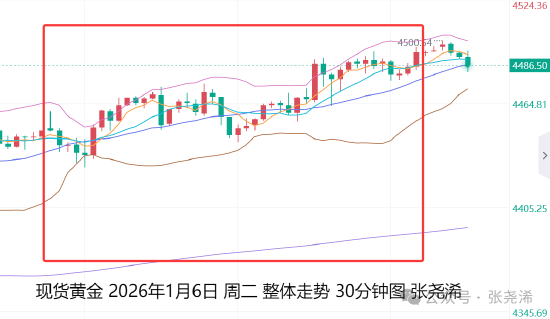
Core Viewpoint - International gold prices continue to rebound and remain above the midline and short-term moving averages, indicating a bullish trend with expectations of reaching new historical highs [1][11]. Price Movement - On January 6, gold opened at $4,448.62 per ounce, recorded a low of $4,427.94, and reached a high of $4,497.21, closing at $4,494.53, with a daily fluctuation of $69.27 and a gain of $45.91, or 1.03% [1][11]. Influencing Factors - The bullish trend is supported by buying interest above the short-term moving averages and strong safe-haven demand due to geopolitical tensions, including U.S. military actions in Venezuela and potential interest rate cuts by the Federal Reserve [3][17]. Market Outlook - Despite a temporary weakening in gold prices due to profit-taking and a stronger U.S. dollar, the overall outlook remains bullish, with expectations for further price increases [3][14]. Economic Data to Watch - Key economic indicators to monitor include U.S. ADP employment numbers, ISM non-manufacturing PMI, JOLTs job openings, global supply chain pressure index, and factory orders, which are generally expected to be favorable for gold prices [4][15]. Technical Analysis - Monthly analysis shows gold prices are strong, recovering most of the previous month's losses, and if the upward trend continues, there is potential for a bull market with gains exceeding 30%, targeting $5,500 to $6,000 [6][17]. - Weekly analysis indicates a potential for price corrections towards $4,000 to $3,900 if the trend reverses, but the overall trend remains upward with support from moving averages [8][19]. Trading Strategy - The recommended trading strategy is to maintain a bullish outlook, with specific support levels at $4,430 or $4,385 and resistance levels at $4,515 or $4,550 for gold [10][20].
大宗商品综述:原油小幅走低 铜创出两个月最大下跌 黄金收窄涨幅
Xin Lang Cai Jing· 2025-12-12 21:44
Oil Market - Oil prices experienced a slight decline amid volatile trading, with WTI crude falling to its lowest level since May, closing below $58 per barrel [2][11] - The market sentiment is increasingly bearish due to concerns over oversupply, exacerbated by a downturn in the US stock market [3][11] - Diesel futures dropped approximately 1.4%, contributing significantly to the overall decline in the oil sector [3][11] - Traders are betting on further declines in oil prices, with short positions on Brent crude reaching a seven-week high [3][11] Copper Market - Copper prices recorded their largest single-day drop in two months, falling by 3% as concerns over demand resurfaced following a sell-off in US tech stocks [6][14] - The price of copper settled at $11,515 per ton, with a weekly decline of 0.9% [7][15] - Analysts noted that copper is highly sensitive to fluctuations in the AI sector, which has seen significant volatility [6][14] Gold Market - Gold prices narrowed their intraday gains, influenced by comments from Federal Reserve officials that made traders more cautious about future monetary policy easing [8][16] - Following the remarks, the yield on 30-year US Treasury bonds rose, causing gold prices to dip by as much as 0.5% [9][17] - As of 3:25 PM NY time, spot gold was up 0.4% at $4,298.46 per ounce, while silver fell by 2.9% to $61.7153 per ounce [9][17]
华尔街一扫阴霾,美股明年又能实现双位数涨幅?
Jin Shi Shu Ju· 2025-12-05 08:22
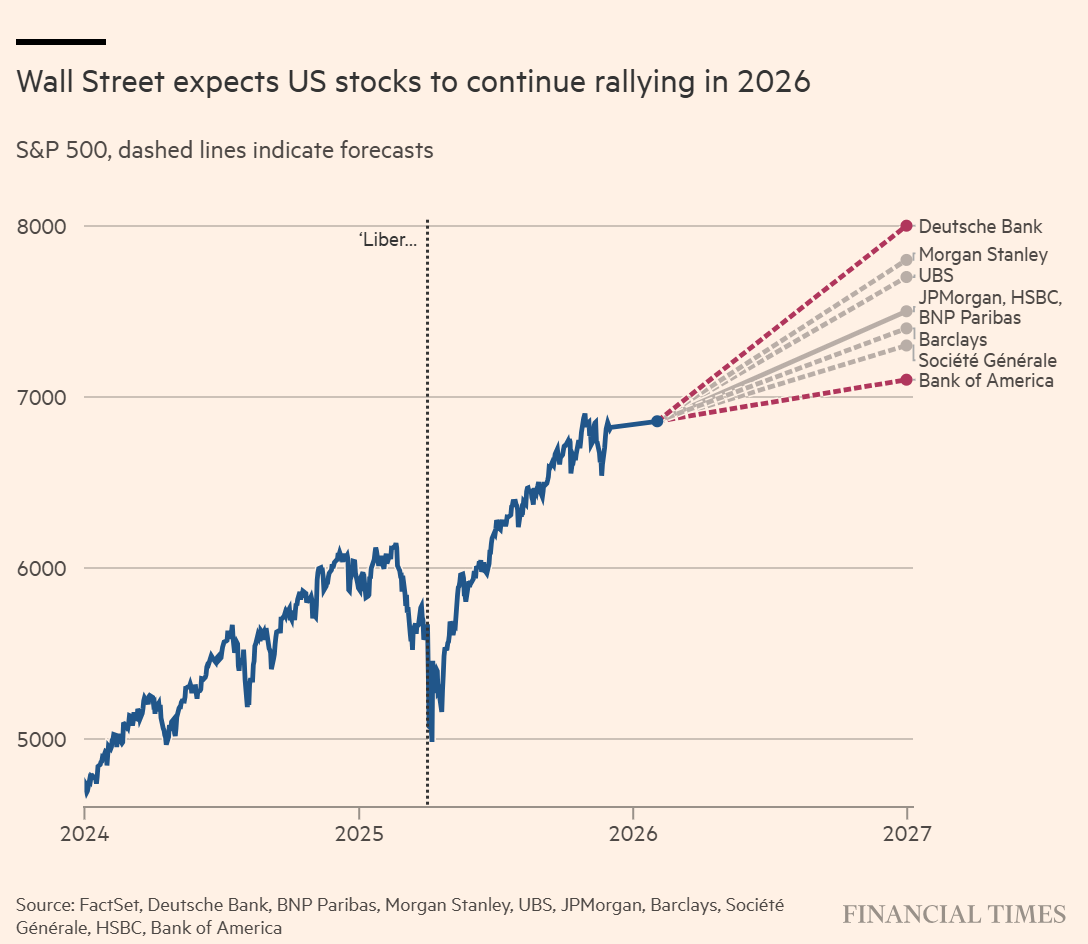
Core Viewpoint - Wall Street banks predict that the U.S. stock market will achieve another year of double-digit growth by 2026, despite recent investor concerns over large tech companies' spending plans and potential AI bubble risks [1][3]. Group 1: S&P 500 Index Predictions - The average forecast from nine major investment banks suggests that the S&P 500 index will rise to over 7500 points by the end of 2026, representing an approximate 10% increase from current levels [1][3]. - The index closed at 6857 points recently, having reached a historical high of 6920 points in October [1][3]. - This growth would mark the seventh year of double-digit increases in the past eight years, although the growth rate is expected to slow compared to the 16.6% increase seen in 2025 and the average growth over the past decade [3]. Group 2: Market Sentiment and Influencing Factors - Analysts believe that the market has moved past the recent pullback caused by AI valuation concerns, supported by President Trump's tax cuts and expectations of interest rate cuts [7]. - Morgan Stanley analysts project the S&P 500 index will reach 7800 points by the end of next year, citing a combination of loose fiscal, monetary, and regulatory policies, along with favorable conditions for AI [7]. - Deutsche Bank forecasts the S&P 500 index will hit 8000 points by 2026, indicating a similar growth rate to 2025, driven by strong corporate earnings growth [8]. Group 3: Broader Market Trends - Outside the U.S., other stock markets are also expected to rise by 2026, though at a slower pace than U.S. markets. The average forecast suggests the European Stoxx 600 index will increase by 6.4% to around 615 points, while Japan's Topix index is expected to rise by 5.6% to approximately 3590 points [9].

张尧浠:金价暂陷调整待数据指引 前景仍是多头蓄势待发
Xin Lang Cai Jing· 2025-12-04 14:09
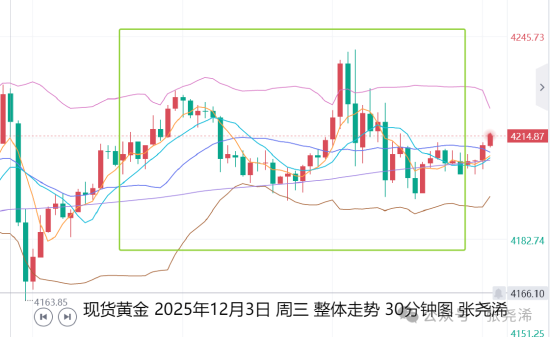
Core Viewpoint - The international gold price experienced fluctuations, indicating a potential consolidation phase, but the overall trend remains bullish [1][11]. Market Performance - On December 3, gold opened at $4206.58 per ounce, briefly rose to $4230 before falling to a low of $4194.70, then peaked at $4241.59 during the US trading session, ultimately closing at $4203.01, down $3.57 or 0.085% [1][11]. - The daily trading range was $46.89, reflecting significant volatility [1][11]. Economic Indicators - Upcoming economic data to watch includes the number of Challenger job cuts, initial jobless claims, and the global supply chain pressure index, which are expected to support gold prices [2][12]. - The ADP report indicated an unexpected decline in US employment for November, contributing to a bearish trend in the US dollar and enhancing expectations for a rate cut [3][15]. Market Sentiment - Despite favorable market conditions, gold prices have not consistently risen, suggesting a period of consolidation as the market assesses real positions [5][14]. - The probability of a December rate cut is close to 90%, but market sentiment is more focused on the outlook for rate cuts in the following year [5][16]. Technical Analysis - Monthly charts show a strong rebound in November, recovering most of October's losses, but a breakthrough above $4400 is necessary to open further upside potential [6][18]. - Weekly charts indicate that gold prices are supported by the 10-week moving average, with a bullish outlook despite some weakening momentum [6][18]. - Daily charts show gold is currently in a consolidation phase below trendline resistance, with multiple moving averages providing support, indicating a favorable outlook for bullish entries [6][18]. Trading Strategy - Suggested trading levels include support at $4193 or $4180 and resistance at $4230 or $4245 for gold [10][18]. - For silver, support is noted at $58.00 or $57.80, with resistance at $59.00 or $59.40 [10][18].
资金狂撤、恐慌上头,比特币的最悲观情景是跌破7万美元?
Hua Er Jie Jian Wen· 2025-11-17 12:42
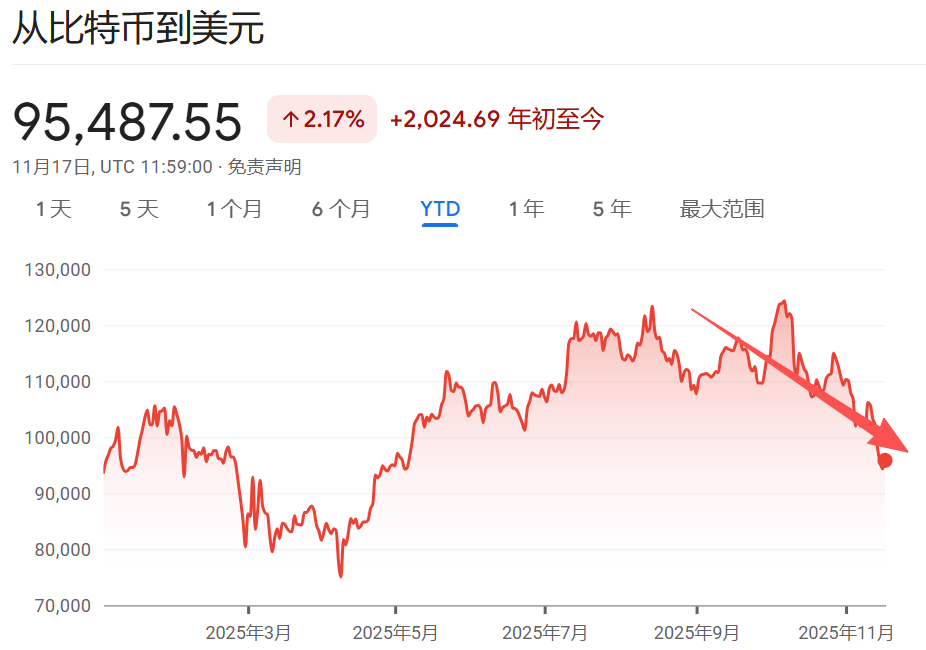
Core Viewpoint - Bitcoin has fallen below the $100,000 mark, raising concerns about its stability and potential further declines, with analysts warning of a possible retest of the $70,000 support level if the U.S. stock market continues to decline [1][4]. Market Dynamics - Bitcoin experienced a significant drop, erasing 30% of its gains for the year, with a peak of $126,000 on October 6, 2023, now down approximately 25% [1]. - Ethereum has also faced challenges, with a decline exceeding 35% from its August highs [1]. Liquidity Crisis - The recent downturn is characterized as a "two-phase decline," starting with macroeconomic risks and followed by a liquidity crisis that has led to increased volatility in the Bitcoin market [3]. - Following the October 10 crash, liquidity in the Bitcoin market has sharply decreased, causing even small trades to result in significant price movements [3]. Economic Environment - The macroeconomic environment is worsening, with reduced expectations for a Federal Reserve rate cut in December and a government shutdown impacting economic data releases, further dampening market sentiment [3]. - The tightening of liquidity is particularly affecting Bitcoin ETFs, which previously attracted over $100 billion but are now facing capital outflows [3]. Technical and Fundamental Pressures - Concerns persist that if the stock market experiences further profit-taking, cryptocurrencies may face a second wave of concentrated selling [4]. - Analysts warn that Bitcoin is still exhibiting characteristics of a risk asset, and further price declines are likely as uncertainties around AI valuations and interest rate cuts loom [4]. Historical Context and Investor Sentiment - There is apprehension among investors about a potential repeat of historical cycles, leading to preemptive market withdrawals to avoid significant downturns [5]. - However, some analysts believe the current sell-off is different from past crises, lacking systemic failures or credit contagion, and expect Bitcoin to reach new highs within 12 to 18 months once conditions stabilize [6]. Investment Strategies - Long-term investors are encouraged to view current price levels as attractive entry points, with some firms reporting record client investments in cryptocurrencies [6]. - Retail investors are advised to adopt dollar-cost averaging strategies and focus on understanding the fundamentals of Bitcoin and Ethereum rather than reacting to market headlines [6].
周三(10月29日)纽约尾盘,欧元兑美元跌0.44%,报1.1601,北京时间02:35美联储主席鲍威尔谈论12月降息前景带来一
Sou Hu Cai Jing· 2025-10-29 21:03
Core Viewpoint - The speech by Federal Reserve Chairman Jerome Powell regarding the prospects of a rate cut in December led to significant currency fluctuations, particularly affecting the euro and the pound against the dollar [1]. Currency Movements - The euro declined by 0.44% against the dollar, trading at 1.1601 [1]. - The British pound fell by 0.57% against the dollar, reaching 1.3195, with a rapid increase in the decline during Powell's remarks [1]. - The US dollar appreciated by 0.83% against the Swiss franc, trading at 0.8001, showing a consistent upward trend throughout the day, particularly during Powell's press conference [1].
黄金连创纪录高位 分析师:黄金走势取决于降息前景及贸易局势
Ge Long Hui· 2025-10-16 13:51
Core Viewpoint - International spot gold prices reached a historic high for the fourth consecutive trading day, driven by escalating trade tensions and the U.S. government shutdown, leading investors to flock to this safe-haven asset. The market's increasing bets on interest rate cuts further fueled the upward trend [1]. Group 1 - Spot gold prices touched a record high of $4,256.21 per ounce during trading [1]. - OANDA analyst Zain Vawda indicated that gold's trajectory will depend on the interest rate cut outlook leading into 2026 and the developments in trade tensions, which could catalyze gold prices to surpass $5,000 per ounce [1]. - Vawda noted that short-term pullbacks in gold prices may be temporary, as bullish investors often re-enter the market during such corrections [1].