
人工智能(AI)

Search documents
2025年第三季度全球IPO趋势报告:稳健驾驭IPO规划(英文版)
Sou Hu Cai Jing· 2025-11-08 01:09
Core Insights - The global IPO market showed a robust recovery in Q3 2025, with 914 IPOs raising a total of $110.1 billion, marking a 5% increase in volume and a 41% increase in proceeds compared to the previous year [1][27][23] - The US, India, and Greater China were the primary drivers of this resurgence, contributing nearly 70% of global IPO transactions and 80% of total proceeds [1][23][24] - Regulatory reforms and market innovations have played a crucial role in enhancing market activity, with exchanges streamlining listing processes and introducing alternative pathways like SPACs and direct listings [2][18][49] Global IPO Market Review - The first three quarters of 2025 saw a total of 914 IPOs, with proceeds reaching $110.1 billion, indicating a gradual recovery in the market [27] - Q3 2025 experienced a significant uptick, with deal volume increasing by 19% and proceeds surging by 89% year-over-year [23][24] - The US achieved its strongest IPO quarter since Q4 2021, while India set a record with 146 IPOs raising $7.2 billion [24][27] Regional Market Dynamics - The Asian market, particularly India, led in IPO volume, driven by active trading in sectors like fintech and manufacturing [2][31] - Greater China maintained strong performance in strategic sectors such as advanced manufacturing and semiconductors, achieving double-digit growth in both deal volume and proceeds [29][31] - The US continued to dominate in terms of capital raised, supported by strong valuations in the technology sector [28][31] Regulatory Landscape - Global exchanges are accelerating reforms to attract innovative firms, with flexible listing rules and streamlined processes becoming common [42][47] - Regulatory changes are aligned with sectoral priorities, focusing on technology, advanced manufacturing, and digital infrastructure [43][47] - Enhanced investor protection measures are being implemented alongside these reforms to maintain market integrity [54][56] PE-Backed IPO Trends - The number of PE-backed IPOs more than doubled year-over-year, with proceeds increasing by 68%, reflecting a shift in exit strategies among private equity firms [62][63] - PE-backed IPOs have shown strong aftermarket performance, particularly in sectors like technology and industrials, with notable gains in the Chinese mainland [64][66] - The trend indicates a growing preference for mature, profitable companies among PE sponsors, emphasizing the importance of financial stability and governance [69][72] Future Outlook - The global IPO market is expected to continue its recovery, with optimism driven by easing monetary policies and strong corporate earnings [76][78] - However, challenges such as persistent inflation and geopolitical uncertainties may impact investor sentiment and IPO valuations [80][81] - Companies are advised to align their strategies with macro trends and demonstrate robust financial health to capitalize on upcoming market opportunities [12][76]


国内机器人走出惊艳“猫步”引发热议 专家解读:是不是越像人越好?
Ke Ji Ri Bao· 2025-11-08 01:00
Core Viewpoint - The development of humanoid robots is driven by the need for them to seamlessly integrate into human-designed environments, rather than merely mimicking human appearance [2][3]. Group 1: Human-like Robots - The "uncanny valley" effect leads to discomfort when robots closely resemble humans, but the goal is to achieve functional compatibility with human environments [2]. - Humanoid robots are designed to operate in spaces built for humans, making them more efficient without requiring extensive modifications to existing environments [2][3]. Group 2: Supporting Technologies - Achieving human-like movement and operation in robots involves complex systems, including motion control, intelligent perception, and AI decision-making [4][5]. - Key capabilities include dynamic balance for walking, precise manipulation for tasks, and advanced AI for understanding and executing commands [4][5]. Group 3: Future Applications - The deployment of humanoid robots is expected to progress in three phases: starting with industrial applications, moving to commercial services, and finally entering household environments [6]. - Initial applications will focus on industrial manufacturing, followed by roles in logistics, healthcare, and hazardous environments, with the ultimate goal of integrating into home settings for various domestic tasks [6].


英伟达CEO今年四度访问中国台湾 黄仁勋:AI需求非常非常强
Jing Ji Ri Bao· 2025-11-07 23:25
英伟达CEO黄仁勋今年第四度访问中国台湾,11月7日日搭乘私人专机到台南,参观南科台积电18厂先 进制程3nm产线,他受访表示,英伟达业务非常强劲,他来鼓励与感谢台积电的辛勤工作。他再回 应"AI泡沫说",强调AI现状与当初网路泡沫化截然不同 ,"需求非常、非常地强劲"。 黄仁勳指出,现在的AI技术已经非常有效,且需求极高。这项技术极其依赖计算,运算需求非常庞 大,辉达正努力追赶上这股极强的需求。 至于是否再游说美国同意英伟达向中国大陆出口Blackwell架构芯片,黄仁勋说目前没有任何积极的讨 论,也没有计划向中国大陆出货。英伟达产品何时能重新进入中国大陆市场,完全取决于中国大陆的决 定,他期待中国大陆改变政策,英伟达能再度服务中国大陆市场。 中国大陆、美国正在拚AI发展速度,英国金融时报(FT)近期报道黄仁勋警告"中国大陆将赢得AI竞 赛",黄仁勋澄清说,他认为中国大陆拥有非常优秀的AI技术,也有许多AI研究人员。全球大约有50% 的AI研究人员都在中国大陆,并开发出非常优秀的AI技术。当今众多广受欢迎的开源AI模型是来自大 陆,当地进展非常迅速,美国必须持续以极快的速度前进,否则全球竞争将会非常激烈。 ...

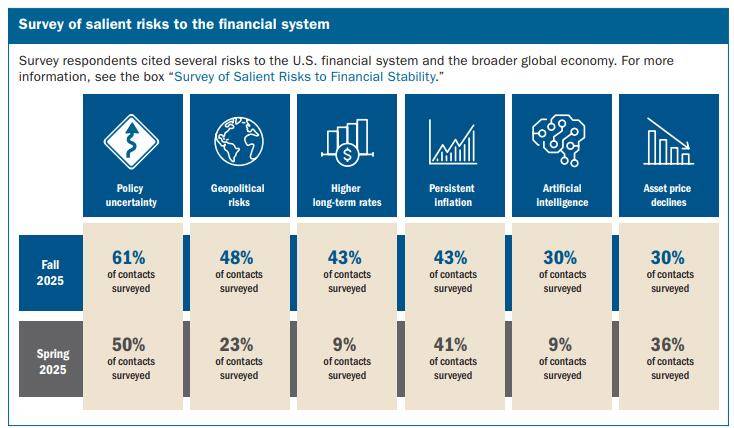
美联储报告:政策不确定性成头号金融稳定风险,央行独立性首次被点名,关注金融杠杆
Sou Hu Cai Jing· 2025-11-07 23:01
Core Viewpoint - The Federal Reserve's Financial Stability Report highlights policy uncertainty as the primary risk facing the U.S. financial system, with concerns shifting from specific trade policies to broader uncertainties, including central bank independence and the availability of economic data [1][2][3] Group 1: Policy Uncertainty - Over 61% of surveyed market participants identified policy uncertainty as the top financial stability risk, up from 50% in the spring survey [3] - The report marks the first time central bank independence has been explicitly mentioned as a risk factor, reflecting recent political pressures on the Fed [1][3] - Geopolitical risks have also gained attention, with 48% of respondents highlighting this concern, a significant increase from 23% in the previous survey [3] Group 2: Interest Rate Concerns - Concerns about rising long-term interest rates have increased, with 43% of respondents mentioning this risk, compared to just 9% in the spring survey [4] - Higher long-term rates could lead to unrealized losses for banks and impact fixed-income investors [4] Group 3: AI-Related Risks - The perception of AI-related asset valuation risks has risen sharply, with 30% of respondents viewing it as a potential shock in the next 12 to 18 months, up from 9% previously [4] Group 4: Leverage in Financial Institutions - The report emphasizes high leverage levels in non-bank financial institutions, particularly hedge funds, which have reached their highest levels since tracking began over a decade ago [7] - Hedge funds' leverage has steadily increased across various strategies, raising concerns about systemic risk [7] - Life insurance companies also exhibit high leverage, although their use of non-traditional liabilities remains limited [7] Group 5: Asset Valuation - Asset valuations are noted to be high, with stock price-to-earnings ratios nearing historical highs and corporate bond yield spreads at low levels compared to long-term averages [9] - The real estate market shows signs of vulnerability, particularly with upcoming refinancing needs in commercial real estate [9] Group 6: Debt Levels - Corporate and household debt vulnerabilities are assessed as moderate, with total debt as a percentage of GDP declining to a two-decade low [11] - While overall debt levels are manageable, certain consumer groups face repayment pressures, particularly in credit card and auto loans [11] Group 7: Financing Risks - Financing risks remain moderate, with government money market funds driving asset growth [12] - The commercial real estate market is showing signs of stabilization, but significant debt maturities in the coming year could increase volatility [12]
美联储杰斐逊:利率接近中性水平 未来政策行动应更谨慎
Zhi Tong Cai Jing· 2025-11-07 13:07
Core Viewpoint - The Federal Reserve should adopt a more cautious approach in future policy actions as interest rates are closer to neutral levels, which neither restrict nor stimulate the economy [1] Group 1: Economic Conditions - Current interest rates have a "slightly restrictive" impact on the economy, and a slowdown in policy actions is deemed wise as the Fed approaches neutral rates [1] - The overall economic situation in the U.S. has not changed significantly in recent months, characterized by "moderate growth" and a "gradual cooling" labor market [1] - Inflation rates are roughly stable compared to a year ago, influenced by tariff policies from the Trump administration, with signs indicating core inflation may be moving towards the Fed's 2% target [1] Group 2: Federal Reserve Officials' Perspectives - Multiple Federal Reserve officials have expressed differing views on the monetary policy outlook since the recent interest rate decision [2] - San Francisco Fed President Daly supports the recent 25 basis point cut and suggests further slight reductions in policy rates are appropriate given the cooling labor market [2] - New York Fed President Williams believes the market's estimate of "neutral rates" may be too high, indicating room for further rate cuts without undermining inflation control [2] - St. Louis Fed President Bullard sees the past year's easing measures as necessary for labor market support, expecting 50 to 75 basis points of policy adjustment space [2] Group 3: Diverging Views on Rate Cuts - Chicago Fed President Goolsbee has adopted a more hawkish stance, indicating a higher threshold for supporting rate cuts and cautioning against premature easing due to persistent inflation [3] - Cleveland Fed President Mester emphasizes that current inflation remains "too high," suggesting that risks to the economy outweigh the labor market slowdown, and further easing may be premature [3] - Mester anticipates that inflation may not reach the Fed's 2% target until 2026 or later, indicating a prolonged period without achieving price stability [3]
Rightmove (OTCPK:RTMV.F) Trading Update Transcript
2025-11-07 10:32
Rightmove (OTCPK:RTMV.F) Trading Update Summary Company Overview - Rightmove has been a leader in the U.K. estate agency and new homes market for over 25 years, leveraging exceptional network effects to deliver value to partners and consumers [1][2][4] Key Industry Insights - The U.K. property and home moving services market is valued at approximately GBP 10 billion, with significant opportunities for digitization and efficiency improvements [19][20] - Rightmove's brand awareness exceeds 90%, with 85% of traffic being direct and organic, indicating a strong market position [23] Core Business Performance - Residential find constitutes 90% of Rightmove's total revenue, with a strong focus on maintaining leadership in this area [4][6] - The strategic growth areas (SGAs) contributed around 7% of revenue at the half-year mark, with expectations of sustainable growth rates of 20-30% in the long term [6][53] Financial Performance and Projections - Rightmove aims for 8-10% revenue growth through the investment stage to 2028, with a goal of achieving sustained double-digit growth by 2030 [52][55] - The company plans to invest approximately GBP 12 million in 2026 and a total of GBP 40 million over three years to support growth initiatives [48][49] Technological Advancements - Rightmove is modernizing its platform, transitioning to a cloud-based infrastructure, and enhancing its data capabilities [7][40] - The company is infusing AI into its operations, with 27 prioritized AI projects aimed at improving consumer and partner experiences [29][31] Product Development and Innovation - Rightmove is focused on enhancing consumer engagement through AI-powered features, including personalized search experiences and integrated mortgage tools [34][35] - The launch of the Online Agent Valuation (OAV) product aims to streamline the home valuation process for both consumers and agents [17][18] Strategic Growth Areas - Rightmove is expanding its offerings in commercial property, mortgage solutions, and rental services, with significant operational milestones achieved in these segments [9][10][11] - The company is committed to exploring new wallet areas across the home-moving journey, with a focus on enhancing the network effect [46] Investment Strategy - Rightmove's investment strategy prioritizes consumer innovation, operational efficiency, and strategic R&D to drive future growth [31][32] - The company maintains a disciplined approach to capital allocation, ensuring that every investment delivers tangible business impact [51] Conclusion - Rightmove is well-positioned to capitalize on the evolving landscape of the U.K. property market, leveraging its strong brand, data capabilities, and commitment to innovation to drive future growth and shareholder returns [58]
软银,市值蒸发近500亿美元
半导体芯闻· 2025-11-07 10:24
如果您希望可以时常见面,欢迎标星收藏哦~ 来源 :内容来自 BBC 。 周五,日本软银集团(SoftBank Group)的股价再次开始下滑,此前人工智能(AI)相关股票普 遍暴跌,原因是投资者再次对该板块过高的估值产生警惕。 该 集 团 广 泛 投 资 于 基 础 设 施 、 半 导 体 和 应 用 公 司 等 领 域 的 人 工 智 能 公 司 , 其 股 价 收 盘 下 跌 了 6.87%,从盘中早些时候的跌幅中有所收复。 在此之前,软银股价在前一个交易日上涨了近3%,但周三曾暴跌10%,创下自四月以来的最差单 日 表 现 。 本 周 , 其 市 值 蒸 发 了 近 500 亿 美 元 , 并 录 得 自 2020 年 3 月 以 来 最 差 的 周 跌 幅 , 跌 幅 近 20%。 在人工智能相关股票面临新一轮压力后,软银集团的股价下跌。软银持有英国半导体设计公司Arm Holdings的控股权,该公司的芯片为全球移动和人工智能处理器提供动力。在纳斯达克上市的Arm 股价隔夜下跌了1.21%。 另外,彭博社最近援引知情人士的消息报道称,该集团曾在今年早些时候考虑收购美国芯片制造商 美满电子科技(Mar ...

技术性购债还是变相QE?达利欧警示“危险且通胀性”政策组合
Xin Hua Cai Jing· 2025-11-07 09:44
Core Viewpoint - Ray Dalio warns that a combination of the Federal Reserve stopping quantitative tightening while expanding its balance sheet, alongside interest rate cuts and high fiscal deficits, could create a "more dangerous and inflation-prone" policy environment [1][2]. Group 1: Federal Reserve Actions - The Federal Reserve will officially stop its quantitative tightening program on December 1, ceasing the reduction of its nearly $7 trillion balance sheet [1]. - Fed Chairman Jerome Powell indicated that the Fed may begin to increase asset holdings to ensure reserves grow in line with the banking system and economic scale [1]. - Dallas Fed President Lorie Logan noted that if recent repo rate increases are not temporary, the Fed may need to start purchasing assets to maintain adequate reserve supply [1]. Group 2: Market Implications - There is a divergence in the market regarding whether these actions constitute quantitative easing (QE), as the Fed typically does not classify technical purchases aimed at managing short-term rates as QE [1]. - Analysts suggest that the market effects of these actions may be difficult to distinguish from traditional QE [1]. - Evercore analyst Marco Casiraghi estimates that the Fed may need to purchase up to $50 billion in assets monthly by Q1 2026, primarily focusing on short-term Treasury bills, which could indirectly lower long-term yields [1]. Group 3: Economic Environment and Risks - Dalio emphasizes that the current environment differs fundamentally from historical stimulus cycles, highlighting active private credit, strong capital market financing, high stock market levels, low credit spreads and unemployment rates, and persistent high inflation [2]. - He describes the situation as a "bold and dangerous gamble" on economic growth, particularly in AI, supported by extremely loose fiscal, monetary, and regulatory policies [2]. - Dalio warns that if inflation risks reignite, companies with physical assets (like mining and infrastructure) may outperform pure long-duration tech stocks [2]. Group 4: Historical Context - Dalio compares the current market conditions to the liquidity-driven market rallies of late 1999 and 2010-2011, suggesting that such conditions may lead to forced policy tightening due to excessive risk accumulation [2]. - He advises that the classic time to sell assets is just before inflation spirals out of control and policies shift towards tightening [2].
电子行业双周报(2025、10、24-2025、11、06):行业前三季度业绩快速增长,AI相关细分表现亮眼-20251107
Dongguan Securities· 2025-11-07 09:22
Investment Rating - The report maintains an "Overweight" rating for the electronic industry, expecting it to outperform the market index by more than 10% in the next six months [1]. Core Insights - The electronic industry experienced rapid growth in the first three quarters of 2025, with revenue reaching 2.44 trillion yuan, a year-on-year increase of 20.86%. Net profit attributable to shareholders was 1,003.33 billion yuan, up 33.41% year-on-year [28][32]. - The strong performance is attributed to robust demand from AI data centers, which boosted the demand for PCB/CCL components and server/switch hardware. Additionally, the recovery in traditional consumer electronics such as smartphones and PCs, along with emerging fields like AI glasses, AR/VR, and robotics, contributed to this growth [28][29]. - The industry's gross margin for the first three quarters was 13.36%, a slight decrease of 0.26 percentage points year-on-year, while the net margin improved by 0.54 percentage points to 4.08% [28]. Summary by Sections Market Review and Valuation - The Shenwan electronic sector rose by 4.29% over the past two weeks (10/24-11/06), outperforming the CSI 300 index by 2.40 percentage points, ranking third among Shenwan industries. Year-to-date, the sector has increased by 49.97%, outperforming the CSI 300 index by 30.69 percentage points [9][10]. Industry News - Major companies reported strong earnings: - Apple reported Q4 revenue of $102.47 billion, a 7.9% year-on-year increase, with expectations of 10%-12% growth in Q1 2026 [18]. - Amazon's AWS revenue grew by 20% year-on-year to $33.01 billion, marking the largest increase since 2022 [18]. - Alphabet's Q3 revenue was $102.35 billion, up 16% year-on-year, with Google Cloud revenue reaching $15.16 billion [18]. - Microsoft's Q1 revenue was $77.67 billion, an 18% increase year-on-year [18]. Industry Data - Global smartphone shipments in Q3 2025 reached 323 million units, a 2.57% year-on-year increase. In China, shipments were 21.64 million units, up 2.59% [20]. - The prices of LCD panels in October 2025 showed a slight decline, with 32-inch panels priced at $35, down $1 from the previous month [23]. Weekly Perspective - The report highlights the strong performance of various segments within the electronic industry: - PCB segment revenue grew by 24.61%, with net profit increasing by 61.41% [29]. - CCL segment revenue rose by 33.81%, with net profit up by 86.47% [29]. - Consumer electronics revenue increased by 27.56%, with net profit growing by 32.05% [29]. - Panel manufacturing revenue grew by 8.90%, with net profit increasing by 58.18% [32]. Key Companies to Watch - The report suggests focusing on specific companies due to their strong performance: - Huadian Technology reported a revenue of 13.51 billion yuan, up 49.96% year-on-year [33]. - Lixun Precision reported a revenue of 220.91 billion yuan, a 24.69% increase [33]. - Shenghong Technology's revenue surged by 83.40% to 14.12 billion yuan [33].





超威半导体(AMD)FY25Q3业绩点评及说明会纪要:CPU&GPU共振向上,推动新一轮成长
Huachuang Securities· 2025-11-07 08:45
Investment Rating - The industry investment rating is "Recommended," indicating an expected increase in the industry index by more than 5% over the next 3-6 months compared to the benchmark index [40]. Core Insights - AMD reported FY2025Q3 revenue of $9.2 billion, a year-on-year increase of 36% and a quarter-on-quarter increase of 20%. The GAAP gross margin was 54%, with a Non-GAAP EPS of $1.20, reflecting a 30% year-on-year growth [3][7]. - The data center segment achieved record revenue of $4.3 billion, up 22% year-on-year and 34% quarter-on-quarter, driven by strong sales of the fifth-generation EPYC "Turin" processors and Instinct MI350 GPUs [3][8]. - The client and gaming segment also reached record revenue of $4.0 billion, a 73% year-on-year increase, with gaming revenue soaring by 181% [3][9]. - The embedded segment reported revenue of $857 million, down 8% year-on-year but up 4% quarter-on-quarter [3][10]. - AMD expects FY2025Q4 revenue to be approximately $9.6 billion, a year-on-year increase of 25%, with a projected Non-GAAP gross margin of about 54.5% [4][11]. Summary by Sections AMD FY2025Q3 Performance - AMD's revenue for FY2025Q3 was $9.2 billion, with a gross margin of 54% and a record free cash flow of $1.5 billion [7]. Business Segment Performance - **Data Center Segment**: Revenue of $4.3 billion, with a 25% operating margin [8]. - **Client and Gaming Segment**: Revenue of $4.0 billion, with a 21% operating margin [9]. - **Embedded Segment**: Revenue of $857 million, with a 33% operating margin [10]. FY2025Q4 Guidance - Expected revenue of approximately $9.6 billion, with a Non-GAAP gross margin of about 54.5% [11].
