
新能源

Search documents
影响市场重大事件:工信部推动人工智能、400G/800G光传送等前沿技术在交换中心部署和应用
Mei Ri Jing Ji Xin Wen· 2025-12-30 22:00
Group 1 - China successfully launched the Tianhui-7 satellite on December 30, 2025, using the Long March 4B rocket, marking the 622nd flight of the Long March series [1] - The Tianhui-7 satellite is primarily used for geographic information surveying, land resource census, and scientific research [1] Group 2 - The Ministry of Education aims to build a self-controlled AI model for education during the 14th Five-Year Plan period, focusing on platform, data, AI tools, and policy consistency [2] - Key initiatives include advancing integrated data support systems, promoting AI in education, enhancing digital literacy among teachers and students, and contributing to global digital education governance [2] Group 3 - Huawei reported that over 36 million devices are using HarmonyOS 5.0 and above, and the Kunpeng ecosystem has developed 3.8 million developers [3] - The company has supported 60 million users with 5G-A networks and has over 1.6 million installations of the openEuler operating system [3] Group 4 - The National Development and Reform Commission and the Ministry of Finance announced continued support for the renewal of new energy city buses and power batteries in 2026 [4] - The subsidy standards will follow the guidelines established in the 2025 implementation details for new energy city buses [4] Group 5 - Qianzhao Optoelectronics announced breakthroughs in radiation resistance for its flexible space solar cell products, enhancing satellite stability in space [5] - The lightweight nature of these solar cells helps reduce satellite weight and launch costs, with a focus on expanding international market presence [5] Group 6 - XPeng Motors' CEO stated that true fully autonomous driving will arrive in 2026, skipping L3 and moving directly from L2 to L4 [6] - The Ultra version of XPeng's vehicles will achieve next-generation autonomous driving capabilities, similar to the transition seen in smartphones with the introduction of the iPhone [6] Group 7 - Four departments, including the Ministry of Industry and Information Technology, released a plan to accelerate AI applications in the automotive industry, focusing on key manufacturing processes [7][8] - The initiative aims to integrate AI in research, production, and management, and to create intelligent demonstration production lines in the automotive sector [7][8] Group 8 - The Ministry of Industry and Information Technology issued guidelines to promote the deployment of cutting-edge technologies like AI and 400G/800G optical transmission in internet exchange centers [9] - The focus is on enhancing network efficiency and smart operations while supporting the development of key technologies through collaboration among industry, academia, and research [9] Group 9 - The National Energy Administration held a meeting to discuss the construction of high-quality charging infrastructure for electric vehicles, aiming for a three-year doubling of service capacity [10] - The plan includes improving coverage in residential and rural areas and enhancing safety management in the charging infrastructure sector [10] Group 10 - The first fire power holding-type real estate ABS in China was listed on the Shanghai Stock Exchange, led by GCL Group, with a project scale of 5.46 billion yuan [11] - The funds raised will be directed towards clean energy technology research and will help optimize financial structures and support major strategic projects [11]
数说A股2025:十大亮点绘制市场新图景
Zheng Quan Shi Bao· 2025-12-30 18:50
主编:彭玉琼 编辑:谢伊岚 美峰:刘晓庆 2025年12月31日 星期三 2025年A股注定 载入中围资本市场发展 史册:总市值首破百万亿元 大关,实现历史性体量跨越:科 校板块强势团归重塑市场主线,成 为行情核心引擎。从规模跃升的"量 的突破,到结构优化的"质"的飞跃,资本 市场以全方位的进阶,清晰映射出中国经济 高质量发展新格局。 数说A股2025 绘制市场 证券时报记者 梁谦别 2025年 A 股市场今日收官。回顾这一年,市场在经济复苏.产业政策深化与投资者结构变迁 的共同驱动下,演绎了一场深刻而又充满活力的结构性行情。这一年, A股不仅实现了规模的踪 越式增长,更在产业结构、资金强向与投资生态上,呈现出标志性的新特征。本文将从十大角度 逐一展开,解读数据背后的趋势与信号。 两融会额攀升至历史高位 30000 ■ 单位:亿元 25000 200000 15000 10000 5000 0 2016年 2017年 2018年 2019年 2020年 2021年 2022年 2023年 2024年 2025年 2025年融资净买入前十股票 | 代码 | 简称 | A股市值 (Z元) | #1155 融资净买 ...


这两场战争,美国只要输一场,中国就将在大国博弈中不战而胜!
Sou Hu Cai Jing· 2025-12-30 18:20
Group 1: Historical Context of U.S. Manufacturing - In the 1950s to early 1970s, the U.S. manufacturing sector was thriving, with factories widespread and workers earning enough to support families and buy homes [1] - The U.S. held a dominant position in global manufacturing until competition from post-war Europe, Japan, and South Korea emerged, leading to a decline in U.S. market share [3][5] - The U.S. automotive industry faced significant challenges from Japanese cars, which offered better price-performance ratios, leading to a loss of market share for American manufacturers [5] Group 2: Strategic Shifts in U.S. Industry - The U.S. shifted low-end manufacturing overseas while retaining high-end production, negotiating military protection for oil transactions with Middle Eastern countries [7] - In 1985, the U.S. pressured Japan to appreciate the yen, which led to a prolonged economic downturn in Japan while stabilizing U.S. trade positions [8] - The U.S. benefited from various global crises, including the dissolution of the Soviet Union and the 2008 financial crisis, which reinforced its economic dominance [9] Group 3: China's Rise and Global Dynamics - China's emergence as a global economic power has disrupted U.S. dominance, with the country challenging the existing order and expanding its influence through initiatives like BRICS [13][25] - The U.S. faces difficulties in revitalizing its manufacturing sector due to societal shifts towards consumerism and a reluctance to return to traditional manufacturing jobs [13] Group 4: Current Geopolitical Tensions - The ongoing conflict in Ukraine has strained U.S. resources and alliances, with NATO's support for Ukraine facing challenges as the situation remains unresolved [15][16] - The semiconductor industry is a focal point of U.S.-China tensions, with the U.S. implementing strict export controls to maintain its technological edge [18][19] Group 5: Economic Challenges and Future Outlook - The U.S. national debt has surpassed $35 trillion, projected to reach $37.3 trillion by 2025, raising concerns about fiscal sustainability and potential credit crises [21] - The rise of BRICS and the challenge to the dollar's dominance indicate a shift in global economic power dynamics, with emerging markets seeking alternatives to U.S. financial systems [24][25]
2025年港股观察:首募规模大增 交投更为活跃
Zheng Quan Ri Bao· 2025-12-30 16:06
本报记者 毛艺融 12月30日,6只新股在港交所挂牌上市,涵盖人工智能制药、数字孪生科技、预制钢结构、高端美妆、数据基础设施及家 用机器人等领域。 回顾2025年,港股市场在一级和二级市场均表现强劲。除了股指上涨,2025年港股在制度建设和市场结构上也取得重要进 展,包括IPO机制重大改革、开通"科企专线"等,不仅吸引了更多优质科技企业,也推动国际长线资金、南向资金等增量资金 流入。 展望2026年,机构对港股趋势态度乐观。中信证券认为,2026年,港股将迎来第二轮估值修复,恒生指数和恒生科技的动 态PE分别有望扩张5%和10%,全年节奏预计为先稳后升。 交投活跃度显著提升 今年以来,港股市场交投活跃。港交所官网数据显示,2025年11月底,香港证券市场市价总值为48万亿港元,较去年同期 (34万亿港元)增长41%。2025年前11个月的平均每日成交金额为2558亿港元,较去年同期(1309亿港元)增长95%,港股流 动性显著改善。 南向资金成为港股市场的重要增量资金。Wind资讯数据显示,截至12月30日,年内南向资金净买入总额达1.40万亿港元, 成为港股市场最重要的流动性支撑。 随着优质企业接连上市,港 ...
“世界工厂”迭代升级!东莞万家规上工业企业完成数字化转型
Zhong Guo Jing Ji Wang· 2025-12-30 13:38
Group 1 - Dongguan is positioned as a national advanced manufacturing base and international technology innovation center, with industrial scale ranking among the top ten cities in China [1] - The proportion of high-tech manufacturing in the above-scale industrial sector increased from 37% to 44%, while the share of advanced manufacturing rose from 46% to 52% during the 14th Five-Year Plan period [1] - Dongguan's industrial investment nearly doubled over five years, with over 8,500 enterprises upgraded to above-scale status, ranking first in Guangdong province [1] Group 2 - The industrial sector contributes over 50% to Dongguan's GDP, maintaining the top position in Guangdong province [2] - Cumulative technological transformation investment reached 336.6 billion yuan, growing over 50% during the 14th Five-Year Plan period [2] - Dongguan has created 183 smart factories and promoted digital transformation for nearly 10,000 above-scale industrial enterprises, accounting for over 70% of the total [2] Group 3 - Dongguan is focusing on strategic emerging industries, including artificial intelligence, low-altitude economy, and new energy, with special support policies in place [2] - The city has established a national AI application pilot base and launched an AI computing power service platform for the manufacturing sector [2] - Dongguan is planning to create 133 low-altitude application scenarios [2] Group 4 - Dongguan's R&D expenditure and effective invention patents are projected to be 1.4 times and 2 times that of 2020, respectively, with an R&D intensity of 4.01%, ranking third in Guangdong province [3] - The talent pool in Dongguan has increased from 2.58 million to over 3.3 million [3] - The city has achieved significant breakthroughs in key technologies, including the return of Huawei's Mate series and advancements in materials research [3]
中国价值链系列研究之一:纵横捭阖:全球价值链重构与中国产业体系突破
工银国际· 2025-12-30 13:22
Group 1: Economic Context and Trends - China's value chain has rapidly expanded, becoming a key hub in global production networks, with domestic value added (DVA) consistently ranking first globally since 2000[6] - The complete industrial system of China has led to over 22% average global value added share in key manufacturing sectors, surpassing traditional manufacturing powerhouses like Germany and the USA[8] - The GVC position of China has steadily improved, indicating a shift from reliance on imported intermediate goods to becoming a supplier of high-value components[15] Group 2: Challenges and Strategic Responses - The international trade order faces challenges from technological hegemony and protectionism, leading to a decline in the degree of global value chain fragmentation[1] - China is actively addressing vertical supply chain risks by focusing on core technology breakthroughs and upgrading its industrial capabilities[19] - The shift from product export to multinational chain building is accelerating, with Chinese companies establishing overseas production and assembly bases to enhance supply chain resilience[30] Group 3: Future Outlook and Innovations - The modern service industry is emerging as a new driver for overall value chain upgrades, with significant contributions from sectors like industrial design and brand operations[24] - By 2025, China is expected to enter the top ten of the global innovation index, bolstered by advancements in AI, renewable energy, and healthcare[23] - Regional cooperation, such as the RCEP and the Belt and Road Initiative, is enhancing trade ties and reducing costs, with ASEAN becoming China's largest trading partner by 2023[31]
万里同春,徽聚未来丨2025凤凰网安徽企业家思享荟圆满落幕
凤凰网财经· 2025-12-30 12:43
Core Viewpoint - The event "万里同春·徽聚未来——2025安徽企业家思享荟" held in Hefei, Anhui, aimed to empower regional businesses by analyzing capital market dynamics and exploring opportunities for industrial upgrades [1][3]. Group 1: Economic Trends and Investment Strategies - The global macroeconomic environment is undergoing profound structural adjustments, with China's economic development now driven by innovation, emphasizing "new quality productivity" as a core engine for future growth [4]. - The "14th Five-Year Plan" is a critical phase for transformation, requiring a balance between consolidating traditional industry advantages and actively building systemic competitiveness in new sectors such as technological innovation and green low-carbon initiatives [4]. - The construction of a forward-looking and defensive wealth management framework has become essential for both family asset appreciation and corporate capital strategic allocation [4]. - Key factors defining China's long-term economic development include the green transition represented by new energy and technological breakthroughs [4][6]. Group 2: Insights from Industry Experts - Notable economist Shao Yu emphasized that significant technological advancements in history are often driven by "bubbles," particularly the current wave of artificial intelligence, which must transition from the virtual to the real economy to effect meaningful change [6]. - Shao Yu identified potential disruptive products for the next decade, such as smart devices that combine hardware and software, including robots and autonomous vehicles, which could lead a new industrial revolution [6]. - The automotive industry, particularly in the context of electric vehicles, faces challenges such as overcapacity, necessitating a search for differentiated breakthroughs in new areas like solid-state batteries and hydrogen energy [7]. - Economist Fu Peng highlighted that the core factors influencing the stock market are efficiency, which stems from productivity improvements, changes in production relations, and institutional adjustments [7]. Group 3: Regional Development and Strategic Positioning - Anhui's unique geographical advantages, positioned at the intersection of major national strategies, are transforming into developmental strengths, making it a key node for collaborative innovation and emerging industries [8]. - The urbanization process in China has room for improvement, with projections indicating that it will peak by 2035, providing ongoing development opportunities for regions like Anhui that are early adopters of technological industrialization [8]. - Fu Peng noted that the current global economic suspense revolves around whether the technological revolution represented by AI can successfully transform production relations and significantly enhance productivity [8][9]. Group 4: Cultural and Brand Significance - The event served as a platform for high-level dialogue and resource linkage, with the brand Jian Nan Chun embodying a spirit of "craftsmanship and innovation," aiming to deepen cooperation across various dimensions [13][14]. - Jian Nan Chun's historical significance as a royal court wine and its commitment to cultural heritage were highlighted, emphasizing the importance of values in constructing future worth [15][14]. - The event facilitated discussions on investment strategies, risk management, and industry collaboration, fostering a shared understanding among participants [18][24].
历史新高后,再涨1.75%!有色ETF华宝(159876)获资金净申购2880万份!机构:明年有色牛或延续亮眼表现!
Xin Lang Cai Jing· 2025-12-30 12:05
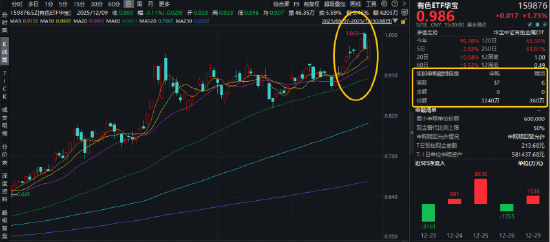
Core Viewpoint - The performance of the non-ferrous metals sector is strong, driven by macroeconomic policies and structural changes in supply and demand, with significant interest in the sector from investors [4][14]. Group 1: ETF Performance - The non-ferrous ETF Huabao (159876) opened significantly lower on December 30, dropping over 2%, but quickly rebounded, reaching a high of 2.27% and closing up 1.75%, with an overall daily fluctuation of 4.95% [1][9]. - The ETF saw a net subscription of 28.8 million units, indicating strong investor confidence in the non-ferrous metals sector [1][9]. Group 2: Stock Performance - Key stocks in the non-ferrous metals sector, such as Yun Aluminum and Tianshan Aluminum, reached historical highs, with Yun Aluminum rising by 6.82% and Tianshan Aluminum by 4.99% [2][11]. - Other notable performers included Hailiang Co. with a 5.41% increase and China Aluminum with a 4.72% rise [2][12]. Group 3: Market Influences - The recent decline in gold and silver futures was attributed to two main factors: an increase in margin requirements by the Chicago Mercantile Exchange and the need for international funds to rebalance their positions due to the surge in gold and silver prices [2][12]. - Analysts expect that the passive selling during the 2026 BCOM rebalancing will primarily affect short-term trading patterns without altering the long-term positioning of gold and silver in macro hedging and asset allocation [3][13]. Group 4: Future Outlook - The non-ferrous metals sector is expected to continue its strong performance into 2026, supported by favorable macroeconomic conditions such as loose liquidity, rising inflation, and a weak dollar [4][14]. - The Chinese government is encouraging consolidation and optimization in traditional industries, which may enhance the profitability of the aluminum industry chain, particularly in downstream smelting [3][14].
国家电投安徽公司华北分公司馆陶50兆瓦风电项目并网
Xin Lang Cai Jing· 2025-12-30 11:04
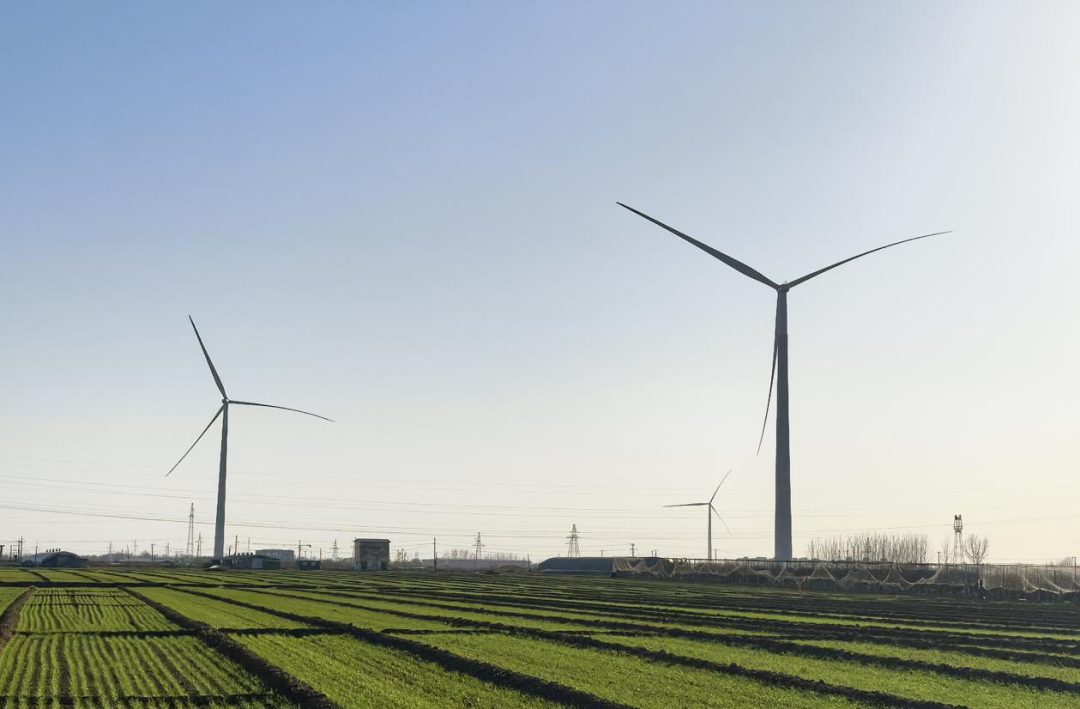
Group 1 - The project has a first-phase installed capacity of 50 megawatts, equipped with 7.5 megawatts/15 megawatt-hours of electrochemical energy storage, and includes 8 wind turbines with a single capacity of 6.25 megawatts [2][5] - The project is connected to a 110 kV booster station through two collection lines, and the management team has successfully navigated significant challenges such as large equipment transportation and complex external coordination [2][5] - Upon operation, the project is expected to generate approximately 110 million kilowatt-hours of electricity annually, equivalent to saving 35,000 tons of standard coal and reducing carbon dioxide emissions by about 86,000 tons each year [2][5] Group 2 - WETOWN ELECTRIC aims to build trust in Chinese electrical products, focusing on customer satisfaction and innovation, while providing solutions and quality services across various sectors including renewable energy and industrial manufacturing [3][6] - The company operates in three main business areas: distribution equipment, energy storage systems, and photovoltaic new materials, positioning itself as a leader in the distribution equipment sector and a significant player in the energy storage market [3][6] - WETOWN ELECTRIC has established itself as a major manufacturer of photovoltaic welding strips in China, contributing to the development of a zero-carbon lifestyle through technological empowerment [3][6]
26年港股策略展望:日积跬步,水涨船高
GF SECURITIES· 2025-12-30 10:43
Core Insights - The current rise in Hong Kong stocks is supported by fundamentals, with signs of structural recovery in profitability starting from the second half of 2024, driven by stabilization in both domestic and external demand and macroeconomic policies [3][10] - The growth in high-end manufacturing and technology is transitioning from "single-point breakthroughs" to "multi-point explosions," with Hong Kong stocks shifting focus from traditional economic cycles to hard technology sectors like AI applications, new energy, and semiconductors [3][9] - The Hang Seng Index's earnings growth is expected to rebound to 10.8% in 2026, indicating a potential shift from liquidity-driven growth to a combination of profitability and liquidity support [3][11] Group 1: Fundamental Support for Hong Kong Stocks - Historical correlation exists between the Hang Seng Index's performance and earnings growth, with the current strength primarily driven by net inflows from southbound funds and foreign capital [10] - The structural recovery in profitability is evident, particularly in sectors less affected by traditional economic pressures, with emerging industries like pharmaceuticals and technology showing significant growth [20][19] - The impact of external factors, such as the recent food delivery subsidy war, has temporarily disrupted earnings expectations but is not indicative of a fundamental downturn [10][11] Group 2: Market Sentiment and Liquidity - Current market sentiment may have adjusted, and a potential liquidity improvement could lead to a new upward trend in Hong Kong stocks [3][31] - The Hang Seng Technology Index has experienced volatility due to external liquidity pressures, but the peak of lock-up share releases has passed, reducing market sentiment pressure [33][32] - Factors such as the potential for a dovish shift in the next Federal Reserve chair's policies and the stabilization of the Hong Kong dollar could alleviate liquidity constraints [50][52] Group 3: Sector Allocation Strategies - Focus on growth sectors, particularly those related to AI applications, energy storage, and innovative pharmaceuticals, as they are expected to catalyze earnings improvements [3][9] - Economic cycle-related assets should be monitored for potential supply-demand mismatches, particularly in chemicals and metals [3][19] - Stable value assets may still provide absolute returns, but the cost-effectiveness may decline compared to previous years, necessitating a focus on sectors with supply barriers and pricing power [3][30]



