产能出清

Search documents
奥特维,净利同比降近六成
3 6 Ke· 2025-08-27 03:03
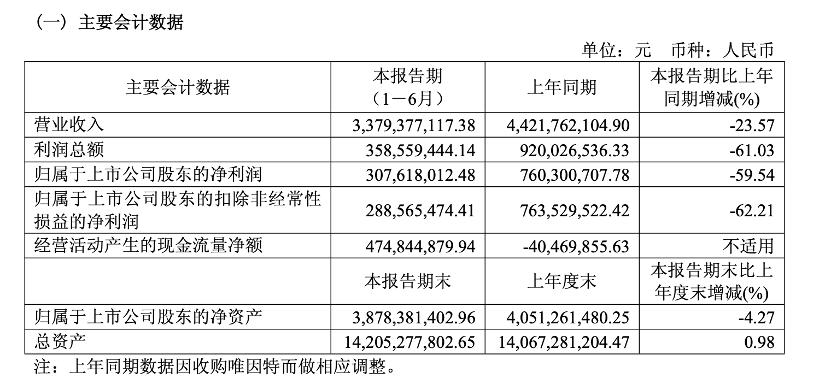
Core Viewpoint - The company reported a significant decline in revenue and profit for the first half of 2025, primarily due to the ongoing downturn in the photovoltaic industry and challenges faced by downstream customers [1][2][3] Financial Performance - The company achieved operating revenue of 3.38 billion yuan, a year-on-year decrease of 23.57% [2] - The net profit attributable to shareholders was 308 million yuan, down 59.54% compared to the previous year [2] - The net profit after deducting non-recurring gains and losses was 289 million yuan, a decline of 62.21% year-on-year [2] - The total profit for the period was 359 million yuan, reflecting a 61.03% decrease from the same period last year [2] - The net cash flow from operating activities was 475 million yuan, a significant improvement from a negative 40 million yuan in the previous year [3] Business Segments - Revenue from photovoltaic equipment reached 2.67 billion yuan, accounting for 78.87% of total revenue, with core products maintaining a competitive edge in the market [3] - Revenue from lithium battery equipment was 176 million yuan, representing 5.20% of total revenue [3] - The company had a backlog of orders amounting to 10.57 billion yuan, a decrease of 26.32% year-on-year, primarily due to a decline in photovoltaic industry orders [3] Market and Product Development - The company is expanding into overseas markets to mitigate the impact of declining orders in the photovoltaic sector [5] - Domestic revenue was 2.59 billion yuan, making up 76.56% of total revenue, while international revenue was 792 million yuan, accounting for 23.44% [5] - The company has invested 363 million yuan in a high-end intelligent equipment smart factory project, with a completion progress of 35.16% [5] Intellectual Property and R&D - As of June 30, 2025, the company held a total of 2,361 authorized intellectual property rights, including 313 invention patents [4] - The company's products are primarily used in the photovoltaic, lithium battery, and semiconductor industries [4] Stock Performance - As of August 25, 2025, the company's stock price was 39.96 yuan per share, with a total market capitalization of 12.595 billion yuan [6]


石化板块走高 机构圈出这些机会
Di Yi Cai Jing· 2025-08-26 06:38
Group 1 - The petrochemical sector is experiencing an upward trend, with companies like Compton, Tongkun Co., and Xin Fengming leading the gains [1] - Everbright Securities highlights that despite geopolitical uncertainties, the medium to long-term oil supply and demand dynamics remain favorable, maintaining a positive outlook on "three major oil companies" and the oil service sector [1] - The recovery of the macro economy is boosting chemical demand, and long-term capacity elimination in chemical products is beneficial for leading enterprises, with a positive outlook on large refining, coal chemical, and ethylene profitability [1] Group 2 - Minsheng Securities notes the emergence of "anti-involution" policies in the petrochemical industry, recommending a focus on industry leaders with strong performance stability and consistent high dividends [1] - Oil prices are expected to have a floor, leading to high earnings certainty for oil companies, combined with high dividend characteristics, which may enhance valuations; attention is advised on companies with sustained production growth and low cost [1] - Domestic policies encourage oil and gas reserve increases and production, suggesting a focus on companies in the growth phase of production [1]

奥特维:上半年净利润同比下降59.54% 拟每10股派5元
Zheng Quan Shi Bao Wang· 2025-08-25 09:16
Core Viewpoint - The company reported a significant decline in both revenue and net profit for the first half of 2025, primarily due to the ongoing downturn in the photovoltaic industry and challenges faced by downstream customers [1] Financial Performance - The company achieved an operating revenue of 3.379 billion yuan, representing a year-on-year decrease of 23.57% [1] - The net profit attributable to shareholders was 308 million yuan, down 59.54% year-on-year [1] - Basic earnings per share were reported at 0.98 yuan [1] Dividend Distribution - The company plans to distribute a cash dividend of 5 yuan (including tax) for every 10 shares to all shareholders [1] Industry Context - The decline in performance is attributed to the persistent low demand in the photovoltaic industry, with ongoing capacity adjustments and extended acceptance periods for products [1]
碳酸锂日评:波动再放大,持仓注意保护-20250825
Hong Yuan Qi Huo· 2025-08-25 09:16
Report Summary 1. Report Title - "Carbonate Lithium Daily Review 20250825: Fluctuations Amplified Again, Protect Positions" [1] 2. Core View - On August 22, 2025, the main contract of carbonate lithium futures fluctuated downward. The short - term supply and demand both strengthened, with high carbonate lithium production, rising downstream demand, and social inventory destocking. The short - term fundamentals changed little, and it was necessary to guard against the repeated "anti - involution" sentiment. It was expected that the carbonate lithium price would fluctuate widely. Operationally, short - term, interval trading was recommended, and one could buy on dips and appropriately purchase options for protection [2]. 3. Key Data Summary Futures Market - **Closing Prices**: The closing prices of near - month, consecutive - one, consecutive - two, consecutive - three contracts and others on August 22, 2025 were 79180, 79180, 78620, 78620, 78960 yuan/ton respectively, all showing a decline compared to August 21 [2]. - **Trading Volume**: The trading volume of carbonate lithium futures on August 22 was 932675 hands, an increase of 154848 hands compared to August 21 [2]. - **Open Interest**: The open interest of the active contract on August 22 was 362254 hands, a decrease of 27815 hands compared to August 21 [2]. Spot Market - **Prices of Lithium - Related Products**: Most lithium - related products' prices decreased on August 22 compared to August 21. For example, the average price of battery - grade carbonate lithium decreased by 1300 yuan/ton, and the average price of industrial - grade carbonate lithium also decreased by 1300 yuan/ton [2]. - **Inventory**: The SMM carbonate lithium inventory data showed that the total inventory on August 21 was 141543 tons, a decrease of 713 tons compared to the previous total [2]. 4. Industry News - A rumored "capacity clearance" document was confirmed, and a closed - door meeting of the lithium iron phosphate industry was held in Shenzhen [2]. - Dazhong Mining (001203) is applying for a lithium mining license in Hunan. It plans to put the first - phase 20,000 - ton lithium mining, beneficiation and smelting project in Hunan into production in 2026, and has achieved by - product ore revenue in the first half of 2025. The Sichuan lithium mine will start producing and selling raw ore this year [2]. - Premier African Minerals completed the second - phase trial operation of the main flotation plant of its Zulu project in Zimbabwe on August 21. The plant can operate continuously as expected, and the grade of lithium oxide in the lithium concentrate has reached 6.2% [2].
碳酸锂日评:波动再放大持仓注意保护-20250825
Hong Yuan Qi Huo· 2025-08-25 07:08
Report Summary 1. Core View - On August 22, the main contract of lithium carbonate futures fluctuated downward. The spot market's purchasing willingness increased, and the basis premium widened. In the short - term, both supply and demand are strengthening, the fundamentals change little, and prices are expected to fluctuate widely. It is recommended to conduct short - term, range - bound operations, and buy options for protection after sharp declines [2]. 2. Market Data Summary Futures Market - **Prices**: On August 22, the closing prices of near - month, continuous - one, continuous - two, continuous - three contracts and others decreased compared to the previous day, with declines ranging from 3,560 to 3,820 yuan/ton [2]. - **Volume and Open Interest**: The trading volume was 932,675 lots (+154,848), and the open interest of the active contract was 362,254 lots (-27,815) [2]. - **Spreads and Basis**: The spreads between different contracts and the basis between the SMM battery - grade lithium carbonate average price and the active contract's closing price changed. For example, the basis increased by 2,500 yuan [2]. Spot Market - **Raw Material Prices**: The average prices of lithium spodumene concentrate, lithium mica, and other lithium ores decreased. For example, the average price of lithium spodumene concentrate (6%, CIF China) dropped by 14 dollars/ton [2]. - **Lithium Compound Prices**: The average prices of battery - grade and industrial - grade lithium carbonate, lithium hydroxide, and other lithium compounds mostly decreased. For example, the average price of battery - grade lithium carbonate (99.5% battery - grade/China - made) decreased by 1,300 yuan/ton [2]. Inventory - The total SMM lithium carbonate inventory decreased by 713 tons compared to the previous week. The inventory of smelters decreased by 2,847 tons, while the downstream inventory increased by 3,224 tons, and other inventory decreased by 1,090 tons [2]. 3. Industry News - A so - called "capacity clearance" document was confirmed, and a closed - door meeting of the lithium iron phosphate industry was held in Shenzhen [2]. - Dazhong Mining (001203) plans to have its Hunan lithium mine's first - phase 20,000 - ton mining, beneficiation, and smelting project completed and put into production in 2026. The Sichuan lithium mine will start producing and selling raw ore this year [2]. - Premier African Minerals completed the second - stage trial run of its main flotation plant at the Zulu project in Zimbabwe, achieving a lithium oxide grade of up to 6.2% [2].
中泰期货晨会纪要-20250825
Zhong Tai Qi Huo· 2025-08-25 06:32
Report Industry Investment Ratings No relevant content provided. Core Viewpoints of the Report - A series of significant events are taking place globally and in China, including international summits, policy announcements, and industry - related initiatives, which have a wide - ranging impact on the financial and commodity markets [9][10][11] - Different commodity futures have distinct trends and investment strategies, influenced by factors such as macro - economic conditions, supply - demand relationships, and geopolitical events [13][17][19] Summaries by Relevant Catalogs Macro - economic News - The 2025 Shanghai Cooperation Organization Summit will be held in Tianjin from August 31 to September 1. President Xi Jinping will preside over relevant meetings [9] - Fed Chair Powell's speech at the Jackson Hole symposium led traders to increase bets on a September rate cut [9] - The central bank conducted 600 billion yuan of MLF operations on August 25, with a net injection of 300 billion yuan this month [9] - Multiple policies were issued, including those related to securities company classification, futures company internet marketing, and the "Three - North" project [10] - The China Photovoltaic Industry Association called for an end to cut - throat competition, and a major procurement bid saw an increase in average prices [10] Macro - finance Stock Index Futures - The strategy is to consider going long on dips for the long - term and using an option covered - call strategy for the short - term. The A - share market showed a strong upward trend on Friday, with the Shanghai Composite Index breaking through 3,800 points [13] Bond Futures - In the short - term, it is mainly in a volatile state. The medium - term curve steepening strategy can still be held. Attention should be paid to the possible emotional swing after Central Huijin's reduction of Hong Kong - listed brokerage stocks [14][15] Black Commodities Steel and Iron Ore - Steel and ore prices are expected to remain volatile. Policy has a "de - involution" impact, and the supply - demand situation shows that seasonal demand is weak, but the medium - term supply - demand contradiction is not prominent [17] Coking Coal and Coke - The prices of coking coal and coke may enter a high - level volatile stage in the short - term. Supply is affected by safety inspections and production restrictions, while demand is supported by high iron - making output but may decline [18] Ferroalloys - The supply of ferrosilicon and silicomanganese is increasing, and the cost of silicomanganese is slightly weakening. The mid - term strategy is to short on rebounds, and the market may open higher on the 25th due to macro - sentiment [19] Soda Ash and Glass - For soda ash, the strategy is to short on rallies, and for glass, it is to wait and see. Soda ash supply may increase in the future, and glass needs to digest speculative inventory [20] Non - ferrous Metals and New Materials Aluminum and Alumina - Aluminum prices are expected to be volatile and strong, and it is recommended to go long on dips. Alumina prices are expected to be volatile and weak, and it is recommended to short on rallies [22] Zinc - Zinc prices are expected to weaken as social inventories increase, processing fees rise, and downstream demand is weak [23] Lithium Carbonate - Lithium carbonate prices will mainly operate in a wide - range volatile state after returning to a reasonable valuation. There may be a supply gap in September - October [24] Industrial Silicon and Polysilicon - Industrial silicon is expected to be in a volatile state, and polysilicon is mainly affected by policy expectations, with a wide - range volatile trend [25] Agricultural Products Cotton - In the short - term, cotton prices are strong due to downstream demand and low inventory, but in the long - term, there are concerns about increased production and demand. It is recommended to short on rallies in the long - term and wait and see in the short - term [27] Sugar - Domestic sugar prices are under pressure due to expected increased supply, but there may be support from holiday - related demand. It is recommended to wait and see in the short - term and look for short - covering opportunities in the long - term [29] Eggs - The egg futures market has intensified competition. It is recommended to short on rallies in the near - term, and be cautious about bottom - fishing [32] Apples - The price of stored apples is expected to be stable, and early - maturing apples are expected to maintain a high - quality, high - price trend. It is recommended to conduct a light - position positive spread operation [34] Corn - It is recommended to short on rallies for the 01 contract or conduct a 11 - 1 positive spread operation. The corn market is currently bearish due to supply and demand pressures [35] Red Dates - It is recommended to wait and see. The market is in a consumption off - season, and attention should be paid to weather and sales conditions [37] Pigs - It is recommended to wait and see in the short - term. The market is currently supply - dominant, but there may be a short - term price rebound at the end of the month [38] Energy and Chemicals Crude Oil - Crude oil prices are in a strong - side volatile state in the short - term but are expected to be weak in the medium - and long - term. Attention should be paid to geopolitical events and OPEC+ meetings [39] Fuel Oil - Fuel oil prices are expected to follow crude oil prices, with a short - term volatile range between 65 - 70 dollars [39] Plastics - Polyolefins are expected to be weak and volatile from a supply - demand perspective, but market sentiment may be affected by the expectation of eliminating backward production capacity [41] Rubber - Rubber has no obvious short - term contradictions. It is recommended to go long on dips with a stop - loss and be cautious about chasing high prices [42] Methanol - Methanol prices are expected to be weak and volatile due to port inventory accumulation. It is recommended to exit short positions and wait and see [43] Caustic Soda - Caustic soda prices are strong in both the spot and futures markets. It is recommended to maintain a long - position idea [44] Asphalt - Asphalt prices follow crude oil prices. The current fundamentals are in a seasonal off - season but are turning to the peak season [45] Polyester Industry Chain - It is recommended to try to go long on dips. The supply - demand structure of the polyester industry chain has improved, and prices are expected to be strong [46] Liquefied Petroleum Gas (LPG) - LPG prices are strong in the short - term but are expected to be weak in the long - term due to sufficient supply and limited demand growth [47] Pulp - Pulp prices are mainly affected by news and sentiment. It is recommended to observe port inventory reduction and demand changes after Chenming's resumption of production [48] Urea - Urea prices are expected to be weak due to weak domestic demand and doubts about large - scale exports. It is recommended to maintain a bearish view [49] Synthetic Rubber - Synthetic rubber has no obvious contradictions in the short - term. It is recommended to conduct high - selling and low - buying operations or wait and see [50]
磷酸铁锂行业闭门会在深圳召开,新能车ETF(515700)涨超1.0%
Xin Lang Cai Jing· 2025-08-25 02:37
Core Insights - The lithium iron phosphate (LFP) industry is facing challenges related to overcapacity and the need for structural adjustments, as discussed in a recent closed-door meeting in Shenzhen [1] - The demand for LFP is expected to grow significantly in the second half of 2024, driven by the energy storage battery sector and the mass production of next-generation materials [1] - By the first half of 2025, China's LFP production is projected to reach 1.632 million tons, a year-on-year increase of 66.6%, with total available capacity rising to 5.32 million tons [1] Group 1 - The meeting focused on addressing the issue of outdated production capacity in the LFP industry and exploring low-carbon transformation paths for the entire supply chain [1] - The current supply-demand situation is characterized by an overall surplus but a structural shortage, with high-quality capacity being relatively scarce while low-end capacity is excessive [1] - Leading companies maintain over 70% operating rates due to their technological, financial, and supply chain advantages, while smaller firms face idle capacity due to lower product quality [1] Group 2 - The "anti-involution" trend in the LFP sector may lead to the elimination of certain capacities, particularly those unable to keep pace with product upgrades, those affected by bankruptcies, and those with poorly designed production lines [2] - The New Energy Vehicle (NEV) ETF closely tracks the CSI New Energy Vehicle Industry Index, with nearly half of its component stocks being from the battery sector, indicating potential benefits from the industry's "anti-involution" [2] - As of July 31, 2025, the top ten weighted stocks in the CSI New Energy Vehicle Industry Index include major players like CATL, BYD, and Ganfeng Lithium, collectively accounting for 55.33% of the index [2]
鲍威尔暗示9月降息
Dong Zheng Qi Huo· 2025-08-25 00:15
Report Industry Investment Ratings Not provided in the given content. Core Views of the Report - Global central bank meeting, Powell's dovish speech, market's Fed rate - cut expectation heats up, boosting risk appetite and affecting multiple asset prices [13][17][58] - Multiple commodities are affected by various factors such as supply - demand, policies, and international events, showing different trends and investment opportunities [26][32][59] Summary by Directory 1. Financial News and Reviews 1.1 Macro Strategy (Gold) - Trump plans to impose tariffs on imported furniture, and Powell hints at a September rate cut [12][13] - Gold price rose about 1% on Friday. Market priced in a 25bp rate cut in September and two rate cuts this year. But current positives can't break gold out of the consolidation [13] - Investment advice: Gold price will continue to fluctuate in the short - term [14] 1.2 Macro Strategy (Foreign Exchange Futures - US Dollar Index) - Iran's supreme leader rules out direct talks with the US, and the US vice - president says new sanctions on Russia are "not impossible" [15][16] - Powell's speech at the central bank annual meeting is dovish. The Fed's policy focus shifts to the labor market, and the US dollar index trends weaker [17] - Investment advice: The US dollar trends weaker [18] 1.3 Macro Strategy (US Stock Index Futures) - Powell signals a rate cut, and Canada cancels some retaliatory tariffs on US goods [19][20] - Market sentiment turns cautious initially, then risk appetite recovers after Powell's dovish speech. US stocks are expected to fluctuate strongly in the short - term [21] - Investment advice: Expect US stocks to fluctuate strongly in the short - term due to rate - cut expectations. Pay attention to Nvidia's earnings report and July PCE data next week [21] 1.4 Macro Strategy (Stock Index Futures) - Chinese leaders attend the SCO Summit - related events, and the State Council studies measures to release sports consumption potential [22][23] - A - shares are strong with increasing trading volume, showing a short - term bullish pattern. But beware of the test of mid - year reports [24] - Investment advice: Suggest balanced long positions in stock index futures [25] 2. Commodity News and Reviews 2.1 Black Metal (Steam Coal) - As of the end of July, the cumulative installed power generation capacity is 36.7 billion kilowatts, with solar and wind power growing significantly [26] - Coal price ends its rising trend and enters a weak consolidation. It is expected to fluctuate between 650 - 700 yuan in the future [26][27] - Investment advice: Coal price may decline slightly with the season. It is expected to fluctuate between 650 - 700 yuan [27] 2.2 Black Metal (Iron Ore) - Guangxi acquires 20,000 existing commercial housing units [28] - Iron ore price continues to fluctuate. Its fundamentals are slightly weak, and the market sentiment is divided. It is expected to maintain a consolidation pattern [28][29] - Investment advice: Iron ore price is expected to fluctuate. The downside is limited, and it is expected to remain in a consolidation pattern [29] 2.3 Agricultural Products (Soybean Oil/Rapeseed Oil/Palm Oil) - The WTO supports Indonesia in the biodiesel tariff dispute, and the Trump administration makes decisions on SRE applications [30][31] - The negative impact of SRE is less than expected, and US soybean oil price rebounds. Domestic edible oils are expected to rise and then fluctuate [32] - Investment advice: After last week's adjustment, US biofuel policies drive up US soybean oil price. Domestic edible oils are expected to rise and then fluctuate, with palm oil having the largest increase [32] 2.4 Agricultural Products (Cotton) - Cotton mills destock, Brazil's cotton exports reach a record high, and US cotton export contracts are poor [33][34][35] - US cotton export contracts are still weak, and ICE cotton price is expected to fluctuate at a low level in the short - term [35][36] - Investment advice: ICE cotton price has limited upward momentum and is expected to fluctuate at a low level in the short - term. Pay continuous attention to demand [36] 2.5 Agricultural Products (Sugar) - Brazil's port sugar inventory decreases, a large - scale sugar shipment is made to China, and sugar production estimates are lowered [37][38][40] - International sugar production may be lower than expected, supporting sugar price. Zhengzhou sugar price is expected to fluctuate, and there may be long - entry opportunities on dips [41][42] - Investment advice: Zhengzhou sugar price has limited downside and is expected to fluctuate. Wait for long - entry opportunities on dips for the January contract [42] 2.6 Black Metal (Rebar/Hot - Rolled Coil) - Steel mills' iron - making capacity utilization and iron - water output are at a certain level, and the automobile industry's inventory decreases [43][44] - Steel products continue to accumulate inventory, and steel price is expected to fluctuate. Pay attention to actual demand release in mid - to late September [44][45] - Investment advice: Steel price fluctuates. Wait for market dips [46] 2.7 Agricultural Products (Soybean Meal) - Brazil's soybean production is expected to increase by 3%, and Pro Farmer predicts US soybean yield [47][48] - CBOT soybean price rises due to demand. China's soybean imports in Q4 to next Q1 affect soybean meal supply. Long positions on dips are recommended [49] - Investment advice: Long soybean meal on dips but don't chase highs. Pay continuous attention to Sino - US relations [49] 2.8 Agricultural Products (Corn Starch) - Cassava starch port inventory decreases slightly, and the price difference with corn starch widens slightly [50][51] - Corn starch inventory pressure is high, and the CS11 - C11 spread may strengthen when new - season production is determined [51][52][53] - Investment advice: The CS11 - C11 spread may strengthen when new - season production is determined [53] 2.9 Agricultural Products (Corn) - Corn price in North China is weakening, and the market is bearish as new grain approaches [54] - Corn futures price may fluctuate widely around 2150. Hold short positions and 11 - 3 reverse spreads [54] - Investment advice: Hold short positions and 11 - 3 reverse spreads. Pay attention to weather and policies [54] 2.10 Non - Ferrous Metals (Copper) - Glencore plans to produce 1 million tons of copper in Argentina, and Freeport Indonesia will accelerate copper concentrate exports [55][56] - Powell's dovish speech supports copper price. Copper price is expected to turn to a fluctuating - strong pattern in the short - term [58][59] - Investment advice: Adopt a short - term long - biased strategy for copper futures. Take profits on domestic - foreign reverse spreads and turn to observation [59] 2.11 Non - Ferrous Metals (Lithium Carbonate) - The "capacity clearance" document is confirmed, and a phosphoric acid iron - lithium industry meeting is held [60] - Short - term de - stocking provides support, and there are opportunities for long positions on dips and positive spreads [61] - Investment advice: Pay attention to long - entry opportunities on dips and positive spreads [61] 2.12 Non - Ferrous Metals (Polysilicon) - The photovoltaic industry advocates fair competition, and Huadian Group's 20GW photovoltaic module procurement is bid [62][64] - Component prices are expected to rise, driving up upstream prices. Polysilicon price is expected to fluctuate between 49,000 - 57,000 yuan/ton in the short - term [65][66] - Investment advice: Adopt a long - biased strategy on dips for polysilicon futures. Consider 11 - 12 reverse spreads around - 2000 yuan/ton [66] 2.13 Non - Ferrous Metals (Industrial Silicon) - The operating capacity of industrial silicon's main production areas increases [67] - The fundamentals of industrial silicon are slightly weakening. Its price is expected to fluctuate between 8200 - 9500 yuan/ton. Pay attention to range - trading opportunities [68] - Investment advice: Pay attention to the resumption rhythm of large factories in Xinjiang. Industrial silicon price may fluctuate between 8200 - 9500 yuan/ton. Pay attention to range - trading opportunities [68] 2.14 Non - Ferrous Metals (Nickel) - GEM signs a strategic cooperation agreement with Weilan Lithium [69] - Powell's dovish speech may boost nickel price in the short - term. Nickel price is expected to fluctuate, with short - term long - entry opportunities and medium - term short - entry opportunities on highs [70][71] - Investment advice: Short - term long - entry opportunities and medium - term short - entry opportunities on highs for nickel [71] 2.15 Non - Ferrous Metals (Lead) - LME lead shows a discount, and lead's supply - demand is weak [72] - Lead price has cost support, and it is recommended to observe in the short - term [72][73] - Investment advice: Observe in the short - term for lead [73] 2.16 Non - Ferrous Metals (Zinc) - LME zinc shows a discount, and a Peruvian zinc mine resumes operation [74] - Zinc price may fluctuate strongly in the short - term. Pay attention to medium - term positive spreads and maintain a positive - spread strategy before overseas inventory bottoms out [75] - Investment advice: Observe for zinc in the short - term. Pay attention to medium - term positive spreads and maintain a positive - spread strategy before overseas inventory bottoms out [75] 2.17 Energy Chemicals (Carbon Emissions) - EUA's closing price is 72.53 euros/ton, and carbon price is affected by energy and geopolitics [76] - EU carbon price is expected to fluctuate in the short - term [76][77] - Investment advice: EU carbon price will fluctuate in the short - term [77] 2.18 Energy Chemicals (Crude Oil) - US oil rig count decreases [78] - Oil price rises slightly and is expected to fluctuate in a range, waiting for new drivers [78][79] - Investment advice: Oil price will fluctuate in a range in the short - term, waiting for new drivers [79] 2.19 Energy Chemicals (Caustic Soda) - The price of caustic soda in Shandong rises, with supply increasing slightly and demand stable [80][81] - Caustic soda price is expected to stabilize in the short - term. Be cautious when chasing highs [83] - Investment advice: The 9.3 military parade may disrupt supply. The spot price may have limited upside. Be cautious when chasing highs [83] 2.20 Energy Chemicals (Pulp) - The price of pulp in Shandong rises, with supply increasing slightly and demand stable [82][84] - Pulp price is expected to fluctuate in the short - term [85] - Investment advice: Pulp price will fluctuate in the short - term [85] 2.21 Energy Chemicals (PVC) - PVC powder price is narrowly sorted, with weak downstream procurement and some good export orders [86] - PVC price is expected to be weak in the short - term due to anti - dumping duties [87] - Investment advice: PVC price is expected to be weak in the short - term due to anti - dumping duties [87] 2.22 Energy Chemicals (Bottle Chips) - Bottle chip factory export quotes change little, and domestic prices increase [88][89] - Bottle chip inventory is decreasing due to production cuts. Its price follows polyester raw materials [89] - Investment advice: Bottle chip inventory is decreasing due to production cuts. Pay attention to the pressure from device restart and new capacity [89] 2.23 Energy Chemicals (Soda Ash) - Soda ash market in Shahe fluctuates, with prices slightly rising and stable basis [90] - Soda ash price rises slightly, with stable fundamentals. Adopt a short - entry strategy on highs [90] - Investment advice: Adopt a short - entry strategy on highs for soda ash. Pay attention to supply disturbances [90] 2.24 Energy Chemicals (Float Glass) - Float glass price in Shahe is stable, with different factory shipment situations [91] - Glass price rises slightly. Be cautious with single - side operations and focus on arbitrage [92] - Investment advice: Be cautious with single - side operations for float glass. Focus on the long - glass short - soda - ash arbitrage strategy when the spread widens [92] 2.25 Shipping Index (Container Freight Rate) - A shipping company halts a new - shipbuilding plan due to high costs [93] - SCFI index declines. Container freight rate is expected to decline, and the futures price is expected to fluctuate. Look for short - entry opportunities on highs [93][94] - Investment advice: Look for short - entry opportunities on highs for container freight rate futures. The October contract tests the 1300 support level [94]
音频 | 格隆汇8.25盘前要点—港A美股你需要关注的大事都在这
Ge Long Hui· 2025-08-24 23:53
Group 1: Market Overview - Powell hints at possible interest rate cut in September, leading to a surge in US stocks with the Dow reaching a new high and the Chinese concept index rising by 2.73% [3] - Ethereum surpasses $4900 per coin, setting a new historical high [3] - Fitch confirms the US "AA+" rating with a stable outlook [3] - Powell's dovish stance on economic risks strengthens the case for rate cuts [3] - Trump announces an investigation into tariffs on furniture imports [3] - Expiration of small tariff exemptions in the US leads to multiple postal companies halting package acceptance from various countries [3] - Canada makes concessions by canceling several retaliatory tariffs on US goods [3] Group 2: Chinese Market Developments - Shanghai Composite Index reaches a ten-year high, with the "market value/GDP" indicator remaining at historical midpoints, significantly lower than other major global economies [3] - Shanghai Composite Index surpasses 3800 points for the first time in a decade, with hedge funds rapidly net buying Chinese stocks at the fastest pace in seven weeks [3] - CITIC Securities indicates a "deposit migration" signal, with outflows potentially reaching 9 trillion yuan [3] - The People's Bank of China conducts a 600 billion yuan MLF operation with a one-year term on August 25 [3] - Confirmation of a "capacity clearance" meeting in Shenzhen for the lithium iron phosphate industry [3] - The Ministry of Industry and Information Technology launches a special action to empower computing capabilities across education, healthcare, and energy sectors [3] - The State Council encourages the stimulation of sports consumption demand and the expansion of sports consumption scenarios [3] - Multiple ride-hailing platforms announce reductions in commission rates, capping at 27% [3] - Express delivery fees increase, with e-commerce customer prices in Guangdong and Zhejiang adjusting first [3] - Regions reveal that the childcare subsidy application system will officially launch from August 26 to 27 [3] Group 3: Company Performance - World Steel Association reports global crude steel production of 150.1 million tons in July, a year-on-year decrease of 1.3% [3] - China Steel production forecast for July 2025 is 79.66 million tons, a year-on-year decrease of 4.0% [3] - China National Railway's net profit for the first half of the year is 7.246 billion yuan, a year-on-year increase of 72.48% [3] - Jiuguijiu reports a net profit of 8.955 million yuan for the first half of the year, a year-on-year decrease of 92.60% [3] - One Auto Liberation reports a net profit of 19.6558 million yuan for the first half of 2025, a year-on-year decrease of 96.12% [3] - Jiangbolong reports a net profit of 1.47663 million yuan for the first half of the year, a year-on-year decrease of 97.51% [4] - Longi Green Energy reports a net loss of 2.569 billion yuan for the first half of the year [6]
“反内卷”题材轮动 化工、建材等板块或迎结构性机会
Di Yi Cai Jing· 2025-08-24 12:22
Core Viewpoint - The "anti-involution" trend is reshaping the competitive landscape in industries such as photovoltaic and lithium battery, with a focus on capacity clearing and structural opportunities in traditional sectors like agriculture and chemicals [1][5]. Industry Analysis - The photovoltaic and lithium battery sectors are experiencing a "cooling down" phase, with polysilicon futures prices dropping from a historical high of 55,000 yuan/ton to 51,400 yuan/ton, indicating a significant decrease in market activity [2]. - Lithium carbonate futures prices have also declined from over 90,000 yuan/ton to around 78,000 yuan/ton, reflecting a drop of more than 10,000 yuan within a week [2]. - The overall profitability in the lithium battery sector is under pressure, with a projected revenue decline of 2.8% in 2024, despite a 32.6% increase in shipment volume to 1,175 GWh [3]. Structural Opportunities - Traditional industries such as chemicals and agriculture are emerging as more certain structural opportunities due to differentiation and demand upgrades, with significant capital inflows observed in these sectors [1][4]. - The chemical sector has seen a rise in the Chemical 50 ETF and other related ETFs, with cumulative increases of 16% to 20% since July [1][4]. - The agricultural sector is also benefiting from policy adjustments aimed at reducing outdated production capacity, with a noted decline in the number of breeding sows [6]. Policy Impact - Recent policies are focused on capacity clearing and price guidance, which are expected to reshape competition across multiple industries, including lithium and photovoltaic [5]. - The "anti-involution" policies are anticipated to enhance profitability in related sectors by eliminating low-efficiency competition and outdated capacity, potentially leading to a 53% increase in industry profits over the next two years [6].