
经济转型

Search documents
研究立身、勇立潮头(申万宏观·赵伟团队)
申万宏源宏观· 2025-08-20 16:04
Core Viewpoint - The research process is iterative and requires continuous denial and reconstruction to approach the truth, emphasizing the importance of diligent and practical research in the investment banking sector [22]. Group 1 - The year 2025 is marked as a year of comprehensive upgrade for the research team, focusing on restructuring the research framework and systematically displaying research results [22]. - The new development phase of the economy is characterized by a shift in policy focus towards "people-centered" strategies, emphasizing long-term strategies for expanding domestic demand rather than short-term stimuli [25]. - The "new three drivers" of the economy, including service consumption, service industry investment, and service exports, have shown significant acceleration, indicating an approaching transformation opportunity [24]. Group 2 - The "anti-involution" movement is seen as a new phase of supply-side structural reform, with increased government and industry attention, broader coverage, and stronger coordination between policies and market mechanisms [26]. - The global macroeconomic landscape is expected to experience significant changes, particularly with the "American exceptionalism" narrative being challenged, leading to a rebalancing of global funds [29]. - Geopolitical risks have become a crucial factor in global macroeconomics and asset pricing since the Russia-Ukraine conflict, with ongoing developments in geopolitical tensions influencing market narratives [32].


杨德龙:经济转型下三大领域投资展望 牛市有望持续两到三年
Xin Lang Zheng Quan· 2025-08-18 04:05
Group 1 - The core viewpoint is that a bull market trend is being established, with expectations for the third quarter and the overall market in the second half of the year [1][2][3] - The sectors expected to sustain growth in the future are primarily concentrated in consumption, finance, and technology, with finance and technology already showing upward momentum [1][2] - The banking sector is attracting attention from investors seeking low valuations and high dividends, although there may be profit-taking once the market rises [1][2] Group 2 - The consumption sector has shown relatively poor performance this year, particularly due to slowing income growth and policy impacts, but there is potential for recovery in the third quarter [2] - The current market trend is shifting from a localized bull market to a broader advantage, with more sectors beginning to participate in the upward movement [2] - The bull market is expected to last for two to three years, indicating a long-term investment opportunity rather than a short-term trend [2]
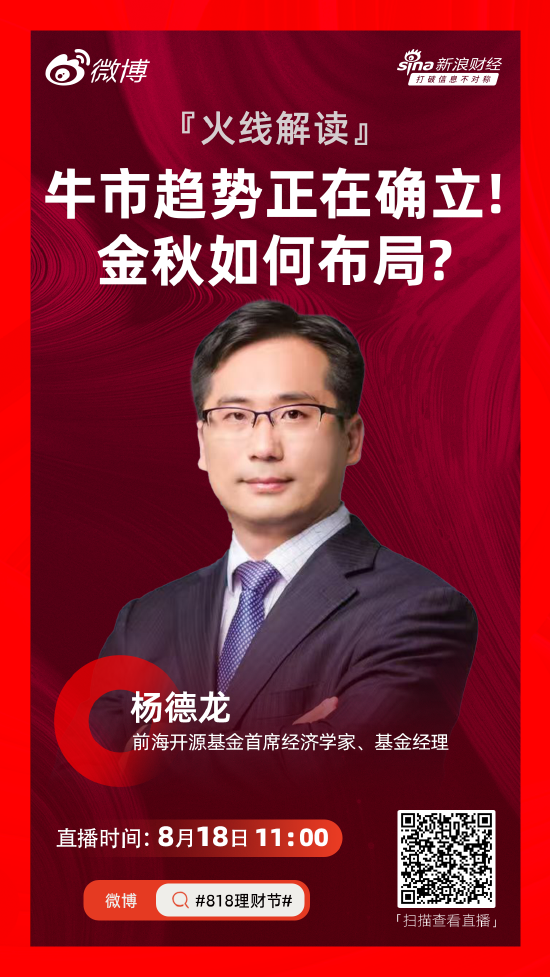
8月以来两融余额增长778.15亿元,参与交易投资者数量增长40%,市场持续火热,中证A500指数盘中突破5000点创年内新高!
Xin Lang Cai Jing· 2025-08-18 03:23
Group 1 - The financing balance in the A-share market has exceeded 2 trillion yuan, reaching 20,626.42 billion yuan as of August 15, with an increase of 77.815 billion yuan since the beginning of August [1] - The number of investors participating in margin trading has grown to 547,700, an increase of 160,100 since the start of the month [1] - The CSI A500 index has reached a new high for the year, peaking at 5,035.59 points [1] Group 2 - The increase in margin trading balance is attributed to improved policy expectations and a recovery in market risk appetite, supported by regulatory signals aimed at stabilizing the capital market [1] - Financing funds have primarily flowed into sectors such as information technology, industrials, and materials, indicating confidence in the optimization and upgrading of industrial structure [1] - The A500 ETF has shown strong performance, with a year-to-date price increase and 21 days of new highs [1] Group 3 - The macroeconomic environment is favorable for the market, with emerging industries rising and traditional sectors undergoing a gradual clearing process [1] - The A-share market is currently in the second phase of a bull market, characterized by risk appetite recovery, while the decline in risk-free interest rates has reduced investment costs for equity assets [2] - The A500 ETF provides a balanced allocation of quality leading companies across various industries, representing core assets in the A-share market [2]
房地产退潮后,社保成新底牌,十五五释放信号,看懂掌声
Sou Hu Cai Jing· 2025-08-17 15:15
Group 1 - The social security system is transforming from a simple safety net into a robust buffer against risks, supporting China's economic transition amid challenges like weak exports, high local debt, and aging population [1] - The dynamic adjustment mechanism of social security rates is crucial for fostering innovation, as evidenced by a biotech company reducing labor costs by 5% while increasing research positions by 14% due to policy incentives [3] - The social security fund is exploring innovative paths to address hidden debts through equity investments, with pilot projects in affordable housing REITs yielding a 6.8% annual return while absorbing 111,200 units of inventory [4] Group 2 - The cross-provincial adjustment mechanism of unemployment insurance is becoming vital in the context of industrial restructuring, with the central adjustment fund ratio increasing from 3% to 5% to enhance labor market fluidity [6] - The national coordination of social security is a systematic upgrade of risk hedging mechanisms, with a focus on efficient fund utilization in housing construction through special government bonds [9] - The upgrade of the social security system is emerging as a new logic for China's economic development, acting as both a stabilizer for society and a catalyst for economic transformation [10]
国家撒钱!发3000亿、1200亿育儿补助、5万贴息,全面激活消费?
Sou Hu Cai Jing· 2025-08-16 07:26
Group 1 - China has made significant financial commitments to strengthen its economy, focusing on consumer spending, childbirth, housing, and transportation subsidies [3][18][20] - The government has implemented a total of 300 billion yuan in subsidies, with various initiatives aimed at stimulating consumption and supporting families [18][20] - The country is transitioning from a manufacturing powerhouse to a consumption-driven economy, with nearly 50 trillion yuan in annual consumption and over 20 trillion yuan in imports [29][30] Group 2 - The Chinese economy has shown resilience, with a notable increase in domestic savings and a 12.8% rise in household savings in the first half of the year [23][25] - The state-owned enterprises play a crucial role in the economy, with their assets accounting for 67% of the national GDP, providing a foundation for financial stability and investment [25][27] - The shift in macroeconomic policy emphasizes improving living standards and promoting consumption, which is expected to lead to significant economic transformation by 2025 [29][30][32]

长三角41城半年考,“成绩单”来了
Sou Hu Cai Jing· 2025-08-14 12:13
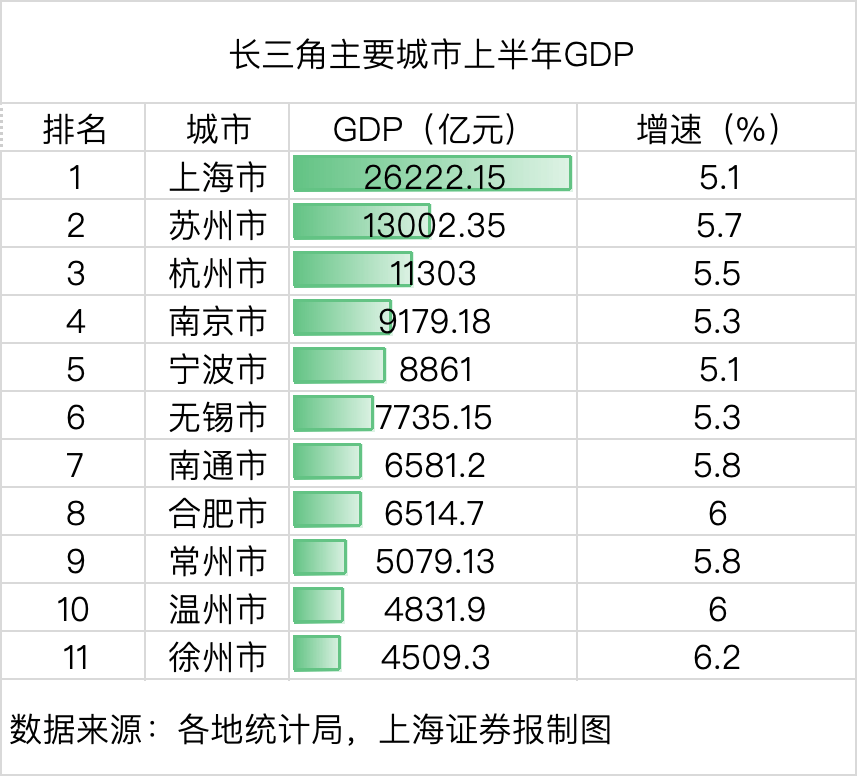
Core Insights - The economic data for 41 cities in the Yangtze River Delta for the first half of 2025 shows a stable GDP ranking, with some cities experiencing notable growth, particularly in the consumption sector, which exhibits internal differentiation [1][2]. GDP Performance - The Yangtze River Delta has nine cities with a GDP exceeding 1 trillion yuan, with Nantong moving up from 8th to 7th place, surpassing Hefei [2]. - Zhoushan leads in GDP growth with a reported GDP of 110.91 billion yuan, reflecting a year-on-year increase of 6.9%, driven primarily by industrial growth [2]. - Major cities' GDP figures for the first half of 2025 include: - Shanghai: 2622.215 billion yuan, growth of 5.1% - Suzhou: 1300.235 billion yuan, growth of 5.7% - Hangzhou: 1130.3 billion yuan, growth of 5.5% - Nanjing: 917.918 billion yuan, growth of 5.3% - Ningbo: 886.1 billion yuan, growth of 5.1% [3]. Consumption Trends - The overall retail sales growth in the Yangtze River Delta outpaced the national average of 5.0%, with Jiangsu province achieving a retail sales total of 2.39 trillion yuan, marking a net increase of 113.72 billion yuan [5]. - Consumption growth is uneven, with first-tier cities like Shanghai showing slower growth (1.7%) compared to third and fourth-tier cities, which are exhibiting stronger consumption dynamics [5][6]. - Notable retail sales figures include: - Shanghai: 826.041 billion yuan, growth of 1.7% - Suzhou: 463.5 billion yuan, growth of 3.8% - Hangzhou: 458.5 billion yuan, growth of 6% - Nanjing: 438.422 billion yuan, growth of 5.3% [8]. Regional Economic Challenges - Some traditional industries are facing slower growth, particularly in cities like Huainan and Huaibei, which reported GDP growth rates of 4.0% and 3.4%, respectively, indicating a need for economic transformation [4]. - Cities like Wenzhou and Xuzhou are approaching the 1 trillion yuan GDP target, with Wenzhou at 483.19 billion yuan and Xuzhou at 450.93 billion yuan, both showing promising growth rates [4].
付鹏:日本三十年大萧条对中国的启示
2025-08-11 14:07
Summary of Key Points from the Conference Call Industry or Company Involved - The discussion primarily revolves around the historical economic development of Japan, particularly post-World War II, and its implications for current economic conditions in China. Core Points and Arguments 1. Historical data on Japan's economy is challenging to obtain, especially from before the 1990s, but some insights have been gathered from various databases like Bloomberg and CEIC [1][2] 2. A chart was created to illustrate five key data sets regarding Japan's economy, including housing prices, household leverage, savings growth, and demographic changes [3] 3. Post-WWII, Japan experienced rapid economic recovery due to U.S. support and external demand, particularly during events like the Korean War, leading to significant growth from 1955 to 1973 [4] 4. Economic structure, rather than interest rates, is a primary determinant of economic performance; Japan's interest rates were appropriate given its growth during the 1960s [5] 5. Japan's industrialization reached a mature stage by the 1970s, but it lagged in high-tech sectors compared to the West [6] 6. The 1970s oil crisis significantly impacted Japan, revealing vulnerabilities in its reliance on external demand and leading to a shift towards internal demand stimulation [7][8] 7. Japan's government implemented policies to boost domestic demand and initiated supply-side reforms in response to the energy crisis [9][10] 8. The government also supported innovation in high-tech industries, which laid the foundation for Japan's electronics sector in the following decades [12][13] 9. Japan's heavy industry faced environmental challenges, prompting a shift towards energy efficiency and renewable energy sources in the late 1970s [14][15] 10. The economic transformation in Japan during the 1970s and 1980s is often cited as a model for other countries, including China, facing similar transitions [16][17] 11. The service sector grew significantly during Japan's economic transition, but it posed risks for sustainable income growth compared to manufacturing [17][18] 12. The relationship between income growth and debt levels is critical; a divergence can lead to economic instability [18] 13. Japan's real estate bubble in the late 1980s was fueled by low interest rates and speculative investments, leading to a significant economic downturn [19][20] 14. The first and second real estate bubbles in Japan had different underlying conditions, with the second bubble being more problematic [20][21] 15. The rapid urbanization and labor migration in Japan supported economic growth and real estate demand, but also led to demographic challenges [22][23] 16. The government’s efforts to stimulate internal demand in the 1970s resulted in a housing market boom, which was unsustainable [24][25] 17. The tightening of monetary policy in the early 1970s aimed to cool the overheating economy and control inflation, leading to a decline in real estate prices [26][27] 18. The economic slowdown from the mid-1980s onwards revealed structural issues in Japan's economy, despite maintaining a positive growth rate [27][28] 19. The second real estate bubble's burst was attributed to a combination of domestic and international economic pressures, including the Plaza Accord [32][33] 20. The long-term effects of the real estate bubble and subsequent economic stagnation have shaped Japan's current economic landscape, including low growth and high debt levels [34][35] Other Important but Possibly Overlooked Content 1. The historical context of Japan's economic policies provides valuable lessons for current economic strategies in China, particularly regarding the balance between external and internal demand [4][8] 2. The transformation of Japan's economy highlights the importance of innovation and technology in sustaining growth, which is relevant for other developing economies [12][13] 3. The challenges faced by Japan in managing its service sector growth and income distribution can serve as a cautionary tale for other nations undergoing similar transitions [17][18] 4. The demographic shifts and urbanization trends in Japan have long-term implications for economic stability and growth, which are pertinent to current global economic discussions [22][23]
港投公司已投项目超100个 10余家公司已经或准备递交香港上市申请
Zheng Quan Ri Bao· 2025-08-10 13:43
Group 1 - As of July 2023, the total number of registered local companies in Hong Kong exceeded 1.5 million, and registered non-Hong Kong companies surpassed 15,000, both reaching historical highs [1] - From January to July 2023, the Investment Promotion Agency assisted 1,333 enterprises in establishing or expanding their businesses in Hong Kong, bringing in HKD 174 billion in first-year direct investment and creating over 19,000 new jobs [1] - The Chief Executive of Hong Kong emphasized the importance of innovative services and products during the economic transformation period, suggesting a combination of online and offline marketing strategies to meet market preferences [1] Group 2 - The Hong Kong Investment Corporation, acting as the government's "patient capital," has invested in over 100 projects, with more than 10 companies preparing to submit applications for listing in Hong Kong [2] - Each HKD 1 invested by the Hong Kong Investment Corporation has attracted over HKD 5 in long-term market funding, including contributions from sovereign funds and family offices [2] - The introduction of cutting-edge technology companies is expected to bring approximately HKD 50 billion in investment and create over 20,000 jobs in the coming years [1][2] Group 3 - The Hong Kong government supports local enterprises in collaborating with international companies, such as a green energy project with Thailand and financial technology expansion into Indonesia [3] - The introduction office will soon announce a fifth batch of over ten key enterprises, bringing the total number of introduced companies to around 100 since its establishment in late 2022 [3] - The Chief Executive stated that the pace of attracting investment will not slow down but will become more stable and faster [3]
全球供应链牌桌上 澳大利亚正沦为盘中餐!黄金期货价首破3500美元/盎司 TGM坐拥610万盎司黄金资源量将迎重估窗口期
Sou Hu Cai Jing· 2025-08-08 10:28
Group 1 - Australia is facing challenges in its energy transition and must adapt to the new global supply chain dynamics to avoid becoming irrelevant on the world stage [2][3][8] - The "Future Made in Australia" strategy aims to optimize the country's industrial structure and economic transformation, but internal bureaucratic obstacles hinder progress [10][11] - The absence of Australian leadership at key international forums sends a negative signal to neighboring countries, indicating a lack of proactive engagement in shaping future supply chains [8][9] Group 2 - The Foreign Investment Review Board (FIRB) is identified as a significant barrier to attracting necessary capital for Australia's renewable energy ambitions [10][11] - A proposed "FMiA fast track" could streamline the FIRB review process for projects deemed critical to national interests, focusing on investor backgrounds rather than project specifics [11][12] - Industry leaders advocate for a collaborative future with China, emphasizing the need for a simplified assessment channel for clean energy projects [13][14] Group 3 - The global competition for resources is intensifying, with countries like South Africa actively securing investments that Australia could have attracted [7][9] - The Australian government must align its economic strategy with national security to effectively compete in the evolving global landscape [11][14] - The ongoing dialogue about decarbonization policies and foreign investment simplification is seen as a cautious first step, with more decisive actions needed to secure Australia's manufacturing future [14][15] Group 4 - The gold sector in Australia is experiencing significant interest, with Theta Gold Mines Ltd (ASX: TGM) positioned for a potential valuation re-rating due to its substantial gold resources and upcoming production plans [19][28][49] - Theta Gold Mines has a JORC resource of 6.1 million ounces and is expected to generate over $500 million in cash flow, indicating strong economic viability [28][29][39] - The company is advancing towards production with a focus on community engagement and ESG compliance, which enhances project stability and local support [45][46][49]

拆解信贷“成绩单”资金流向了哪里?
Zheng Quan Ri Bao· 2025-08-08 07:19
作为实体经济的根基,制造业获得信贷支持,有助于推动产业升级,提高创新能力和国际竞争力;而基 础设施建设关乎国计民生,对拉动经济增长、改善投资环境具有重要意义。 从居民端来看,信贷结构同样亮点突出。上半年,住户贷款增加1.17万亿元。其中9239亿元流向了经营 性贷款,占比近八成,表明金融机构积极支持个体工商户和小微企业主的生产经营活动。 个体工商户、小微企业是经济运行的"毛细血管",也是社会就业的"蓄水池",更是激活市场经济的"一 池春水"。金融机构对他们源源不断地支持,将进一步激发市场活力,促进就业、稳定民生、推动创 新。 在这张资金流向热力图上,行业投向的脉络同样清晰可辨。上半年,新增贷款主要投向制造业、基础设 施业等重点领域。6月末,制造业中长期贷款余额同比增长8.7%,上半年增加9207亿元;基础设施业中 长期贷款余额同比增长7.4%,上半年增加2.18万亿元。 ■ 刘 琪 7月14日,中国人民银行公布了今年上半年的信贷"成绩单"——上半年,人民币贷款新增12.92万亿元; 6月末,人民币贷款余额268.56万亿元,同比增长7.1%。在金融总量合理增长的同时,信贷结构也在持 续优化。这种结构演变既是经 ...