绿色低碳转型

Search documents
创新驱动低碳跃迁 传统行业“破茧成蝶”
Jin Rong Shi Bao· 2025-05-20 03:13
Core Insights - The article highlights the significant role of transformation finance in supporting traditional industries in Guangdong to achieve green and low-carbon production, particularly in the ceramics sector [1][2][3] Group 1: Transformation Finance Implementation - Guangdong has accelerated the development of transformation finance under the "dual carbon" goals, becoming a key force in promoting the green low-carbon transition of traditional industries [1] - The People's Bank of China Guangdong Branch is set to release the first transformation finance standards for the ceramics industry in September 2024, providing a framework for financial institutions to support low-carbon transition projects [2] - A total of 1.7 billion yuan in credit has been signed between eight financial institutions and eight ceramics companies, with 1.37 billion yuan already disbursed for transformation loans [3] Group 2: Product Innovation and Financial Tools - Transformation finance is characterized by product innovation that meets diverse financing needs of enterprises, with various specialized credit products being developed to support green transitions [4] - Guangdong banks have introduced dynamic pricing transformation finance products linked to carbon emissions, effectively incentivizing high-carbon enterprises to reduce emissions [5] - By the first quarter of 2025, Guangdong banks had launched 44 specialized credit products, disbursing a total of 32.44 billion yuan in transformation finance loans [5] Group 3: Collaborative Mechanisms and Policy Support - Guangdong has established a collaborative mechanism that combines professional agency credit enhancement with policy leverage to effectively implement transformation finance [6] - The region is exploring fiscal and financial policy synergies to guide resources towards green low-carbon transitions, including subsidies and risk compensation for enterprises [7] - The breakthrough in transformation finance standards provides a feasible path for the green transition of "brown industries," demonstrating the integration of financial innovation with industrial transformation [7]
4月份主要指标继续向好——我国经济顶住压力稳定增长
Jing Ji Ri Bao· 2025-05-19 22:02
Economic Growth and Policy Implementation - The national economy has shown resilience and stable growth in April, supported by proactive macro policies that effectively respond to external shocks [1][2] - Major production demand indicators have seen significant growth compared to the previous year, with industrial value-added increasing by 6.1% year-on-year in April [2] - Fixed asset investment has also expanded, with a year-on-year growth of 4% in the first four months [2] Trade and External Resilience - Despite a challenging international environment, China's foreign trade has maintained steady growth, with total goods import and export value increasing by 2.4% year-on-year in the first four months [3] - Trade with countries involved in the Belt and Road Initiative has grown by 3.9%, indicating a diversification in trade partnerships [3] Consumer Market Dynamics - The consumer market has shown stable growth, with retail sales of consumer goods increasing by 4.7% year-on-year in the first four months, supported by policies promoting consumption [4] - The "old for new" consumption policy has positively impacted sales in various categories, with significant year-on-year growth in household appliances and communication equipment [4] New Economic Drivers - New consumption drivers are emerging, with online retail and instant retail gaining popularity, leading to a 5.8% year-on-year increase in physical goods online retail sales [4] - The high-tech manufacturing sector has also seen robust growth, with a 10% year-on-year increase in value-added for high-tech manufacturing in April [3] Policy Effectiveness and Future Outlook - The effectiveness of macro policies has been evident, with a focus on stabilizing employment, businesses, and market expectations to ensure sustainable economic development [5][8] - The government aims to enhance consumer capacity and improve the consumption environment to further unlock consumption potential [5]
2024年 拉美销售的新能源汽车超过一半为中国品牌 中国新能源汽车走俏拉美市场(国际视点)
Ren Min Ri Bao· 2025-05-19 21:40
Group 1: Market Growth and Trends - The International Energy Agency's report indicates that emerging markets like Asia and South America are becoming centers for electric vehicle (EV) sales growth, with total sales expected to increase by over 60% year-on-year in 2024 [1] - In Latin America, electric vehicle sales are projected to reach 412,493 units in 2024, with pure electric vehicle sales growing by 139.3% and plug-in hybrid vehicle sales increasing by 156.1% [1] - In Brazil, Chinese brand electric vehicles accounted for 91.4% of imported EV sales in the first half of 2024, generating sales worth $1.2 billion [2] Group 2: Consumer Acceptance and Preferences - Brazilian consumers are increasingly recognizing Chinese brands for their cost-effectiveness and environmental benefits, with a notable increase in sales of brands like Chery [2] - In Mexico, Chinese brands such as JAC and Geely saw a 63% increase in sales in 2024, capturing a market share of 19.5% [2] - Costa Rica leads Latin America in electric vehicle ownership per capita, with 34.3 electric vehicles per 10,000 people, and six out of the top ten best-selling models being Chinese [2] Group 3: Infrastructure and Policy Support - The acceleration of electric vehicle adoption in Latin America is attributed to tax incentives, improved charging infrastructure, and heightened consumer awareness of environmental issues [3] - By 2028, it is predicted that electric vehicles will account for 10% to 20% of new passenger car sales in Latin America [3] Group 4: Public Transportation Electrification - Over 6,000 electric buses are currently operating in Latin America, primarily from Chinese brands like BYD and Yutong [4] - In Brazil, the first fully electric bus line was launched in 2021, featuring buses from BYD [4] - Chinese electric taxis are rapidly gaining popularity in major Colombian cities, contributing to significant reductions in carbon emissions [4] Group 5: Localization and Strategic Partnerships - Chinese automakers are focusing on local production and technological innovation to enhance cooperation and mutual growth in the Latin American market [7] - Great Wall Motors plans to establish a factory in São Paulo, Brazil, aiming for local production to reach 60% within three years [7] - MG Motors is set to build a manufacturing plant and R&D center in Mexico, positioning it as a hub for the Latin American market [7] Group 6: Economic and Employment Impact - BYD aims to sell 80,000 vehicles in Mexico by 2025 and plans to create approximately 10,000 jobs with a new manufacturing facility [8] - Peru has established the first "Luban Workshop" in Latin America to train technical talent in the electric vehicle sector, enhancing cooperation in green industries [8] Group 7: Broader Economic Implications - The rise of Chinese electric vehicles in Latin America reflects an upgrade in Sino-Latin American economic cooperation, with a focus on sustainable economic development [9] - Chinese automakers are not only providing green transportation solutions but also introducing advanced EV industry chains and technologies to Latin America, promoting local industry transformation and job creation [9]



四月份经济韧性与结构性突破并存 向“新”特征更明显
Zheng Quan Shi Bao· 2025-05-19 18:00
Economic Performance - In April, the industrial added value above designated size increased by 6.1% year-on-year, and the service production index grew by 6.0% year-on-year, indicating stable and rapid growth in major economic indicators [1][2] - The retail sales of consumer goods increased by 5.1% year-on-year, with significant growth in the sales of home appliances and audio-visual equipment, which rose by 38.8% [2] - Fixed asset investment saw a month-on-month increase of 0.10%, reflecting a stable investment environment [1] Investment and Trade - The investment in equipment and tools from January to April increased by 18.2% year-on-year, contributing 64.5% to total investment growth [2] - Despite external shocks, China's total goods import and export volume grew by 2.4% year-on-year from January to April, accelerating by 1.1 percentage points compared to the first quarter [2] High-tech and New Energy Sectors - The added value of high-tech manufacturing increased by 10% year-on-year in April, with aerospace equipment and integrated circuit manufacturing growing by 21.4% and 21.3%, respectively [3] - Production of new energy products, such as electric vehicles and charging piles, surged by 38.9% and 43.1%, respectively, highlighting the rapid development of the green low-carbon transition [3] Policy and Future Outlook - Recent policy measures, including interest rate cuts and the establishment of new financial tools, aim to support technological innovation and expand consumption [4] - Analysts expect that as policy effects continue to manifest, consumption will strengthen, further supporting investment growth [4] - The economic operation is anticipated to improve moderately in May and June, with a focus on effectively utilizing existing policies [4]
空客深耕中国市场 加速探索可持续航空燃料应用
Zhong Guo Xin Wen Wang· 2025-05-19 15:05
Core Viewpoint - The aviation industry's carbon reduction is a critical issue in the global low-carbon transition, with Sustainable Aviation Fuel (SAF) being a key solution that can reduce carbon emissions by an average of 80% over its lifecycle, contributing to the goal of achieving net-zero carbon emissions in the aviation sector by 2050 [1][2]. Group 1: Development Advantages in China - China possesses comprehensive advantages in the sustainable aviation fuel sector, with a predicted potential annual production capacity of up to 12 million tons by 2030 [2]. - As the world's largest renewable energy market, China has a wind and solar power installed capacity that accounts for one-third of the global total, with electricity costs 20% to 30% lower than the international average [2]. - China has accumulated rich experience in key technology areas such as biomass conversion and coal chemical processes, supported by strong manufacturing capabilities and engineering execution [2]. Group 2: Airbus's Commitment and Achievements - Airbus plans to use over 14 million liters of pure sustainable aviation fuel in 2024, which will account for 16% of its total fuel usage, successfully avoiding nearly 35 million tons of carbon dioxide emissions [3]. - Approximately half of the large white shark transport flights will utilize sustainable aviation fuel, and Airbus has implemented a commercial policy for sustainable aviation fuel at its four major assembly lines, offering 5% pure sustainable aviation fuel at no extra cost [3]. - Airbus has a history of collaboration in China since 2011 to promote the application of sustainable aviation fuel, with testing flights and delivery flights using sustainable aviation fuel starting in Tianjin in 2022 [3].

精工钢构: 长江精工钢结构(集团)股份有限公司主体与相关债项2025年度跟踪评级报告
Zheng Quan Zhi Xing· 2025-05-19 11:28
Core Viewpoint - The credit rating of Changjiang Jinggong Steel Structure (Group) Co., Ltd. is maintained at AA with a stable outlook, reflecting its strong market competitiveness and support from national policies in the steel structure sector [1][2]. Company Overview - Changjiang Jinggong Steel Structure (Group) Co., Ltd. primarily engages in steel structure business, with a focus on energy-efficient and environmentally friendly construction [1][2]. - The company has a registered capital of 2.01 billion yuan, with major shareholders being Jinggong Holding Group Co., Ltd. and Jinggong Holding Group (Zhejiang) Investment Co., Ltd. [9][10]. Financial Performance - Total assets increased from 221.03 billion yuan in 2022 to 256.14 billion yuan in 2024, while total liabilities rose from 69.00 billion yuan to 73.82 billion yuan during the same period [2][3]. - Operating revenue grew from 157.15 billion yuan in 2022 to 184.92 billion yuan in 2024, although net profit decreased from 7.06 billion yuan to 5.27 billion yuan [2][3]. - The gross profit margin slightly declined from 14.06% in 2022 to 12.66% in 2024, indicating increased cost pressures [2][3]. Debt and Financing - The company has a total interest-bearing debt of 73.82 billion yuan, with a debt-to-asset ratio of 64.96% as of 2024 [2][3]. - The "Jinggong Convertible Bonds" have a total issuance of 20 billion yuan, with the funds primarily used for the Liu'an Technician College Comprehensive Industrial Park project and to supplement working capital [7][8]. Industry Environment - The steel structure industry is supported by national policies promoting green building practices, with a target for steel structure usage to reach 15% of new construction by 2025 [16][17]. - The market for steel structures is expected to grow due to increasing demand from infrastructure, real estate, and manufacturing sectors, with government initiatives aimed at stabilizing investment in these areas [18][19][20]. Competitive Landscape - The steel structure market is characterized by intense competition, with major players including state-owned enterprises and private firms like Changjiang Jinggong [21][22]. - The industry is gradually consolidating, with larger firms expected to gain market share as regulatory pressures increase on smaller competitors [21][22].

最新报告显示:我国农业化肥用量已连续8年下降
Xin Jing Bao· 2025-05-19 10:57
记者从日前举行的中国农业农村低碳发展报告发布会上获悉,至2023年,我国农用化肥已经连续8年下 降。2022年,全国主要农作物的秸秆综合利用率达88.1%,东北四省区已累计在223个项目实施县实施 保护性耕作2.01亿亩次。 农业农村减排固碳成效显著 当日发布的《2025中国农业农村低碳发展报告》显示,2022年我国发布《农业农村减排固碳实施方案》 以来,我国农业农村绿色低碳转型和高质量发展取得了显著成效。 中国农科院双碳中心主任、农业农村部农业农村生态环境综合实验室主任梅旭荣介绍,2022年以来,在 农业农村低碳绿色转型领域,我国先后发布和实施了数十项政策、措施。如在畜牧业领域,截至2023 年,全国畜禽养殖规模化率达73.2%,种养结合农牧循环发展新格局初步形成,全国畜禽粪污综合利用 率达79.4%。 在渔业减排中,我国鼓励建造新材料新能源渔船,研制节能环保装备,研发了适用于养殖期间调控底质 的池塘底质改良机;结合紫菜养殖模式,相关科研单位联合研发了节能环保型紫菜采收作业工船等。 "当前,我国正处于从传统生产模式向可持续发展转型的关键攻坚阶段,区域间发展存在一定的结构性 差异和不均衡性,东、中部地区发展较 ...
顶住压力稳定增长,4月份经济数据释放积极信号
Ren Min Ri Bao· 2025-05-19 05:12
Economic Performance - In April, China's economy demonstrated resilience and stable growth despite external pressures and internal challenges, continuing a positive development trend [1] - The latest data from the National Bureau of Statistics indicates that the economy is showing signs of improvement, which helps to alleviate concerns and boost confidence [1] Domestic Demand - Domestic demand is steadily expanding, with retail sales of consumer goods in April increasing by 5.1% year-on-year, driven by policies encouraging the replacement of old goods [3] - The service retail sector also maintained stable growth, with a 5.1% year-on-year increase from January to April, marking two consecutive months of acceleration [3] - Fixed asset investment grew by 4% year-on-year from January to April, with investment in machinery and equipment rising by 18.2%, contributing 64.5% to total investment growth [3] Supply Side - The real economy is experiencing both quantity and quality improvements, with industrial added value for large enterprises increasing by 6.1% year-on-year in April, marking one of the fastest monthly growth rates since last year [4] - The equipment manufacturing sector saw a 9.8% year-on-year increase in added value, contributing 55.9% to the growth of large-scale industry [4] - High-tech manufacturing added value increased by 10% year-on-year in April, with significant growth in aerospace and integrated circuit manufacturing, which rose by 21.4% and 21.3% respectively [4] Foreign Trade - In April, China's total goods import and export value reached 38,391 billion yuan, a year-on-year increase of 5.6%, with exports growing by 9.3% and imports by 0.8% [5] - From January to April, the total goods import and export value increased by 2.4% year-on-year, accelerating by 1.1 percentage points compared to the first quarter [5] - The growth in foreign trade is attributed to China's robust manufacturing capabilities and a diversified export strategy, particularly with countries involved in the Belt and Road Initiative, which saw a 3.9% increase in trade [5] Economic Resilience - Despite the rapidly changing international environment and increased external pressures, China's economic fundamentals remain strong, with significant potential for long-term growth [5] - Recent high-level economic talks between China and the U.S. have led to substantial progress in reducing bilateral tariffs, laying the groundwork for further negotiations [5] - The focus remains on stabilizing employment, businesses, markets, and expectations to ensure high-quality development in response to external uncertainties [6]
一图速览4月经济数据,关于消费、投资......国家统计局最新回应
2 1 Shi Ji Jing Ji Bao Dao· 2025-05-19 04:21
Economic Overview - In April, external shocks increased, but macro policies worked in coordination, leading to stable and rapid growth in major indicators, indicating a continued positive trend in the national economy [1] Consumption Trends - The retail sales of consumer goods related to the "old for new" policy, including home appliances, cultural office supplies, furniture, communication equipment, and building materials, contributed 1.4 percentage points to the total retail sales growth in April. Service retail sales grew by 5.1% from January to April, accelerating for two consecutive months. Domestic travel during the "May Day" holiday increased by 6.4% year-on-year, suggesting that consumption's contribution to economic growth is expected to continue strengthening [2] Policy Implementation - To better unleash consumption potential, it is essential to implement special actions to boost consumption, enhance residents' consumption capacity, increase quality supply, and improve the consumption environment, promoting healthy economic development and continuous improvement in people's livelihoods [3] Digital and High-Tech Industry Growth - In April, the added value of high-tech manufacturing above designated size increased by 10% year-on-year, with aerospace equipment manufacturing and integrated circuit manufacturing growing by 21.4% and 21.3%, respectively. The "Artificial Intelligence +" driving effect is strengthening, with the added value of the digital product manufacturing industry also growing by 10%. The transition to a green and low-carbon economy is deepening, with significant growth in new energy products, including a 38.9% increase in new energy vehicles and a 43.1% increase in charging piles [4] Investment Potential - The overall stability of economic operations this year, along with the effects of "two heavy" construction and "two new" policies, indicates that there is still significant investment potential in the country, supported by various favorable factors for investment growth [5] Price Stability and Macro Policy - Current prices are generally low, which increases operational pressure on enterprises and affects residents' employment and income. Therefore, it is crucial to promote prices to remain within a reasonable range. Future efforts should focus on continuing to leverage macro policy effects, expanding domestic demand, deepening supply-side structural reforms, improving economic circulation, and maintaining market order to promote reasonable price recovery [6] Economic Resilience - Despite a complex and severe international environment with many unstable and uncertain factors, the long-term positive fundamentals of the economy remain unchanged. Coordinated macro policies and collective efforts are expected to foster innovation and support the continued recovery of the economy [7]
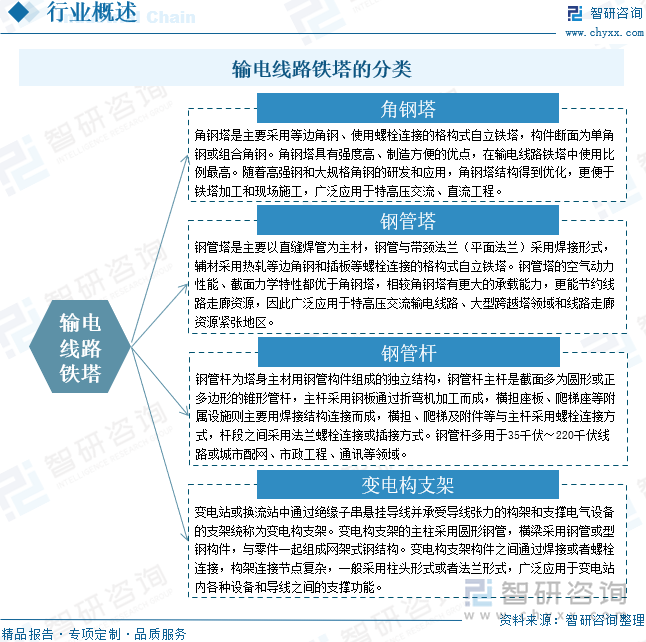
2025年中国输电线路铁塔行业发展历程、产业链、发展现状及未来趋势研判:电力需求不断增加,推动输电线路铁塔建设提速[图]
Chan Ye Xin Xi Wang· 2025-05-19 01:14
Core Insights - The transmission line tower industry in China is experiencing significant growth, with the market size projected to reach approximately 71.1 billion yuan in 2024, driven by increasing electricity demand and urbanization [1][16] - The industry is characterized by a dual structure, with a large number of small enterprises competing in the low-end market and a few large companies dominating the high-end market [21][23] Industry Overview - Transmission line towers are essential infrastructure for supporting high and ultra-high voltage overhead power lines, primarily made of metal materials like iron and steel [3] - The industry has evolved from using low-voltage transmission lines to high-voltage lines, leading to increased demand for steel towers [5][19] Market Dynamics - The growth in electricity demand is reflected in the increase of total electricity consumption in China, which rose from 55,500 billion kWh in 2015 to 98,521 billion kWh in 2024, with a compound annual growth rate of 6.58% [11] - The length of 220 kV and above transmission lines has also increased significantly, from 609,100 km in 2015 to 952,800 km in 2024, indicating a compound annual growth rate of 5.1% [11] Investment Trends - Investment in power engineering construction is on the rise, with power source engineering investment expected to grow from 409.1 billion yuan in 2015 to 1,168.7 billion yuan in 2024, reflecting a compound annual growth rate of 12.37% [14] - The investment in grid engineering is also increasing, from 460.3 billion yuan in 2015 to 608.6 billion yuan in 2024, with a compound annual growth rate of 3.15% [14] Key Players - Major companies in the industry include China Tower Corporation, which is the leading player, and other significant firms such as Wind范股份, 东方铁塔, and 汇金通 [21][23] - China Tower Corporation reported a revenue of 75.7 billion yuan from tower-related businesses in 2024, showing a year-on-year growth of 0.89% [23] Industry Structure - The industry is divided into three tiers: a large number of small enterprises in the low-end market, a second tier of larger private companies, and a first tier of leading companies like China Tower [21] - The market for transmission line towers is highly competitive, with price wars prevalent among smaller firms producing low-end products [21] Future Trends - The industry is expected to undergo technological upgrades driven by the construction of ultra-high voltage transmission lines, leading to a shift towards new tower structures and materials [27] - The demand for intelligent operation and maintenance solutions is increasing, with the adoption of IoT and sensor technologies [28] - The push for green and low-carbon solutions is reshaping the industry, with a focus on environmentally friendly materials and recycling practices [30]