
大国博弈

Search documents
特朗普用关税逼印度战队,普京放出大招:准备向印度转让核技术
Sou Hu Cai Jing· 2025-11-11 12:11
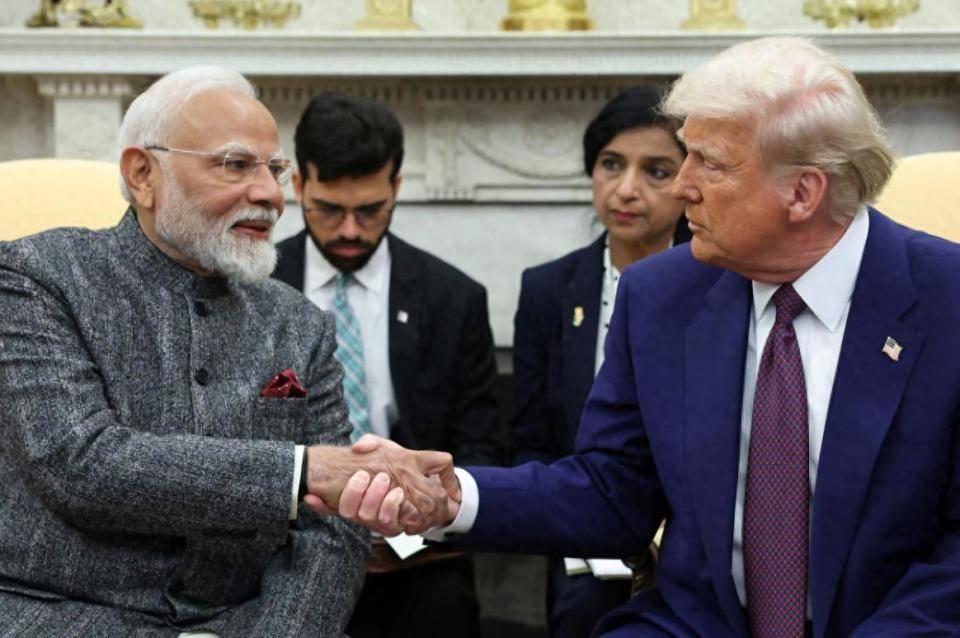
Group 1 - Russia's announcement to transfer nuclear technology to India comes unexpectedly, especially after India ceased purchasing Russian oil, indicating a complex geopolitical maneuvering involving energy and tariffs [1][4] - The U.S. imposed high tariffs on Indian goods to pressure India into stopping oil imports from Russia, which significantly impacted India's economy and led to a drastic reduction in oil imports from 2 million barrels per day to nearly zero [3][4] - The loss of India's oil market is a severe blow to Russia, resulting in a daily revenue loss of several hundred million dollars, as India accounted for approximately 15% of Russia's oil exports before the sanctions [4][6] Group 2 - The U.S. is close to reaching a trade agreement with India, which may include tariff reductions, as a result of India's compliance in halting Russian oil imports [6][8] - Russia's offer of nuclear technology transfer to India serves as a strategic move to maintain its influence and relationship with India, which is seen as a potential ally in the future [8][9] - The nuclear technology transfer is also a countermeasure against U.S. efforts to weaken Russia's energy influence, signaling that Russia can still engage with U.S. allies [8][11] Group 3 - India's acquisition of nuclear technology aligns with its ambitions to enhance its status as a major power, as it seeks to develop its own nuclear capabilities beyond military applications [9][11] - The ongoing geopolitical dynamics suggest that while there may appear to be winners in this scenario, the long-term implications for India, Russia, and the U.S. could lead to increased complexities and challenges in international relations [11][12]

因地制宜发展新质生产力(学习贯彻党的二十届四中全会精神)
Ren Min Ri Bao· 2025-11-10 22:41
Core Insights - The article emphasizes the importance of developing new quality productivity tailored to local conditions as outlined in the 20th Central Committee's Fourth Plenary Session [1][2] Group 1: Historical and Theoretical Context - The development of new quality productivity has historically driven comprehensive improvements in social productivity, representing the most innovative and forward-looking aspects of productivity evolution [3] - The socialist system's advantages facilitate faster and better productivity development, with significant advancements in key technologies and industries since the 18th National Congress [4] Group 2: Current Economic and Strategic Implications - Developing new quality productivity is essential for achieving high-quality development and gaining strategic advantages in global competition, focusing on creating a modern industrial system that meets people's needs [5] - The emphasis is on innovation as the primary driver, with strategic emerging industries and traditional sectors being vital for fostering new quality productivity [5] Group 3: Major Tasks and Initiatives - Strengthening technological innovation is identified as the core driver for developing new quality productivity, with a focus on original and disruptive innovations [6][7] - Optimizing and upgrading industrial structures is crucial, with initiatives to enhance traditional industries and foster emerging sectors [8] - Promoting a comprehensive green transformation in economic and social development is highlighted as a key direction for new quality productivity [9] Group 4: Market and Social Considerations - Building a strong domestic market is essential for supporting new quality productivity, leveraging the scale of the domestic market to stimulate demand and innovation [10] - Ensuring common prosperity and comprehensive human development is a fundamental value orientation for developing new quality productivity, emphasizing the importance of investing in human capital [11] Group 5: Institutional and Policy Framework - Adjusting production relations to align with new quality productivity is necessary, focusing on enhancing the market-oriented allocation of resources and improving the financial system [12] - The article stresses the need for a unified national strategy while allowing local regions to leverage their comparative advantages in developing new quality productivity [14][15] - Encouraging enterprises to play a leading role in innovation and productivity development is crucial, with support for both state-owned and private enterprises [16][17]
中美各退三步,中方“厚礼”送特朗普,加拿大“变心”暗向中国
Sou Hu Cai Jing· 2025-11-10 10:17
Group 1 - The core viewpoint of the articles highlights significant concessions made by the U.S. in the recent China-U.S. trade negotiations, including a reduction of tariffs on Chinese goods to 47% and the cancellation of planned tariffs on fentanyl-related products [1][3] - The U.S. also terminated the 301 investigation, indicating a shift in its trade policy towards China due to increasing trade tensions [1][3] - China responded by adjusting its counter-tariff measures and announced a large-scale purchase of 12 million tons of U.S. soybeans this quarter, committing to purchase at least 25 million tons annually for the next three years [1][3] Group 2 - China's strategic concessions are seen as a calculated move to gain a time window to alleviate external pressures while enhancing its bargaining position in global markets [3][5] - The articles emphasize China's efforts to reduce dependency on the U.S. and strengthen ties with ASEAN and the EU, as evidenced by the recent upgrade of the China-ASEAN Free Trade Area agreement [3][5] - The U.S. missed earlier opportunities to contain China, which has rapidly advanced its industrial capabilities and innovation through globalization [5][7] Group 3 - The current concessions from both countries are not merely compromises; they reflect the U.S.'s need to adjust its hardline stance due to domestic political pressures, while China aims to utilize this period for industrial upgrades and technological advancements [7] - The shift in Canada's approach towards China indicates a reevaluation of international relationships and the diminishing influence of the U.S. in the region [5][7] - The articles suggest that countries will increasingly adopt flexible and diverse diplomatic and economic strategies in response to the evolving great power competition [7]
金属周报 | 流动性紧缩,金银的韧性与铜的疲态
对冲研投· 2025-11-10 07:08
Group 1 - The article discusses the impact of the prolonged U.S. government shutdown on market liquidity, particularly the tightening of dollar liquidity, with expectations for the government to potentially reopen by November 17 [2][7]. - Gold and silver prices experienced slight declines, with COMEX gold down 0.14% and silver down 0.05%, while copper prices saw a more significant drop of -3.05% on COMEX [5][8]. - The copper market is under pressure due to reduced domestic consumption and increased inventory levels, with SHFE copper prices returning to around 85,000 yuan per ton [9][10]. Group 2 - The article notes that the gold price is expected to have limited downside potential in the medium to long term, supported by factors such as U.S. sovereign credit risk and geopolitical tensions [8][56]. - The copper concentrate TC weekly index increased slightly to -42.1 USD/dry ton, indicating ongoing negotiations and price fluctuations in the copper concentrate market [14]. - COMEX copper inventory has increased significantly, surpassing 360,000 tons, reflecting a continued accumulation since mid-March [10][11]. Group 3 - The article highlights that the financial liquidity risks are brewing due to the government shutdown, leading to a significant pullback in U.S. stocks and Bitcoin, which are sensitive to liquidity changes [7][8]. - The article mentions that the domestic market for electrolytic copper has seen an increase in inventory, with a total of 202,600 tons, indicating a slight rise in supply amid weak demand [21]. - The SPDR gold ETF holdings increased by 2.9 tons to 1,042 tons, while SLV silver ETF holdings decreased by 1.01 tons to 15,089 tons, reflecting shifts in investor sentiment [48].

中美大交易没欧洲的份,欧盟搞捆绑销售,中国想卖商品得送稀土?
Sou Hu Cai Jing· 2025-11-08 18:46
Group 1 - The core issue revolves around the recent US-China agreement on rare earth supply, which excludes the EU, leading to dissatisfaction from the European Union [1][3] - The EU initially hoped that the trade suspension measures would apply globally, but the US did not consider the interests of its allies, leaving the EU to negotiate separately with China for rare earths [3][8] - The EU's request for equal treatment from China, similar to that received by the US, reflects its frustration and perceived marginalization in the negotiations [6][13] Group 2 - The US has suspended 50% of its export control rules against China and lowered some tariffs, while China has paused its upcoming rare earth export controls for US compliant companies, creating a "green channel" [8][9] - However, China has retained its April export control measures, which specifically affect EU companies, highlighting a strategic differentiation in treatment [8][11] - The EU's passive position stems from its alignment with US strategies, which has limited its negotiating power and led to its exclusion from key agreements [11][13] Group 3 - The EU's contradictory stance of demanding the lifting of rare earth controls while simultaneously investigating subsidies on Chinese electric vehicles complicates negotiations [13] - The EU's new proposal to require China to bundle rare earths with other exports is seen as a desperate measure that overestimates its bargaining power [6][13] - For effective cooperation, the EU must abandon its zero-sum mindset and cease following US restrictions on China, returning to a path of equal negotiation [13]
为什么美国不敢把中国逼到绝路?三点说透大国制衡博弈的秘密
Sou Hu Cai Jing· 2025-11-07 15:44
Group 1 - The core truth of US-China relations is that the US does not want China to collapse, as it would create greater problems for the US itself [1][14] - The US-China competition is characterized by a "strange balance" that does not resemble traditional warfare or cold war dynamics, but rather a mix of confrontation and cooperation [3][14] - The tariff war initiated during Trump's presidency serves as an example of how the US and China can engage in economic battles while ultimately protecting their own interests and avoiding direct conflict [4][7] Group 2 - The case of Iran illustrates the new rules of US-China competition, where neither side is willing to fully embrace the other, leading to a complex geopolitical situation [7][9] - The ongoing Russia-Ukraine war demonstrates how the US maintains its hegemony while China benefits from the situation by expanding its market presence in Russia and enhancing its own industrial capabilities [10][13] - The current geopolitical landscape indicates that both the US and China have mutual interests in maintaining a balance, where the US needs China to remain stable and China seeks to leverage this relationship for its own development [14][16]
刘煜辉:学习十五五公报,感受到的最大冲击是这两个字
Xin Lang Zheng Quan· 2025-11-06 12:59
Core Viewpoint - The article emphasizes China's shift from a defensive to an offensive strategy in its economic and industrial goals, particularly highlighted in the recent 15th Five-Year Plan, which aims for aggressive growth and reaching the pinnacle of industrial strength [1] Summary by Relevant Sections - **Strategic Shift**: The 15th Five-Year Plan marks a significant change in tone and strategy compared to the previous plans, moving from a defensive posture to an offensive one, indicating a strong intent to dominate globally [1] - **Historical Context**: Over the past decade, during the 13th and 14th Five-Year Plans, China focused on building the world's strongest supply chain and establishing itself as a leading industrial power, akin to reaching the base camp of Mount Everest [1] - **Future Goals**: The next five to ten years are framed as a critical period for China to achieve its ultimate goal of reaching the "summit," with the 15th Five-Year Plan setting ambitious targets for this final ascent [1] - **Terminology Change**: The language used in the 15th Five-Year Plan reflects a proactive approach, with terms like "comprehensive efforts," "active response," and "confidence in victory," contrasting with the more defensive language of the previous plan [1]
刘煜辉:当前美国经济高度空心化,过度押注AI
Xin Lang Zheng Quan· 2025-11-06 12:28
Core Insights - The current U.S. government shutdown is causing short-term tightening of the dollar, leading to downward pressure on dollar assets, particularly in cryptocurrencies [1] - The U.S. strategy in the great power competition is to go "ALL in AI," as without a full commitment to AI, it lacks a competitive edge against China [1] - Excluding the impact of AI, U.S. economic data indicates stagnation or even negative growth [1] - The U.S. is decoupling from China's AI supply chain, relying on its internal cycle to achieve current AI prosperity [1] - Major U.S. tech giants have formed a closed-loop investment system since June, which is essential for maintaining local AI prosperity and significant expenditures [1] - The financial structure, particularly the debt structure, behind these tech giants is showing signs of vulnerability, raising concerns among external observers [1]
美国对华进行301调查,中国3种金属管制反击,扼住美高端制造命脉
Sou Hu Cai Jing· 2025-11-06 11:52
Core Points - The recent developments in the US-China trade war indicate a significant escalation, with both countries adopting new strategies in their ongoing economic rivalry [1][2] - The US has initiated a new round of investigation under Section 301, citing the need to verify the implementation of the 2020 trade agreement, which is perceived as a political maneuver rather than a genuine trade concern [2][4] - China's response includes implementing export licensing for critical metals such as tungsten, antimony, and silver, leveraging its resource dominance to counter US pressure [6][7] US Actions - The US Trade Representative announced the initiation of a Section 301 investigation against China, claiming it is to check compliance with the 2020 trade agreement [1][2] - The US government has been criticized for using Section 301 as a tool for political leverage rather than fair trade practices, reflecting a pattern of inconsistent policies [2][4] - The US aims to exert maximum pressure on China to secure concessions in future negotiations, but this approach is seen as outdated and ineffective [4] China's Response - In retaliation, China has announced export controls on tungsten, antimony, and silver, which are essential for various high-tech industries, potentially impacting US manufacturing capabilities [6][7] - China holds a significant advantage in the production of these metals, controlling 83% of global tungsten production and substantial shares of antimony and silver, which positions it favorably in the trade conflict [6][7] - The export control policy signals China's strategic resource management and its ability to respond effectively to US actions [9][14] Geopolitical Context - The ongoing trade tensions reflect a broader geopolitical struggle, with the US attempting to contain China's growth through military and economic means, while China seeks to expand its influence through initiatives like RCEP and the Belt and Road Initiative [11][13] - China's trade with RCEP countries has reached 50.3%, indicating a successful shift towards regional cooperation amidst US pressures [11] - The economic outlook shows a stark contrast, with the IMF projecting a 2.0% growth for the US in 2025 compared to China's 4.5%, highlighting the differing trajectories of the two economies [11][13] Strategic Implications - The trade conflict underscores the importance of comprehensive strength, strategic foresight, and wisdom in international relations, with China maintaining a steady approach while the US grapples with internal political challenges [14][15] - The focus of this economic rivalry is shifting from immediate outcomes to long-term strategic positioning, with China appearing to solidify its advantages in resource control and industrial capabilities [14][15]

突发特讯!中美刚停关税战,留给俄罗斯的时间不多了,引发国际舆论
Sou Hu Cai Jing· 2025-11-04 19:15
Group 1 - Recent fluctuations in US-China relations are influencing global strategies, with India and Russia becoming more active in their responses [1][3] - India has significantly increased its oil purchases from Russia, capitalizing on discounted prices, saving nearly $90 per ton compared to other sources, which could fund a medium-sized infrastructure project annually [3][5] - The Indian government is prioritizing energy security, as it relies on imports for nearly 90% of its oil, making it cautious about abruptly changing suppliers [5][6] Group 2 - The US has considered imposing tariffs on India but is currently hesitant due to the need to focus on US-China relations, allowing India to leverage this situation for its benefit [6][10] - Russia is concerned about being marginalized in the event of improved US-China relations, prompting it to strengthen its military position in Ukraine and seek closer ties with China [8][11] - Russian Prime Minister Mishustin's visit to China aims to enhance economic cooperation, particularly in energy and trade, as Russia faces significant economic pressure from Western sanctions [10][11] Group 3 - The dynamics of US-China relations are central to global geopolitical strategies, with countries like India and Russia adjusting their positions to maximize their advantages [13] - The ongoing competition between the US and China creates a complex international landscape where nations must carefully navigate their interests to avoid being sidelined [13]
