
美元走弱

Search documents
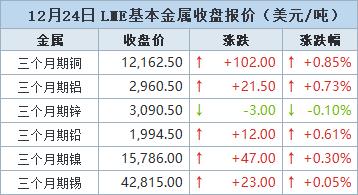
金属涨跌互现 期铜续创历史新高,逼近12300美元【12月24日LME收盘】
Wen Hua Cai Jing· 2025-12-25 00:41
Core Viewpoint - The London Metal Exchange (LME) copper prices have reached a historic high, driven by strong U.S. economic growth and a weakening dollar, with three-month copper prices closing at $12,162.5 per ton on December 24, 2023, marking a 0.85% increase [1]. Group 1: Copper Market Performance - LME three-month copper rose by $102, or 0.85%, closing at $12,162.5 per ton, with an intraday peak of $12,282 [1][2]. - Copper prices have increased by 2.4% this week and over 8% in December, positioning for the best monthly performance since April 2024, with an annual increase of 38% [3]. - The copper premium at Yangshan Port surged to $55 per ton, the highest level since September 24 [3]. Group 2: Economic Indicators - The U.S. GDP grew at an annualized rate of 4.3% in Q3 2023, surpassing market expectations and marking the fastest quarterly growth in two years [3]. - Consumer spending in the U.S. showed strong growth, while both investment and imports declined [3]. Group 3: Other Metals Performance - LME three-month aluminum increased by $21.5, or 0.73%, closing at $2,960.5 per ton [2][4]. - LME three-month zinc decreased by $3, or 0.1%, closing at $3,090.5 per ton [2][4]. - LME three-month lead rose by $12, or 0.61%, closing at $1,994.5 per ton [2][4]. - LME three-month tin increased by $23, or 0.05%, closing at $42,815 per ton [2][4]. - LME three-month nickel rose for the sixth consecutive day, increasing by $47, or 0.3%, closing at $15,786 per ton, amid market speculation about reduced mining output in Indonesia by 2026 [4].

人民币破“7”在望 影响几何?
Zheng Quan Shi Bao· 2025-12-24 09:37
Group 1 - The recent appreciation of the RMB has reached a 14-month high, with expectations of breaking the "7" level soon due to strong economic data and increased willingness of exporters to settle in RMB [1][2] - China's current account surplus is substantial, reaching $600 billion, which supports the positive outlook for the economy and the RMB's strength [2] - The People's Bank of China is managing market expectations through the RMB central parity rate and adjusting the interest rates in the swap market to influence foreign capital inflows [2][3] Group 2 - The central economic work conference emphasizes the importance of domestic demand, which could support the RMB's appreciation if policies are effectively implemented to reverse weak domestic demand and low credit needs [3] - Short-term RMB appreciation may boost stock market performance, with a historical correlation indicating that a 0.1% increase in exchange rate could lead to a 3%-5% rise in stock valuations [3] - The appreciation of the RMB may increase the cost of currency exchange for cross-border investments, potentially affecting the returns on investments in Hong Kong stocks and other cross-border financial products [3]
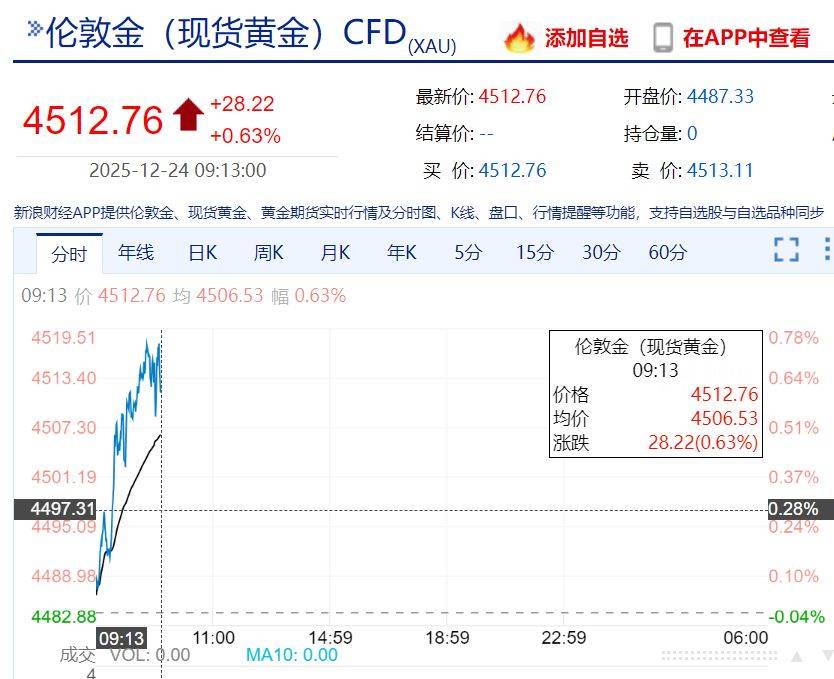
黄金价格创历史新高,12月24日现货黄金首次突破4500美元/盎司!美联储降息预期、美元走弱及地缘风险推动金价飙升,投行预测未来或达5055美元
Sou Hu Cai Jing· 2025-12-24 05:32
当周生生、周大福的足金饰品标价单日跳涨35元/克,当国际金价以70%的年涨幅碾压多数资产类别,我们正见证一个历史性时刻——12月24日,现货黄金 首次突破4500美元/盎司关口。这场持续两年的黄金牛市背后,究竟是美联储政策转向的狂欢,还是新一轮泡沫的前兆? 三大引擎推动金价狂飙 美国11月失业率创四年新低的信号,叠加核心CPI数据不及预期,彻底点燃了市场对美联储降息的押注。东方金诚研究发展部高级副总监瞿瑞指出,劳动力 市场降温与美元指数走弱形成双重利好,而日本央行加息利空出尽后,更多资金选择回归黄金的避险港湾。 国际投行的乐观预期更添一把火。摩根士丹利预测2026年金价将达4800美元,摩根大通甚至上看5055美元,高盛则在最新报告中给出4900美元的目标价。这 些预测的核心逻辑在于:全球央行持续购金(预计2026年月均70吨)、美元霸权松动以及地缘政治风险的长期化。 历史警示:黄金并非永动机 就在市场一片沸腾之际,上海半夏投资李蓓的抛售宣言显得格外刺耳。她提醒投资者回顾1980-2000年的二十年熊市,当时央行抛售潮曾让黄金跌去三分之 二市值。更值得警惕的是,俄罗斯央行近期出售黄金的操作,与人民币国际化进程 ...
见证历史!现货黄金首次涨破4500美元/盎司关口
新华网财经· 2025-12-24 02:26
12月24日, 现货黄金首次升破4500美元/盎司,日内涨0.48%。今年累涨超1870美元。 受近期国际金价影响,以人民币计价的黄金价格再创新高。 12月23日, 多个品牌足金饰品报价首次 冲上每克1400元。 周生生足金饰品 标价1403元/克,较前一日1367元/克 的价格 上涨36元/克; 周大福、周大生足金饰品标价1403元/克,较前一日1368元/克 的价格 上 涨35元/克; 老凤祥足金饰品标价1399元/克,较前一日1365元/克的价格上涨34元/克;老庙黄金足金饰品标价1402元/克,较前一日 1367元/克的价格 上涨35元/克。 | 今日黄金最新价格 | 单位:元/克 更新时间:12-23 | | | | | | --- | --- | --- | --- | --- | --- | | ■** 周大福 | 周六福 | 輝 周生生 | | | | | 1403.00 | 1389.00 | 1403.00 | | | | | 金条价格 1230.00 金条价格 1284.00 金条价格 1231.00 | | | | | | | ■ 潮宏基 | 图大生 | 一六福珠宝 | | | | | ...
热门品种又涨停!交易所已出手!什么信号?
Sou Hu Cai Jing· 2025-12-24 01:25
Group 1 - Gold and silver prices have surged, with silver closing up 3.42% to surpass $70 per ounce for the first time, while gold rose 0.92%, marking its largest single-day increase in over a month [1] - Year-to-date, gold prices have increased by over 70%, and silver prices have risen approximately 140%, driven by geopolitical tensions, a weakening dollar, and expectations of further interest rate cuts by the Federal Reserve [1] - As of December 24, gold prices reached $4500 per ounce, and silver peaked at $71.869 per ounce [1] Group 2 - Palladium futures rose by 5.58%, currently priced at 570.40 yuan per gram, while silver futures increased by over 6%, reaching 17250 yuan per kilogram, setting a new historical high [4] - The Dalian Commodity Exchange announced multiple risk control measures affecting platinum, palladium, lithium carbonate, and polysilicon, including adjustments to transaction fees, margin requirements, and trading limits [4] - Starting December 25, 2025, transaction fees for platinum and palladium futures will be adjusted to 0.025% of the transaction amount, with daily price limits set at 10% and margin requirements at 12% [4] Group 3 - The Dalian Commodity Exchange emphasized the need for market participants to strengthen risk prevention and investor education due to increased market volatility [5] - As of December 24, platinum futures hit the daily limit with a 7% increase, priced at 657.65 yuan per gram, marking the third consecutive trading day of limit-up [5] - Lithium carbonate futures surged by 2.75%, surpassing 120,000 yuan per ton, currently priced at 121,000 yuan per ton [5]
创14个月新高 人民币汇率破“7”在望 影响几何?
Zhong Guo Jing Ji Wang· 2025-12-24 00:14
来源:证券时报 综合以上观点来看,首先要考虑到我国出口对经济的影响,央行是否会允许人民币汇率破"7"?12月23 日,我国人民币对美元汇率中间价较前一交易日调升49个基点,报价7.0523。可以合理猜测,人民币汇 率升值的趋势可能延续,但速度大概率是缓慢的。其次是基本面是否支持人民币汇率走强?中长期来 看,中央经济工作会议提出坚持内需主导,建设强大国内市场,若增量政策加持,内需疲软与信贷需求 低迷的状况得以逆转,人民币汇率升值则具备经济基本面支撑。 值得关注的是,人民币升值如何对资本市场形成影响。短期内,股市表现可能会获得提振,使得以人民 币计价的资产出现同向升值,前提是基本面不发生背离。国际投行高盛曾就美股做过一个复盘研究,显 示汇率上涨0.1个百分点,股票估值则提升3%~5%。 此外,人民币升值还可能带来跨境投资的换汇成本增加。比如,港股通、跨境理财通、互认基金等资金 跨境投资,持股期间人民币汇率升值,最终收益率可能会打折扣。 (责任编辑:叶景) 探究2025年人民币汇率的波动,离不开经济基本面的预期和美元走弱的影响。一方面,我国出口强劲, 超出了市场预期,具备经济基本面向好的支撑;另一方面,美元信用走弱 ...
升破4500美元!国际金价又创新高,还能追吗
2 1 Shi Ji Jing Ji Bao Dao· 2025-12-23 14:55
Core Viewpoint - The price of gold has surged significantly, reaching historical highs, driven by multiple macroeconomic and geopolitical factors [1][2]. Group 1: Price Movement - On December 22, gold prices increased by nearly 1.5%, surpassing $4,400 per ounce, and on December 23, it reached $4,500 per ounce [1]. - Year-to-date, gold prices have risen over 67%, with other precious metals like silver and platinum also showing strong performance, some exceeding 100% cumulative gains [1]. Group 2: Driving Factors - The weakening of the US dollar is a direct catalyst for gold's rise, as gold typically has an inverse relationship with the dollar [1]. - Continued expectations of interest rate cuts by the Federal Reserve contribute to the bullish outlook for gold [1]. - The renewed focus on gold's anti-inflation and value preservation properties is driven by significant fiscal imbalances in the US and Europe, raising concerns about long-term inflation [1]. - Heightened geopolitical tensions have increased demand for gold as a safe-haven asset, further pushing prices up, alongside increased purchases by global central banks [2]. Group 3: Future Predictions - The World Gold Council predicts moderate price increases if global economic slowdown and interest rate declines occur, with potential for a 15%-30% rise by 2026 in the event of a "black swan" event [2]. - Goldman Sachs has raised its 2025 gold price target to $4,800, citing expanding US fiscal deficits and declining dollar credibility [2]. - UBS has a more aggressive forecast, predicting gold prices could reach between $5,000 and $5,500 by 2026, emphasizing gold's role in hedging against "de-globalization" risks [2]. Group 4: Investment Strategies - For long-term strategic investors (holding over 3 years), maintaining a certain allocation to gold is advisable as it serves as a stabilizing asset in investment portfolios [3]. - Trend traders (holding under 3 months) may consider selling in increments to lock in profits [3]. - New investors are encouraged to adopt a dollar-cost averaging approach rather than attempting to time the market [3].
离岸人民币兑美元升破7.02关口 刷新14个月新高
Shang Hai Zheng Quan Bao· 2025-12-23 07:12
美元走弱与年末季节性因素成为本轮人民币升值的重要助推力。12月以来,随着美联储降息落地,美元 指数再度走弱,一度失守97。"市场预期伴随着美联储继续开展降息,将进一步压制美元长期走势,为 人民币提供长期的外部升值空间。"国家金融与发展实验室特聘高级研究员庞溟对记者表示。 新华财经上海12月23日电 人民币近期持续走强,迭创新高。23日,离岸人民币兑美元率先升破7.02关 口,为2024年10月以来首次,距离7整数关口仅"一步之遥",与此同时,在岸人民币兑美元升破7.03关 口,日内上涨近百点。 截至13时30分,在岸、离岸人民币兑美元分别报7.0283、7.0195。 事实上,此轮人民币强势行情自10月中旬起,便已拉开帷幕。期间,在岸、离岸人民币兑美元分别升值 约1000点、1200点,涨幅分别达1.58%、1.68%。 (文章来源:上海证券报) 年末"结汇潮"也是人民币走势的关键支撑。东方金诚首席宏观分析师王青对记者表示,临近年底,企业 结汇需求增加,带动人民币季节性走强。在人民币持续走强后,前期累积的结汇需求有可能加速释放。 从各类影响因素上看,预计短期内人民币还会处在偏强运行状态。 历史数据显示,春节前 ...
离岸人民币对美元升破7.02关口 刷新14个月新高
Sou Hu Cai Jing· 2025-12-23 06:07
上证报中国证券网讯(记者 范子萌)人民币近期持续走强,迭创新高。 事实上,此轮人民币强势行情自10月中旬起,便已拉开帷幕。期间,在岸、离岸人民币对美元分别升值 约1000点、1200点,涨幅分别达1.58%、1.68%。 历史数据显示,春节前银行代客结售汇顺差规模往往是全年的最高水平,国内外汇市场供需关系对人民 币升值的支持力度即将达到全年最高水平。 12月23日,离岸人民币对美元率先升破7.02关口,为2024年10月以来首次,距离7整数关口仅"一步之 遥",与此同时,在岸人民币对美元升破7.03关口,日内上涨近百点。 截至13时30分,在岸、离岸人民币对美元分别报7.0283、7.0195。 美元走弱与年末季节性因素成为本轮人民币升值的重要助推力。12月以来,随着美联储降息落地,美元 指数再度走弱,一度失守97。"市场预期伴随着美联储继续开展降息,将进一步压制美元长期走势,为 人民币提供长期的外部升值空间。"国家金融与发展实验室特聘高级研究员庞溟对记者表示。 年末"结汇潮"也是人民币走势的关键支撑。东方金诚首席宏观分析师王青对记者表示,临近年底,企业 结汇需求增加,带动人民币季节性走强。在人民币持续走强后 ...
黄金挑战5000美元
Xin Lang Cai Jing· 2025-12-23 00:30
Core Viewpoint - Wall Street is generally optimistic about gold prices in the coming year, with target ranges between $4,800 and $5,000 [1] Group 1: Market Outlook - HSBC's recent commodity outlook report indicates that the upward momentum for gold is expected to continue until 2026, driven by strong central bank purchases, ongoing fiscal concerns in the U.S., and expectations of further monetary easing, with a target price of $5,000 [1] - The report emphasizes that the U.S. fiscal deficit is a significant factor driving gold demand, as investors increasingly view gold as a hedge against debt sustainability risks and potential dollar weakness [1] Group 2: Central Bank Demand - HSBC anticipates that central bank gold purchasing will remain high, particularly due to sustained buying from emerging market central banks, which constitutes a key support for gold prices [1] - However, HSBC warns that if the Federal Reserve's rate cuts are fewer than market expectations, the upward trajectory of gold may face resistance [1]