
资产配置

Search documents
险资大力加仓股票:上半年净买入6400亿元,环比增长78%
Zhong Guo Jing Ji Wang· 2025-08-20 02:14
Core Viewpoint - Current valuations of A-shares and Hong Kong stocks are relatively low, while dividend yields are high, suggesting that long-term capital allocation to equities may yield substantial returns and promote stable capital market operations [1] Group 1: Insurance Capital Allocation Trends - Insurance capital utilization has surpassed 36 trillion yuan, with a strong push towards equity investments due to low interest rates and asset scarcity [1][3] - As of the end of Q2, funds allocated to stocks reached 3.07 trillion yuan, an 8.9% increase from Q1, indicating a net purchase of approximately 640 billion yuan in the first half of the year [3][4] - The proportion of insurance funds allocated to equities has risen from 7.3% at the end of 2024 to 8.47% [3] Group 2: Investment Strategy Shifts - Insurance funds are transitioning from a focus on "position control" to "selecting sectors," adapting to market volatility and structural changes [2][5] - The preference for large-cap, high-dividend, and low-volatility assets is evident, with banks being the most favored sector, followed by public utilities and transportation [6] Group 3: Long-term Investment Reforms - Recent approvals for private fund management companies signal progress in long-term investment reforms for insurance capital, with the number of pilot funds increasing to seven [8] - Notable private equity funds have been established, including a 50 billion yuan fund initiated by China Life and New China Life, which has already invested in several A-share companies [8]
二季度末保险公司资金运用余额超36万亿元
Zhong Guo Jing Ji Wang· 2025-08-20 01:59
Core Insights - As of the end of Q2 2025, the total assets of insurance companies in China reached 39.2 trillion yuan, an increase of 3.3 trillion yuan or 9.2% from the beginning of the year [1][2] - The balance of funds utilized by insurance companies exceeded 36 trillion yuan, growing by 17.4% year-on-year [1][2] - The insurance industry maintained a strong solvency position, with a comprehensive solvency adequacy ratio of 204.5% and a core solvency adequacy ratio of 147.8% as of the end of Q2 2025 [2][3] Asset Allocation - The asset allocation structure of the insurance industry is continuously optimizing, with the proportion of stock investments increasing for five consecutive quarters [1][4] - As of the end of Q2 2025, the allocation of bonds was 51.1%, up 0.7 percentage points from the previous quarter, while stock allocation reached 8.8%, an increase of 0.4 percentage points [3][4] - The proportion of bank deposits decreased to 8.6%, down 0.2 percentage points from the previous quarter [3] Premium Income and Claims - In the first half of 2025, the original insurance premium income was 3.7 trillion yuan, reflecting a year-on-year growth of 5.1% [2] - Claims and benefit payments amounted to 1.3 trillion yuan, a year-on-year increase of 9% [2] - The number of new insurance policies issued reached 524 billion, marking an 11.1% increase year-on-year [2] Solvency and Financial Health - The solvency ratios for property insurance, life insurance, and reinsurance companies were 240.6%, 196.6%, and 250.5% respectively [2] - The core solvency ratios for these companies were 211.2%, 134.3%, and 219.6% respectively, indicating a stable financial health across the sector [2][4] - The solvency ratios remained stable compared to the previous quarter, with slight improvements in core solvency ratios for property and life insurance companies [2][3]
基金早班车丨ETF规模首破四点八万亿元,长钱长投成主流
Sou Hu Cai Jing· 2025-08-20 00:47
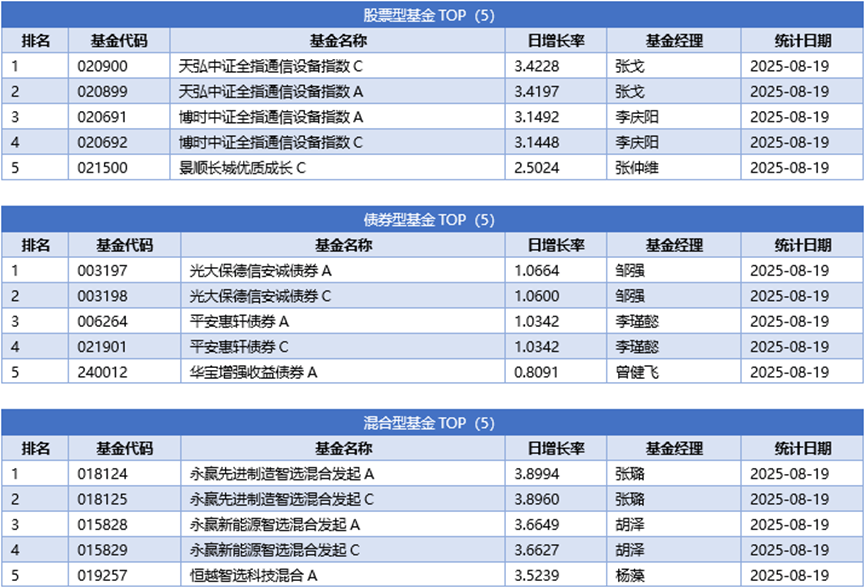
Trading Insights - The ETF market has been thriving this year, with a total market size reaching 4.8 trillion yuan as of August 18, showing significant growth in stock ETFs, cross-border ETFs, commodity ETFs, and bond ETFs compared to the end of last year [1] - ETFs are evolving from mere trading tools to essential wealth management infrastructure, becoming important vehicles for long-term investments amid steady economic recovery and policy support [1] Fund News - On August 19, three new funds were launched, primarily ETF-linked funds and equity funds, with the Huatai-PineBridge SSE Sci-Tech Innovation Board Artificial Intelligence ETF having an undisclosed fundraising target [2] - Public funds are actively entering the market, with the stock positions of active equity funds reaching a year-to-date high; newly established funds have quickly built positions, with several achieving over 10% returns within a month [2] - The A-share market has seen a simultaneous increase in volume and price, with public fund issuance remaining robust; 45 new funds are planned for issuance in the week of August 18 to August 24, marking a 36.36% increase from the previous week and continuing a trend of over 30 new funds issued weekly for four consecutive weeks [2] Fund Performance - The best-performing fund on August 19 was the Yongying SSE Sci-Tech Innovation Board Artificial Intelligence Index A, with a daily growth rate of 4.4065% [3] - In the stock fund category, the top performer was also the Yongying SSE Sci-Tech Innovation Board Artificial Intelligence Index A, while the bond fund champion was the Everbright Prudential Ancheng Bond A, with a daily growth rate of 1.0664% [3][4] - The top-performing mixed fund was Yongying Advanced Manufacturing Select Mixed Initiation A, with a daily growth rate of 3.8994% [3][4] - The leading ETF-linked fund was the Guotai CSI All-Share Communication Equipment ETF, achieving a daily growth rate of 3.8776% [3][4] - The top QDII fund was the Invesco Great Wall Hang Seng Consumer ETF, with a daily growth rate of 1.1153% [3][4]

收益表现亮眼,银行热推含权类理财产品
Zhong Guo Zheng Quan Bao· 2025-08-19 23:23
Group 1 - The recent performance of rights-containing wealth management products has been impressive, with many products showing an annualized return of over 4% in the past month [1][2] - Two popular wealth management products highlighted include one from Xingyin Wealth Management with an annualized return of 5.39% year-to-date and 4.28% in the last month, and another from Zhaoyin Wealth Management with a year-to-date return of 4.83% and a last month return of 6.59% [2] - The underlying assets of these products include bonds, stocks, commodities, and derivatives, utilizing various professional investment strategies to enhance returns [2] Group 2 - Many banks are recommending rights-containing wealth management products due to low returns from traditional fixed-income products and money market funds, which have seen declining yields [3] - The average yield of money market funds has decreased from 1.79% in January to 1.32% recently, while fixed-income products have shown returns of less than 1% year-to-date [3] - Bank wealth management products are primarily positioned for stable returns rather than short-term high returns, with recent strong performance attributed to the bullish A-share market [4] Group 3 - Most recommended rights-containing wealth management products have a holding period of one year or more, which helps mitigate short-term volatility through long-term operation [4] - Investors are advised to have realistic expectations regarding different risk levels of wealth management products and to choose products that match their risk tolerance [4] - Diversification and proper asset allocation are recommended strategies for investors, who should consider their financial situation across various dimensions such as active management, stable investment, aggressive investment, and protection management [4]
金风科技炼金有术:抓超级牛股,卡热门赛道,一年狂赚20亿元
2 1 Shi Ji Jing Ji Bao Dao· 2025-08-19 22:31
Core Viewpoint - JinWind Technology's subsidiary, JinWind Investment Holdings, has been actively reducing its stake in its associate company, Shangwei New Materials, amid a significant rise in the latter's stock price, indicating JinWind's growing capital management capabilities beyond its core wind power equipment manufacturing business [1][2]. Group 1: Shareholding and Financial Performance - Since July, JinWind Investment has reduced its holdings in Shangwei New Materials by 1.6328 million shares, generating over 100 million RMB in cash [1]. - The investment income from JinWind Investment reached 1.962 billion RMB in 2024, surpassing JinWind Technology's net profit of 1.86 billion RMB during the same period [2][13]. - JinWind Investment's shareholding in Shangwei New Materials was originally acquired at an issue price of 2.49 RMB per share, while the stock price surged to 85.65 RMB per share by August 19 [11]. Group 2: Market Dynamics and Investment Strategy - The stock price of Shangwei New Materials experienced a remarkable increase of 992.54% from July 9 to August 12, coinciding with JinWind Investment's reduction in holdings [11]. - JinWind Technology has built a diversified investment portfolio across various sectors, including new energy, equipment manufacturing, and agriculture, indicating a strategic focus on emerging industries [12]. - The company has invested in several key players in the new energy sector, including companies involved in core components for wind power and smart operation technologies [12]. Group 3: Broader Market Trends - The A-share market has seen a resurgence, with 57 companies announcing plans to use idle funds for securities investment this year, reflecting a growing trend among listed companies to engage in stock market investments [14]. - Despite the overall positive market sentiment, there are concerns regarding the risks associated with stock market investments, as evidenced by the mixed financial outcomes for companies involved in such activities [15][16].


乘股市回暖东风 含权类理财产品销售升温
Zhong Guo Zheng Quan Bao· 2025-08-19 20:17
Core Viewpoint - The recent surge in demand for equity-linked wealth management products is driven by favorable policies and market conditions, with many products achieving annualized returns exceeding 4% in the past month [1][2]. Group 1: Product Performance - Several equity-linked wealth management products have shown strong performance, with one product achieving an annualized return of 5.39% year-to-date and 4.28% in the last month, while another reached 4.83% year-to-date and 6.59% in the last month [2]. - The popularity of these products is reflected in their rapid sales, with some banks releasing around 1 billion yuan worth of products daily, which sell out within minutes [1]. Group 2: Market Trends - The banking sector is increasingly focusing on equity-linked products as a response to the "asset shortage" environment, viewing them as a key opportunity to enhance product scale [1][4]. - Following the recovery of the A-share market, many investors are opting for equity-linked products to participate in stock market gains, leading to a significant increase in the issuance of such products by banks [4][5]. Group 3: Investor Behavior - Investors are shifting from low-yield fixed-income products to equity-linked products due to declining returns on traditional investments, with some expressing dissatisfaction with the low yields of money market funds and fixed-income products [3][6]. - Bank wealth management professionals are advising clients to consider equity-linked products for higher returns, especially for those with a certain risk tolerance [3][6]. Group 4: Strategic Adjustments - Banks are enhancing their investment capabilities in equity-linked products, with a focus on diversifying their product offerings to meet varying risk appetites among investors [5][6]. - The low interest rate environment is prompting banks to reduce reliance on traditional fixed-income products and to capture structural opportunities in the equity market [4][5].

乘股市回暖东风含权类理财产品销售升温
Zhong Guo Zheng Quan Bao· 2025-08-19 20:09
Group 1 - The core viewpoint of the articles highlights the increasing popularity of equity-linked wealth management products driven by favorable policies and market conditions, with many products showing annualized returns exceeding 4% in the past month [1][2][3] - Banks are actively promoting equity-linked wealth management products, with some products selling out quickly, indicating strong demand from investors seeking higher returns compared to traditional fixed-income products [1][2] - The growth in equity-linked products is a strategic response from banks to the "asset shortage" environment, aiming to enhance product scale and capture market opportunities [1][3] Group 2 - Several banks have reported a significant increase in the issuance of equity-linked wealth management products, with some institutions seeing a multiple increase compared to the same period last year [3] - The low interest rate environment poses challenges for asset management firms, prompting them to diversify their portfolios by increasing equity asset allocations to seek higher returns [3][4] - Experts suggest that banks should optimize product structures and expand marketing channels to develop diversified wealth management products, particularly equity and mixed products, to meet varying investor risk preferences [4][5] Group 3 - The majority of recommended equity-linked products have holding periods of one year or more, which helps mitigate short-term volatility associated with underlying stock assets [5][6] - Industry insiders emphasize that wealth management products are primarily designed for stable returns rather than short-term high yields, and recent performance improvements are largely attributed to the A-share market rally [5][6] - Investment advisors recommend that investors adopt a diversified investment strategy, balancing their portfolios across different asset classes and industries to manage risk effectively [6]
沪指创近十年新高,基金投资该怎么办
天天基金网· 2025-08-19 11:23
Core Viewpoint - The article discusses the recent rise of the A-share market, with the Shanghai Composite Index surpassing 3700 points, and questions whether this indicates a market peak or if investment opportunities still exist [2][3]. Market Valuation Comparison - The A-share market has shown a significant increase, but comparisons with past bear market levels suggest that while it may seem expensive, it is essential to evaluate against other asset classes like bonds [3]. - The equity risk premium indicates that stocks remain competitively priced compared to bonds, with current levels around the median of the past five years [4]. - The dividend yield of the A-share market suggests that, under conservative assumptions, the overall valuation is not significantly overvalued, remaining around the five-year average [6]. Signs of Market Overheating - There are emerging signs of "overheating" in specific sectors, with the overall dynamic PE ratio of A-shares at 21 times, and certain indices like the Sci-Tech 50 and CSI 2000 showing PE ratios around 140 times, indicating potential overvaluation [7][10]. Historical Insights - The article reflects on the 2015 bull market, highlighting that many investors who chased small-cap stocks at their peak did not achieve favorable outcomes, while quality leading companies have shown resilience and value creation over time [14]. - It emphasizes the importance of understanding market mechanisms and risks, particularly in different markets like Hong Kong, where mechanisms such as short selling can introduce additional risks for investors [14]. Investment Strategies - The article advocates for a diversified asset allocation strategy, focusing on quality funds and maintaining liquidity to manage risks and seize opportunities during market corrections [18][19]. - It suggests that investors should consider systematic investment plans (SIPs) to mitigate the impact of market volatility and average investment costs over time [19][20].

【资产配置快评】总量“创”辩第109期:突破3674,后市怎么看
Huachuang Securities· 2025-08-19 09:52
Report Industry Investment Rating No relevant content provided. Core Viewpoints of the Report - The decline in corporate loans does not affect the "watch stocks and trade bonds, stock - bond reversal" judgment. The overall corporate financing scale is still growing, and the current market rally may have significant potential. The recovery of the residents' balance sheet is triggered by the return of the average earnings of the 3 - trillion - yuan funds issued during the 2019 - 2021 bull market. The market re - balancing style may be influenced by the subsequent inflow channels of market - entering funds. The bond market has entered the second stage of the "three - step" process in the second half of the year, and the 10 - year Treasury bond yield may fluctuate in the range of 1.65% - 1.75%. Euro assets face systemic risks, and most A - share and Hong Kong stock timing models are bullish [3][13][18]. Summary by Directory Macro - Zhang Yu - Corporate loan contraction is related to the control of manufacturing investment, which may be beneficial for PPI growth. The overall corporate financing scale is increasing as equity and bond financing have improved compared to the previous year. The current economic cycle is improving, and stocks are more cost - effective than bonds. The "watch stocks and trade bonds" narrative remains unchanged, and the central bank may address potential capital idling [13][15][16]. Strategy - Yao Pei - The balance sheets of various sectors are being repaired. The return of the average earnings of the 3 - trillion - yuan funds issued during the 2019 - 2021 bull market is a key trigger for the repair of the residents' balance sheet. The stock market is an important cornerstone for the repair of the residents' balance sheet. After the funds return to profitability, the redemption pressure may increase, and the "redemption" funds are likely to flow back to financial assets. The market re - balancing style is affected by the inflow channels of subsequent market - entering funds [18][19][25]. Fixed Income - Zhou Guannan - In August, the bond market enters the policy effect verification period, with potential support from new policy - based financial tools, "anti - involution" price repair, and external factors. Liquidity may face disturbances from payments and the stock - bond seesaw effect. The supply of bonds is increasing while demand is limited, resulting in supply - demand pressure. Historically, the bond market in August may be volatile. The bond market has entered the second stage of the "three - step" process in the second half of the year, and investors should adjust positions and take profits in a timely manner [26][27][30]. Multi - Asset Allocation - Guo Zhongliang - Euro assets face three systemic risks: extremely low risk premiums, weak economic recovery, and a strong euro. These risks may lead investors to reduce their allocation of euro assets [32][33][34]. Quantitative Finance - Wang Xiaochuan - Most A - share and Hong Kong stock timing models are bullish. The total positions of stock - type and hybrid funds have increased this week. Communication and basic chemicals have received the largest institutional increases, while transportation and electronics have received the largest institutional decreases. The VIX index has risen. The recommended industries for next week are textile and apparel, consumer services, power and utilities, transportation, and non - ferrous metals [34][39][46]. Finance - Xu Geng - The A - share trading volume has exceeded 2 trillion yuan on 27 trading days in three periods, indicating the market's evolution towards a more mature one. The current trading volume and margin trading balance confirm active market sentiment. The securities sector has performance growth and valuation repair potential. Short - term focus on market sentiment - driven opportunities, and long - term focus on high - quality targets [47][48].
十年国债ETF(511260)收红,险资增配与利率下行预期助推债市
Mei Ri Jing Ji Xin Wen· 2025-08-19 08:14
国信证券指出,2025年二季度,在10年期国债收益率震荡下行、高收益资产稀缺背景下,险资通过增配 长久期利率债优化资产负债久期匹配,规模持续突破历史新高。截至二季度末,保险业债券配置规模达 17.9万亿元,占总投资规模的49.3%,创历史新高。其中,人身险公司债券配置规模为16.9万亿元,同 比增长26.6%;财产险公司债券配置规模为0.95亿元,同比增长19.9%。在"资产配置荒"背景下,人身险 行业持续加大以长债等资产为代表的配置规模,以拉长资产久期,优化资产负债管理水平。 十年国债ETF(511260)跟踪上证10年期国债指数,选取剩余期限7到10年且在上交所挂牌的国债作为 样本,久期恒定,目前组合平均久期为7.6年。从过往表现来看,十年国债ETF(511260)成立以来净值 屡创新高,历史业绩持续稳健。根据基金定期报告,截至二季度末,近1年回报率达5.88%,近3年回报 率达16.13%,近5年回报率达22.41%,成立至今累计回报率达36.68%。 值得关注的是,十年国债ETF成立以来经历了2018~2024年共计7个完整自然年度,均保持每年正收益, 有望成为穿越牛熊周期的资产配置利器。 此外,十年 ...