
资产配置

Search documents
从“定存族”到理财高手:低利率时代的资产配置升级战
Sou Hu Cai Jing· 2025-08-18 07:01
Core Viewpoint - The traditional bank deposit attractiveness has significantly declined due to low interest rates, prompting a shift in investment strategies among young people towards alternative financial products [1][2][13]. Group 1: Low Interest Rate Environment - The one-year fixed deposit rate of the six major banks in China has dropped to 0.95%, marking a historic low [1]. - The People's Bank of China has indicated a trend towards a moderately loose monetary policy, which may lead to further declines in deposit rates [1][2]. - The phenomenon of "deposit migration" is increasingly evident, with funds moving from traditional savings accounts to other financial products [2]. Group 2: Investment Alternatives - Money market funds, bond funds, and gold are becoming popular investment choices for young people seeking higher returns and lower volatility [1][3][14]. - Money market funds offer high liquidity and low risk, with annualized returns between 1.1% and 1.5%, which is higher than bank savings but may decrease further [4][5]. - Bond funds provide greater yield elasticity and are considered medium-low risk, suitable for investors with a six-month or longer investment horizon [6][7][14]. - Gold serves as a hedge against inflation and has a low correlation with stocks and bonds, but it carries higher volatility and does not generate interest or dividends [8][9]. Group 3: Investment Strategies - The emergence of hybrid investment strategies, such as money-bond advisory strategies, aims to balance liquidity and yield elasticity by dynamically adjusting the proportions of money market and bond funds [10][12]. - The "工银货债通" product exemplifies this strategy, achieving an annualized return of 2.33% since its inception, with a maximum drawdown of 0.12% [12][14]. - These strategies are particularly suitable for low-risk investors seeking slightly higher returns while maintaining liquidity [12][14].
楼市和黄金,信仰资产的“乾坤大挪移”
2 1 Shi Ji Jing Ji Bao Dao· 2025-08-18 06:39
Group 1: Gold Market Dynamics - The current gold price surge is referred to as a "re-monetization trend," marking the longest bull market since the dollar decoupled from gold in 1971, with gold prices rising from $1,046 per ounce in December 2015 to a record high of $2,685 per ounce by December 2024 [4][6] - Over the past two years, the primary buyers of gold have shifted from Western ETF retail investors to central banks and sovereign wealth funds, indicating a significant change in market dynamics and pricing mechanisms [4][6] - Central banks have purchased over 1,000 tons of gold annually from 2022 to 2024, a historic high, as they seek to diversify away from dollar reserves and mitigate risks associated with potential sanctions [7][8] Group 2: Bitcoin Market Trends - Bitcoin has experienced a remarkable price increase, soaring from $26,000 in August 2023 to over $122,000 by August 2025, representing a nearly 470% increase in market capitalization from $500 billion to $2.4 trillion [5] Group 3: Global Economic Shifts - The post-World War II dollar system is perceived to be collapsing, prompting countries to seek new anchors for their financial systems, including potential gold-backed digital currencies [6][8] - The share of the dollar in global foreign exchange reserves has decreased from 73% in 2001 to 58% in 2024, while gold's share has increased from 9% to 20%, reflecting a significant shift in reserve asset preferences [8] Group 4: Real Estate Market Changes - The perception of real estate as a safe investment is changing, with properties transitioning from being viewed as wealth amplifiers to financial liabilities, leading to a reevaluation of their investment potential [10][11] - The belief in continuously rising property values is being challenged, as individuals now focus on cash flow and the potential for depreciation rather than solely on price appreciation [12][14]


非银存款飙升2.14万亿,居民存款减少1.11万亿,结构性资金迁移加速
Sou Hu Cai Jing· 2025-08-18 04:00
Group 1 - The core viewpoint of the articles highlights a significant structural change in the financial landscape, with non-bank deposits reaching a record high of 2.14 trillion yuan in July, while resident deposits decreased by 1.11 trillion yuan [1][2] - The surge in non-bank deposits is closely linked to the strong performance of the capital markets, which has led to increased trading activity and higher margin deposits at securities firms [2][3] - There is a noticeable shift in asset allocation among residents, as funds move from traditional bank deposits to non-bank financial institutions, reflecting a changing investment mindset [3] Group 2 - The increase in non-bank deposits is attributed to a decline in deposit rates and a recovery in the capital markets, which has created a "see-saw" effect in asset allocation [3] - Financial products such as wealth management and funds are becoming significant destinations for resident funds, indicating a diversification in investment channels [3] - The capital market's strength since late June has attracted off-balance-sheet funds back into the banking system, further driving the growth of non-bank deposits [2]
多策略叠加打造增强引擎 南方中证A500指数增强8月18日正式发售
Zhong Guo Jing Ji Wang· 2025-08-18 02:15
Core Viewpoint - The Southern Asset Management has launched the Southern CSI A500 Index Enhanced Fund, aiming to provide investors with a quality tool for allocating core A-share assets while striving for excess returns based on the new generation of broad-based indices, the CSI A500 Index [1] Group 1: Fund Overview - The Southern CSI A500 Index Enhanced Fund is anchored to the CSI A500 Index and leverages the quantitative investment team's expertise to achieve excess returns while tracking the index's beta returns [1] - The fund's management fee is set at 0.80% per year, with a custody fee of 0.10% per year and a sales service fee of 0.40% for Class C shares, combining low costs and high transparency typical of index funds with the management capabilities of the fund manager [5] Group 2: Team and Strategy - The quantitative investment team consists of 13 members with an average of over 8 years of industry experience, focusing on a platform-based work model to enhance transparency and collaboration in investment research [2] - The investment strategy employs a "multi-strategy overlay" approach, utilizing a diverse set of sub-strategies to achieve stable enhancement of the target benchmark, incorporating models such as multi-factor, fundamental quantitative, style rotation, and deep learning [4] Group 3: Market Positioning - The CSI A500 Index covers 107 industries in the A-share market, including sectors like semiconductors, healthcare, banking, and liquor, representing a "condensed version" of the entire market, which allows the fund to capture opportunities in new productivity sectors while balancing traditional industry values [5] - Southern Asset Management has validated its strength in broad-based management, with multiple index products exceeding 100 billion in scale, indicating a robust track record in managing large-scale index funds [5]
818理财直播周重磅来袭!“星火计划”讲师团坐镇5大专场
Sou Hu Cai Jing· 2025-08-18 02:04
Core Viewpoint - The upcoming "818 Financial Live Streaming Week" aims to address investors' concerns about navigating the complex financial market, focusing on both identifying genuine opportunities and avoiding risks associated with non-standard financial activities [1][2]. Group 1: Event Overview - The event is organized by the Securities Times and supported by the Capital Market Investor Education "Spark Plan," featuring five specialized sessions and numerous experienced financial instructors from leading financial institutions [1][2]. - The live streaming will take place from August 18 to 22, with daily sessions at 15:00 on the Securities Times website, app, and video channels [1][8]. Group 2: Session Breakdown - **August 18 (Asset Allocation Session)**: Experts will discuss practical strategies for achieving stable returns amidst market volatility, focusing on "cash is king" and "cross-cycle allocation" [4]. - **August 19 (Stock Investment Session)**: The session will help novice investors build their investment framework by covering stock fundamentals, technical analysis, and market information collection [5]. - **August 20 (Fund Investment Session)**: This session will explain advanced techniques for fund investment, emphasizing the importance of systematic investment plans for ordinary investors [6]. - **August 21 (Futures Investment Session)**: Experts will analyze the practical applications of futures and options, providing insights into investment, hedging, and arbitrage strategies [7]. - **August 22 (Financial Literacy Session)**: The focus will be on financial education for both youth and general investors, exploring effective money management [8]. Group 3: Educational Initiative - The "Spark Plan" is a collaborative initiative involving multiple stakeholders, including stock exchanges and investor service centers, aimed at creating a comprehensive investor education platform [8]. - Since its launch on May 15, 2024, the initiative has attracted over 100 institutions and reached more than 50 million investors through quality content and innovative activities [8].
股债“跷跷板”又来了!资产如何更好配置?
Zhong Guo Zheng Quan Bao - Zhong Zheng Wang· 2025-08-18 01:19
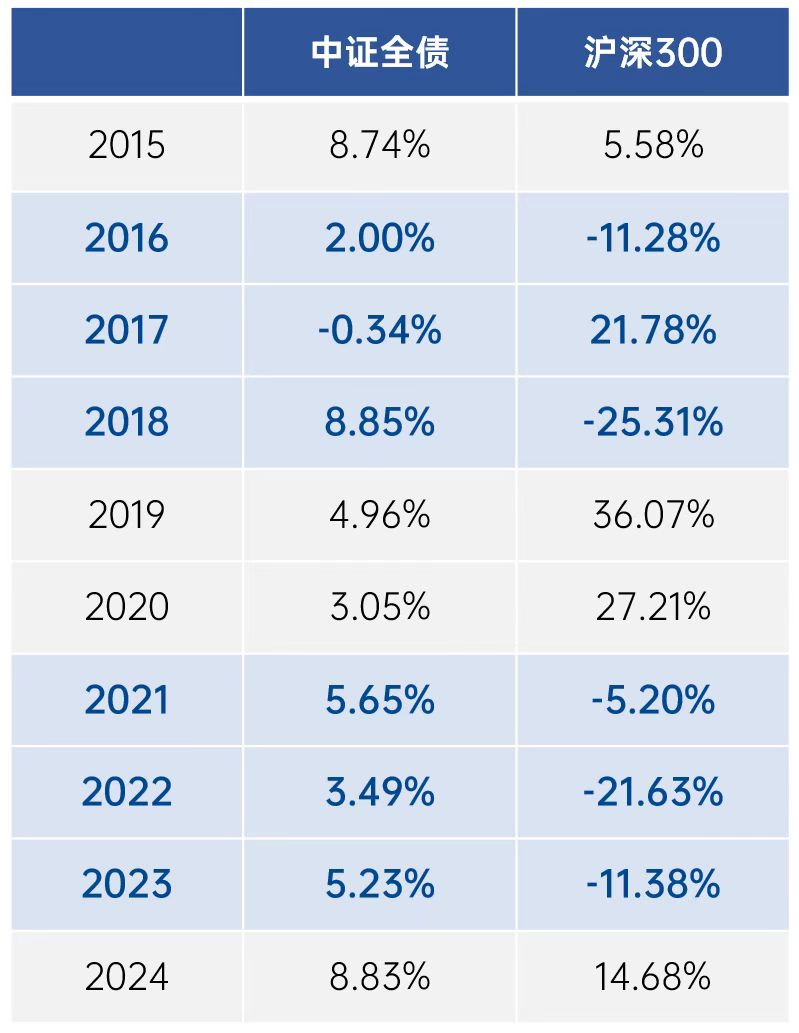
Core Viewpoint - The article discusses the recent fluctuations in the A-share market and the bond market, highlighting the "see-saw" effect between stocks and bonds, and suggests a balanced asset allocation strategy to mitigate risks and enhance returns [1][2]. Group 1: Market Performance - Since 2015, the performance of the stock index (CSI 300) and the bond index (CITIC All Bond) has shown significant fluctuations, with six periods of opposite performance noted [1]. - The annual performance data from 2015 to 2024 indicates that the bond index has outperformed the stock index in several years, with notable differences in percentage changes [1]. Group 2: Investment Strategy - Investors are advised against focusing solely on either stocks or bonds due to the cyclical nature of their performance, suggesting a mixed asset allocation approach [2][3]. - A proposed strategy involves primarily investing in bonds while allocating a smaller portion to stocks, which can help capture opportunities during stock market upswings while providing stability during downturns [2][3]. Group 3: Fund Performance - The article highlights the performance of mixed-asset funds, particularly those with a bond focus, which have shown better cumulative returns and lower volatility compared to the CSI 300 index over the past 20 years [3][4]. - Specific funds, such as the "Guofu Anyi Stable 6-Month Holding Period Mixed Fund," have demonstrated positive returns across various time frames, indicating effective risk management and performance consistency [6][7]. Group 4: Risk Management - The "Guofu Anyi Stable" fund has shown superior risk control metrics, including lower annualized volatility and maximum drawdown compared to its peers, suggesting a strong risk-adjusted performance [6][7]. - The fund's Sharpe and Calmar ratios also outperform the average of similar funds, indicating a favorable risk-return profile [6].
基金经理开实盘,收益率跑输普通网民?
Hu Xiu· 2025-08-18 00:01
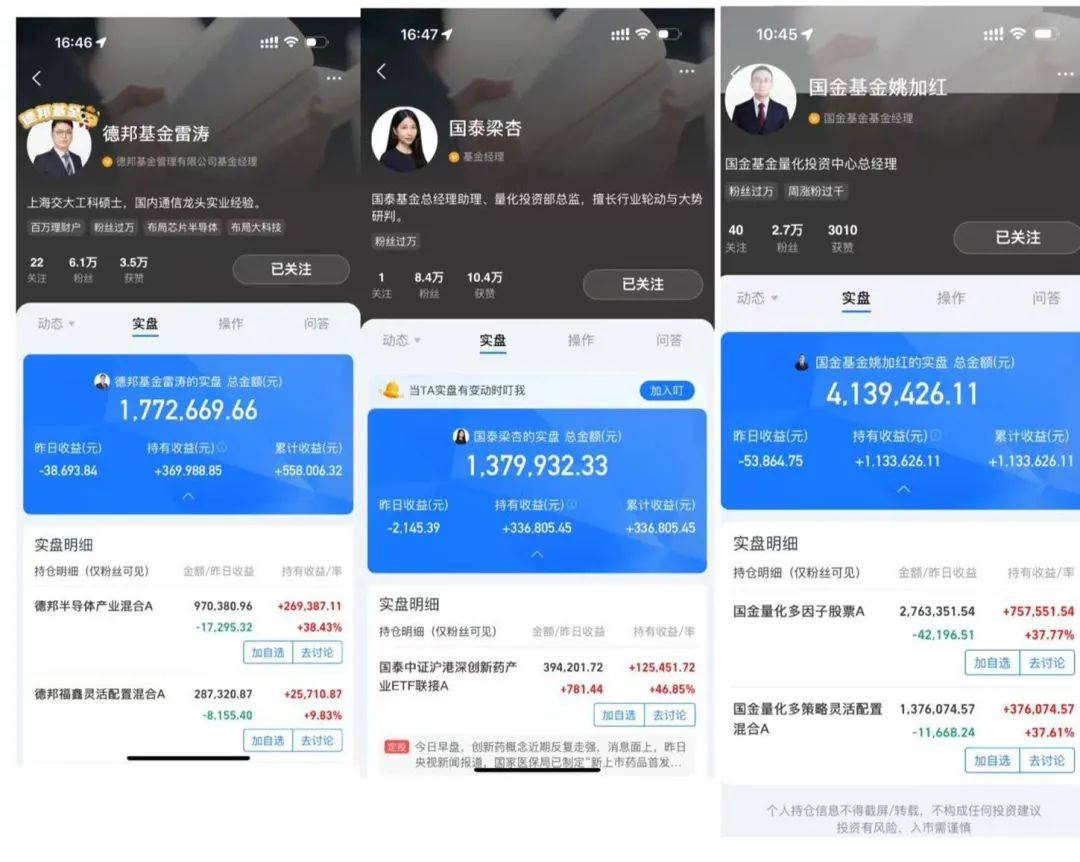
Core Viewpoint - The increasing popularity of A-shares has led many public fund managers to open real-time trading accounts on online platforms to showcase their performance [1][2]. Group 1: Fund Managers Opening Real Accounts - Numerous public fund managers, including those from Guojin Fund and Guotai Fund, have opened real accounts on platforms like Tiantian Fund and Ant Wealth [2][10]. - The total amount of these real accounts is generally high, with some exceeding 4 million yuan, such as Guojin Fund's Yao Jiahong, whose account reached 4.1394 million yuan [11]. Group 2: Performance and Investment Choices - Some fund managers have reported holding profits exceeding 1 million yuan, indicating positive returns [3][13]. - Fund managers predominantly invest in their own products or those from their fund companies, with no evidence of investing in products from other companies [8][9]. Group 3: Comparison with Retail Investors - Despite the reported profits, fund managers' returns often lag behind those of ordinary investors, with the top retail investors achieving monthly returns between 30.41% and 39.39% [16][17]. - Over the past year, no fund manager has made it to the top performance rankings, which raises questions about their short-term investment capabilities compared to retail investors [18][19]. Group 4: Implications and Industry Perspectives - The practice of fund managers opening real accounts may enhance trust and transparency with investors, especially for smaller firms or emerging managers [22][23]. - However, there are concerns that these accounts primarily serve as a marketing tool for their own products rather than providing genuine investment insights [12][21][26].
险资运用规模突破36万亿 股票投资创新高
Zheng Quan Shi Bao· 2025-08-17 17:43
Core Viewpoint - The insurance companies in China have significantly increased their investment in stocks and securities, with total funds reaching 36.23 trillion yuan by the end of Q2 2025, marking a 17.4% year-on-year growth [1] Group 1: Investment Trends - By the end of Q2 2025, the total investment balance of life insurance companies reached 32.6 trillion yuan, with stock investments amounting to 2.87 trillion yuan, an increase of over 200 billion yuan from Q1 and over 600 billion yuan since the beginning of the year [1] - The proportion of stock investments in life insurance companies rose to 8.81%, up 0.38 percentage points from the previous quarter and 1.8 percentage points from the same period in 2024 [1] - Property insurance companies also showed similar trends, with stock investments totaling 195.5 billion yuan and a proportion of 8.33%, increasing by 0.77 percentage points from Q1 and 1.84 percentage points from 2024 [1] Group 2: Overall Asset Allocation - The combined balance of stock and securities investment funds for life and property insurance companies reached 4.73 trillion yuan, a 25% increase from the same period in 2024 [2] - Life insurance companies' investments in stocks and securities funds amounted to 4.35 trillion yuan, accounting for 13.34% of their total investment balance, marking a peak since 2023 [2] - The rapid growth in stock investments is attributed to several factors, including stock market gains, a low interest rate environment, and policy changes facilitating long-term investments [2] Group 3: Bond Investments - By the end of Q2 2025, the total bond investment balance for life and property insurance companies reached 17.87 trillion yuan, an increase of 1.9 trillion yuan since the beginning of the year [2] - Life insurance companies held 16.92 trillion yuan in bonds, representing 51.90% of their total investments, the highest among all asset types [2] - The increase in bond investments is driven by the need for long-term liability matching and the diminishing availability of stable high-yield assets in a declining interest rate environment [2][3]
[8月17日]美股指数估值数据(全球股票市场继续上涨;A股港股涨幅排第几)
银行螺丝钉· 2025-08-17 14:02
Group 1 - The article discusses the valuation of global stock indices, US Treasury indices, and the limited availability of investment funds in mainland China for overseas markets [2][3][4]. - The author has created valuation tables for US stocks, global stock indices, and US Treasury indices, which will be updated weekly [5][6]. - The global stock market saw an overall increase of 1.19% this week, with European and Asia-Pacific regions experiencing higher gains compared to the US stock market [9][11][12]. Group 2 - The A-share CSI All Share Index increased by approximately 13.92% this year, while the Hang Seng Index rose by 25.97% [15][18]. - The article notes that the Hang Seng Index has outperformed the A-share market due to additional upward movements after the Spring Festival [21][22]. - The article highlights that the valuation of A-shares and Hong Kong stocks is lower than the average valuation of overseas markets, which may benefit from the US interest rate cut cycle [33][34]. Group 3 - The article provides a star rating system for global stock indices, indicating that the global stock market is currently at 3.0 stars, with previous low valuation phases occurring in 2018, 2020, and 2022 [10][40]. - The author mentions that there are no global stock index funds available in mainland China, but a simulated global index investment can be achieved through a diversified investment advisory portfolio [43][44]. - The article introduces a new book titled "The Long-Term Investment Treasure," which has gained significant popularity and provides insights into long-term stock market investments [49][50].
鹏华基金刘嵚:ETF工具多样化 助力ETF生态焕发新活力
2 1 Shi Ji Jing Ji Bao Dao· 2025-08-17 13:51
Group 1 - The core viewpoint of the articles emphasizes the rapid growth and diversification of the ETF market in China, driven by increasing adoption of index investment strategies and the appeal of ETFs to institutional and individual investors [1][2][3] - ETFs have become a crucial component of asset allocation, with the total number of ETFs exceeding 1200 and total assets surpassing 4.5 trillion yuan, indicating a significant expansion in the market [2][3] - Institutional investors play a dominant role in the ETF market, holding 70% of stock ETFs and 91% of bond ETFs, highlighting their importance in driving market growth [2][3] Group 2 - The ETF market is characterized by a wide range of products covering multiple asset classes and strategies, enhancing the depth and breadth of asset allocation options available to investors [3][4] - Penghua Fund has positioned itself strategically in the ETF space, focusing on innovation and comprehensive product offerings, including a diverse range of technology-focused ETFs [4][5] - The company aims to meet diverse client needs by providing a "one-stop" ETF solution, covering various sectors and themes, and has launched several pioneering bond ETFs [5][6] Group 3 - Penghua Fund is committed to building a robust ETF investment service system, enhancing market liquidity and investor education, which is essential for the sustainable development of the ETF ecosystem [6] - The company emphasizes collaboration and resource sharing with partners to enhance the value of the ETF ecosystem, aiming to support the healthy development of the capital market [6]