资产配置

Search documents
攻守兼备 让客户获得实实在在的收益——访民生加银恒泽债券基金经理关键
Shang Hai Zheng Quan Bao· 2025-08-17 13:36
Group 1 - The core viewpoint emphasizes that bond funds remain an effective "ballast" for asset allocation, while convertible bond funds are expected to provide better experiences and long-term returns for investors [1][2] - The Minsheng Jianyin Hengze Bond Fund, managed by the key manager, achieved a net value growth rate of 13.63% over the past three years, ranking in the top 5% among similar long-term pure bond funds [2] - The Minsheng Jianyin Convertible Bond Preferred Fund has shown good returns amid market structural rotation, validating the effectiveness of its dual low defense strategy [2][3] Group 2 - The investment style focuses on a top-down approach to assess major asset classes, maximizing utility when opportunities arise while paying attention to major cycle shifts [3] - Risk management is highlighted as a priority, with a strong emphasis on the long-term value of stable allocations over frequent trading, particularly for ordinary investors [3] - The current convertible bond market is at a historically high valuation, driven by the equity market and continuous capital inflow, which poses risks for low-risk investors [3][4] Group 3 - The company has a robust research and investment management framework, ranking second in active bond investment management capabilities over nearly 11 years [4] - The investment philosophy aligns with the company's mission to ensure that clients achieve tangible returns, fostering trust and support from investors for sustainable long-term development [4]
资产配置+工具化 ETF成公募FOF“新宠”
Shang Hai Zheng Quan Bao· 2025-08-17 13:36
Group 1 - The core viewpoint is that public FOFs are increasingly aligning with index-based investments, with a notable rise in the issuance of ETF-FOF products in 2023 [1][2] - As of August 15, 2023, a total of 39 public FOF products were issued this year, with a total issuance of 359.13 billion shares, significantly higher than the entire years of 2024 and 2023 [2] - The average net asset value growth rate for public FOFs over the past year reached 16.38% as of August 14, 2023, with over 80% of public FOFs recovering their net asset value to above 1 yuan [1] Group 2 - The proportion of ETF holdings within FOF products is gradually increasing, with the upcoming Xingzheng Global Yingfeng Multi-Asset Allocation FOF focusing on ETFs, allocating at least 80% of its non-cash fund assets to ETFs [1] - By the end of Q3 2024, passive index funds (including enhanced index funds) are expected to hold more A-share market value than active equity funds for the first time [2] - The number of ETF-FOF products has been steadily increasing, with significant interest from fund managers in utilizing ETFs for flexible and efficient equity asset allocation [3]
险资大力加仓股票:上半年净买入6400亿元,环比增长78%丨36万亿险资重构资产底仓②
Xin Lang Cai Jing· 2025-08-17 08:17
Group 1 - The current valuation of A-shares and Hong Kong stocks is relatively low, while dividend yields are high, suggesting that long-term capital allocation to equities may yield substantial returns [1][2] - Insurance funds have significantly increased their stock allocations, with the proportion reaching a recent high, driven by low interest rates and asset scarcity [1][2] - As of the end of Q2, the balance of insurance funds allocated to stocks was 3.07 trillion yuan, an 8.9% increase from the previous quarter, equating to a net purchase of approximately 640 billion yuan in the first half of the year [2][3] Group 2 - The shift in insurance funds' investment strategy from "controlling positions" to "selecting sectors" is necessary due to increased market volatility during the economic transition [2][4] - Insurance funds have shown a preference for large-cap, high-dividend, and low-volatility assets, with banks being the most favored sector, followed by public utilities, transportation, and energy [4][5] - The investment in long-term equity has increased to 2.75 trillion yuan, representing 7.6% of the overall asset allocation, while the allocation to securities investment funds stands at 4.6% [3][4] Group 3 - Recent regulatory changes have facilitated insurance funds' entry into the capital market, allowing for increased investments through private equity funds and shareholding [4][7] - The number of equity stakes taken by insurance companies has reached a four-year high, with 28 stakes in 23 listed companies this year [4][7] - The establishment of new private fund management companies by major insurance firms indicates a growing trend towards long-term investment strategies [7]
基金经理晒实盘,“战绩”可查!
Sou Hu Cai Jing· 2025-08-17 07:23
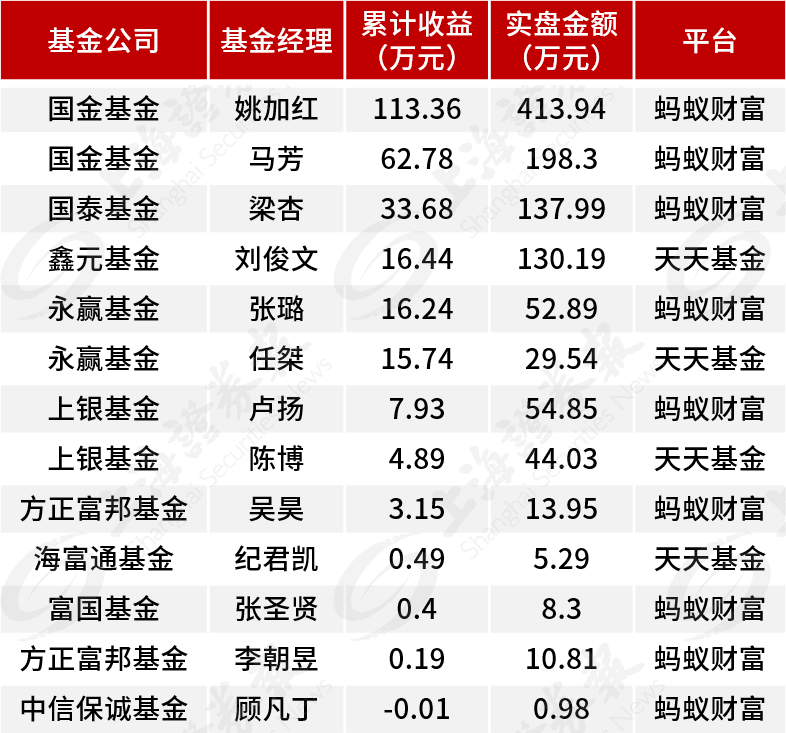
Core Viewpoint - The trend of "showing real accounts" among fund managers is becoming a new competition, reflecting increased industry transparency, upgraded investor professionalism, and a transformation in marketing models [1][6]. Group 1: Fund Manager Performance - Several fund managers have reported substantial real account gains, with notable examples including Yao Jiahong from Guojin Fund achieving a cumulative profit of 1.1336 million yuan on an investment of 4.139 million yuan, and Ma Fang from Guojin Fund with a profit of 627,765 yuan on an investment of 1.982 million yuan [3][4]. - Other fund managers like Zhang Lu and Ren Jie from Yongying Fund have also seen significant returns, with Ren Jie achieving a return rate close to 120% on an investment of 295,400 yuan [4][6]. Group 2: Industry Trends - The practice of "showing real accounts" is enhancing communication between fund managers and investors, allowing for more immediate and interactive exchanges regarding investment strategies and market conditions [6][7]. - Analysts believe that this trend helps break down information asymmetry, allowing investors to better understand fund managers' strategies and performance, thus fostering a more informed investment environment [6][7]. Group 3: Market Insights - Fund managers are addressing investor concerns about market conditions, particularly regarding the recent highs in indices, attributing these movements to ample liquidity and supportive government policies [6][7]. - The shift in market sentiment is seen as a response to the previous two years of pessimism, with expectations that the transition to new economic drivers will occur more rapidly than anticipated [7].

投资的目的与心态
雪球· 2025-08-17 02:14
Core Viewpoint - The essence of investment is to achieve financial freedom through stable dividend income, allowing individuals to focus on meaningful pursuits rather than repetitive labor [3]. Group 1: Investment Philosophy - Many investors chase after quick profits and high returns, often leading to losses due to overtrading and poor decision-making [4]. - A complex investment system with multiple goals may result in lower efficiency and success rates; thus, a focus on long-term capital market returns is recommended [5]. - Understanding oneself and setting realistic expectations are crucial to avoid losses stemming from unrealistic goals [6]. Group 2: Investment Mechanics - Investment fundamentally involves the interplay of principal, annualized return, and time; maintaining a long-term compounding effect is more critical than merely achieving high returns [7]. - The relationship between investment risks and goals is significant, emphasizing the need for alignment between risk tolerance and investment objectives [8]. Group 3: Focus on Fundamentals - Investors should prioritize company fundamentals, such as dividend yield and growth cycles, over short-term stock price fluctuations [10]. - Accumulating undervalued quality stocks and reinvesting dividends can lead to a self-sustaining growth of assets, where dividends eventually exceed living expenses [11]. - An investment portfolio that grows organically over time does not require constant selling, making price fluctuations less of a concern [11]. Group 4: Legacy and Knowledge Transfer - Unlike education or job positions, the investment mindset and asset growth can be passed down, creating a lasting legacy [12].

买了指数基金就不用分散投资吗?
雪球· 2025-08-16 13:01
Core Viewpoint - The article discusses the performance differences among various index funds, particularly focusing on the volatility and returns of large-cap and small-cap indices over the past decade, highlighting the challenges in choosing the best investment strategy among them [3][5][24]. Performance Analysis of Different Indices - Historical data shows significant performance disparities among indices of different sizes over the past ten years, with the 中证2000 exhibiting the highest volatility and returns during bullish phases, while the 沪深300 remains relatively stable [5][7]. - The 中证全指 demonstrates a balanced performance, generally staying within a moderate range with fewer extreme fluctuations compared to other indices [5][7]. Bull Market Performance - In 2014, all five indices saw substantial gains, with 沪深300 and 中证2000 both around 50%, while 中证全指, 中证500, and 中证1000 had returns between 30%-45% [10]. - The year 2015 marked extreme differentiation, with 中证2000 soaring over 100%, while 沪深300 showed minimal growth [11]. - In 2019, all indices rose moderately, with gains concentrated in the 20%-35% range, favoring 沪深300 and 中证全指 slightly [12]. - The year 2020 saw a general tightening of gains, with most indices recording increases between 10%-20%, and 沪深300 slightly outperforming small-cap indices [13]. Bear Market Performance - During bear markets, indices generally experienced significant declines, with the depth of the drop closely related to market capitalization structure [17]. - In 2016, the 中证全指 and 沪深300 fell by 5%-8%, while 中证500 and 中证1000 dropped by 10%-15%, and 中证2000 remained relatively stable [17]. - The year 2018 witnessed a severe downturn, with 中证1000 and 中证2000 suffering losses of nearly 40% and over 35%, respectively, while large-cap indices also faced declines exceeding 25% [18]. - In 2022, all indices recorded declines in the 15%-25% range, with small-cap indices and 中证全指 experiencing slightly larger drops, while 沪深300 fared better [19]. - In 2023, most indices recorded slight declines or remained flat, with only 中证2000 achieving approximately 2% positive returns, indicating that small-cap indices often bear greater adjustment pressure in bear markets [20]. Summary of Returns and Volatility - 中证2000 has the highest cumulative return at nearly 197% with an annualized return of 10.19% and a volatility of 28.26%, indicating high elasticity and risk [23]. - 中证全指 and 沪深300 show long-term returns of 84.46% and 79.11%, respectively, with annualized returns in the 5%-6% range and lower volatility, reflecting stability and balanced returns [23]. - 中证500 and 中证1000 fall in between, with cumulative returns of 67.92% and 55.63%, annualized returns slightly below 5%, and volatility ranging from 21%-27% [23]. Investment Strategy Recommendations - The article suggests that small-cap indices perform better during favorable market conditions but come with higher volatility and drawdown risks, while large-cap and broad-based indices offer more stable returns [24]. - A diversified investment approach, such as balancing large-cap and small-cap allocations and integrating growth and value styles, is recommended to enhance adaptability across different market conditions [24].

葛小波:关于中国财富管理发展思路的思考|财富与资管
清华金融评论· 2025-08-16 09:31
Core Viewpoint - Enhancing wealth management service levels is essential for achieving "financial people's nature" and promoting long-term investment strategies, ultimately aiming to build investor trust through diversified asset allocation and improved service capabilities [2][3]. Group 1: Current State of Wealth Management in China - The wealth management business in China is still in its early stages, with significant room for growth, as the demand from clients is high but the supply of effective services is lacking [18][19]. - Chinese residents' wealth has rapidly accumulated, exceeding 600 trillion RMB, with property income growing at an annual rate of approximately 8.5% from 2015 to 2023 [19]. - Despite the growth in wealth, the allocation of assets in capital markets remains low, with less than 20% of total assets invested in these markets, indicating a need for improved financial services [19][20]. Group 2: Challenges in Wealth Management - The depth of buy-side advisory services is insufficient, with the scale of fund advisory services still far below the potential of the wealth management business [24]. - Financial institutions face challenges in team building, asset allocation capabilities, product creation, and service tools, which need significant improvement to enhance client satisfaction and service quality [24]. Group 3: Development Trends and Opportunities - The transformation of wealth management in China has begun, with many institutions shifting from transaction-based services to a focus on long-term asset preservation and growth [21][22]. - The introduction of fund advisory services has established a new type of relationship between securities companies and clients, with over 60 institutions now qualified to offer these services, managing assets exceeding 150 billion RMB [21]. - The future of wealth management in China is promising, as financial institutions are encouraged to adopt a client-centered service model, optimizing their operational strategies to support residents in preserving and growing their wealth [20][22].
居民存款减少1.1万亿元去哪了?存款“搬家”信号初现
Mei Ri Jing Ji Xin Wen· 2025-08-16 09:05
Group 1 - The core viewpoint of the articles highlights a significant trend of "deposit migration" where residents are moving their savings from traditional bank deposits to non-bank financial products, influenced by the rising stock market and improving investment sentiment [1][2][3]. - In July, non-bank deposits increased by 2.14 trillion yuan, while household deposits decreased by 1.1 trillion yuan, indicating a shift in asset allocation among residents [2][3]. - Analysts suggest that the current market environment, characterized by a "slow bull" trend in the stock market, is prompting residents to seek higher returns through investments in stocks and other financial instruments [1][2]. Group 2 - The number of new stock accounts opened in July reached 1.9636 million, a year-on-year increase of 70.54%, reflecting growing interest in the stock market among retail investors [5]. - Young investors, particularly those born after 2000, are increasingly participating in the stock market, driven by the perception of abundant investment opportunities as the market rises [6][7]. - The sentiment among new investors is one of excitement and engagement, with many expressing a strong desire to learn and invest actively in various sectors, including technology and pharmaceuticals [6][7].
2021年高位发行的基金,至今没回本数量最多的是广发基金
Sou Hu Cai Jing· 2025-08-16 05:18
Core Insights - The Shanghai Composite Index (沪指) has recently surpassed the 3700-point mark, marking a significant moment in the market this year [1] - The last major bull market occurred in 2021, a year that also saw substantial growth in public fund sizes, with many investors still trapped in those high valuations [3][5] Fund Performance Analysis - As of August 14, 2023, out of 3353 funds established in 2021, 1732 funds have negative returns since inception, indicating that nearly half of these funds have not recovered their initial investments [5][8] - The top-performing funds since their inception include: - 华夏北交所创新中小企业精选两年定开 with a return of 133.59% - 易方达标普信息科技C人民币 with a return of 101.70% - 汇添富北交所创新精选两年定开C with a return of 92.72% [6][7] - Notably, 3 of the top ten funds are themed around the Beijing Stock Exchange, while 4 are index funds, and 3 are actively managed funds [6] Fund Manager Performance - The analysis highlights that several funds managed by prominent managers, such as 郑澄然 from 广发基金, have underperformed significantly, with some funds showing losses exceeding 40% [11][18] - The fund with the highest loss is 富安达新兴成长C, which has a return of -63.21% [14] - The performance of funds managed by different managers varies, with some funds experiencing substantial shrinkage in size, indicating potential issues in investment strategy [11][13] Market Trends and Implications - The current market environment suggests increasing risks as the index rises, particularly for funds that have not yet recovered from previous losses [11] - The analysis indicates that investors should be cautious about concentrating their investments in single funds, as there is a significant probability of being trapped in underperforming products [18]

投资的目的与心态
雪球· 2025-08-16 05:15
Core Viewpoint - The essence of investment is to achieve financial freedom through stable dividend income, allowing individuals to focus on meaningful pursuits rather than repetitive labor [3]. Group 1: Investment Philosophy - Many investors chase quick profits and high returns, often leading to losses due to overtrading and poor decision-making [4]. - A complex investment system with multiple goals may reduce efficiency and success rates; thus, a focus on long-term capital market returns is recommended [5]. - Understanding oneself and setting realistic expectations are crucial to avoid losses stemming from unrealistic goals [6]. Group 2: Investment Mechanics - Investment fundamentally involves the interplay of principal, annualized return, and time; maintaining a long-term compounding effect is key to significant returns [7]. - The focus should shift from stock price fluctuations to the company's dividend yield and growth potential [10]. - Accumulating undervalued quality stocks and reinvesting dividends can lead to a self-sustaining growth of assets over time, independent of market price concerns [11]. Group 3: Legacy and Continuity - Unlike education or job positions, the investment asset snowball and investment philosophy can be passed down, ensuring continuity in wealth generation [12].