
去美元化

Search documents
年末流动性、降息周期与地缘风险合力 贵金属上演历史性行情
智通财经网· 2025-12-26 09:12
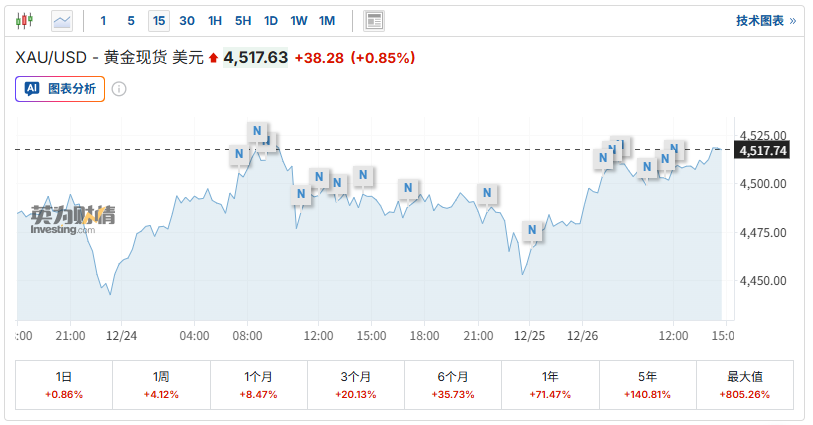
Core Viewpoint - Driven by speculative buying and tightening year-end market liquidity, alongside expectations of further interest rate cuts by the Federal Reserve and escalating geopolitical tensions, the prices of gold, silver, and platinum reached historic highs on Friday [1][5]. Group 1: Gold Market - As of the report, spot gold rose by 0.85% to $4,517.63 per ounce, previously hitting a record high of $4,531.24 per ounce; February futures for gold increased by 0.97% to $4,546.50 per ounce [1]. - The strong performance of gold this year is attributed to the Fed's shift to a loose monetary policy, geopolitical uncertainties, strong central bank gold purchases, increased ETF holdings, and ongoing de-dollarization, resulting in the largest annual gain since 1979 [5]. - Looking ahead to the first half of 2026, gold is projected to potentially reach $5,000 per ounce [5]. Group 2: Silver Market - Spot silver surged by 4.16% to $74.8705 per ounce, briefly surpassing the $75 mark [3]. - Silver has seen a remarkable increase of 158% this year, significantly outpacing gold's nearly 72% rise, driven by structural supply-demand gaps, its designation as a critical mineral in the U.S., and robust industrial demand [5]. Group 3: Platinum and Palladium Markets - Spot platinum rose over 8% to $2,451.25 per ounce, continuing to set historical highs; palladium increased by 5.55% to $1,822.70 per ounce, maintaining its upward trend from the previous trading day [6]. - Platinum's price has surged approximately 165% this year, while palladium has risen over 90%, influenced by supply tightness, tariff uncertainties, and a shift in some gold investment demand [8]. - The recent adjustment of the EU's internal combustion engine ban policy has bolstered platinum's demand outlook, as it is a key material for related technologies [8].


李鑫恒:黄金再破历史新高 今日行情趋势分析!
Xin Lang Cai Jing· 2025-12-26 08:40
12月26日,现货黄金价格在圣诞假期前夕的最后一个活跃交易日(12月24日)中收报于约4479美元/盎 司,此前曾在日内触及4525美元的历史新高。今天周五(北京时间12月26日)亚市早盘金价开盘暴涨, 直接创下4531美元的历史纪录,不断的刷新历史新高,随后出现小幅度回落,目前交投于4500整数关口 附近。 周四恰逢圣诞假期,美国股债汇、贵金属市场,欧洲多数股市及港股同步休市。回顾历史行情规律,圣 诞假期结束后资金回流、市场情绪逐步修复,短期大概率维持区间震荡博弈格局,后续若区间突破,趋 势性资金或将跟风入场,推动行情走出明确方向。 基本消息面: 地缘政治风险的持续发酵为黄金的避险需求提供了强劲助力。中东地区,以色列计划向特朗普通报对伊 朗发动新一轮打击,美伊谈判陷入僵局,地区冲突风险持续升温;俄乌冲突方面,尽管美乌提及磋 商"有建设性",泽连斯基提议举行三方会谈,但欧盟正式批准2026-27年向乌克兰提供900亿欧元无息贷 款,将援乌长期化、制度化,意味着冲突大概率将拖入持久消耗战。此外,美国与委内瑞拉因石油制裁 问题关系升级,进一步加剧了全球地缘政治的不确定性。 多家国际金融机构对未来金价走势持乐观预期 ...

机构看金市:12月26日
Xin Hua Cai Jing· 2025-12-26 08:27
金瑞期货表示,此前公布的非农以及CPI数据偏弱,市场降息预期小幅回升,叠加议息会议偏鸽,使得 金银获得一定支撑。白银继续受到工业和金融双重属性影响,在供需缺口和现货偏紧的驱动下强势上 涨;铂钯则在外盘休市和国内市场情绪和资金带动下走出独立行情。而中长期来说,宏观上包括主权国 家赤字问题、地缘风险以及去美元化驱动的央行购金等因素并未改变,金银价格的长期核心驱动因素仍 保持稳健。 新湖期货表示,市场投资热情高涨,叠加国内库存在10月底接近干涸,虽然本月以来有所回升,但仍处 于较低水平,使得国内沪银溢价大幅飙升,创下历史新高。国际方面,全球白银ETF持续流入,全球最 大的白银ETF——SLV(美国)22日单日流入533吨,是历史上第四大单日流入量。同时COMEX白银通 知交割单量持续增加,目前仍未看到交割压力缓解迹象。预计白银在12月底交割前可能仍有一定上涨空 间,但追高风险较大,建议投资者谨慎考虑。中长期来看,央行购金具有持续性,叠加全球货币的泛滥 和去美元化趋势不可逆甚至加速,将继续支撑贵金属中枢上行,后续贵金属可能仍偏强。 金瑞期货:宏观与低库存共振,银价保持强势 新湖期货:白银在12月底交割前可能仍有一定上 ...
共筑负责任黄金生态:ESG,正在重塑黄金行业的底层逻辑
Xin Lang Cai Jing· 2025-12-26 08:12
登录新浪财经APP 搜索【信披】查看更多考评等级 热点栏目 自选股 数据中心 行情中心 资金流向 模拟交易 客户端 12月12日,"2025黄金行业可持续发展大会"在三亚举行。大会下半场围绕"共筑负责任黄金生态",从政 策趋势、行业战略、企业实践及投资视角等多个维度,系统探讨了黄金行业在ESG框架下的转型方向与 实现路径。 一、ESG不只是责任,而是连接资本市场的"价值语言" 在主题发言中,中央财经大学绿色金融国际研究院首席经济学家刘锋指出,全球ESG浪潮与"双碳"目标 已成为黄金行业转型升级的核心驱动力。 从行业背景来看,黄金并非单一商品,而是同时具备商品、工业与货币属性的战略性资源。近年来,随 着全球不确定性上升,黄金的投资需求显著增长,ETF等金融产品规模持续扩大。在这一过程中,资本 市场对黄金企业的关注点也发生了变化: · 不再只看产量和成本 · 开始关注长期治理能力与可持续表现 · ESG逐步成为影响估值的重要因素 在去美元化趋势、绿色转型与智能化升级并行的背景下,黄金行业正面临国际监管趋严、标准多元化的 现实挑战,但也迎来了通过绿色矿山、智能冶金和金融创新实现结构性升级的窗口期。 刘锋强调,行业需 ...


从黄金的四大属性来理解涨跌逻辑 | 轻分享
高毅资产管理· 2025-12-26 07:30
Core Viewpoint - The article discusses the complexities of gold price fluctuations and emphasizes understanding its four core attributes: commodity, monetary, financial, and hedging properties, to clarify the underlying logic of its price movements [3][4]. Group 1: Gold's Four Core Attributes - **Commodity Property**: Gold prices are primarily determined by supply and demand dynamics, with demand influenced by economic cycles and market expectations. The main contributors to gold demand are jewelry, investment, and central bank purchases, while industrial demand is relatively low [5]. - **Monetary Property**: Gold is considered "hard currency" due to its scarcity, durability, and universal acceptance, serving as an effective store of value. Its price is closely linked to the US dollar index, typically decreasing when the dollar strengthens and increasing when the dollar weakens [6][9]. - **Financial Property**: Gold's investment value is shaped by real interest rates, expected inflation rates, and market liquidity. Lower real interest rates increase gold's attractiveness as a non-yielding asset, especially during periods of low interest rates or rate cuts by central banks [14][15]. - **Hedging Property**: Gold performs well in risk scenarios where market pessimism rises, making it a preferred asset over riskier investments. Historical events show that gold prices tend to rise during crises, highlighting its unique characteristics as a safe-haven asset [17][18]. Group 2: Historical Review of Gold Price Movements - Historical analysis indicates that significant price movements in gold are closely related to Federal Reserve policies, inflation changes, and central bank behaviors. Major price increases are driven by structural trends like de-dollarization and central bank diversification, alongside cyclical factors such as inflation and risk aversion [21][22]. - Price declines are often triggered by tightening monetary policies, rapid inflation declines, or central bank sell-offs. For instance, the period from 1983 to 1985 saw a drop of over 40% due to US economic recovery and interest rate hikes [23][24]. - The article highlights that current global challenges, including debt expansion and economic slowdown, have accentuated gold's monetary and hedging properties, leading to recent price surges. Notably, Ray Dalio views gold as a hedge against unsustainable debt levels, suggesting a reasonable allocation of 10% to 15% in investment portfolios [25].
新世纪期货:美联储降息预期升温 金价稳涨逻辑延续
Jin Tou Wang· 2025-12-26 07:05
Macro Messages - The U.S. debt issue has led to cracks in the dollar's monetary credibility, highlighting gold's de-dollarization attributes amid the ongoing process of de-dollarization [1] - In a global high-interest rate environment, gold's role as a zero-yield asset has diminished, reducing its sensitivity to the actual interest rates of U.S. Treasury bonds [1] - Persistent geopolitical risks continue to drive market demand for safe-haven assets, significantly contributing to the short-term rise in gold prices [1] - There has been a notable increase in physical gold demand in China, with the central bank resuming gold purchases since November last year, marking eleven consecutive months of increases [1] Institutional Views - The logic driving the current rise in gold prices remains intact, with the Federal Reserve's interest rate policy and risk aversion likely to be short-term disruptive factors [1] - The Federal Reserve needs to balance employment and inflation indicators, focusing more on job stability; it began a rate-cutting cycle in September, having cut rates three times this year [1] - Recent U.S. data shows mixed signals: November non-farm employment exceeded expectations, while the unemployment rate unexpectedly rose to 4.6% [1] - The September PCE data indicates a decline in inflation, with core PCE year-on-year rising by 2.8%, below market expectations, while November CPI year-on-year increased by 2.7%, lower than expected and down from 3% in September [1] - In the short term, recent U.S. data has strengthened market expectations for rate cuts, with predictions of two rate cuts next year; the Fed's rate-cutting cycle and leadership transition are bullish for gold prices, supported by global central bank gold purchases and geopolitical conflicts [1]
金银铂钯齐创新高!年末流动性、降息周期与地缘风险合力 贵金属市场上演历史性行情
Zhi Tong Cai Jing· 2025-12-26 07:03
Core Viewpoint - The prices of gold, silver, and platinum have reached historical highs due to speculative buying, tightening market liquidity at year-end, expectations of further interest rate cuts by the Federal Reserve, and escalating geopolitical tensions [1][3]. Group 1: Precious Metals Price Movements - As of the latest report, spot gold increased by 0.85% to $4,517.63 per ounce, previously hitting a record high of $4,531.24 per ounce; February futures for gold rose by 0.97% to $4,546.50 per ounce [1]. - Spot silver surged by 4.16% to $74.8705 per ounce, briefly surpassing the $75 mark [4]. - Platinum prices rose over 8% to $2,451.25 per ounce, marking a new historical high, while palladium increased by 5.55% to $1,822.70 per ounce [5]. Group 2: Market Drivers and Future Outlook - The strong performance of gold this year is attributed to the Federal Reserve's shift to a loose monetary policy, geopolitical uncertainties, robust central bank gold purchases, increased ETF holdings, and ongoing de-dollarization, resulting in the largest annual gain since 1979 [5]. - Silver has seen a remarkable increase of 158% this year, significantly outpacing gold's nearly 72% rise, driven by structural supply-demand gaps, its designation as a critical mineral in the U.S., and strong industrial demand [5]. - Looking ahead to the first half of 2026, gold is projected to potentially reach $5,000 per ounce, while silver could approach $90 per ounce [3]. Group 3: Supply and Demand Dynamics - Platinum and palladium prices have surged due to supply tightness, tariff uncertainties, and a shift in some gold investment demand; platinum has risen approximately 165% this year, while palladium has increased over 90% [7]. - The EU's recent adjustment to its 2035 internal combustion engine ban policy, relaxing CO2 emission reduction targets, has bolstered the demand outlook for platinum, a key material in related technologies [7]. - Strong industrial demand is supporting platinum prices, with U.S. inventory holders replenishing stocks due to concerns over sanction-related risks, helping to maintain high price levels [7].
知名经济学家吉姆·瑞卡兹:明年底金价或涨至1万美元!上海金ETF(159830)盘中市价逼近前高
2 1 Shi Ji Jing Ji Bao Dao· 2025-12-26 07:00
Group 1 - The precious metals market continues its strong upward trend, with spot silver breaking through $75 per ounce and spot gold surpassing $4530 per ounce, both reaching historical highs [1] - The Shanghai Gold ETF (159830) maintains its upward momentum, with trading volume exceeding 50 million yuan and a net inflow of approximately 24 million yuan yesterday [1] - Jim Rickards, a well-known economist and financial analyst, predicts that gold could reach $10,000 per ounce and silver could hit $200 per ounce by the end of 2026, indicating a bullish outlook for the metals market [1] Group 2 - According to a recent report by Shenwan Hongyuan, the long-term outlook for gold remains positive due to persistent high U.S. fiscal deficits and the ongoing trend of de-dollarization, with expectations for price increases in 2026 [2] - The report highlights that changes in the U.S. interest rate cycle and increased trading dynamics may enhance gold's volatility, suggesting the need for tactical timing in investments [2]
“十五五”时期或将面临哪些国际挑战?陈文玲:全球货币体系调整、美股泡沫等七大风险需警惕
Jin Rong Jie· 2025-12-26 06:57
Group 1 - The conference "Qihang·2025 Financial Annual Meeting" was held in Beijing, focusing on the theme of "New Starting Point, New Momentum, New Journey," with over 100 guests and more than 500 financial institutions and listed companies in attendance [1] - Chen Wenling, Deputy Director of the Academic Committee of the China International Economic Exchange Center, discussed potential international uncertainties, including "gray rhinos" and "black swans," that may impact China's economy and the global economy during the 2026 and "15th Five-Year" period [1] Group 2 - Seven major international risks were highlighted by Chen Wenling, including risks from economic bubbles in certain countries, significant adjustments in the global monetary system, uncertainties in China-U.S. relations, geopolitical tensions, structural changes in the global energy landscape, risks in the Japanese economy, and risks from extreme weather and public health events [3] - Specific risks related to the global monetary system adjustment were discussed, including potential over-tightening or over-easing by the Federal Reserve, the rapid expansion of virtual currencies, the accumulation of bubbles in the U.S. stock market, and the potential risks from financial derivatives [3] - The global trend of de-dollarization is noted, with 159 countries entering this wave, and the U.S. introducing stablecoins linked to the dollar to counteract this trend, indicating significant adjustments and changes in the international monetary system [3]

黄金、白银价格再创历史新高
Xin Lang Cai Jing· 2025-12-26 05:11
Core Viewpoint - The surge in gold and silver prices is attributed to geopolitical risks and a shift in the global monetary system, leading to increased demand for gold as a safe-haven asset [1][2][4]. Group 1: Gold and Silver Price Movements - On December 26, spot gold prices surpassed $4500 per ounce, reaching a peak of $4531.284, marking a historical high [1][4]. - Spot silver also saw significant gains, breaking through $75 per ounce and increasing by over 4% during the trading session [1][4]. Group 2: Economic Insights and Trends - The acceleration of a multipolar international monetary system has eroded trust in the safety of dollar-denominated assets, prompting central banks to increase their gold holdings to hedge against geopolitical and monetary uncertainties [2][5]. - The long-term downtrend in dollar credit is expected to challenge the safety of traditional safe-haven assets like U.S. Treasuries, leading many central banks to exchange dollars and Treasuries for gold, which will support gold prices [2][5]. - Current market conditions suggest that the gold market is likely in the mid-phase of a bull market, with no reversal signals observed, supported by ongoing central bank purchases and geopolitical fragmentation [2][5]. Group 3: Future Price Projections - According to JPMorgan's 2026 outlook report, the long-term trend of diversifying into gold by official reserves and investors is expected to continue, with gold prices projected to reach $5000 per ounce by the end of 2026 [3][6].