关税冲击

Search documents
深度专题 | 美国经济:关税冲击的监测框架——关税“压力测试”系列之八
赵伟宏观探索· 2025-05-18 23:47
文 | 赵伟、陈达飞、王茂宇 联系人 | 王茂宇 摘要 截止到5月中旬,美国进口商品的平均关税税率已经降至16%左右,但仍处历史高位。目前已进入数据验 证期,如何观察美国的"抢进口"动能和"滞胀"压力?本文提出了一个监测框架。 热点思考: 美国经济:关税冲击的监测框架 一、关税冲击进入数据"验证期",如何监测其经济影响?三大维度:贸易、价格、风险偏好 关税冲突虽有缓和,但美国税率仍处历史高位。 5月12日以来,美国对华进口平均关税税率降至42%,总 体平均税率降至16%,但仍处于历史高位。耶鲁大学预算实验室的测算认为,该关税或使美国GDP下降 0.65个点,通胀上升1.7个点。所以,"滞胀"是基准假设。 关税对美国经济的传导,可从贸易(数量)、价格、风险偏好三个维度进行监测。 1)贸易方面,关税 冲击体现为美国进口先增后减(抢进口)、出口受抑,并影响国内需求;2)价格方面,关税将由进口价 格传导至生产和消费价格,抑制实际消费需求;3)风险偏好方面,关税推升政策不确定性,影响金融压 力、美元指数,进而降低居民消费意愿、企业投资意愿。 二、短期内,应该关注哪些核心经济指标?进口、库存和通胀压力 一季度,美国开始抢 ...

关税“压力测试”系列之八:美国经济:关税冲击的监测框架
Shenwan Hongyuan Securities· 2025-05-18 11:44
Group 1: Tariff Impact on the US Economy - As of mid-May, the average tariff rate on US imports has decreased to approximately 16%, yet remains at a historical high[15] - The average tariff on imports from China is now 42%, with the overall average tariff rate dropping from 27% to 16% following recent agreements[19] - The Yale Budget Lab estimates that these tariffs could reduce US GDP by 0.65 percentage points and increase inflation by 1.7 percentage points[23] Group 2: Monitoring Economic Indicators - The economic impact of tariffs can be monitored through three dimensions: trade, prices, and risk appetite[31] - In the short term, key economic indicators to watch include imports, inventory levels, and inflation pressures[2] - The first quarter saw a significant "import rush" in the US, with inventory levels rising, but the inventory-to-sales ratio remained stable[2] Group 3: Inflation and Consumer Behavior - The inflation effects of tariffs are becoming apparent, although the response of import prices has been insufficient so far[3] - Tariffs are expected to transmit increased costs from import prices to production and consumer prices, suppressing actual consumption demand[32] - There are signs that consumer purchasing power is weakening, with previous "panic buying" trends showing signs of exhaustion[3] Group 4: Economic Outlook - The US economy may follow a dynamic path from "stagflation" to "slowdown" or "recession," depending on how tariff conflicts evolve[3] - High-frequency indicators suggest that investment, consumption, and employment in the US may weaken in the near term[3] - The potential for a "recession panic" cannot be ruled out if inflationary pressures continue to rise while economic growth slows[3]
深度专题 | 美国经济:关税冲击的监测框架——关税“压力测试”系列之八
申万宏源宏观· 2025-05-18 11:26
Group 1 - The article discusses the monitoring framework for assessing the economic impact of tariff shocks in the U.S., focusing on trade, prices, and risk preferences [3][27] - As of mid-May, the average tariff rate on U.S. imports has decreased to around 16%, but it remains at a historical high, with potential GDP decline of 0.65% and inflation increase of 1.7% due to tariffs [4][13][10] - The article emphasizes that the current economic condition is characterized by "stagflation," which is the baseline assumption for the short term [18][19] Group 2 - In the short term, key economic indicators to monitor include imports, inventory levels, and inflation pressures, with a notable increase in imports and stable inventory turnover ratios [4][39] - The article highlights that the inflation effects of tariffs may be delayed but are expected to manifest, impacting consumer demand [4][58] - The U.S. economy is likely to follow a dynamic path from "stagflation" to "slowdown" or "recession," depending on how tariff conflicts evolve [5][105] Group 3 - The article notes that the U.S. has experienced a significant "import rush" in the first quarter, with a stable inventory-to-sales ratio, indicating robust domestic demand despite tariff impacts [4][39] - Tariffs have led to a shift in U.S. import patterns, with increased imports from countries with lower tariff rates, such as Canada and Mexico, while imports from China have decreased significantly [36][30] - The article suggests that certain U.S. export sectors, particularly oil, coal, and basic metals, may face significant challenges due to retaliatory tariffs [47][5] Group 4 - The inflation effects of tariffs are becoming evident, with U.S. retail prices starting to reflect the impact of tariffs on imported goods [58][61] - The article indicates that the inflationary pressures may suppress consumer spending, as observed in the correlation between inflation and consumer behavior [69][61] - The financial market's volatility and increased financial pressure could further suppress investment and consumer sentiment in the U.S. economy [75][88]
海外高频 | 中美日内瓦谈判实现关税互降,金价回落
申万宏源宏观· 2025-05-18 11:26
Group 1 - The article discusses the recent US-China trade negotiations in Geneva, resulting in mutual tariff reductions, with the US tariff on China decreasing to 42% and China's tariff on the US decreasing to 27% [2][26][31] - The US overall average tariff rate has dropped from 27% to 16%, although the new tariffs may still lead to a 0.65% decline in US GDP and a 1.7% increase in inflation [2][26] - The article highlights the performance of major stock indices, with the Nasdaq rising by 7.2% and the S&P 500 by 5.3% during the week [2][3] Group 2 - The article notes that the US CPI for April was 2.3%, slightly below the market expectation of 2.4%, indicating ongoing inflationary pressures influenced by tariffs [40] - Retail sales in the US for April showed a slight increase of 0.1%, which was better than the expected 0%, but excluding automobiles and gasoline, the retail performance was weaker than anticipated [44] - Initial jobless claims in the US were reported at 229,000, slightly above the market expectation of 228,000, suggesting potential upward pressure on the unemployment rate [46] Group 3 - The article mentions that the US 10-year Treasury yield rose by 6 basis points to 4.43%, while the yields in other developed countries showed mixed movements [12][14] - The dollar index increased by 0.6% to 100.98, with most other currencies depreciating against the dollar [17] - The article also highlights the performance of commodities, with WTI crude oil rising by 2.4% to $62.5 per barrel, while gold prices fell by 4.0% to $3191.8 per ounce [21][23]


关税冲击缓解下信心回归 全球IPO市场再度升温
智通财经网· 2025-05-15 13:32
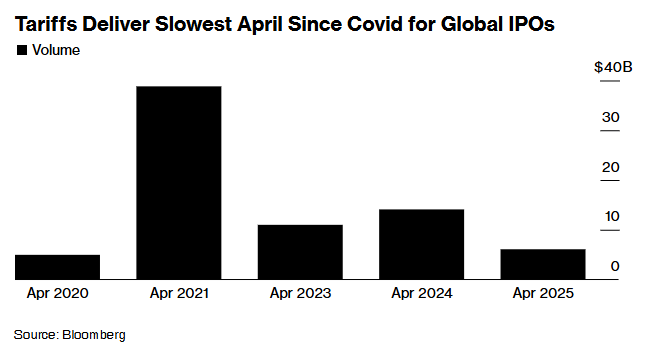
Group 1: IPO Market Recovery - The global IPO market is experiencing a resurgence as companies seek to complete transactions before summer and geopolitical tensions escalate again [1][5] - In April, the IPO financing amount reached its lowest level since the pandemic began in 2020 due to a series of suspended IPO projects following tariff announcements by former President Trump [1][5] - As tensions eased, the IPO market began to recover, with $43.6 billion raised in 2025 so far, slightly below the same period last year [1] Group 2: Notable IPOs and Companies - Chime Financial, valued at $25 billion in 2021, is expected to complete the largest IPO in the U.S. this year before the summer lull [2] - EToro Group, an Israeli trading and investment platform, successfully priced its IPO above the guidance range, with its stock soaring 29% on the first trading day [1][6] - Other companies like MNTN and Hinge Health have also initiated their IPO projects, indicating a broader recovery in the market [2][6] Group 3: Market Sentiment and Investor Behavior - Market sentiment has improved, with investors willing to participate in IPOs as long as companies can demonstrate resilience against tariffs and economic downturns [6][10] - The volatility index (VIX) dropped below 20 after the U.S. and China announced a 90-day pause on mutual tariffs, which is seen as a threshold for investment banks to proceed with IPOs [6] Group 4: Future Outlook and Trends - The upcoming summer holidays will compress the operational window for companies looking to go public, with many expected to push their IPOs to the fall [9] - The technology sector is anticipated to see increased IPO activity in the fall, with estimates of around 10 tech IPOs expected in the U.S. this year [9] - Despite some companies returning to the IPO queue, many remain cautious due to supply chain issues and inflation risks [10] Group 5: International IPO Activity - Chinese companies have successfully listed despite tariff uncertainties, with notable IPOs like the tea brand Bawang Chaji raising $473 million [10][11] - The Middle East continues to show strong IPO enthusiasm, with Flynas's $1.1 billion IPO fully subscribed shortly after launch [11] - The Indian market is also showing signs of recovery, with expectations for large stock issuances in the second half of the year [12]
韩元兑美元跌0.3%,报道称美韩举行一系列贸易会谈,但韩方拒绝评论是否讨论过汇率问题
news flash· 2025-05-15 10:14
Group 1 - The South Korean won has depreciated by 0.3% against the US dollar, currently trading at 1397.67 [1] - South Korea is engaging in a series of trade talks with US officials visiting Jeju Island for a regional summit, aimed at mitigating the impact of tariffs imposed by President Donald Trump [1] - Two top trade officials from South Korea met with US Trade Representative Jamison Greer during the APEC meeting on Thursday and Friday [1]
中国金融系列十三:4月关税冲击影响,待5月一揽子政策
Hua Tai Qi Huo· 2025-05-15 06:42
期货研究报告|宏观数据 2025-05-15 4 月关税冲击影响,待 5 月一揽子政策 ——中国金融系列十三 研究院 徐闻宇 xuwenyu@htfc.com 从业资格号:F0299877 投资咨询号:Z0011454 投资咨询业务资格: 证监许可【2011】1289 号 宏观事件 5 月 14 日,央行发布 2025 年 4 月金融统计数据。数据显示:2025 年 1-4 月社融规模增 量为 16.34 万亿(15.18 万亿 ),比去年同期多 3.61 万亿( 多 2.37 万亿 );4 月 M2 余额 325.17 万 亿(326.06 万亿 ),同比+8%(+7%);M1 余额 109.14 万亿(113.49 万亿 ),同比+1.5%(+1.6%)。4 月末人民币贷款余额同比+7.2%(+7.4%),存款余额同比+8%(+6.7%) *。 * 括号内为前值,数据来源:人民银行。 核心观点 ■ 4 月谨慎 负债端:M1/M2 剪刀差扩张。1)4 月 M1 改善低预期(3 月+1.6%;4 月+1.5%),2024 年防空转的低基数下扩张有限;M2 增速小幅回升(由+7.0%回升至+8.0%),表现为非 ...
关税冲击下 东莞的底气是什么?
Yang Shi Xin Wen· 2025-05-15 00:47
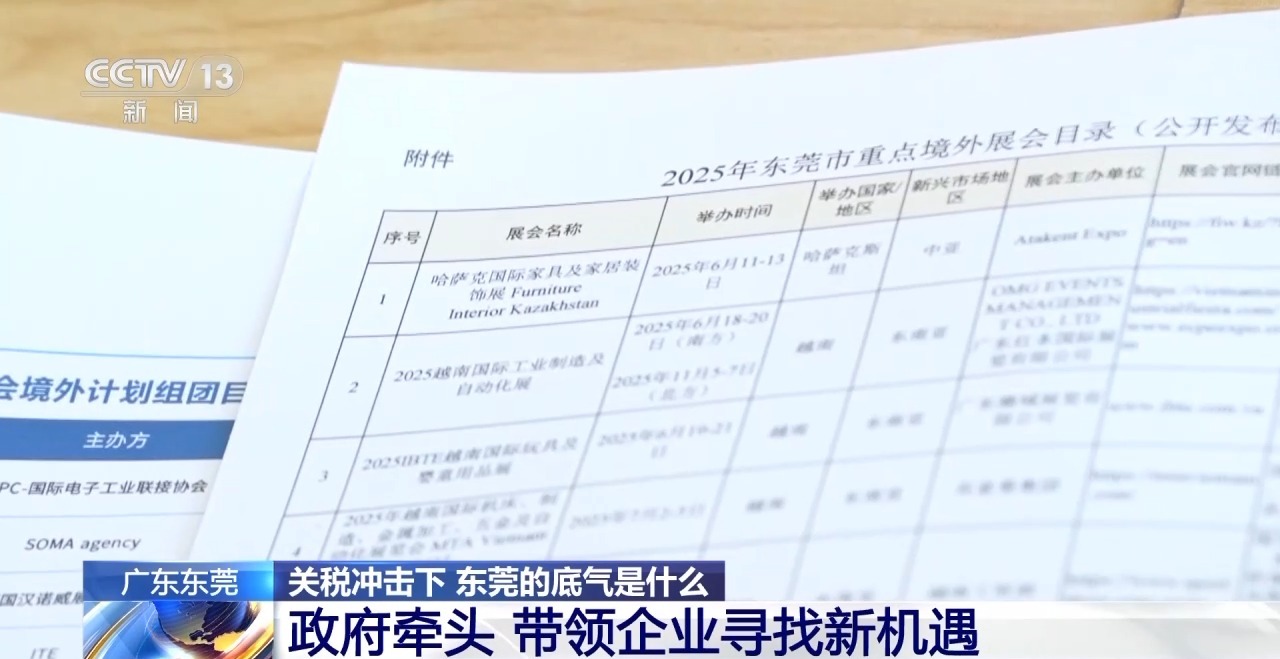
Group 1 - Dongguan is a city with a well-developed foreign trade industry, engaging in trade with over 200 countries and regions, which allows it to respond effectively to tariff impacts [1][19] - The Guangdong Provincial Department of Commerce has implemented policies to encourage companies to explore international markets, including subsidies for participation in overseas exhibitions [4][5] - Companies in Dongguan are leveraging their strong capabilities and product quality to navigate external pressures, with some reporting stable order volumes despite tariff increases [8][10] Group 2 - A company producing ultra-fine circuit board drilling needles has achieved a global sales share of nearly 30%, maintaining order volumes despite U.S. tariffs [8][10] - Another company specializing in smart cutting machines has developed technology that allows for precise cutting of leather materials, significantly reducing costs compared to traditional methods [12] - The complete and efficient industrial chain in Dongguan enhances product competitiveness, enabling rapid response to market demands and personalized services [19][21] Group 3 - Dongguan's furniture industry, with over 2,000 enterprises, demonstrates a high export ratio, with materials sourced locally to ensure quick production [19][21] - The local industrial ecosystem supports the customization of automated production lines, facilitating the transition from traditional manufacturing to intelligent manufacturing [21][23] - The collaboration between government support, technological innovation, and industrial chain synergy strengthens the resilience and vitality of Chinese manufacturing [23]
4月金融数据点评:社融增速仍在上行通道
Changjiang Securities· 2025-05-14 23:30
Economic Overview - As of the end of April, the year-on-year growth rate of social financing (社融) stock rebounded to 8.7%, while the credit growth rate under the social financing measure fell to 7.1%[3] - In April, new social financing amounted to 1.2 trillion RMB, with RMB loans increasing by 280 billion RMB[5] Government Support - Government bonds continue to support the year-on-year increase in social financing, with new government bonds issued in April totaling 980 billion RMB, a year-on-year increase of 1.07 trillion RMB[9] - The issuance of replacement bonds in April approached 260 billion RMB, indicating that corporate medium-to-long-term loans also experienced a year-on-year increase when considering this factor[5] Future Projections - Despite potential pressure on credit due to tariff impacts, social financing and credit growth are expected to fluctuate upwards, with a possibility of the annual peak returning to over 9%[3] - The upcoming months may see improved macroeconomic data, particularly if progress is made in US-China tariff negotiations[5] Monetary and Fiscal Policy Tools - The regulatory body has deployed the first round of monetary policy tools to stabilize growth, emphasizing the importance of maintaining economic stability amid international trade tensions[6] - A robust monetary and fiscal toolbox is available, including further reserve requirement ratio cuts, interest rate reductions, and accelerated issuance of government bonds[6] Risks - Economic recovery may not meet expectations, potentially leading to weaker credit growth and social financing stock growth[31] - Uncertainties remain regarding the final implementation of tariff policies between China and the US, which could impact domestic economic conditions[31]
【广发宏观钟林楠】如何理解4月信贷社融数据
郭磊宏观茶座· 2025-05-14 14:36
Core Viewpoint - The article discusses the financial data for April, highlighting a significant increase in social financing and various trends in credit and government bond financing, indicating a response to external shocks and a potential shift in monetary policy [1][6][14]. Summary by Sections Social Financing - In April, social financing increased by 1.16 trillion yuan, which is approximately 1.2 trillion yuan more year-on-year, aligning with market expectations [1][7]. - The stock growth rate of social financing was 8.7%, up by 0.3 percentage points from the previous month [1][7]. Credit and Financing Trends - New entity credit was 844 billion yuan, showing a year-on-year decrease of 2.505 trillion yuan, which was below market expectations [8][9]. - The decline in credit is attributed to three factors: cautious sentiment due to tariff impacts, delayed financial policy implementation, and high repayment volumes from previous short-term financing [8][9]. Structure of Loans - Short-term and medium-to-long-term loans for enterprises both saw a decrease, while bill financing remained high due to its lower risk profile [2][9]. - In the household sector, medium-to-long-term loans decreased by 123.1 billion yuan, while short-term loans dropped by 401.9 billion yuan, marking the lowest level since 2007 [2][9]. Government and Corporate Bond Financing - Government bond financing increased by 976.2 billion yuan, reflecting a significant year-on-year increase of 1.0699 trillion yuan, indicating accelerated fiscal implementation [10][11]. - Corporate bond financing rose by 234 billion yuan, with city investment bonds showing some improvement, although overall levels remain low [10][11]. Monetary Aggregates - M1 grew by 1.5% year-on-year, slightly lower than expected, with a notable decrease in the deposits of government and institutional entities [12][13]. - M2 increased by 8% year-on-year, with a significant contribution from interbank assets, driven by a relatively loose monetary policy environment [5][14]. Evaluation of April Financial Data - The financial data for April reflects a notable change compared to the previous year, indicating a trend towards "moderate easing" [6][14]. - The data is seen as a temporary response to external shocks, with expectations for improved credit and financing data in May following new policy measures [6][14].