哑铃策略

Search documents
构建资产配置稳健基石基金经理探讨红利资产长期逻辑
Shang Hai Zheng Quan Bao· 2025-09-21 15:28
Core Viewpoint - Dividend assets have become a stable mainstay in the equity market since 2022, providing steady cash flow and reasonable valuations, and are expected to maintain long-term allocation value despite a shift towards growth styles by 2025 [3][4]. Group 1: Changes in Dividend Asset Allocation Value - The allocation value of dividend stocks has not weakened but rather complements growth sectors due to a diverse market style and active structural opportunities [4]. - Dividend assets provide a stable foundation for investment portfolios, optimizing risk-return structures and enhancing long-term compounding returns [4][5]. Group 2: Long-term Performance and Demand for Dividend Assets - The demand for dividend assets is expected to rise as companies increase their dividend payout ratios following a peak in capital expenditures, supported by ample liquidity in the market [5]. - The market is transitioning to a "dividend+" era, where dividend assets will show significant differentiation based on specific industry and company conditions [5][6]. Group 3: Strategies for Achieving Flexibility and Excess Returns - A balanced approach combining "core-satellite" strategies with cash-rich, stable-profit assets is recommended to adapt to market rotations [6]. - Value investment should not be narrowly defined; it should include identifying quality businesses at reasonable or low prices while adapting to market and fundamental changes [6][7]. Group 4: Value Investment in a Rotating Market - A deep value investment philosophy should guide the entire investment process, distinguishing between "value" and "price" based on ROE, cash flow, and governance [7][9]. - A diversified and balanced portfolio strategy is essential to manage high market volatility and avoid excessive risk exposure to individual stocks or sectors [7][8]. Group 5: Identifying Truly Undervalued Stocks - The selection of stocks should consider both willingness and ability to distribute dividends, focusing on governance and free cash flow [9][10]. - Long-term competitive strength and cash generation capabilities are critical in distinguishing between genuinely undervalued stocks and those that merely appear cheap [10]. Group 6: Investment Opportunities in the Current Market - Future investment opportunities in cyclical dividend assets are anticipated, particularly in sectors like coal, engineering machinery, and consumer goods, as they recover from low profitability [11]. - The focus should also be on stable cash flow sectors such as utilities, highways, and essential consumption, alongside opportunities driven by new policies and external demand [11][12]. Group 7: Evaluating the "Dumbbell Strategy" of Small and Dividend Stocks - The combination of stable dividend assets and small-cap stocks can reduce portfolio volatility while providing both defensive and offensive characteristics [12][13]. - The economic recovery may impact dividend assets and small-cap stocks differently, necessitating a focus on dividend stability and cash flow resilience in the former, while emphasizing profitability and governance in the latter [13].


跟跌不跟涨,“我在红利基金里躲行情”!红利策略还有效吗?
Zhong Guo Zheng Quan Bao· 2025-09-21 09:33
Core Viewpoint - The recent adjustment in the banking sector has led to challenges for dividend-themed funds, while the technology growth sector remains strong, prompting discussions among investors about the effectiveness of dividend strategies [2][3]. Group 1: Market Performance - The banking sector has experienced a significant downturn, with the Shenwan Banking Index dropping 4.21% this week, marking the largest decline among 31 Shenwan first-level industry indices [2]. - Approximately 90% of equity dividend funds reported negative returns this week, and around 70% have negative returns over the past month [2]. Group 2: Dividend Strategy Effectiveness - Despite the market shift towards technology growth, Huaxia Fund believes that the dividend strategy is not ineffective but rather experiencing a temporary style switch, emphasizing the long-term stability and low volatility of high-dividend assets [3]. - Haitong Securities indicates that dividend assets and technology growth sectors exhibit a rotation effect, suggesting that dividend assets are not merely a short-term safe haven but also a long-term choice for stable investment [3]. Group 3: Investment Strategies - The "barbell strategy" is recommended, which involves incorporating dividend assets into the core portfolio while complementing them with high-growth assets to create a more resilient investment mix [4]. - There is a suggestion to focus on Hong Kong dividend-themed funds, which are seen as deep value plays, with the potential for stable performance despite recent pullbacks [4]. - Industry experts recommend upgrading dividend indices by considering products focused on free cash flow and dividend quality indices [5].
美联储降息箭在弦上,关注港股科技板块
Sou Hu Cai Jing· 2025-09-17 03:01
Core Viewpoint - The Federal Reserve is expected to lower interest rates by 25 basis points with a probability of 96.1%, which could benefit growth sectors and interest-sensitive industries, particularly in the Hong Kong stock market [1]. Group 1: Market Reactions to Interest Rate Changes - Historical data shows that during preventive rate cuts, growth sectors and interest-sensitive industries benefit significantly, with Hong Kong stocks exhibiting greater elasticity [1]. - The Hong Kong internet technology sector, transitioning from a focus on delivery services to AI narratives, is likely to continue benefiting from these rate cuts [1]. Group 2: Currency and Market Performance - The appreciation of the Renminbi typically correlates with overall market gains, with Hong Kong stocks showing greater responsiveness due to improved economic expectations [1]. - Market sentiment, foreign capital flows, and corporate fundamentals are influenced by currency fluctuations, making growth styles in Hong Kong stocks more favorable during appreciation periods [1]. Group 3: Investment Strategies - For ordinary investors, direct stock investment may be challenging; thus, utilizing related ETFs is recommended for exposure [1]. - The Hong Kong Stock Connect Technology ETF (159101) closely tracks the CSI Hong Kong Stock Connect Technology Index, selecting 30 high-market-cap and high-R&D technology leaders, with the top ten stocks accounting for 77% of the weight [1]. - The ETF covers major players like Tencent and Alibaba, as well as emerging forces like Li Auto and BeiGene, spanning popular sectors such as software, hardware, new consumption, innovative pharmaceuticals, and new energy vehicles [1]. Group 4: Flexible Investment Strategies - Investors can adopt flexible allocation strategies based on their needs, such as using the ETF as a core holding for growth assets combined with low-volatility dividend stocks to create a "barbell strategy" [2]. - Trend investors can leverage the high elasticity of the technology sector to capture market phases [2]. - Dollar-cost averaging investors can gradually build positions in low-valuation ranges to smooth risks and enhance investment experiences [2].
鹏华基金邓明明:把握债市调整布局机会,坚持红利与科技双主线
Zhong Guo Jing Ji Wang· 2025-09-17 02:13
Core Insights - The importance of multi-asset allocation is increasing in the context of low interest rates and "asset scarcity," leading to the continued market acceptance of the "fixed income +" strategy, which allows for flexible allocation across various asset classes [1] - The current bond market is viewed as undergoing an adjustment rather than a reversal, with a neutral outlook for September and potential for a second buying opportunity within the year [1][5] - The equity market is expected to present more opportunities than risks moving forward, particularly favoring large-cap dividend stocks and small-cap technology sectors [1][6] Multi-Asset Strategy - The "fixed income +" products managed by the company include two funds: Penghua Fengze and Penghua Jinxiang, focusing on low volatility and balanced management [2] - Emphasis is placed on risk control, with strategies developed for both bonds and stocks, including duration and spread strategies for bonds, and dividend and technology styles for stocks [4] Performance Metrics - Penghua Fengze has maintained a maximum drawdown of 0.49% in 2023, with consistent annual positive growth from 2021 to 2024, showing net value growth rates of 4.90%, 1.29%, 4.68%, and 3.53% respectively [3] Market Outlook - The bond market is characterized by a slowdown in new fund inflows due to low absolute yields, but lacks the fundamentals for a bear market, indicating a potential for a second buying opportunity later in the year [5] - The equity market is currently in a high-level consolidation phase, with a preference for a "dividend + technology" strategy, which has been dynamically adjusted based on market conditions [5][6]
利率 - 市场关注的4个问题
2025-09-15 14:57
Summary of Conference Call Notes Industry Overview - The focus is on the bond market and macroeconomic conditions in China, particularly in relation to interest rates and economic growth forecasts [1][2][3][4][5][6]. Key Points and Arguments 1. **Economic Data Predictions**: August economic data is expected to weaken due to factors like anti-involution policies, but a rebound may occur in September due to seasonal end-of-quarter effects. If the current pace of industrial value-added growth is maintained, it could exceed 6% for the year, with GDP growth projected above 5% [1][4][5]. 2. **Bond Market Performance**: The bond market is currently underperforming, influenced by seasonal institutional behaviors and regulatory pressures. However, there may be opportunities in the fourth quarter [6]. 3. **Impact of New Lending Regulations**: New regulations on centralized lending are expected to have limited short-term negative effects but aim to improve market mechanisms in the long term, benefiting short-selling activities [7]. 4. **Conditions for Resuming Government Bond Trading**: The resumption of government bond trading is contingent on factors such as Sino-US relations, economic fundamentals, fiscal expansion, and financial risks. There is a high necessity for this to occur within the year [8][9]. 5. **Market Impact of Resuming Bond Trading**: Resuming government bond trading is seen as a positive development for the market, increasing demand for bonds, providing medium to long-term liquidity, and reducing costs for financial institutions, which helps stabilize market expectations [10]. 6. **Social Financing Data**: Recent social financing data shows a decline in growth for August, raising concerns about whether this trend will continue and if local government debt funds will be disbursed early in the fourth quarter [11]. 7. **Trends in Deposits**: There is a notable decrease in resident deposits below seasonal norms, while non-bank deposits have surged, primarily due to the expansion of wealth management products leading to financial disintermediation. This trend should not be simplistically interpreted as funds moving into the stock market [12][13]. Additional Important Insights - **Investment Strategy Recommendation**: In the current high-interest rate environment, a barbell strategy is recommended for investment portfolios, focusing on medium to high-grade credit bonds for the short term and long-term government bonds for flexibility [2][14]. Specific recommendations include 25T6 for three-year government bonds and 250,215 for ten-year bonds from the China Development Bank [2][14].
全球流动性宽松在即,借道恒生科技ETF把握港股修复机遇
Sou Hu Cai Jing· 2025-09-15 09:52
Core Viewpoint - The recent U.S. CPI data aligns with market expectations, reinforcing the anticipation of interest rate cuts by the Federal Reserve, which is expected to benefit emerging markets like Hong Kong stocks [1] Group 1: Market Reactions - Following the CPI data release, the U.S. dollar weakened, and U.S. Treasury yields declined significantly, with a 90% expectation for a 75 basis point rate cut by the end of the year and calls for a 50 basis point cut in September [1] - The liquidity easing trend is approaching, indicating a potential influx of capital into markets, particularly benefiting Hong Kong stocks [1] Group 2: Hong Kong Stock Market Dynamics - Despite a bullish sentiment in A-shares, Hong Kong stocks are still hovering around the 25,000-point mark, leading to skepticism among investors regarding future market performance [4] - Year-to-date, the Hang Seng Tech Index has been a leading indicator, with a strong start in Q1 driven by AI narratives, while A-shares only began to catch up in Q3 due to liquidity support [4] Group 3: Challenges and Opportunities - Current constraints on Hong Kong stocks include lower EPS growth expectations for 2025 at -2.7% compared to 6.9% for the CSI 300, high Hibor rates limiting foreign capital inflow, and a narrowing valuation advantage with the AH premium dropping to 122% [7] - A potential shift could occur with the onset of interest rate cuts, leading to a rapid decline in Hong Kong dollar interest rates and increased foreign capital inflow [7] Group 4: Sector Analysis - The technology sector in Hong Kong shows positive signals despite a downward adjustment in 2025 earnings expectations due to increased e-commerce investments, with large-cap company valuations rising by 41% [8] - The current P/E ratio for the tech sector is approximately 16 times, lower than the U.S. market's 24 times, with a projected compound growth rate of 11% from 2024 to 2026 [8] Group 5: Investment Strategy - Investors are advised to adopt a "barbell strategy," balancing aggressive assets in A-shares with defensive positions in Hong Kong stocks benefiting from interest rate cuts and earnings recovery [8] - The E Fund Hang Seng Tech ETF is highlighted as a product positioned for performance recovery and liquidity improvement, covering key sectors such as internet platforms, semiconductors, and innovative pharmaceuticals [8]
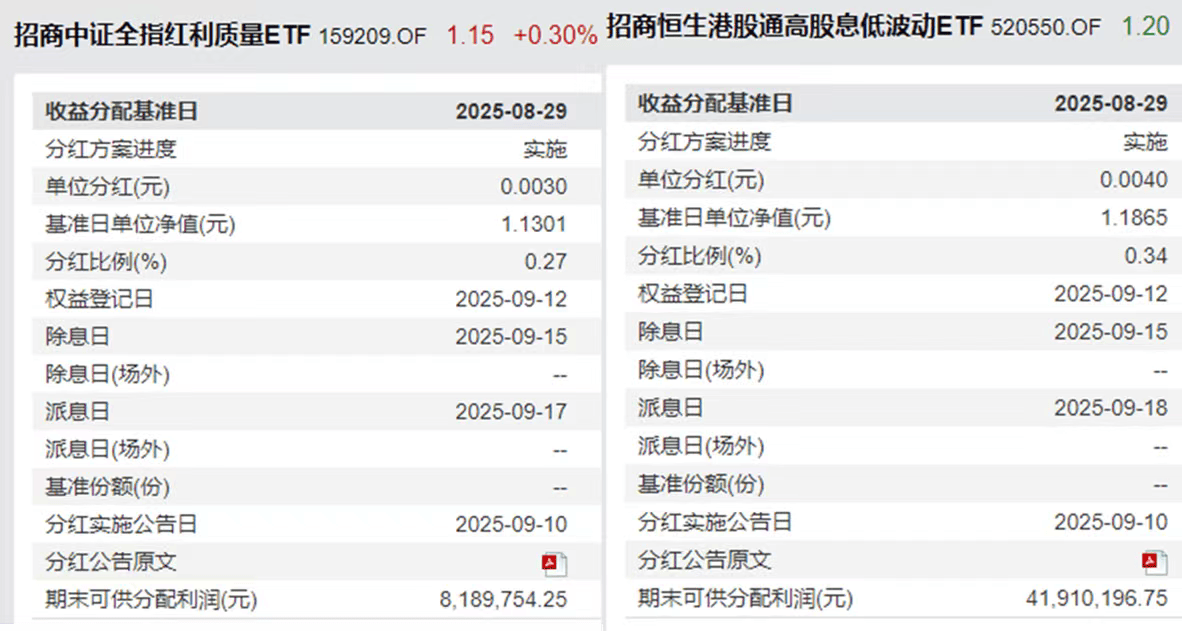
月月分红机制启动!中证红利质量ETF(159209)、港股红利低波ETF(520550)今日分红除息
Sou Hu Cai Jing· 2025-09-15 02:45
Core Viewpoint - The news highlights the dividend distribution plans for two ETFs, indicating their respective strategies and market positioning, which cater to different investor preferences. Group 1: Dividend Distribution Details - The China Securities Dividend Quality ETF (159209) will distribute a cash dividend of 0.0030 yuan per fund share, marking its third dividend distribution of the year [1] - The Hong Kong Stock Dividend Low Volatility ETF (520550) will distribute a cash dividend of 0.0040 yuan per fund share, representing its fifth dividend distribution of the year, with both ETFs achieving a dividend ratio of 0.3% [1] - The profit available for distribution at the end of the period for the China Securities Dividend Quality ETF is 8,189,754.25 yuan [1] Group 2: Product Strategy and Market Positioning - The 159209 ETF employs a "high dividend + high profitability quality" strategy, focusing on quality companies in growth sectors such as consumer and pharmaceuticals, balancing defensive and growth potential [2] - The 520550 ETF tracks the Hong Kong high dividend low volatility index, concentrating on defensive sectors like finance and public utilities, with the current index dividend yield exceeding 6%, highlighting its deep value and anti-volatility attributes [2] - Market perspectives suggest that these two products represent the two main directions of dividend strategies, providing differentiated tools for investors [2] - The associated linked funds (Class A 024029/Class C 024030) are now open for subscription and redemption, facilitating off-market allocation [2] - Investors are advised to choose based on their risk preferences: aggressive investors may focus on the China Securities Dividend Quality ETF, while conservative investors may prefer the Hong Kong Stock Dividend Low Volatility ETF; a "barbell strategy" can also be employed for dynamic balancing of value and growth exposure [2]
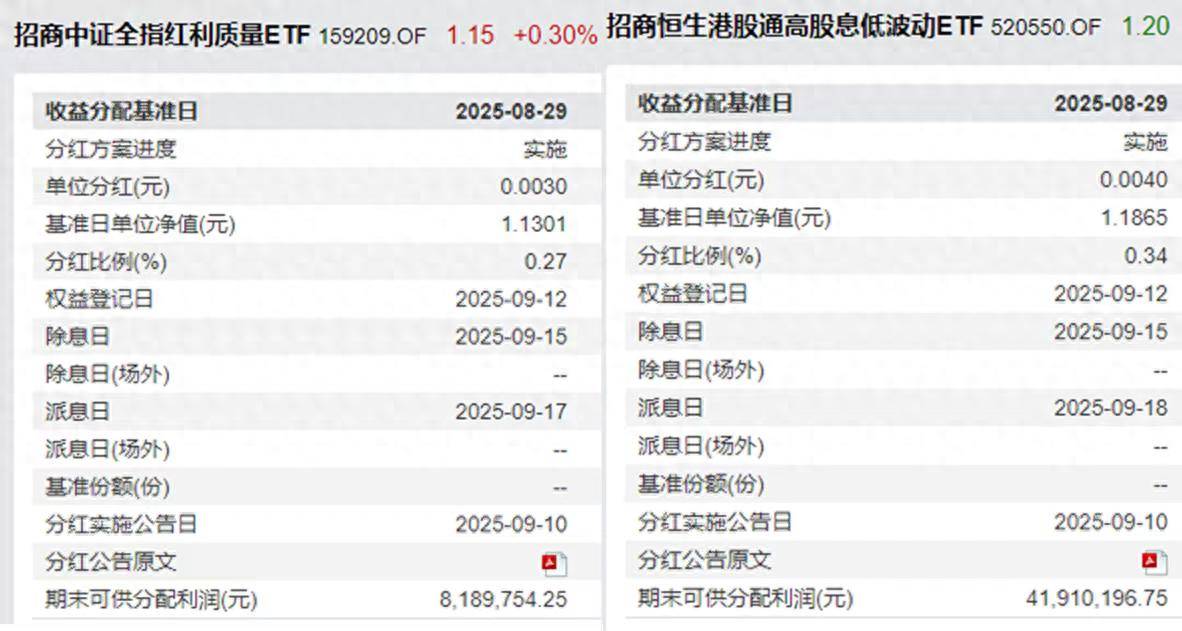
今日分红除息!月月评估分红的中证红利质量ETF(159209)、港股红利低波ETF(520550)同步分红进行时
Sou Hu Cai Jing· 2025-09-15 02:16
Group 1 - The core viewpoint of the news highlights the implementation of a dividend distribution plan, with a unit dividend of 0.0030 yuan and a dividend ratio of 0.27% based on a net asset value of 1.1301 yuan as of the distribution benchmark date of August 29, 2025 [1] - The announcement of the dividend implementation is set for September 10, 2025, with the record date for rights being September 12, 2025, and the payment date on September 17, 2025 [1] - The total distributable profit at the end of the period is reported to be 8,189,754.25 yuan [1] Group 2 - Market analysis indicates that the current dividend distribution coincides with the growing recognition of the investment value of dividend assets [2] - The two products represent mainstream dividend strategy directions: the CSI Dividend Quality ETF focuses on "high dividend + high profitability quality," particularly in consumer and pharmaceutical sectors, with a historical dividend yield of 3%-5% and robust ROE levels [2] - The Hong Kong Dividend Low Volatility ETF follows a "deep value" strategy, tracking the Hang Seng High Dividend Low Volatility Index, with a current dividend yield exceeding 6%, benefiting from undervaluation in the Hong Kong market and supportive state-owned enterprise dividend policies [2] - Investors are advised to dynamically capture investment opportunities in dividend assets based on their risk preferences, with aggressive investors focusing on the CSI Dividend Quality ETF and conservative investors leaning towards the Hong Kong Dividend Low Volatility ETF [2] - A "barbell strategy" is suggested for portfolio construction, allowing for a balanced allocation between the two product types with periodic rebalancing to achieve a more stable risk-return profile [2]
一线投资人热议AI:三大赛道仍处风口,不完美创业者受青睐
Zheng Quan Shi Bao Wang· 2025-09-14 04:38
Core Insights - The AI industry is at a pivotal moment, transitioning from large models to multimodal systems, agents, and embodied intelligence, indicating a convergence of technological singularity and commercial explosion [1] Investment Trends - Three key investment areas are currently favored: computing power, agents, and "AI + industry" applications [2] - Ant Group has focused on computing power companies, emphasizing the need to address token consumption and energy support for future personalized agents [2] - Ming Shih Venture has invested in several fast-growing agent companies, highlighting that even the best agents currently score only 30-40 out of 100, suggesting a significant market for those achieving 50-60 [2] - Jingwei Venture is particularly interested in the integration of AI with various industries, including consumer electronics and robotics [2] Smart Agent Landscape - The smart agent sector is divided into general and vertical agents, with the former having higher potential but also greater risks [3] - Ant Group primarily invests in vertical agents, focusing on large market space and strong willingness to pay [3] - Investors are advised to avoid competing directly with large model capabilities to mitigate risks from technological upgrades [3] - A "dumbbell strategy" is suggested, investing in both high-risk general directions and stable To B applications [3] Chinese AI Development - China is leading in AI applications, particularly in the deployment of smart agents, due to its extensive experience in internet and mobile internet sectors [4] - The current generation of entrepreneurs is younger and more technically adept, with a higher barrier to entry compared to previous generations [4] Entrepreneurial Characteristics - Investors favor entrepreneurs with unique insights into technology and strong commercial acumen [5] - The ideal entrepreneur is seen as passionate yet imperfect, capable of creating great products despite potential irrationality [5] - Experience in AI should not exceed three years, as the field has evolved significantly [5] Future Outlook - There is a strong belief that the next generation of super intelligent agents will predominantly emerge from Chinese entrepreneurial teams [6]

从All in 大赚,到麻木装死!一轮牛熊的毒打,让我明白了慢就是快!
雪球· 2025-09-12 13:00
Core Viewpoint - The article narrates the investment journey of a 90s female investor who transitioned from speculative trading in a bull market to a disciplined asset allocation strategy, emphasizing the importance of systematic investment approaches for wealth growth [1][2]. Investment Journey - The investor began her financial journey in 2016 during a bear market, influenced by simplified investment strategies like "asset allocation" and "regular investment" [3]. - Her initial experiences included significant gains in the booming renewable energy sector, followed by a painful loss of 100,000 yuan, which prompted a shift towards a more structured investment approach [4][5]. Investment Philosophy - The investor's philosophy evolved to prioritize risk management and long-term stability over short-term gains, leading to the adoption of a diversified asset allocation strategy [5][6]. - The "Permanent Portfolio" strategy, which balances four asset classes to mitigate risks across different economic cycles, became a cornerstone of her investment approach [5][6]. Asset Allocation Strategy - The current asset allocation consists of 45% equities, 25% bonds, 15% gold, and 15% cash, tailored to her risk tolerance and investment goals [6][7]. - Specific fund selections include a mix of domestic and international equities, bonds, and gold, with a focus on low-volatility and dividend-paying assets [8][10]. Performance Metrics - The investor's portfolio has shown a cumulative return of approximately 11% since its inception, with a maximum drawdown of 3.94%, significantly lower than the benchmark index [11][12]. - The strategy emphasizes liquidity and risk control, allowing for stable growth while meeting daily financial needs [11]. Personal Insights - The investor highlights the psychological benefits of a stable investment strategy, which alleviates anxiety related to market fluctuations and enhances confidence in making significant life decisions [13]. - Key advice for new investors includes using only disposable income for investments, abandoning the notion of quick wealth, and focusing on improving personal skills and knowledge for long-term benefits [14].