
逆周期和跨周期调节

Search documents
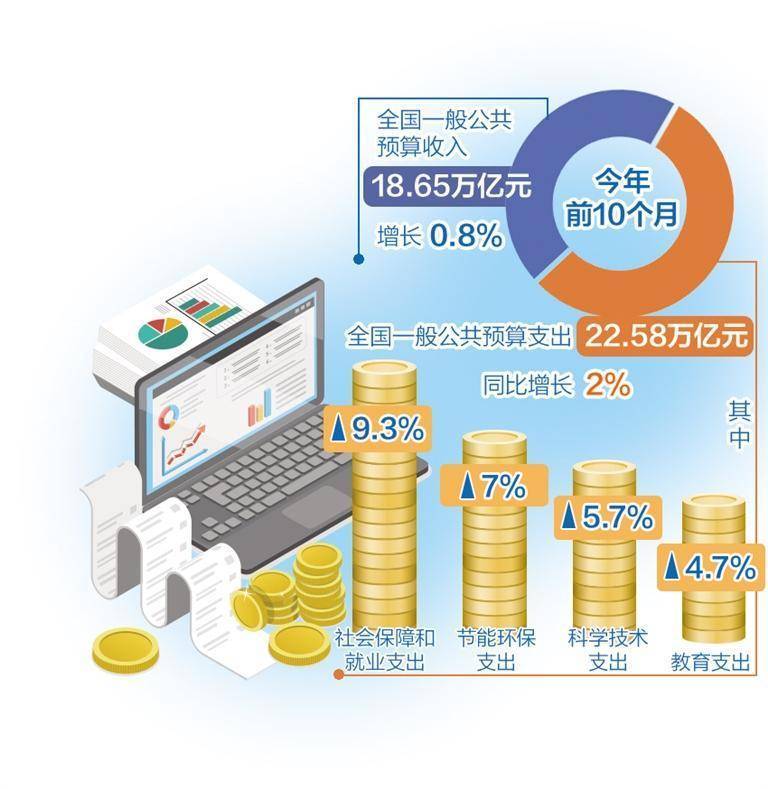
前10个月全国一般公共预算收入增长0.8% 财政收入稳步回升
Sou Hu Cai Jing· 2025-11-17 22:23
Core Insights - The national general public budget revenue showed a steady increase in October, with a total revenue of 2.26 trillion yuan, marking a year-on-year growth of 3.2% [2] - Tax revenue in October reached 2.07 trillion yuan, growing by 8.6%, indicating strong economic support for tax sources [2] - The first ten months of the year saw a total general public budget revenue of 18.65 trillion yuan, with a growth rate of 0.8%, an increase of 0.3 percentage points compared to the previous nine months [2] Revenue Breakdown - Major tax categories showed positive growth: domestic VAT increased by 4%, domestic consumption tax by 2.4%, corporate income tax by 1.9%, and individual income tax by 11.5% [2] - Stamp duty revenue reached 378.1 billion yuan, up 29.5%, with securities transaction stamp duty at 162.9 billion yuan, reflecting a vibrant capital market [3] Sector Performance - The equipment manufacturing and modern service industries reported strong tax revenue performance, with computer and communication equipment manufacturing up 12.7%, and scientific research and technical services up 14.8% [4] - Expenditure in key areas such as social security and employment grew by 9.3%, education by 4.7%, and health by 2.4%, indicating a focus on human investment and innovation support [4] Fiscal Policy Outlook - The overall fiscal operation in the first ten months showed improving revenue, strong expenditure support, and continuous structural optimization [5] - The Ministry of Finance emphasized the need for maintaining an active fiscal policy to support economic recovery and sustainable development [5]

利率周报(2025.11.10-2025.11.16):10月主要经济指标走弱,降准降息可期-20251117
Hua Yuan Zheng Quan· 2025-11-17 08:43
1. Report Industry Investment Rating - The report is bullish on the bond market, predicting that the 10Y Treasury yield will return to around 1.65%, the 30Y Treasury yield to reach 1.9%, and the 5Y major bank Tier 2 capital bonds to reach 1.9% (all referring to bonds without VAT) [4][68][71]. 2. Core View of the Report - In October, major economic indicators weakened, and there are expectations for reserve requirement ratio cuts and interest rate cuts. The "troika" supporting the economy is under pressure. Policy rate cuts and the implementation of incremental tools may be the key means to support the economy. The bond market has prominent allocation value, and bond yields may decline in a volatile manner [2][68]. 3. Summary by Related Catalogs 3.1 Macro News - In October, the total retail sales of consumer goods were 4.6 trillion yuan, a year-on-year increase of 2.9%, 0.1 percentage points lower than the previous month, and have been falling for five consecutive months. From January to October, fixed - asset investment decreased by 1.7% year - on - year, 1.2 percentage points lower than the first nine months. In October, the added value of industrial enterprises above the designated size increased by 4.9% year - on - year, 1.6 percentage points lower than September [4][10]. - In the first 10 months of 2025, the cumulative increase in social financing scale was 30.9 trillion yuan, 3.83 trillion yuan more than the same period last year. At the end of October 2025, the stock of social financing scale was 437.72 trillion yuan, a year - on - year increase of 8.5%. At the end of October, the balance of broad money (M2) was 335.13 trillion yuan, a year - on - year increase of 8.2% [12]. - The central bank's "2025 Q3 China Monetary Policy Implementation Report" shows a more pessimistic view of the world and domestic economic environment compared to the Q2 report. The next - stage monetary policy emphasizes "counter - cyclical and cross - cyclical adjustment" [16]. 3.2 Meso - level High - frequency Data - **Consumption**: As of November 9, the average daily retail volume of passenger car manufacturers decreased by 18.8% year - on - year, and the average daily wholesale volume decreased by 22.1% year - on - year. As of November 7, the total retail volume of three major household appliances decreased by 21.8% year - on - year, and the total retail sales decreased by 34.6% year - on - year [18][22]. - **Transportation**: As of November 9, the weekly container throughput of ports increased by 6.5% year - on - year. The weekly postal express pick - up volume increased by 6.2% year - on - year, and the delivery volume increased by 3.3% year - on - year. The weekly railway freight volume decreased by 0.1% year - on - year, and the highway truck traffic volume decreased by 0.7% year - on - year [25][27]. - **Capacity Utilization**: As of November 12, the blast furnace capacity utilization rate of major steel enterprises was 76.7%, a year - on - year increase of 0.6 percentage points. As of November 13, the average asphalt capacity utilization rate was 21.0%, a year - on - year decrease of 3.0 percentage points. The soda ash capacity utilization rate was 84.5%, a year - on - year increase of 0.7 percentage points, and the PVC capacity utilization rate was 77.7%, a year - on - year increase of 0.6 percentage points [29][32]. - **Real Estate**: As of November 14, the total commercial housing transaction area of 30 large - and medium - sized cities in the past 7 days decreased by 28.5% year - on - year. As of November 7, the second - hand housing transaction area of 9 sample cities decreased by 28.5% year - on - year [34][37]. - **Prices**: As of November 14, the average wholesale price of pork decreased by 25.0% year - on - year and 1.0% compared to four weeks ago. The average wholesale price of vegetables increased by 13.5% year - on - year and 15.3% compared to four weeks ago. The average wholesale price of 6 key fruits decreased by 0.7% year - on - year and increased by 0.8% compared to four weeks ago [41]. 3.3 Bond and Foreign Exchange Markets - On November 14, overnight Shibor and various short - term interest rates such as R001, R007, DR001, DR007, IBO001, and IBO007 all declined compared to November 10. Most Treasury yields declined. On November 14, the 1 - year/5 - year/10 - year/30 - year Treasury yields were 1.41%/1.58%/1.81%/2.15% respectively, with changes of +0.8BP/ - 0.6BP/ - 0.1BP/ - 1.1BP compared to November 7 [47][51]. - As of November 14, 2025, the 10 - year Treasury yields of the United States, Japan, the United Kingdom, and Germany were 4.1%, 1.7%, 4.5%, and 2.8% respectively, with increases of 3BP, 2BP, 7BP, and 4BP compared to November 7. On November 14, the central parity rate and spot exchange rate of the US dollar against the Chinese yuan were 7.08/7.10, down 11/218 pips compared to November 7 [60][63]. 3.4 Institutional Behavior - Since the beginning of 2025, the duration of medium - and long - term pure bond funds for interest - rate bonds has shown a trend of first decreasing, then increasing, and then decreasing. In recent months, it has continued to decline. On November 14, 2025, the estimated average duration was around 4.9 years, and the median duration was around 4.2 years, a decrease of about 0.15 years compared to November 7. The duration of medium - and long - term pure bond funds for credit bonds has shown a volatile trend. In recent months, it has increased and then rapidly decreased. On November 14, the estimated average and median durations were around 2.1 years, a decrease of about 0.01 years compared to November 7 [66][67]. 3.5 Investment Recommendations - The bond market has prominent allocation value, and bond yields may decline in a volatile manner. Due to the weakening of economic indicators and the opening of the Fed's interest - rate cut cycle, the policy rate may be cut by 20BP in the next six months. The bond market in the fourth quarter may turn favorable. It is predicted that the 10Y Treasury yield will return to around 1.65%, the 30Y Treasury yield to reach 1.9%, and the 5Y major bank Tier 2 capital bonds to reach 1.9% (all referring to bonds without VAT) [4][68][71].
东兴晨报P1-20251117
Dongxing Securities· 2025-11-17 06:45
Economic News - The State Council meeting emphasized enhancing supply-demand adaptability to unleash consumption potential and promote economic circulation, focusing on consumption upgrades to lead industrial upgrades [1] - The Ministry of Foreign Affairs and Chinese consulates in Japan warned Chinese citizens about the deteriorating safety environment in Japan, advising against travel [1] - The National Bureau of Statistics reported that the industrial added value above designated size grew by 4.9% year-on-year in October, with a cumulative growth of 6.1% from January to October [4] Key Company Information - Ningde Times' shareholder Huang Shilin plans to transfer 1% of shares [4] - Huaxia Happiness has had its pre-restructuring accepted by the Langfang Intermediate Court [4] - Kaiser Travel Industry formed a consortium with Guangzhou Haina to participate in the restructuring investment of Zhangjiajie Tourism Group, acquiring 800,000 shares [4] - Huakang Clean won a project worth 100 million yuan [4] - Chuangye Huikang is planning a change of control and will resume trading on November 17 [4] Antimony Industry Insights - China holds 30% of global antimony resources, with reserves increasing from 480,000 tons in 2020 to 670,000 tons in 2024, reflecting a CAGR of 8.7% [6] - In 2024, China is projected to produce 60,000 tons of antimony, accounting for 57.7% of global production, which has been declining over the past decade [7] - The demand for antimony in flame retardants remains the highest, while the fastest growth is seen in photovoltaic glass, with a projected 10.8% increase in global antimony consumption in 2024 [8] - The strong growth in photovoltaic installations is expected to drive sustained demand for antimony, with projections indicating a significant increase in demand from 2024 to 2027 [9] - The global antimony supply-demand gap is expected to widen, with a projected shortfall of 9.5 million tons by 2027, representing 42.8% of demand [10] - The tightening of antimony supply due to export controls and environmental policies in China is likely to push prices higher, with potential increases of up to 56% in domestic prices [11]
国常会部署增强消费品供需适配性;华为将发布AI领域突破性技术|周末要闻速递
21世纪经济报道· 2025-11-16 12:59
Group 1 - The State Council's meeting emphasized enhancing the adaptability of supply and demand in consumer goods to unleash consumption potential and facilitate economic circulation [1] - The meeting highlighted the importance of leading industrial upgrades through consumption upgrades and better meeting diverse demands with high-quality supply [1] - The focus is on accelerating the application of new technologies and models, particularly in key industries, to develop new products and value-added services [1] Group 2 - The Ministry of Finance is committed to strengthening counter-cyclical and cross-cyclical adjustments, determining deficit rates and debt scales based on changing circumstances [2] - The China Securities Regulatory Commission aims to enhance market resilience and stability, making the system more inclusive and attractive while improving the quality of listed companies [3] - The People's Bank of China announced an 800 billion yuan reverse repurchase operation to maintain ample liquidity in the banking system [4] Group 3 - The State Administration for Market Regulation released a draft for public consultation on antitrust compliance guidelines for internet platforms, aiming to clarify compliance responsibilities and promote fair competition [5][6] - The Ministry of Commerce and other departments issued a notice to strengthen management of second-hand car exports, particularly controlling new cars exported under the guise of second-hand vehicles [7] - The Shanghai Stock Exchange is monitoring stocks with severe abnormal fluctuations, including specific companies facing delisting risks [8][9] Group 4 - Several smartphone manufacturers have paused procurement of storage chips due to soaring prices, with some companies reporting DRAM inventory levels below three weeks [11] - Industrial Fulian responded to rumors of order downgrades, stating that current project progress and delivery schedules are normal [12] - Huawei is set to release breakthrough AI technology aimed at improving the efficiency of computing resource utilization [13] Group 5 - Samsung Electronics has raised contract prices for certain memory chips by up to 60% due to a shortage driven by the global AI data center construction boom [14] - Multiple airlines have announced free ticket changes for flights to Japan amid safety concerns, urging Chinese citizens to avoid travel to Japan [15] - The U.S. government has adjusted the "reciprocal tariffs" list, removing certain agricultural products from additional tariffs [17]

国常会部署增强消费品供需适配性;华为将发布AI领域突破性技术
2 1 Shi Ji Jing Ji Bao Dao· 2025-11-16 09:19
Group 1 - The State Council meeting emphasized enhancing the adaptability of supply and demand in consumer goods to further stimulate consumption and promote economic circulation [1] - The meeting highlighted the importance of leading industrial upgrades through consumption upgrades and better meeting diverse demands with high-quality supply [1] - The focus will be on accelerating the application of new technologies and innovative models, particularly in key industries and fields, to develop new products and value-added services [1] Group 2 - The Ministry of Finance plans to strengthen counter-cyclical and cross-cyclical adjustments, determining deficit rates and debt scales based on changing circumstances [2] - The People's Bank of China announced an 800 billion yuan reverse repurchase operation to maintain ample liquidity in the banking system [4] Group 3 - The China Securities Regulatory Commission aims to enhance market resilience and stability, making the system more inclusive and attractive while improving the quality and value of listed companies [3] - The market supervision authority released a draft guideline for antitrust compliance for internet platforms, aiming to protect legal rights and maintain fair competition [5] Group 4 - Multiple smartphone manufacturers, including Xiaomi and OPPO, have paused storage chip purchases due to soaring prices, with some having inventory levels below three weeks [11] - Industrial Fulian denied rumors of order or outlook downgrades, stating that current project progress and delivery schedules are normal [12] - Huawei is set to release breakthrough AI technology that could significantly improve the utilization efficiency of computing resources [13] - Samsung Electronics raised contract prices for server memory chips by up to 60% due to supply shortages driven by the AI data center boom [14]
财长蓝佛安最新发声
Di Yi Cai Jing Zi Xun· 2025-11-15 03:54
Core Viewpoint - The Chinese government will maintain an active fiscal policy during the "15th Five-Year Plan" period to stabilize the economy and ensure people's livelihoods, emphasizing the need for sufficient policy strength [2][3]. Fiscal Policy Strategy - The fiscal policy will focus on counter-cyclical and cross-cyclical adjustments, determining deficit rates and debt levels based on changing circumstances, and utilizing various tools such as budgets, taxes, government bonds, and transfer payments [2][3]. - The emphasis will shift from merely focusing on deficit rates to increasing expenditure growth, breaking the 3% deficit rate constraint to ensure necessary spending levels [3][5]. Economic Context - The "15th Five-Year Plan" period is characterized by complex changes in both domestic and international environments, including external instability and internal economic pressures [3]. - Despite challenges, China's economic fundamentals remain strong, with significant potential for long-term growth, although risks in certain sectors have not yet cleared [3]. Budget Expenditure Trends - National general public budget expenditure growth rates from 2020 to 2024 are projected at 2.8%, 0.3%, 6.1%, 5.4%, and 3.6%, with a growth rate of 3.1% in the first three quarters of 2025 [4]. - The total budget for 2025 is expected to approach 30 trillion yuan [5]. Debt and Fiscal Space - China's government debt ratio is projected to be 68.7% in 2024, significantly lower than that of major economies and emerging markets, indicating substantial room for further borrowing [5]. - The central government has considerable borrowing and deficit space, allowing for future fiscal policy initiatives [5]. Targeted Support Areas - The fiscal policy will prioritize high-quality development, focusing on key areas such as modern industrial systems, technology, education, social security, agriculture, and environmental protection [5][6]. - The "15th Five-Year Plan" suggests enhancing support for major national strategic tasks and basic livelihood financing, increasing the proportion of government investment in public services, and supporting high-tech enterprises [5][6]. Policy Coordination - There will be an emphasis on policy coordination, ensuring that fiscal policies align with monetary, industrial, and regional policies to create a synergistic effect for high-quality development [6].

财政部:发挥积极财政政策作用 推动中国式现代化开创新局面
Ren Min Ri Bao· 2025-11-15 03:03
Core Viewpoint - The article emphasizes the importance of proactive fiscal policy in driving China's modernization and economic development, as outlined in the 20th Central Committee's Fourth Plenary Session [1]. Group 1: Achievements of Fiscal Policy - Since the new era, China's fiscal policy has been adjusted based on changing circumstances, leading to significant achievements, including a 24% increase in general public budget expenditure during the "14th Five-Year Plan" period, totaling over 136 trillion yuan [2]. - More than 70% of national fiscal expenditure is directed towards people's livelihoods, with nearly 10 trillion yuan allocated for social welfare over five years [2]. Group 2: Key Strategies for Fiscal Policy - Emphasis on coordinating counter-cyclical and cross-cyclical adjustments to address structural and deep-seated economic issues while enhancing long-term development potential [3]. - Focus on both supply-side and demand-side management, utilizing tax policies and government procurement to support the modern industrial system and stimulate consumption [3]. - Innovation in fiscal tools, such as the use of ultra-long special government bonds and fiscal subsidies, to enhance the effectiveness of fiscal policy [3]. - Strengthening policy coordination to ensure alignment with national development plans and enhance the overall effectiveness of fiscal measures [3]. Group 3: Goals for the "15th Five-Year Plan" Period - The "15th Five-Year Plan" period is critical for achieving socialist modernization, requiring effective responses to complex domestic and international challenges [4]. - Fiscal policies will focus on providing robust support for key strategic goals, ensuring adequate funding and resource allocation to high-quality development areas [5]. Group 4: Expanding Domestic Demand - The construction of a strong domestic market is a priority, with fiscal measures aimed at boosting consumption and effective investment [6]. - Strategies include enhancing consumer spending through subsidies and increasing long-term consumption capacity by improving income levels [6]. - Effective investment will be directed towards strategic projects that enhance overall productivity, with an emphasis on preventing inefficient investments [6]. Group 5: Fiscal Reform and Management - The need for a high-level socialist market economy requires a balance between market freedom and effective fiscal regulation [8]. - Focus on optimizing resource allocation and improving fiscal management through zero-based budgeting and enhancing the efficiency of fund usage [9]. - Emphasis on balancing efficiency and equity in tax policies to promote high-quality development and social fairness [9].
理性认识新旧动能转换过程中的挑战丨温彬专栏
2 1 Shi Ji Jing Ji Bao Dao· 2025-11-14 23:17
Economic Overview - Economic indicators have shown a decline in October due to external uncertainties, reduced working days, and elevated year-on-year bases, but the economy remains above target levels, leading to a moderate policy support stance [1][2] - The export growth rate in October dropped significantly to -1.1% from 8.3% in the previous month, with industrial export delivery value declining by 2.1% year-on-year [1][2] - Manufacturing investment growth slowed by 1.3 percentage points to 2.7% from January to October [1] Demand Side Analysis - Consumer demand showed resilience, with retail sales growing by 2.9% year-on-year in October, slightly better than market expectations [1] - Restaurant revenue increased by 3.8% year-on-year in October, up 2.9 percentage points from the previous month, while durable goods consumption growth slowed [1] Investment Trends - Fixed asset investment growth decreased by 1.2 percentage points to -1.7% from January to October, with infrastructure investment also slowing to -0.1% [2] - Real estate development investment saw a larger decline of 0.8 percentage points to -14.7%, indicating ongoing challenges in the sector [2] Supply Side Analysis - Industrial value-added growth fell by 1.6 percentage points to 4.9% in October, while the service production index decreased by 1.0 percentage points to 4.6% [2] - Despite the decline, cumulative growth rates for industrial and service sectors remain above last year's figures [2] Policy Response - Current policies are characterized by moderate implementation, with limited likelihood of significant increases in policy measures this year [3] - The central bank emphasizes providing ample liquidity for the real economy while balancing short-term growth stabilization and long-term structural adjustments [3] Fiscal Measures - Recent fiscal policies include the allocation of 500 billion yuan to local governments to enhance financial capacity, with specific funds directed towards investment projects [3] - The Ministry of Finance has outlined six key areas for future fiscal policy, including boosting consumption and supporting local government bonds [3] Private Investment Initiatives - The State Council has introduced measures to promote private investment, focusing on easing market access and supporting private projects in emerging sectors [4] - These initiatives aim to optimize investment structures and enhance the flow of private capital into new productive areas [4]
财政部:有力有效实施积极财政政策
Zhong Guo Zheng Quan Bao· 2025-11-14 20:10
Core Viewpoint - The article emphasizes the importance of proactive fiscal policy in driving high-quality development and achieving Chinese-style modernization, as outlined in the 15th Five-Year Plan proposed by the 20th Central Committee of the Communist Party of China [1][2]. Fiscal Policy Implementation - The fiscal policy has maintained a proactive stance since the 14th Five-Year Plan, with adjustments made according to changing circumstances, including an increase in the deficit ratio from 2.7% to 3.8%, and further to 4% this year [1][2]. - New local government special bond quotas amounting to 19.4 trillion yuan have been arranged, alongside over 1 trillion yuan in new tax reductions and deferred payments, expanding fiscal policy space [1][2]. Achievements During the 14th Five-Year Plan - The total public budget expenditure is expected to exceed 136 trillion yuan, a 24% increase compared to the 13th Five-Year Plan, with over 70% of fiscal spending directed towards people's livelihoods, totaling nearly 10 trillion yuan in social welfare investments [2][3]. - The ability to respond to risks and challenges has strengthened, providing a more solid foundation for safe development [2]. Strategic Focus for the 15th Five-Year Plan - The 15th Five-Year Plan is seen as a critical period for achieving socialist modernization, with a focus on adapting to complex domestic and international changes, including rising unilateralism and protectionism [3][4]. - The fiscal department aims to enhance the effectiveness of fiscal policies and macroeconomic regulation to better support high-quality development [3][4]. Key Areas of Fiscal Policy Action - The fiscal policy will focus on three main areas to support domestic market construction: boosting consumption, expanding effective investment, and promoting a unified market [5][6]. - Specific measures include using fiscal subsidies and tax adjustments to enhance consumer spending, optimizing government investment towards strategic projects, and improving the fiscal system to eliminate market fragmentation [5][6]. Fiscal Reform and Management - The establishment of a high-level socialist market economy requires a balance between market freedom and effective regulation, with fiscal funds directed towards public goods and areas with high social returns [6]. - The focus will be on optimizing resource allocation, enhancing tax systems, and ensuring a sustainable fiscal environment while promoting both development and safety [6].
财政部:把准形势任务 有力有效实施积极的财政政策
Xin Hua She· 2025-11-14 14:28
Core Viewpoint - The article emphasizes the importance of proactive fiscal policy in achieving high-quality development and modernizing China's economy during the "15th Five-Year Plan" period, as outlined by the 20th Central Committee of the Communist Party of China [1][2]. Group 1: Fiscal Policy Considerations - The "15th Five-Year Plan" period is crucial for solidifying the foundation of socialist modernization, with complex changes in the development environment both domestically and internationally [2]. - The external environment is characterized by instability, intensified great power competition, and rising unilateralism and protectionism, while the domestic economy remains resilient with strong fundamentals and potential [2]. - Fiscal policy must adapt to these changes, enhancing its effectiveness and macro-control capabilities to better support high-quality development [2]. Group 2: Key Strategies for Fiscal Policy - The government will ensure sufficient fiscal strength by maintaining a proactive stance, adjusting deficit rates and debt levels according to changing circumstances, and utilizing various fiscal tools to sustain economic support [2][3]. - Fiscal resources will be allocated precisely to high-quality development areas, including modern industrial systems, technology, education, social security, agriculture, and environmental protection, ensuring effective use of funds [3]. - A coordinated approach will be adopted in fiscal policy design, aligning it with monetary, industrial, and regional policies to create a synergistic effect that promotes high-quality development [3].