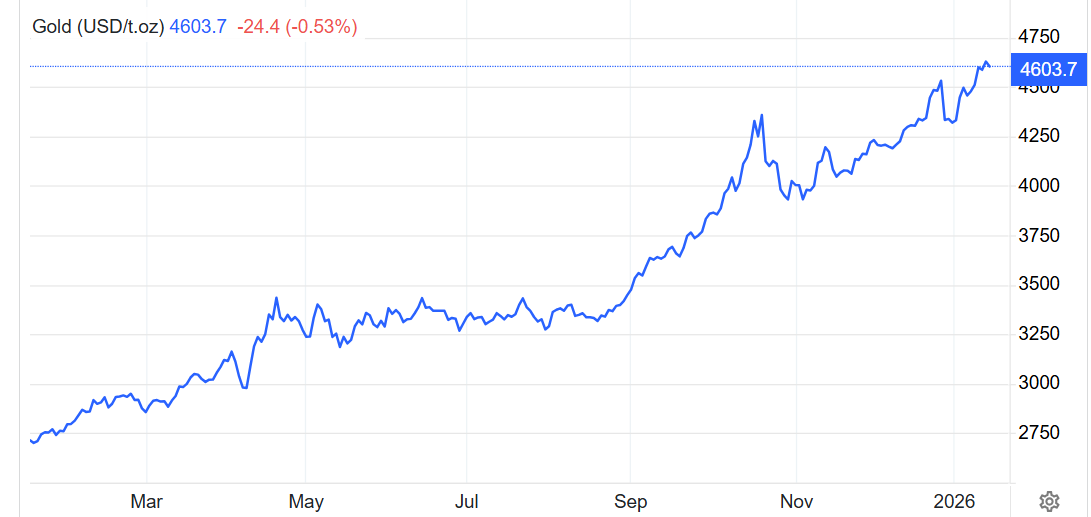
黄金牛市

Search documents
期货日报:利好汇集,黄金配置价值仍存
Qi Huo Ri Bao· 2026-01-20 01:37
Core Viewpoint - The global monetary easing cycle is expected to continue into 2026, supporting a strong outlook for gold due to reserve demand, safe-haven demand, and allocation demand [1]. Monetary Policy Easing - The monetary easing cycle includes both monetary and fiscal policies, with the Federal Reserve likely to implement and extend easing measures in 2025 and 2026, including interest rate cuts and balance sheet expansion [3]. - Weak non-farm data and lack of inflation rebound in the U.S. will prompt the Fed to initiate a new round of interest rate cuts, which will lower the opportunity cost of holding gold [3]. Reserve Demand - The restructuring of the global monetary order continues, with major central banks increasing gold reserves to hedge against potential credit crises [4]. - The ongoing monetary easing by central banks creates excess liquidity, benefiting gold as a monetary asset [4]. Safe-Haven Demand - The upcoming U.S. midterm elections in 2026 and ongoing global political uncertainties will sustain strong safe-haven demand for gold as investors seek to hedge risks [5]. - The likelihood of continued tension in global trade relations and a multipolar political landscape will further support gold's appeal [5]. Allocation Demand - Strong allocation demand for gold persists, with significant capital inflows into the market, as gold serves as a foundational asset for optimizing portfolios and hedging risks [6]. - Global gold ETF holdings are nearing historical highs, indicating robust demand for gold as a hedge against market volatility [6]. Bull Market Outlook - The combination of monetary easing, safe-haven demand, reserve demand, and allocation demand suggests that the gold bull market may not be over [7]. - There is a high possibility of gold prices rising further, with potential for increased volatility, especially if the U.S. economy remains weak and the Fed continues its easing policies [8].
新全球秩序催生金银牛市!美银:黄金有望突破6000美元
Hua Er Jie Jian Wen· 2026-01-19 23:20
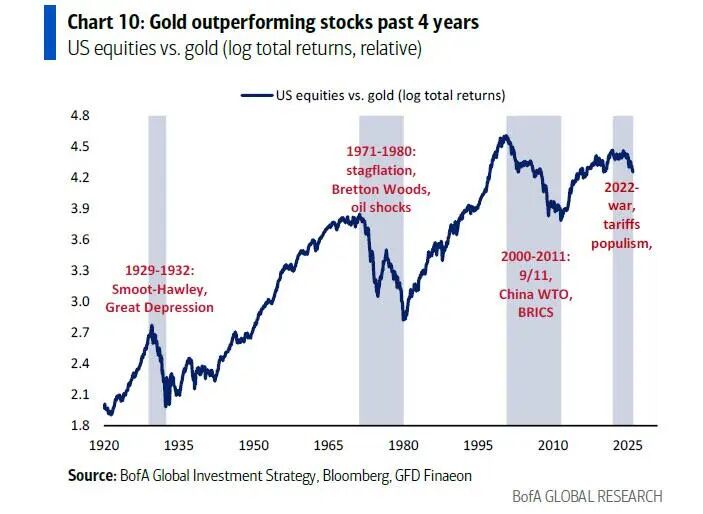
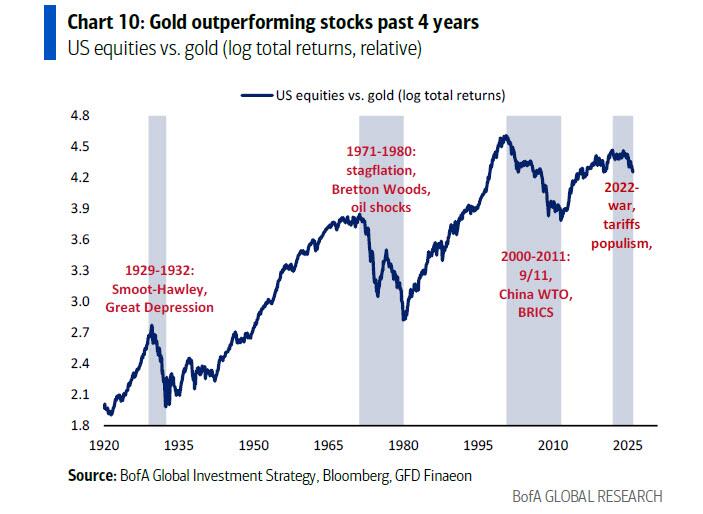
Group 1: New World Order and Global Bull Market - The chief investment strategist at Bank of America, Hartnett, believes that Trump is driving global fiscal expansion, leading to a "New World Order = New World Bull Market" scenario [1][2] - Hartnett suggests going long on international stocks as the market is shifting from U.S. exceptionalism to global rebalancing, with $1.6 trillion flowing into U.S. stock funds in the 2020s compared to only $0.4 trillion into global funds [2] - China is identified as the most promising market, with the end of deflation expected to catalyze bull markets in Japan and Europe [2] Group 2: Gold Bull Market - Hartnett emphasizes that the New World Order is not only fostering a stock bull market but also a gold bull market, despite short-term overbought conditions [3] - Gold was the best-performing asset in 2020, driven by factors such as war, populism, the end of globalization, excessive fiscal expansion, and debt devaluation [4] - The Federal Reserve and Trump’s administration are expected to increase quantitative easing liquidity by $600 billion through the purchase of government bonds and mortgage-backed securities by 2026 [5] - Gold has outperformed bonds and U.S. stocks over the past four years, and a higher allocation to gold remains reasonable, with historical bull markets averaging a 300% increase [6][7] Group 3: Economic Recovery Assets - In addition to gold, other assets are expected to benefit from the New World Bull Market, including mid-cap and small-cap stocks, homebuilders, retail, and transportation sectors [10] - Hartnett advises going long on "economic recovery" related assets while shorting large tech stocks until certain conditions are met, such as the U.S. unemployment rate rising to 5% [11] - Historical precedent shows that Nixon's price and wage freeze improved living costs and boosted his approval ratings, suggesting that if Trump fails to improve his ratings, risks for midterm elections will increase [15] Group 4: Risks from East Asian Currency Appreciation - The biggest risk identified is the rapid appreciation of the yen, won, and new Taiwan dollar, which could trigger global liquidity tightening [1][16] - The yen is currently trading near 160, at its weakest level against the yuan since 1992, and a rapid appreciation could reverse capital flows from Asia [16] - Hartnett warns that investors should closely monitor indicators like the "yen up, MOVE index up" risk aversion combination to determine when to exit the market [16]

“新全球秩序=新全球牛市=金银牛市!” 美银:黄金有望突破6000
华尔街见闻· 2026-01-19 09:46
Core Viewpoint - The article discusses the emergence of a "New World Order = New World Bull Market" driven by global fiscal expansion under Trump's leadership, with a bullish outlook on gold and silver, while highlighting risks associated with the rapid appreciation of East Asian currencies [2][3]. Group 1: Global Market Dynamics - Hartnett believes that the market is entering a phase of global rebalancing, moving away from American exceptionalism, with international stocks being favored [3]. - The article notes that since 2020, U.S. stock funds have seen inflows of $1.6 trillion, while global funds have only attracted $0.4 trillion, indicating a significant imbalance that is expected to correct [3]. Group 2: Investment Recommendations - Hartnett recommends going long on international stocks and assets related to economic recovery, particularly favoring small and mid-cap stocks, homebuilders, retail, and transportation sectors [12]. - The article suggests that gold is expected to break the historical high of $6,000, with a current allocation of only 0.6% among high-net-worth clients, indicating potential for significant price appreciation [8][10]. Group 3: Economic Indicators and Risks - The article highlights that the sustainability of the optimistic outlook depends on the U.S. unemployment rate remaining low and Trump's ability to lower living costs to improve his approval ratings [12][15]. - A major risk identified is the potential rapid appreciation of the Japanese yen, South Korean won, and New Taiwan dollar, which could lead to a tightening of global liquidity [16][18]. Group 4: Geopolitical Context - China is identified as a key market, with the end of deflation expected to catalyze bull markets in Japan and Europe [4]. - The stability of Middle Eastern markets, such as the Tehran Stock Exchange's 65% increase since last August, is seen as a positive signal for global oil supply and market conditions [4].

黄金,重大利好一个接一个!高开暴涨,只是刚刚开始!
Sou Hu Cai Jing· 2026-01-19 01:15
Core Viewpoint - The article discusses the impact of the recent US-Europe tariff war on gold and silver prices, highlighting the geopolitical tensions and their potential effects on market dynamics [1][3]. Group 1: Tariff War and Geopolitical Tensions - The US has announced tariffs on eight European countries, escalating trade tensions and leading to a retaliatory response from Europe [1][3]. - The geopolitical situation is expected to significantly influence gold and silver prices, with historical data showing that previous tariff actions led to substantial price increases [3][5]. - The ongoing conflict over Greenland symbolizes broader territorial and resource disputes, which could further destabilize European unity and the Eurozone [5]. Group 2: Market Predictions and Technical Analysis - Gold prices are projected to rise, with expectations of reaching $4,700 and potentially $5,000 before the Lunar New Year, while silver may hit the $100 mark [5][10]. - Current market conditions indicate a bullish trend for both gold and silver, with key support levels identified for trading strategies [7][9]. - The article emphasizes the importance of monitoring geopolitical developments and Federal Reserve actions, as these factors will heavily influence market movements [7][9]. Group 3: Long-term Outlook - The long-term outlook for gold suggests a bullish trend, with targets set at $5,200 for a small bull market and up to $6,200 for a super bull market [10]. - Silver is expected to maintain a strong position, with targets of $100 to $120, reflecting a solid market sentiment [10].
2026年黄金还能持续飙升吗?3大核心因素决定行情走向
Sou Hu Cai Jing· 2026-01-18 16:44
Group 1 - The core point of the article discusses the potential for gold prices to continue rising in 2026 after a significant increase in 2025, driven by factors such as Federal Reserve interest rate cuts and global demand for gold [1][3][4] Group 2 - The first pillar indicates that the Federal Reserve's interest rate cuts, which dropped rates from 5.5% to 3.25%, were a major driver for the gold price surge in 2025, but future cuts may be limited due to persistent inflation [1][3] - The second pillar highlights that countries like China, Russia, and Turkey purchased a record 1,200 tons of gold in 2025, as they seek to reduce reliance on the US dollar amid geopolitical tensions [3][4] - The third pillar points out that global gold mining output has been declining for five consecutive years, with production dropping to 3,600 tons in 2025, while demand continues to rise, creating a significant supply-demand gap [4][6] Group 3 - The article advises investors to be cautious, suggesting that they should not exceed 10% of their total assets in gold investments and to set stop-loss and take-profit levels [6][9] - It warns against the risks of speculative trading in gold, citing past instances where prices dropped sharply following interest rate hikes by the Federal Reserve [7][9] - The article concludes that gold should be viewed as a safe haven asset rather than a quick profit opportunity, emphasizing the importance of a long-term investment perspective [9]
美银Hartnett:“新全球秩序=新全球牛市=金银牛市”,牛市的最大风险是东亚货币升值
Hua Er Jie Jian Wen· 2026-01-18 10:43
Core Viewpoint - The chief investment strategist of Bank of America, Hartnett, believes that Trump is driving global fiscal expansion, leading to a "new world order = new world bull market" scenario. This framework suggests a sustained bull market for gold and silver, while the rapid appreciation of the yen, won, and New Taiwan dollar poses the greatest risk to global liquidity [1][2]. Group 1: Currency Risks - The rapid appreciation of the yen, won, and New Taiwan dollar is identified as the largest risk in the current market consensus, which is extremely bullish [2]. - The yen is currently trading near 160, at its weakest level against the RMB since 1992. A quick rise in these currencies could trigger global liquidity tightening [2]. - Factors such as potential interest rate hikes by the Bank of Japan, U.S. quantitative easing, geopolitical tensions, or hedging errors could lead to this rapid appreciation [2]. Group 2: Market Outlook - Assuming the yen does not collapse in the short term, the market is entering a "new world order = new world bull market" phase, with Trump promoting global fiscal expansion [3]. - Hartnett suggests a long position in international stocks, as the U.S. exceptionalism is shifting towards global rebalancing. In the 2020s, U.S. stock funds saw inflows of $1.6 trillion, while global funds only saw $400 billion [3]. Group 3: Gold Market - The new world order is expected to foster a bull market for gold, despite short-term overbought conditions, particularly for silver, which is 104% above its 200-day moving average [4]. - Gold has been the best-performing asset since 2020, driven by factors such as war, populism, the end of globalization, fiscal over-expansion, and debt devaluation. The Fed and Trump administration are expected to increase liquidity through $600 billion in quantitative easing by 2026 [4]. - Historical trends indicate that gold's average increase during bull markets is around 300%, with prices potentially breaking the $6,000 mark [4]. Group 4: Economic Recovery Assets - In addition to gold, other assets are expected to benefit from the new world bull market. Hartnett recommends long positions in mid-cap and small-cap stocks, homebuilders, retail, and transportation sectors, while shorting large tech stocks until certain conditions are met [7]. - Key conditions include the U.S. unemployment rate rising to 5%, driven by cost-cutting measures, AI applications, and immigration restrictions, and Trump's policies failing to lower living costs [8]. - Historical context shows that Nixon's price and wage freeze in 1971 improved living costs and boosted his approval ratings, suggesting that if Trump's ratings do not improve by the end of Q1, risks for midterm elections will increase [11].
黄金牛市背后 藏着美元霸权松动的必然逻辑
Mei Ri Jing Ji Xin Wen· 2026-01-15 22:59
Group 1 - The core viewpoint of the article highlights the significant rise in gold prices, reaching a record high of $4639.72 per ounce, driven by the depreciation of the US dollar and the ongoing bull market in gold, which is closely linked to the weakening of dollar dominance [3][8] - In 2025, gold prices saw a cumulative increase of 64.56%, making it one of the highest-yielding asset classes, while the US dollar index fell by 9.41% during the same period [3][8] - Historical patterns indicate that periods of significant gold price increases often coincide with turmoil in the US dollar, such as the breakdown of the Bretton Woods system and ongoing fiscal deficits [9][10] Group 2 - The article discusses the criminal investigation into Federal Reserve Chairman Jerome Powell, marking the first time a sitting Fed chair has faced such scrutiny, which raises concerns about the independence of the Federal Reserve [4][10] - The investigation is seen as a result of pressure from President Trump, who has been advocating for a monetary policy that keeps interest rates below 1%, despite inflation rates exceeding the Fed's target [10][11] - The potential loss of Fed independence could lead to uncontrolled inflation and a loss of confidence in the US dollar, which is critical for its status as the world's primary reserve currency [10][11] Group 3 - The article emphasizes that the repercussions of a weakened dollar would extend globally, prompting central banks to adjust their reserve asset structures, potentially leading to increased currency volatility and reduced liquidity in cross-border transactions [5][11] - The Fed's independence is crucial for maintaining the dollar's reserve currency status, and any erosion of this independence could have severe implications for the global financial system [11][12] - The article suggests that rather than relying on the US to rectify its monetary policy, global actions such as increasing gold reserves and developing alternative settlement systems are necessary to reduce dependency on the dollar [6][11]

每经热评|黄金牛市背后 藏着美元霸权松动的必然逻辑
Mei Ri Jing Ji Xin Wen· 2026-01-15 14:39
Group 1: Gold Market Dynamics - The price of gold reached a record high of $4639.72 per ounce on January 14, 2026, with a cumulative increase of 7.33% in early 2026 and a staggering 64.56% increase in 2025, making it one of the highest-yielding asset classes [1] - The rise in gold prices is closely linked to the depreciation of the US dollar, which fell by 9.41% in 2025, including a nearly 12% decline against the euro, indicating a market divergence between gold and the dollar [1] - Historical data shows that periods of significant gold price increases often coincide with turmoil in the dollar's value, such as the breakdown of the Bretton Woods system and ongoing US fiscal deficits [1] Group 2: Federal Reserve and Economic Implications - The Federal Reserve Chairman Jerome Powell is under criminal investigation, marking the first time a sitting Fed chair has faced such scrutiny, which reflects escalating pressure from President Trump on monetary policy [2] - If the Fed loses its independence, it could lead to uncontrollable inflation and a loss of confidence in the dollar, with the current inflation rate at 2.7% as of December 2025, exceeding the target of 2% [2] - The potential loss of the Fed's independence poses risks not only to the US economy but also to the global financial system, as central banks may adjust their reserve asset structures, leading to reduced dollar liquidity and increased volatility in exchange rates [3] Group 3: Global Financial System and Alternatives - The reliance on the dollar as the primary international currency presents systemic risks, prompting calls for actions to reduce dependency, such as increasing gold reserves and developing alternative settlement systems [4] - Proposed measures include expanding currency swap agreements and promoting a decentralized and diversified global financial system to mitigate the impact of issues arising from the Federal Reserve [4]
金价突破4380美元创纪录!这波暴涨背后,谁才是最大赢家?
Sou Hu Cai Jing· 2026-01-15 13:12
伦敦现货黄金价格攀升至4382美元/盎司,刷新历史纪录;现货铂金价格突破2000美元/盎司,为2008年以来首次,年内涨幅超110%。 与此同时,A股有色金属板块联动走强,有色ETF基金单日上涨2.25%。一场由贵金属引领的牛市正在全球市场上演。 全球宏观对冲基金正迎来至少自2008年以来业绩最佳的一年。2025年,特朗普贸易政策引发市场连锁反应:美元走弱、债券波动、黄金闪耀。 善于在全球经济趋势中寻找机会的宏观对冲基金,精准布局这三大领域,迎来了金融危机后最辉煌的一年。这些基金的回报在11月底上涨了16%。 "可操作的机会很多。"宏观基金格莱姆资本的创始人兼董事长肯·特罗平表示。他指出,公司投资组合经理们的大部分回报来自于美元、黄金和美国国债市 场的交易。 一位宏观对冲基金交易员看着屏幕上金价不断刷新历史高点,露出了微笑。这背后是一个全球央行、矿业巨头和精明投资者共同参与的财富盛宴。 世界黄金协会的最新调查显示,95%的受访央行预计未来12个月全球黄金储备将增加。43%的央行计划增持自家黄金,创下2018年该调查开始以来的新高, 且没有任何央行打算出售黄金。 尽管金价高企,黄金零售市场却呈现出分化的局面。黄 ...

黄金信仰永不灭! 狂飙70%的金价仍在翱翔 华尔街奏响5000美元狂想曲
智通财经网· 2026-01-15 03:05
Core Viewpoint - Gold and silver futures prices have reached new historical highs due to escalating geopolitical tensions, particularly in Venezuela, Cuba, and Iran, alongside concerns over the independence of the Federal Reserve's monetary policy and the depreciation of the US dollar [1][2][3]. Group 1: Geopolitical Factors - The ongoing unrest in Iran and threats from the Trump administration regarding military intervention have heightened geopolitical risks, driving investors towards gold as a safe-haven asset [1][2]. - Analysts from ANZ Bank suggest that geopolitical instability and concerns over monetary policy will continue to boost global demand for gold, with expectations for prices to exceed $5,000 per ounce in the latter half of the year [2][3]. Group 2: Federal Reserve Independence - The Federal Reserve's independence is facing unprecedented political pressure, with Chairman Jerome Powell stating that threats of criminal charges are aimed at undermining the Fed's ability to set interest rates based on economic data rather than political preferences [2][3]. - Concerns over the Fed's independence have led to increased demand for gold, as investors seek to diversify their reserves amid uncertainty [3][7]. Group 3: Market Predictions - Citigroup has raised its price forecasts for gold and silver, predicting gold could reach $5,000 per ounce and silver could rise to $100 per ounce within three months due to ongoing geopolitical risks and supply shortages [3][6]. - HSBC's analysis indicates that the combination of geopolitical risks and rising fiscal deficits is likely to support gold prices, with expectations for prices to surpass $5,000 per ounce in the first half of 2026 [6][7]. Group 4: Demand Dynamics - Emerging market central banks are accelerating their gold purchases as part of a "de-dollarization" trend, indicating a significant shift in global reserve management from US Treasuries to gold [7][8]. - Goldman Sachs and JPMorgan have projected that gold prices could reach approximately $4,900 to $5,055 per ounce by late 2026, driven by structural demand from central banks and potential shifts in private sector investments [8].