
产能治理

Search documents
11月通胀数据点评:食品项拉动CPI同比创年内新高
Mai Gao Zheng Quan· 2025-12-11 09:11
Group 1: CPI Analysis - In November 2025, the CPI increased by 0.7% year-on-year, marking the highest level in 2025 and the highest since March 2024, while it slightly decreased by 0.1% month-on-month[1] - Core CPI, excluding food and energy, rose by 1.2% year-on-year, remaining above 1% for three consecutive months, indicating a gradual recovery in consumer spending[1] - Food prices shifted from a 2.9% decline in October to a 0.2% increase in November, primarily driving the CPI increase[1] Group 2: PPI Insights - In November 2025, the PPI increased by 0.1% month-on-month, achieving positive growth for two consecutive months, but the year-on-year decline widened to -2.2%[2] - Key industries such as coal mining and photovoltaic equipment manufacturing showed narrowing year-on-year price declines, reflecting effective supply-demand optimization policies[2] - The prices of new materials and intelligent technologies rose significantly, with external storage devices increasing by 13.9% year-on-year, indicating a shift towards industrial upgrading[2] Group 3: Market Outlook - The CPI's recovery is largely dependent on short-term supply shocks from fresh produce, while long-term food prices, such as pork, remain low[4] - The divergence in price trends between traditional and emerging industries reflects ongoing economic transformation, with traditional sectors still undergoing capacity reduction[4] - Future expectations suggest a gradual recovery in prices across key industries, with CPI likely to continue a moderate upward trend and PPI expected to turn positive in 2026[4]
扩内需政策措施继续显效
Jing Ji Wang· 2025-12-11 06:56
Group 1: Consumer Price Index (CPI) Insights - In November, the CPI increased by 0.7% year-on-year, marking the highest growth since March 2024, with a month-on-month decrease of 0.1% [2][3] - The rise in CPI was primarily driven by a shift in food prices from decline to increase, with fresh vegetable prices rising by 14.5% after nine consecutive months of decline [2][3] - Core CPI, excluding food and energy, rose by 1.2% year-on-year, maintaining above 1% for three consecutive months, indicating stable inflationary pressures [2][3] Group 2: Producer Price Index (PPI) Insights - The PPI increased by 0.1% month-on-month in November, marking the second consecutive month of growth, influenced by seasonal demand increases in certain industries [4] - Year-on-year, the PPI decreased by 2.2%, with the decline slightly widening compared to the previous month, primarily due to high comparison bases from the previous year [4] - The increase in PPI was supported by rising prices in coal and gas sectors, while international oil price fluctuations led to a decrease in domestic oil and gas extraction prices [4] Group 3: Market Trends and Future Outlook - The ongoing "anti-involution" measures are showing results, with price declines in key industries narrowing, indicating improved market competition [5] - Emerging industries are rapidly developing, contributing to price increases in related sectors, such as a 13.9% rise in external storage devices and components [6] - Future inflation is expected to remain low, with a gradual recovery in prices anticipated due to stable domestic demand and effective competition governance [7][8]
11月核心CPI继续上涨 扩内需政策措施继续显效
Zhong Guo Jing Ji Wang· 2025-12-11 00:29
Group 1: Consumer Price Index (CPI) Insights - In November, the CPI increased by 0.7% year-on-year, marking the highest growth since March 2024, with a month-on-month decrease of 0.1% [2][3] - The rise in CPI was primarily driven by a shift in food prices from decline to increase, with fresh vegetable prices rising by 14.5% after nine consecutive months of decline [2][3] - Core CPI, excluding food and energy, rose by 1.2% year-on-year, maintaining above 1% for three consecutive months, indicating stable inflationary pressures [2][3] Group 2: Producer Price Index (PPI) Insights - The PPI increased by 0.1% month-on-month in November, marking the second consecutive month of growth, influenced by seasonal demand increases in certain industries [4] - Year-on-year, the PPI decreased by 2.2%, with the decline slightly widening compared to the previous month, primarily due to high comparison bases from the previous year [4] - The increase in PPI was supported by rising prices in coal and gas sectors, while international oil price fluctuations led to a decrease in domestic oil and gas extraction prices [4] Group 3: Market Trends and Predictions - The ongoing "anti-involution" measures are showing results, with price declines in key industries narrowing, indicating improved market competition [5] - Emerging industries are rapidly developing, contributing to price increases in related sectors, such as a 13.9% rise in external storage devices and components [6] - Future inflation is expected to remain low, providing room for growth-stimulating policies, with a gradual recovery in consumer prices anticipated [7][8]
国家统计局:整治“内卷式”竞争成效显现;云天化:拟收购天耀化工100%股权 | 新能源早参
Mei Ri Jing Ji Xin Wen· 2025-12-10 23:22
Group 1 - The National Bureau of Statistics reported that the effects of rectifying "involutionary" competition are becoming evident, with price declines in industries such as coal mining, photovoltaic equipment manufacturing, and lithium-ion battery manufacturing narrowing year-on-year [1] - The price decline for new energy vehicle manufacturing also narrowed by 0.6 percentage points compared to the previous month, indicating a gradual improvement in the supply-demand dynamics of the new energy industry chain [1] - This stabilization in prices is expected to enhance corporate profitability, with leading companies benefiting first due to their cost and technological advantages [1] Group 2 - Glencore has not commented on reports suggesting it may become the first cobalt exporter under the new quota system in the Democratic Republic of Congo, which could strengthen supply constraints and improve the long-term supply-demand dynamics of the cobalt industry [2] - If confirmed, this development may boost cobalt prices and market sentiment in the short term, with leading companies benefiting from resource and channel advantages [2] - The stabilization of cobalt prices in the medium to long term is anticipated to enhance the performance of mining companies, necessitating close monitoring of export dynamics and inventory changes [2] Group 3 - Yuntianhua announced plans to acquire 100% of Tianyao Chemical for 36.8858 million yuan, which will enhance its market position in the high-end phosphorus product sector [3] - The acquisition will allow Yuntianhua to create a complete industrial chain from yellow phosphorus to phosphorus-based flame retardants, significantly improving resource utilization efficiency and industry synergy [3] - This strategic move is expected to bolster the company's performance and solidify its leading position in the market [3]

核心CPI同比涨幅连续3个月保持在1%以上——扩内需政策措施继续显效
Jing Ji Ri Bao· 2025-12-10 22:23
Group 1: Consumer Price Index (CPI) Insights - In November, the CPI increased by 0.7% year-on-year, marking the highest growth since March 2024, with a month-on-month decrease of 0.1% [2][3] - The rise in CPI was primarily driven by a shift in food prices from decline to increase, with fresh vegetable prices rising by 14.5% after a nine-month decline [2][3] - Core CPI, excluding food and energy, rose by 1.2% year-on-year, maintaining above 1% for three consecutive months, indicating stable inflationary pressures [2][3] Group 2: Producer Price Index (PPI) Insights - The PPI increased by 0.1% month-on-month in November, marking the second consecutive month of growth, influenced by seasonal demand increases in certain industries [4] - Year-on-year, the PPI decreased by 2.2%, with the decline slightly widening compared to the previous month, primarily due to high comparison bases from the previous year [4] - Input factors such as international commodity prices have led to a mixed impact on domestic prices, with some sectors experiencing price increases while others faced declines [4] Group 3: Market Trends and Future Outlook - The ongoing "anti-involution" measures are showing results, with price declines in certain industries narrowing, indicating improved market competition [5] - Emerging industries are driving price increases in related sectors, with significant year-on-year price rises in new materials and technology sectors [6] - Future inflation is expected to remain low, providing room for growth-stimulating policies, with a gradual recovery in consumer prices anticipated [7][8]
11月份CPI同比上涨0.7% 物价水平进一步企稳
Zheng Quan Ri Bao· 2025-12-10 16:25
Consumer Recovery - In November, the Consumer Price Index (CPI) decreased by 0.1% month-on-month but increased by 0.7% year-on-year, marking the highest growth since March 2024, indicating a continuous recovery in consumer spending [1][2] - The year-on-year increase in CPI was primarily driven by a shift in food prices from decline to growth, with food prices rising by 0.2% after a 2.9% drop in October [2][3] - Fresh vegetable prices saw a significant turnaround, increasing by 14.5% after a 7.3% decline in October, contributing approximately 0.49 percentage points to the CPI year-on-year [2][3] Core CPI and Industrial Prices - The core CPI, excluding food and energy, rose by 1.2% year-on-year, maintaining a growth rate above 1% for three consecutive months [3] - Prices for services and industrial consumer goods, excluding energy, increased by 0.7% and 2.1%, respectively, contributing approximately 0.29 and 0.53 percentage points to the CPI year-on-year [3] - The expansion of domestic demand policies has positively impacted prices, with household appliances and clothing prices rising by 4.9% and 2.0%, respectively [3] Producer Price Index (PPI) - The Producer Price Index (PPI) increased by 0.1% month-on-month in November, marking two consecutive months of growth, while the year-on-year decline was 2.2%, slightly widening from October [4][5] - The improvement in PPI is attributed to the optimization of supply and demand structures in certain domestic industries and the transmission of international commodity prices [4][5] Policy Impact and Market Dynamics - Continuous macroeconomic policies are showing positive effects, with a narrowing of price declines in key industries due to the ongoing governance of "involution" competition [5][6] - Emerging industries are driving price increases, with significant year-on-year price rises in sectors such as external storage devices (up 13.9%) and graphite products (up 3.8%) [5][6] - Consumer demand is being revitalized, leading to price increases in various manufacturing sectors, including a 20.6% rise in the price of arts and crafts products [6]
东海期货11月宏观数据观察:CPI同比超预期回升,PPI降幅有望收窄
Xin Lang Cai Jing· 2025-12-10 09:38
Group 1 - In November, China's CPI increased by 0.7% year-on-year, matching expectations, and up from 0.2% in the previous month [1][19] - The PPI decreased by 2.2% year-on-year, slightly worse than the expected decline of 2.0% and a previous decline of 2.1% [1][19] - The rise in CPI was driven by a significant rebound in food prices, while PPI's decline was influenced by high base comparisons from the previous year and ongoing supply-demand structural optimization in certain industries [20][21] Group 2 - The overall improvement in domestic supply-demand relationships is expected to lead to a gradual narrowing of PPI declines, supported by ongoing capacity governance in key industries [20][21] - International commodity prices have generally risen, while domestic demand remains weak, but some industries are experiencing price increases due to improved supply-demand fundamentals [20][21] - The core CPI maintained a high year-on-year growth rate of 1.2%, with non-food prices rising by 0.8%, indicating effective consumer demand policies [20][21] Group 3 - Food prices shifted from a decline of 2.9% last month to an increase of 0.2%, significantly impacting the CPI [20][21] - Energy prices fell by 3.4% year-on-year, contributing to the overall inflationary pressure [20][21] - The service sector saw price increases, with notable rises in household appliances and clothing prices, reflecting the effectiveness of domestic demand expansion policies [20][21]


11月PPI环比连续两个月上涨,CPI同比创20个月新高
2 1 Shi Ji Jing Ji Bao Dao· 2025-12-10 07:40
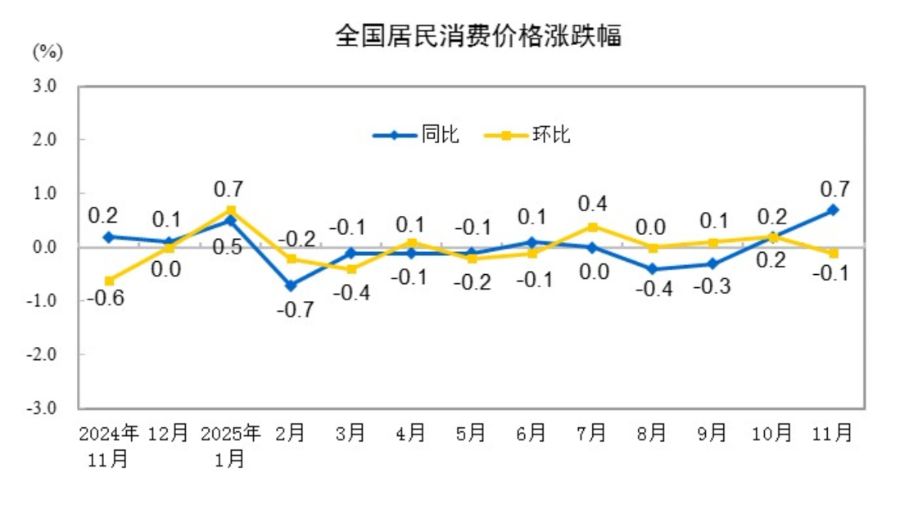
(全国居民消费价格涨跌幅来源:国家统计局) 核心CPI涨幅连续三月保持1%以上 同比来看,11月份,CPI同比上涨0.7%。其中,城市上涨0.7%,农村上涨0.4%;食品价格上涨0.2%,非食品价格上涨0.8%;消 费品价格上涨0.6%,服务价格上涨0.7%。 1—11月平均,CPI与上年同期持平。 国家统计局数据显示,9月份,CPI同比下降0.3%;10月份,同比上涨0.2%。对比前两个月,CPI由降转涨后持续恢复,11月CPI 同比上涨0.7%,涨幅比上月扩大0.5个百分点。 21世纪经济报道记者冉黎黎北京报道12月10日,国家统计局发布的数据显示,2025年11月份,全国居民消费价格(CPI)同比上 涨0.7%,环比下降0.1%;全国工业生产者出厂价格(PPI)同比下降2.2%,环比上涨0.1%。值得注意的是,11月CPI同比上涨 0.7%,涨幅比上月扩大0.5个百分点,为2024年3月份以来最高。PPI环比上涨0.1%,连续两个月上涨。 国家统计局城市司首席统计师董莉娟解读称,CPI同比涨幅扩大主要是食品价格由降转涨拉动。食品价格由上月下降2.9%转为上 涨0.2%,对CPI同比的影响由上月下拉0.5 ...
化工龙头ETF(516220)跌近4%,"反内卷"持续加码推动落后产能出清,回调或可布局
Mei Ri Jing Ji Xin Wen· 2025-11-18 08:02
Group 1 - The core viewpoint of the article emphasizes the ongoing "anti-involution" policies that are driving the elimination of outdated production capacity, which in turn is contributing to a narrowing decline in the Producer Price Index (PPI) year-on-year [1] - The cyclical layout suggests focusing on sectors such as the textile and apparel chain, agricultural chemicals chain, export chain, and areas benefiting from "anti-involution" [1] - The agricultural chemicals chain shows stable demand, supported by an increase in cultivated land area for fertilizers and the rising penetration rate of genetically modified crops for pesticides [1] Group 2 - On the macroeconomic front, expectations of improved supply-demand dynamics in crude oil are strengthening the bottom support for oil prices, while coal prices are expected to oscillate at a long-term bottom, and natural gas import costs may decline [1] - The chemical leader ETF (516220) tracks a specific chemical index (000813), which selects listed companies from various sub-sectors such as chemical products, chemical fibers, fertilizers, and pesticides to reflect the overall performance of the chemical industry [1] - This index is characterized by high industry concentration and representativeness, providing an effective reference tool for investors interested in the dynamics of the chemical industry [1]
化工龙头ETF(516220)跌近4%,“反内卷”持续加码推动落后产能出清,回调或可布局
Mei Ri Jing Ji Xin Wen· 2025-11-18 06:49
Core Viewpoint - The ongoing "anti-involution" policy is driving the elimination of outdated production capacity, leading to a narrowing decline in the Producer Price Index (PPI) year-on-year [1] Industry Policy - The "anti-involution" initiative is promoting the clearance of outdated production capacity, which is positively impacting the PPI [1] - Key industry capacity governance is contributing to the improved PPI performance [1] Sector Focus - Investment recommendations include focusing on the textile and apparel chain, agricultural chemical chain, export chain, and sectors benefiting from the "anti-involution" policy [1] - The agricultural chemical chain shows stable demand, supported by an increase in cultivated area for fertilizers and a rise in pesticide usage due to the penetration of genetically modified crops [1] Macroeconomic Outlook - Expectations of improved supply-demand dynamics in crude oil are strengthening the bottom support for oil prices [1] - Coal prices are expected to experience long-term bottom fluctuations [1] - The cost of natural gas imports may decline [1] Chemical Industry Index - The chemical sector ETF (516220) tracks a specialized chemical index (000813), which selects listed companies involved in chemical products, chemical fibers, fertilizers, and pesticides [1] - This index reflects the overall performance of various sub-markets within the chemical industry and has high industry concentration and representativeness [1] - It serves as an effective reference tool for investors monitoring developments in the chemical industry [1]