人民币汇率走势

Search documents
黄金涨、美元跌,美联储年内首次降息来了!
Jing Ji Guan Cha Wang· 2025-09-18 00:28
Core Viewpoint - The Federal Reserve announced a 0.25 percentage point reduction in the federal funds rate target range to 4% - 4.25%, marking the first rate cut of the year and a resumption of easing measures since December of the previous year [2][4] Economic Indicators - Recent indicators show a slowdown in economic activity during the first half of the year, with job growth decelerating and a slight increase in the unemployment rate, although it remains low [3][4] - The inflation rate has risen and remains slightly elevated [3] Federal Reserve's Dual Mandate - The Federal Open Market Committee (FOMC) aims to maximize employment and maintain an inflation rate of 2%, while acknowledging the uncertainty in the economic outlook [4] - The FOMC has noted an increase in the risks associated with employment [4] Future Rate Expectations - Predictions suggest the Fed may lower rates to around 3% in the future, with potential further reductions by the end of 2026 [2][7] - The dot plot indicates that most Fed officials expect two more rate cuts in 2025, with some anticipating a total of five cuts to bring rates below 3% [7] Market Reactions - Following the rate cut announcement, the U.S. dollar index fell to 96.22, the lowest since February 2022, while gold prices surged, surpassing $3,700 per ounce [11][12] - The U.S. stock market experienced volatility, with the S&P 500 index slightly declining and the Nasdaq index also falling after an initial rise [12] Global Monetary Policy Implications - The Fed's rate cut may open up space for other countries to ease their monetary policies, as seen with the Bank of Canada also lowering its benchmark rate [8] - Analysts suggest that the Fed's actions could create favorable external conditions for domestic monetary easing in other countries, including China [8]


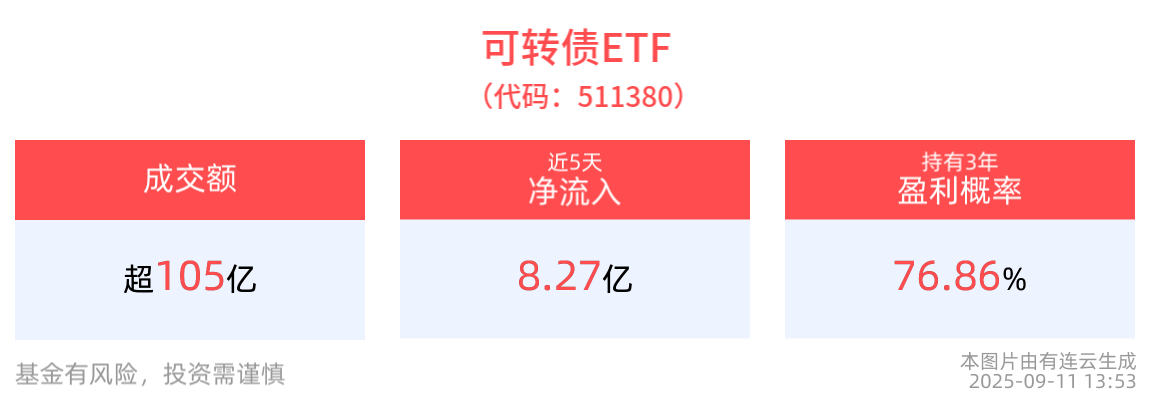
阿里巴巴拟发行可转债筹资约32亿美元,可转债ETF(511380)盘中一度涨超1%,近5日合计“吸金”8.27亿元
Sou Hu Cai Jing· 2025-09-11 06:25
Group 1 - The core viewpoint of the news is that Alibaba plans to issue zero-coupon convertible bonds maturing in 2032, aiming to raise $3.17 billion, which is expected to be the largest transaction of its kind this year [2] - The convertible bond ETF (511380) has seen a recent increase of 0.69%, with a latest price of 13.28 yuan, and a cumulative increase of 0.93% over the past week [2] - The trading volume of the convertible bond ETF was active, with a turnover rate of 16.52% and a transaction value of 10.546 billion yuan, indicating strong market activity [2] Group 2 - The latest scale of the convertible bond ETF reached 63.684 billion yuan, with a recent net outflow of 372 million yuan [3] - Over the past five trading days, there were three days of net inflow, totaling 827 million yuan, with an average daily net inflow of 165 million yuan [3] - The convertible bond market is significantly influenced by the interest rate environment and credit spread changes, with the current RMB exchange rate being supported by cross-border capital flows and rapid growth in domestic foreign exchange deposits [3]

每日机构分析:9月2日
Xin Hua Cai Jing· 2025-09-02 12:15
Currency and Economic Outlook - Citic Securities predicts that the RMB exchange rate may require more catalysts to break the 7 level, despite a recent appreciation driven by external and internal factors [1] - Goldman Sachs expects an acceleration in trading activity in France despite political turmoil, indicating that France remains an attractive investment destination [2] - MUFG analysts believe that the current political situation in France is unlikely to disrupt the upward trend of the euro [3] - Deutsche Bank reports that the UK 30-year government bond yield has reached its highest level since 1998, raising concerns about public finance sustainability [3] Inflation and Interest Rates - CICC forecasts that the US inflation rate may continue to rise, impacting the bond market dynamics [4] - Huatai Securities emphasizes that a potential rate cut by the Federal Reserve could drive down real interest rates in the US, benefiting gold investments [5] - The analysis suggests that unless the US economy returns to a high-growth, low-inflation scenario, the current gold buying strategy may persist [5] Investment Opportunities - The report highlights that typical gold companies currently have favorable valuations and are expected to benefit significantly from rising gold prices and increased production [5] - The narrowing gold-silver ratio is anticipated to occur after a period of monetary easing, suggesting potential investment opportunities in silver if the economy stabilizes post-rate cuts [5]




中国股市大涨 - 人民币(CNH)会跟上吗?
2025-08-31 16:21
Summary of Key Points from the Conference Call Industry and Company Involved - **Industry**: Chinese Equities and Foreign Exchange (FX) Market - **Company**: UBS AG Core Insights and Arguments 1. **CNH Catch-Up Potential**: There is potential for near-term gains in CNH due to rising expectations of Fed rate cuts and a rebound in Chinese equities, with a fair value improvement to 7.00 on models [1][3][5] 2. **FX Management Changes**: The People's Bank of China (PBoC) has shown a gradual tolerance for modest RMB strength, as indicated by the recent decline in USD/CNY fixings, suggesting a shift in FX management policy [2][7] 3. **Tariff Impact on CNH**: A significant reduction in USD/CNH to below 7.00 would require improved US-China trade relations, with a potential need to lower tariffs from approximately 35% to 20% [3][30] 4. **CTA Positioning**: Current positioning by Commodity Trading Advisors (CTAs) is heavily short on CNH, which could lead to a rapid decline in USD/CNH if daily fixings support continues [4][40] 5. **Balance of Payments (BoP) Improvement**: China's current account balance has reached a 10-year high, indicating strong BoP flows that should typically support CNH appreciation [5][20] 6. **Market Sentiment**: Despite the favorable conditions for CNH, the market has not fully embraced the potential for appreciation, with the onshore market remaining around 7.18 [2][18] 7. **Volatility and Carry Trade**: The current low volatility environment for CNH presents risks for carry trades, which could be vulnerable to shifts in FX policy [41][52] Other Important but Potentially Overlooked Content 1. **Historical Context of FX Management**: The current tight trading range for CNH reflects the strongest FX management seen in the last decade, coinciding with the new PBoC governor's tenure [7][10] 2. **Equity Market Correlation**: The relationship between CNH and Chinese equities has weakened, with a notable decline in beta values, indicating a decoupling of these markets [10][12] 3. **Consumer and Business Confidence**: Domestic activity remains weak, with consumer and business confidence lagging, which may affect CNH's performance [52][56] 4. **Potential Regional Impact**: Changes in CNH could influence regional currencies, although the sensitivity of these currencies to CNH movements has been historically low [58][60] 5. **Future Rate Expectations**: If growth expectations rebound, there could be upward pressure on China’s interest rates, but the bar for a sustained rebound is considered high due to ongoing economic challenges [67][69] This summary encapsulates the key points discussed in the conference call, highlighting the dynamics of the Chinese equities and FX market, particularly focusing on CNH's potential movements and the broader economic context.
人民币汇率短期或偏强运行
Zheng Quan Ri Bao· 2025-08-26 16:28
Core Viewpoint - The recent appreciation of the Renminbi (RMB) against the US dollar is attributed to both external and internal factors, including signals from the Federal Reserve and a strong domestic capital market [1][2]. External Factors - The shift in the Federal Reserve's policy has opened up space for RMB appreciation, leading to a significant drop in the US dollar index [2]. - The weakening of the US dollar has encouraged export companies to accelerate their currency conversion, contributing to the RMB's strength [2]. Internal Factors - The recent recovery of the domestic capital market, particularly the A-share market, has increased risk appetite and led to a rise in cross-border capital inflows into RMB assets [2]. - China's stable economic growth and favorable foreign trade conditions, along with a high trade surplus, have improved market sentiment and reduced concerns over trade tensions [2]. Short-term Outlook - The RMB exchange rate is expected to continue fluctuating within a range, supported by stable domestic economic performance and increased currency conversion by enterprises [3]. - A slight adjustment in the RMB exchange rate was observed following a significant rise, influenced by technical corrections and a minor rebound in the US dollar index [2]. Long-term Outlook - The RMB is anticipated to maintain a strong position in the short term, with potential for appreciation, while the long-term outlook remains stable due to the Federal Reserve's policies and domestic economic stability [3]. - The risks of significant appreciation or depreciation of the RMB are considered low, with ample policy space for counter-cyclical adjustments to ensure economic stability [3].
6月外汇市场分析报告:人民币汇率升值行情延续,银行结售汇顺差继续扩大
Bank of China Securities· 2025-07-27 06:41
Report Industry Investment Rating - Not provided in the given content Report's Core View - In June, the uncertainty of US trade policy continued to ease, and Sino-US economic and trade consultations made new progress. With the increasing expectation of the Fed's interest rate cut, the US dollar index continued to decline with an enlarged decline, the RMB bilateral exchange rate gradually appreciated, and the multilateral exchange rate continued to weaken. This helps enhance the competitiveness of China's export products, but attention should be paid to the international community's attention and even speculation on China's currency issues [2]. - Against the backdrop of the easing of Sino-US economic and trade conflicts in June, the net inflow of cross - border funds slowed down, mainly due to the small net outflow of securities investment and the expansion of the net outflow scale of income and current transfers. However, thanks to the strong resilience of China's foreign trade exports, the surplus of goods trade receipts and payments increased month - on - month, reaching a record high for the same period, and continued to play a stabilizing role in cross - border capital flows [2]. - In June, bank settlement and sales of foreign exchange showed a surplus for the fourth consecutive month, and the surplus scale expanded month by month. In May and June, the market's on - the - spot settlement willingness and purchase motivation both decreased, and the purchase motivation was relatively stable, indicating that the market's expectation of the RMB exchange rate continued to diverge, and the demand for foreign exchange purchase at low prices was relatively strong [2]. Summary According to Related Catalogs 1. Exchange Rate Situation - In June, the US trade policy uncertainty continued to ease, and Sino - US economic and trade consultations achieved new progress. After the leaders' phone call on June 5, the first meeting of the Sino - US economic and trade consultation mechanism was held in London from June 9 - 10, reaching a principled framework, and on June 27, the details of the framework were further confirmed [3]. - In June, the US dollar index continued to decline since February, dropping to 96.8 at the end of the month, a new low since March 2022. The monthly decline expanded from 0.2% last month to 2.7%, with a cumulative decline of 2.0% in late June. The expectation of the Fed's interest rate cut increased. The market expected the probability of three interest rate cuts by the Fed within the year to exceed 50% [4]. - In June, the RMB exchange rate continued to appreciate slowly. The appreciation of the central parity rate expanded from 0.2% last month to 0.4%, while the appreciation of on - shore and off - shore spot exchange rates narrowed from 0.9% last month to 0.4% and 0.7% respectively. The divergence of the "three prices" of the RMB exchange rate continued to converge [4]. - The three major RMB exchange rate indices all declined. The CFETS RMB exchange rate index and the RMB exchange rate index referring to the BIS currency basket fell for the sixth consecutive month, with the month - on - month decline expanding from 0.2% and 0.5% last month to 0.6% and 0.9% respectively; the RMB exchange rate index referring to the SDR currency basket turned from rising to falling, with a month - on - month decline of 0.9% [5]. 2. Cross - border Capital Flows - In June, the surplus of banks' foreign - related receipts and payments on behalf of customers continued for the fifth consecutive month, but the surplus scale decreased by $7.7 billion month - on - month to $25.3 billion. The RMB foreign - related receipts and payments on behalf of customers turned from a surplus of $2.6 billion last month to a deficit of $21.6 billion, contributing 316% to the narrowing of the surplus. The foreign - currency foreign - related receipts and payments on behalf of customers continued to have a surplus, increasing by $16.6 billion month - on - month to $47 billion, a new high since October last year [10]. - In June, securities investment foreign - related receipts and payments turned from a surplus of $5.2 billion last month to a deficit of $5.6 billion. Overseas institutions continued to reduce their holdings of RMB bonds, with the balance of bonds held decreasing by 116.1 billion yuan, an increase of 19.8 billion yuan from last month. However, foreign investors' willingness to increase their holdings of domestic stocks increased. In the first half of the year, foreign investors net - increased their holdings of domestic stocks and funds by $10.1 billion, and the net - increase scale in May and June reached $18.8 billion [11][12]. - In June, the deficit of income and current transfers expanded for the fourth consecutive month to $26.9 billion. The surplus of goods trade foreign - related receipts and payments increased by $7.6 billion month - on - month to $66.8 billion, reaching a record high for the same period. The deficit of service trade narrowed for the fifth consecutive month to $8.1 billion, the lowest since July 2023. The deficit of direct investment narrowed for the second consecutive month to $2.7 billion, the lowest since November last year [12]. 3. Bank Settlement and Sales of Foreign Exchange - In June, bank settlement and sales of foreign exchange (including forward and options) showed a surplus for the fourth consecutive month, and the surplus scale increased by $6.7 billion month - on - month to $32.1 billion. The surplus of bank settlement and sales of foreign exchange on behalf of customers increased by $8.3 billion to $25.6 billion, the deficit of banks' own settlement and sales of foreign exchange narrowed for the second consecutive month, and the net purchase scale of forward and options foreign exchange derivatives continued to decline [20]. - From May to June, the surplus of banks' foreign - currency foreign - related receipts and payments on behalf of customers and the surplus of bank settlement and sales of foreign exchange on behalf of customers continued to expand, and the gap between them widened. The market's overall settlement willingness and purchase motivation both decreased, indicating that the market's expectation of the RMB exchange rate continued to diverge, and the demand for foreign exchange purchase at low prices was relatively strong [21]. - In June, the settlement willingness of foreign trade enterprises and the household sector increased, and the purchase motivation decreased. The forward settlement hedging ratio ended its five - month upward trend, and the forward purchase hedging ratio stopped falling and rebounded, indicating that relevant market players' exchange rate expectations were biased towards depreciation [25].
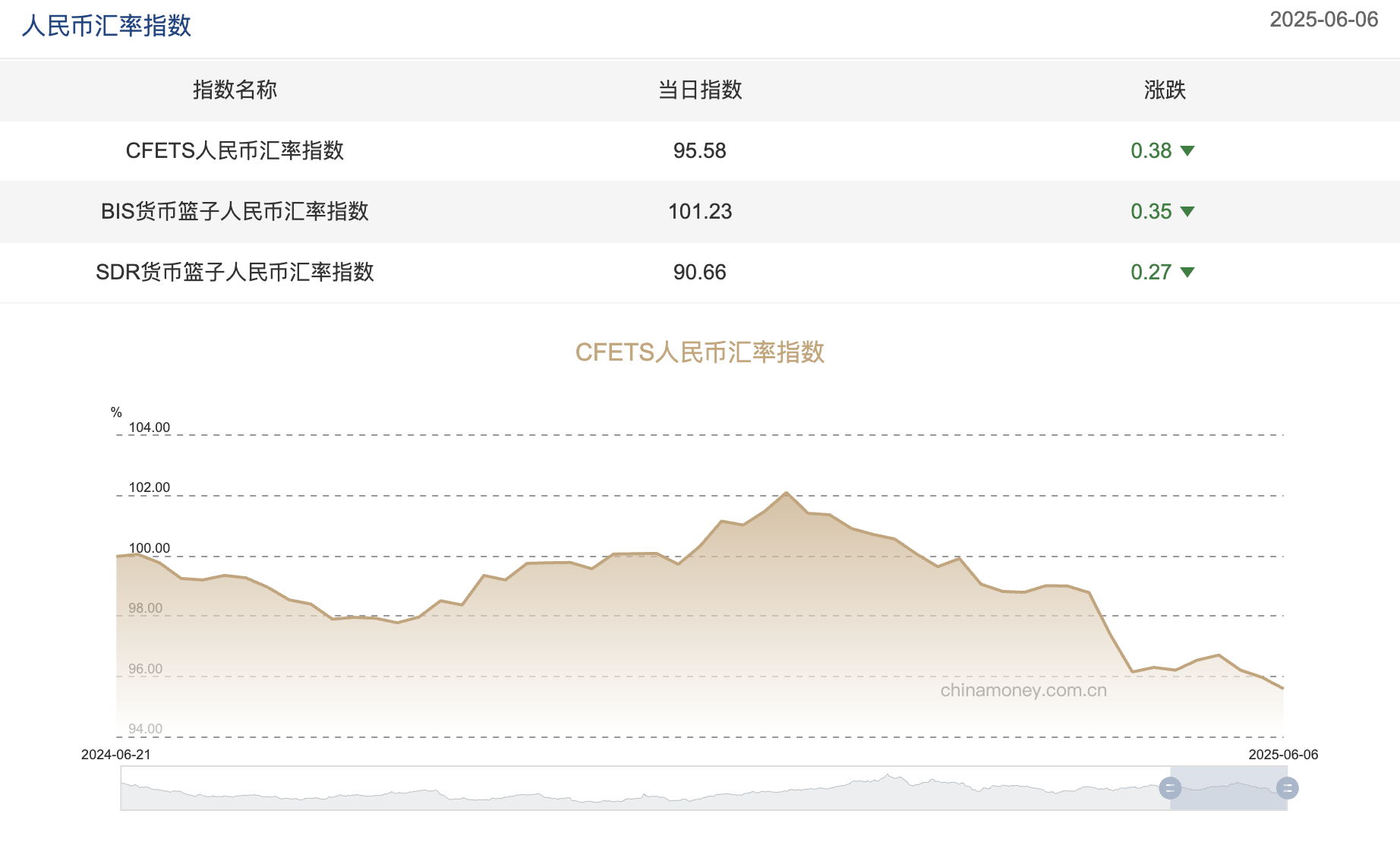
三大人民币汇率指数全线下跌,CFETS按周跌0.38
Xin Hua Cai Jing· 2025-06-09 03:11
Core Viewpoint - The Chinese yuan's exchange rate indices have all declined, reaching their lowest levels since December 2020 and July 2023, indicating a weakening trend in the yuan against other currencies [1][2]. Exchange Rate Indices - CFETS yuan exchange rate index is reported at 95.58, down 0.38 week-on-week, marking the lowest since December 2020 [1] - BIS currency basket yuan exchange rate index stands at 101.23, down 0.35 week-on-week, the lowest since July 2023 [1] - SDR currency basket yuan exchange rate index is at 90.66, down 0.27 week-on-week [1] Dollar Performance - The US dollar has experienced a weekly decline of 0.24%, closing at 99.2, influenced by tariff policies and economic data [5] - Non-US currencies have generally appreciated against the dollar, with the euro rising 0.42% to 1.13, the British pound increasing by 0.54%, and the Australian dollar up 0.95% to 0.649 [5] Analyst Insights - Analysts suggest that despite strong US non-farm payroll data, the underlying trends indicate a slowing economy, leading to expectations that the Federal Reserve will not adopt a more hawkish stance, which will keep the dollar under pressure [5] - Goldman Sachs predicts a new phase of dollar depreciation, with overseas investors diversifying their investments away from US assets [5][6] Future Yuan Outlook - Deutsche Bank and Morgan Stanley have raised their economic growth forecasts for China in 2025, suggesting that trade competitiveness will support a stronger yuan in the long term [6][7] - Deutsche Bank forecasts the yuan to appreciate to 7.0 against the dollar by the end of 2025 and further to 6.7 by the end of 2026 [8] - Goldman Sachs also anticipates a gradual rise of the yuan to 7.0 against the dollar over the next 12 months, supported by several factors including central bank interventions and improved export competitiveness [8] Foreign Exchange Reserves - As of the end of May, China's foreign exchange reserves stood at $32,853 billion, an increase of $36 billion from the end of April, supported by improving economic conditions [9] - The People's Bank of China reported a gold reserve of 73.83 million ounces (approximately 2,296.37 tons), marking a continuous increase for seven months [10]
未名宏观|2025年5月汇率月报—美欧货币政策或分化继续,人民币震荡前行
Sou Hu Cai Jing· 2025-06-05 10:39
Core Viewpoint - The RMB exchange rate is expected to fluctuate between 7.0 and 7.3 in June 2025, influenced by various domestic and international factors, including U.S. economic uncertainty and global monetary policy trends [6][7]. Market Review - In May 2025, the RMB exchange rate fluctuated within the range of 7.1722 to 7.2461, with the onshore rate between 7.1843 and 7.2461, the central parity rate between 7.1833 and 7.2095, and the offshore rate between 7.1722 and 7.2437 [3][4]. - Key factors affecting the RMB exchange rate included the easing of high tariffs during the U.S.-China trade talks, Moody's downgrade of U.S. sovereign credit rating, and significant increases in Japanese long-term bond yields [3][4]. - The Bank of England and the Bank of Korea both announced interest rate cuts in May, contributing to a global trend of monetary easing [3]. Domestic Factors - China's economy remained relatively stable amid global high tariffs and geopolitical tensions, with the central bank lowering the reserve requirement ratio by 0.5 percentage points, expected to release approximately 1 trillion yuan in long-term liquidity [4]. - Following the U.S.-China trade talks, several international investment banks raised their GDP growth forecasts for China, with UBS increasing its forecast from 3.4% to between 3.7% and 4.0% [4]. Future Outlook for RMB Exchange Rate - The uncertainty surrounding the Trump administration's policies may lead to short-term shocks to the U.S. economy, with the OECD lowering its U.S. GDP growth forecast from 2.2% to 1.6% [6]. - The potential for continued monetary easing in major global economies, including the Eurozone, may support the RMB [6]. - However, concerns over rising inflation due to U.S. tariff policies may lead the Federal Reserve to pause interest rate cuts, which could negatively impact the RMB [6][7].

关税风暴下的人民币汇率走势前瞻 | 政策与监管
清华金融评论· 2025-05-22 10:56
Core Viewpoint - The article discusses the impact of Trump's tariff policies on the RMB exchange rate, suggesting that despite the intensification of tariffs in the Trump 2.0 era, the RMB has not depreciated as expected, indicating a potential for two-way fluctuations in the exchange rate [1][2]. Tariff Impact on RMB Exchange Rate - During Trump's first term (Trump 1.0), tariffs imposed from 2018 to 2019 caused the RMB to depreciate from 6.28 to around 7.10 against the USD, with a decline of over 10% in both the onshore and offshore markets [2][4]. - In the Trump 2.0 era, tariffs have escalated to a maximum of 145%, leading to a near halt in US-China trade, yet the overall impact on the RMB has been limited [2][4]. Recent Developments - As of April 18, 2025, the onshore RMB midpoint and spot rates have only decreased by 0.07% and 0.26% respectively since the beginning of the year, while the offshore RMB (CNH) has actually increased by 0.46% [4]. - The RMB strengthened in the first quarter of 2025, with the onshore midpoint, spot rate, and CNH rising by 0.14%, 0.65%, and 0.99% respectively, attributed to several factors including lower-than-expected tariffs and positive market sentiment towards Chinese assets [5]. Market Reactions and Economic Outlook - Following the announcement of the third round of tariffs in April 2025, the RMB experienced a decline, with the onshore midpoint and spot rates dropping to new lows since September 2023 [7]. - The aggressive tariff policies have led to a significant depreciation of the USD, with the dollar index falling below 100, which has helped stabilize the RMB [8]. Economic and Policy Divergence - The article highlights that the divergence in economic cycles between China and the US has led to differing monetary policies, contributing to the pressure on the RMB [10]. - The US is facing economic challenges due to Trump's policies, which have increased market uncertainty and the risk of recession, impacting the overall economic outlook for 2025 [11].

离岸人民币兑美元汇率盘中升至7.1892
Sou Hu Cai Jing· 2025-05-05 10:50
Core Viewpoint - The offshore RMB has strengthened against the USD, breaking the 7.20 mark for the first time since November 2024, driven by reduced risk sentiment and market optimism regarding US-China trade negotiations [2][5]. Exchange Rate Movement - Since reaching a low of 7.4, the offshore RMB has appreciated nearly 2.7% from April 8 to the present [2]. - On May 5, the offshore RMB/USD rate peaked at 7.1892 before slightly retreating to around 7.2041 by the end of the day [2]. - The recent surge began on April 30, with the offshore RMB rising from 7.27 to below 7.20, marking a 1% increase [2]. Market Sentiment and Influences - Market expectations of progress in US-China trade talks and reduced tensions have contributed to the RMB's strength [5]. - The Chinese Ministry of Commerce noted the US's willingness to negotiate on tariffs, which has been positively received by the market [5]. - A crowded long position in the USD and changing market dynamics regarding US economic conditions have triggered a new wave of USD selling [5]. Regional Currency Trends - The RMB's rise coincides with appreciation in other Asia-Pacific currencies, such as the Malaysian Ringgit, South Korean Won, and Thai Baht, all gaining over 1% against the USD [6]. - The Hong Kong Dollar has also strengthened, reaching its trading limit, influenced by the strong performance of the RMB and capital inflows from mainland China [6][7]. Capital Flows and Market Dynamics - Significant capital inflows from mainland China into Hong Kong have been observed, with net purchases through the Stock Connect channels reaching 570.9 billion CNY in 2025 [7]. - The upcoming dividend payments from Chinese companies listed in Hong Kong, totaling 36.1 billion USD, are expected to increase demand for the Hong Kong Dollar [7]. Future Outlook - The RMB exchange rate is expected to remain volatile in the second quarter but may stabilize over the year due to potential macroeconomic stimulus measures from the Chinese government [8]. - The People's Bank of China is anticipated to implement further monetary easing, including possible reserve requirement ratio cuts and interest rate reductions [8]. - The future trajectory of the RMB will depend on the progress of US-China negotiations and the potential recovery of Chinese exports [8][9].