加盟扩张

Search documents
又计提1.7亿商誉减值!潮宏基赴港上市能否海外破局?
凤凰网财经· 2025-11-16 13:10
Core Viewpoint - The article discusses the financial performance and strategic challenges faced by the jewelry brand Chao Hong Ji, highlighting its revenue growth, profitability issues, and the impact of goodwill impairment on its financial results [3][5][7]. Financial Performance - In the first three quarters of 2023, Chao Hong Ji reported revenue of 6.237 billion yuan, a year-on-year increase of 28.35%, while net profit attributable to shareholders was 317 million yuan, a slight increase of 0.33% [3]. - The third quarter alone saw revenue of 2.135 billion yuan, a significant year-on-year growth of 49.52%, but the company faced a net loss of 14.2795 million yuan due to a 170 million yuan goodwill impairment [3][4]. Goodwill Impairment - The company has experienced unstable profitability, with net profit growth rates of -43.22%, 67.41%, -41.91%, and 0.33% from 2022 to 2024 [5]. - Goodwill impairment has been a key factor affecting profitability, with cumulative impairments reaching 466 million yuan over the past four years, primarily due to the high goodwill from the acquisition of the handbag brand FION [5][7]. Strategic Initiatives - To capture the rising trend of young consumers, Chao Hong Ji has implemented strategies such as "lightweight gold," "fixed-price gold," and "IP collaborations," which have contributed to revenue growth despite market challenges [4][9]. - The company is also focusing on expanding its overseas market presence, with plans to open 20 self-operated stores abroad by the end of 2028, although its current overseas revenue contribution is less than 1% [4][15]. Challenges and Risks - The expansion of the franchise model has led to a significant increase in the number of franchise stores, with a total of 1,412 stores as of the end of the third quarter of 2023, but this has not effectively translated into profitability [10][11]. - The overall gross margin has been declining for seven consecutive quarters, dropping from 22.6% in 2022 to 16.6% in 2024, primarily due to the increased proportion of lower-margin gold products in the franchise model [12][13].



从老人鞋到有机食品 足力健加盟转型藏隐忧
Zhong Guo Jing Ying Bao· 2025-11-14 12:36
Core Insights - The company is attempting to revive its growth story by expanding into the organic food sector through a franchise model, transitioning from direct sales to a combination of direct and joint operations [1][2] - The expansion into organic food is seen as a self-rescue measure to recover funds and repay debts, as the company is currently facing significant financial challenges [1][3] - Industry experts highlight that while the organic food market aligns with current trends, the company's success will heavily depend on its operational capabilities, which may not easily transfer from its existing business [1][2] Business Strategy - The organic food business has opened approximately 60 stores within five months and has attracted over 90,000 members, primarily through low pricing strategies and a membership system [2] - The company aims to address the health food needs of the elderly demographic, maintaining a strategic focus on this target group [2][3] - The shift to a franchise model is intended to alleviate debt pressure and operational challenges, allowing the company to focus on product development and brand management [4][5] Financial Situation - The company has faced a significant decline in its main business, with 70%-80% of its annual revenue being used to service debts, amounting to approximately 700 million yuan due by the end of 2024 [3][4] - The franchise model allows the company to quickly recover funds through franchise fees and consumer prepayments, while minimizing the financial burden on franchisees [5][6] Market Challenges - The organic food sector presents inherent challenges, including the need for stringent supply chain management and quality control, which differ significantly from the company's core business [3][7] - The company is currently reliant on contract manufacturers for its organic food products, which raises concerns about quality management as it expands rapidly [7][8] - Increased competition from established players in the organic food market may pose additional challenges for the company [7][8] Recommendations - Experts suggest that the company should focus on solidifying its core business in elderly footwear, which still has substantial growth potential due to the aging population [8][9] - There is a call for the company to enhance its franchise management and product quality to ensure sustainable growth and profitability [9]
百胜中国(09987):点评报告:3Q25业绩符合预期,加盟赋能门店扩张
Haitong Securities International· 2025-11-05 14:01
Investment Rating - The report maintains an "Outperform" rating for Yum China Holdings [2][13] Core Insights - The company's 3Q25 performance met expectations, with revenue of USD 3.206 billion, a year-on-year increase of 4%, and adjusted net profit of USD 282 million, a year-on-year decrease of 5% [3][12] - Same-store sales continued to show positive growth, with overall sales increasing by 4%, and KFC and Pizza Hut sales growing by 5% and 4% respectively [3][4] - The company plans to expand its store network significantly, with a target of adding 1,600 to 1,800 new stores in 2025, supported by franchise strategies [4][5] Financial Performance Summary - For the first three quarters of 2025, total revenue reached USD 8.974 billion, a 3% increase year-on-year, while adjusted net profit was USD 789 million, down 1% [3][12] - The company reported a gross profit margin of 68.2% for 2025, with expectations of gradual improvement in the coming years [7][13] - The forecast for revenue from 2025 to 2027 is USD 11.63 billion, USD 12.16 billion, and USD 12.76 billion respectively, with year-on-year growth rates of 2.9%, 4.6%, and 4.9% [7][13] Store Expansion and Franchise Strategy - As of 3Q25, Yum China had a total of 17,514 restaurants, with a net increase of 536 stores in the third quarter alone [4] - The company aims for franchise stores to account for 40%-50% of new KFC stores and 20%-30% of new Pizza Hut stores [4][5] - The restaurant profit margin improved to 17.3%, driven by reductions in food and packaging costs, as well as lower rental and operational expenses [4][7] New Business Developments - The membership base for KFC and Pizza Hut reached approximately 575 million, with member sales accounting for 57% of total sales [5] - Digital orders contributed USD 2.8 billion, representing 95% of restaurant revenue [5] - The new coffee brand, KFC Coffee, has exceeded expectations with over 1,800 locations and significant sales growth [5] Shareholder Returns - In 3Q25, the company returned USD 410 million to shareholders, with USD 330 million in stock buybacks and USD 90 million in cash dividends [5] - The company is on track to meet its goal of returning USD 1.5 billion to shareholders by the end of 2025 [5][7]
要卖啤酒了?蜜雪冰城斥资近3亿元,拿下鲜啤福鹿家53%股权
Sou Hu Cai Jing· 2025-10-02 10:37
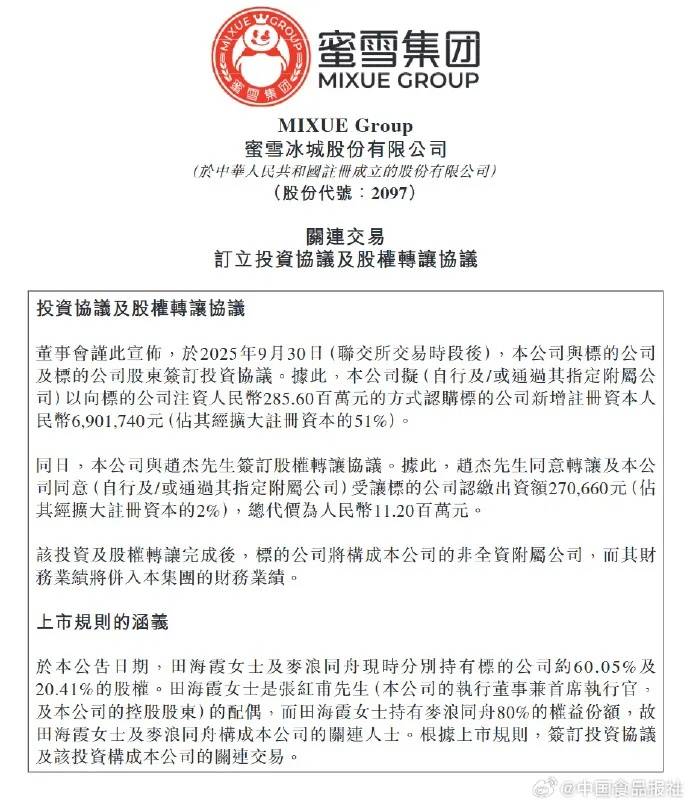
Core Viewpoint - Mijue Ice City has acquired a 53% stake in Fresh Beer Fulu Family for approximately 297 million RMB, expanding its product offerings to include freshly brewed beer, aligning with its mission to provide high-quality and affordable products to consumers [1][5]. Group 1: Investment and Acquisition - The investment in Fresh Beer Fulu Family is seen as a strategic move for Mijue Ice City to diversify its product range and tap into the freshly brewed beer market [1][5]. - Fresh Beer Fulu Family operates under a franchise model, similar to Mijue Ice City and Lucky Coffee, which allows for rapid expansion of its store network [5][6]. Group 2: Financial Performance and Growth - Mijue Group reported a revenue of 14.87 billion RMB in the first half of 2025, a year-on-year increase of 39.3%, with product and equipment sales contributing 14.49 billion RMB, up 39.6% [5]. - The gross profit margin for product and equipment sales was 30.3%, while the margin for franchise and related services was significantly higher at 82.7% [5]. - As of June 30, 2025, Mijue Group had over 53,000 stores globally, with 48,281 located in China [5].

冷饮更贵! 肯德基1元差价遭声讨,冰块刺客?
Xin Lang Ke Ji· 2025-09-06 08:52
Core Viewpoint - The pricing discrepancy between iced and hot soy milk at KFC has sparked widespread consumer debate, with many questioning the rationale behind the higher price for iced soy milk, leading to complaints and even product withdrawals in some locations [1][4][5]. Pricing Discrepancy - KFC has maintained that iced soy milk is priced higher than hot soy milk due to a difference in cup size and capacity, with iced soy milk being approximately 1/4 larger [3][4]. - Industry analysts suggest that the higher cost for iced drinks is justified by the increased energy consumption for refrigeration and the complexity of the ice-making process [4]. Customer Complaints - KFC has faced a significant number of customer complaints, totaling over 20,000, primarily related to food quality, service issues, and after-sales support [5]. - Specific complaints include the presence of foreign objects in food, unresponsive customer service, and complicated refund processes, indicating a gap between service quality and consumer expectations [5]. Sales Performance - KFC remains a crucial revenue source for Yum China, contributing approximately 70% of its total revenue. In the first half of 2025, KFC's sales grew by 4% year-on-year, with total revenue reaching $43.42 billion [6][7]. - The growth in sales is largely attributed to the expansion of store locations rather than organic growth, with KFC's store count reaching 12,238 by mid-2025 [7]. Store Expansion and New Ventures - KFC is accelerating its store expansion, with a net addition of 295 stores in the second quarter of 2025 and a significant increase in franchise stores, which accounted for 39% of new openings [7]. - The company is also diversifying its offerings by launching new sub-brands, such as "Fried Chicken Brothers," indicating a strategic move to capture more market segments [8].

潮宏基上半年净利润同比增长44.34% 拟每10股派1元
Zheng Quan Ri Bao Zhi Sheng· 2025-08-22 14:05
Core Insights - The company,潮宏基, reported a revenue of 4.102 billion yuan for the first half of 2025, representing a year-on-year growth of 19.54% [1] - The net profit attributable to shareholders reached 331 million yuan, marking a 44.34% increase compared to the previous year [1] - The company announced a cash dividend of 1 yuan per 10 shares, continuing its strategy of stable shareholder returns [1] Revenue and Profit Growth - The growth was driven by franchise expansion and brand differentiation, with a total of 1,540 jewelry stores by June 2025, including 1,340 franchise stores, an increase of 72 stores since the beginning of the year [1] - The company focused on three core product lines: heritage craft series, bead products targeting young consumers, and collaborations with popular IPs and cross-border artists [1] Digital and International Expansion - The company is pursuing a dual-track strategy of internationalization and digitalization, achieving breakthroughs in Southeast Asia with strong performance in Malaysia, Thailand, and Cambodia [2] - Digital tools are being utilized to optimize supply chain management for franchisees, enhancing inventory turnover efficiency and driving terminal profit growth [2]
百胜中国(9987.HK):Q2同店表现优异 经营利润超预期
Ge Long Hui· 2025-08-06 19:48
Core Viewpoint - Yum China reported a revenue of $2.787 billion for Q2 2025, reflecting a year-over-year increase of 4%, and a total revenue of $5.768 billion for the first half of 2025, up 2% year-over-year [1] Financial Performance - Q2 operating profit reached $304 million, a 14% increase year-over-year, exceeding the consensus estimate of $292 million, with an operating margin of 10.9%, up 1 percentage point year-over-year [1] - The net profit attributable to shareholders for Q2 was $215 million, a 1% increase year-over-year, with a net profit margin of 7.7%, down 0.2 percentage points year-over-year [1] - For the first half of 2025, operating profit was $703 million, a 10% increase year-over-year, and a 11% increase when excluding foreign currency translation effects [1] Store Expansion and Capital Expenditure - As of June 30, 2025, the company operated 16,978 stores, with a net addition of 336 stores in the quarter, of which 89 were franchised, accounting for 26% [2] - The company achieved its target for the proportion of new franchised stores, with KFC and Pizza Hut's new franchised store ratios at 41% and 26%, respectively [2] - The average capital expenditure per KFC and Pizza Hut store was optimized to $1.4 million and $1.1-1.2 million, respectively [2] Future Guidance - The company maintains its guidance for net new store openings of 1,600-1,800 for the year and has increased the KFC store opening target from 1,500 to 1,700 [3] - The company expects a gradual increase in the proportion of new franchised stores and a moderate increase in operating profit margins for 2025 [3] Shareholder Returns - The company maintains a shareholder return guidance of $3 billion for 2025-2026, with expectations of increased free cash flow starting in 2025 due to reduced capital expenditures [4] - The target price is set at HKD 444.80 / USD 56.66, maintaining a "buy" rating, with slight adjustments to revenue and net profit forecasts for 2025-2027 [4]
直营店不够加盟店来凑,百胜中国重申全年1600-1800家开店目标
3 6 Ke· 2025-08-06 11:05
Core Insights - Yum China Holdings, Inc. reported its Q2 and H1 2025 performance amidst a challenging dining consumption market, showing steady revenue and profit growth, particularly driven by Pizza Hut's high-value strategy, while KFC's same-store traffic remained stagnant [1][3][24] Financial Performance - For H1 2025, Yum China's total revenue reached $5.768 billion, a 2% year-over-year increase; operating profit was $703 million, up 10%; and net profit was $507 million, also a 2% increase [3] - In Q2 2025, total revenue grew 4% to $2.8 billion, with operating profit increasing 14% to $304 million, marking a historical high for the quarter [3] - Pizza Hut's same-store sales rose 2% in Q2, driven by a 17% increase in transaction volume, although this came at the cost of a 13% decline in average ticket price [3][5] Brand Performance - Pizza Hut's significant profit growth of 22% in H1 2025, reaching $106 million, indicates the effectiveness of its high-value strategy [3] - KFC's same-store sales increased by 1% in Q2, but transaction volume remained flat, suggesting challenges in attracting new customers [5][24] - KFC's sales growth was primarily due to a higher proportion of takeout orders, reflecting changes in existing customer behavior rather than new customer acquisition [5] Expansion Strategy - Yum China continues to expand its store network, opening 781 KFC locations in H1 2025, with 255 being franchise stores, while closing 191 [6][9] - Pizza Hut opened 271 new stores, with 41 being franchises, but closed 131, resulting in a net addition of only 140 stores [9][12] - The company aims for a net addition of approximately 1,600 to 1,800 stores in 2025, with a focus on increasing the proportion of franchise stores [12][15] Market Penetration - KFC has over 12,000 stores across more than 2,430 cities, entering about 300 new cities in the past year, while Pizza Hut has over 3,800 stores in 900 cities, entering around 150 new cities [9][12] - KFC's strategy includes opening mini stores in lower-tier cities to adapt to local market conditions, while Pizza Hut's expansion in these areas is slower due to its reliance on high-end urban locations [15][16] New Growth Initiatives - Yum China is exploring new growth avenues through internal brand incubation, notably with its coffee business, KCOFFEE, which has expanded to over 1,300 locations [20] - The company is also focusing on health-oriented offerings through its KPRO brand, targeting urban professionals [20][24] - The strategy aims to leverage KFC's supply chain and brand strength to capture new market segments, although concerns about long-term sustainability of low-price strategies remain [24]