
地缘政治影响油价

Search documents
油价一夜下跌!今天1月6日调整后,全国加油站92、95汽油最新售价
Sou Hu Cai Jing· 2026-01-07 09:39
Core Viewpoint - The oil price is expected to increase due to a recent adjustment window, despite a recent trend of price decreases in December 2025. The anticipated increase is approximately 50 yuan per ton, translating to an increase of about 4 to 5 cents per liter, which could impact consumers significantly over time [1][2]. Price Trends - Brent crude oil is currently priced just above $60, while WTI is around $57, showing a slight increase compared to the end of last year. The geopolitical situation remains unpredictable, affecting oil prices [2]. - The International Energy Agency (IEA) predicts a surplus of nearly 5 million barrels per day in global oil supply during the first quarter of this year, which may limit price increases despite geopolitical tensions [2]. Regional Price Variations - The price of 92-octane gasoline varies across different regions in China, with Beijing at 6.70 yuan, Shanghai at 6.67 yuan, and Hainan at a significantly higher 7.82 yuan. This price discrepancy is attributed to local taxes and fees [2][4]. - In the Southwest region, prices are relatively high, with Sichuan at 6.81 yuan and Yunnan at 6.85 yuan. The price of 98-octane gasoline is even higher, with prices reaching up to 9.30 yuan in Hainan [4]. Consumer Behavior - There is a noticeable trend of consumers rushing to fill up their tanks before the price increase, even if the difference is minimal. This behavior reflects a psychological tendency to avoid spending more than necessary [6][7]. - The overall trend in 2025 shows that there were 25 price adjustments, with 7 increases and 12 decreases, resulting in a net decrease of nearly 900 yuan per ton for the year. Despite the upcoming increase, prices remain lower than at the beginning of the year [6].

原油月报:油价大幅波动,地缘成为主要锚点
Xin Lang Cai Jing· 2026-01-04 23:13
Core Viewpoint - The oil market experienced significant volatility in December 2025, primarily driven by geopolitical tensions and an oversupply of crude oil, with WTI and Brent crude prices declining by 1.93% and 3.72% respectively by the end of the month [5][32]. Group 1: Market Review - As of December 31, WTI crude futures closed at $57.42 per barrel, Brent at $60.85 per barrel, and INE crude at 436.5 yuan per barrel, reflecting monthly declines of 1.93%, 3.72%, and 3.19% respectively [5][32]. - The oil prices initially rose due to geopolitical tensions but fell sharply after news of potential ceasefire agreements between Russia and Ukraine, alongside bearish EIA data [6][33]. - The market saw a rebound after hitting a low of $60.16 per barrel for Brent, but the overall recovery was limited due to persistent oversupply [6][33]. Group 2: Global Supply Dynamics - Global crude oil supply remains significantly oversupplied, with U.S. crude production reaching 13.827 million barrels per day, the highest seasonal level in five years [11][38]. - U.S. crude oil demand decreased by 3.34% month-over-month, while commercial inventories stood at 422.888 million barrels, indicating a slight draw but still at a moderate seasonal level [11][38]. - The low oil prices have not substantially impacted the operational costs of U.S. shale oil production, which are estimated at around $45 per barrel [11][38]. Group 3: Geopolitical Factors - Geopolitical conflicts have become a major trading anchor, with significant events such as attacks on energy facilities by both Ukraine and Russia influencing market sentiment [23][50]. - The U.S. has intensified its blockade on Venezuela, impacting its oil exports, although the overall effect on global supply remains manageable [24][51]. - The ongoing tensions in the Middle East, particularly between Iran and Israel, are also contributing to market volatility and uncertainty [32].

光大期货能化商品日报-20251230
Guang Da Qi Huo· 2025-12-30 05:31
1. Report Industry Investment Rating No investment rating information is provided in the report. 2. Core View of the Report - The prices of various energy and chemical commodities are expected to fluctuate. Crude oil, fuel oil, asphalt, polyester, rubber, methanol, polyolefins, and polyvinyl chloride are all forecasted to maintain an oscillatory trend [1][2]. - The uncertainty in the Middle - East geopolitical situation and the US military strikes in Nigeria may impact the oil market. The increase in US oil inventories and the decrease in refinery processing volume also affect the oil price trend [1]. - The supply and demand fundamentals of different energy and chemical products vary. For example, low - sulfur fuel oil supply is sufficient, while high - sulfur fuel oil has some support; asphalt supply and demand are in a state of short - term stability and long - term uncertainty [2]. 3. Summary by Relevant Catalogs 3.1 Research Views - **Crude Oil**: On Monday, oil prices rose. WTI February contract closed up $1.34 to $58.08 per barrel, a 2.36% increase; Brent February contract closed up $1.30 to $61.94 per barrel, a 2.14% increase. SC2602 night - session closed at 436.9 yuan/barrel, up 1.3 yuan/barrel, a 0.3% increase. Geopolitical uncertainties in the Middle East and military strikes in Nigeria raised concerns about supply, but the increase in US inventories and the decrease in refinery processing volume also had an impact. With the New Year's Day holiday approaching, the market trading was light, and oil prices were expected to continue to fluctuate [1]. - **Fuel Oil**: On Monday, the main fuel oil contracts on the Shanghai Futures Exchange declined. The low - sulfur fuel oil market structure remained stable, and high - sulfur fuel oil had some support. Singapore was expected to receive more low - sulfur blending components, increasing local inventories. The short - term absolute prices of FU and LU might follow the oil price, and the increase in FU warehouse receipts might put additional pressure on the market [2]. - **Asphalt**: On Monday, the main asphalt contract on the Shanghai Futures Exchange rose. The arrival of diluted asphalt in ports was stable in the short term, and domestic refinery raw material supply in January was not affected by the US - Venezuela geopolitical event. Supply was expected to increase slightly at the end of the year but decrease in January. The demand in the southern region still had a tail - end effect, while in the north, it was mainly for stocking. The short - term asphalt price might follow the oil price and be relatively stronger than crude oil and fuel oil [2]. - **Polyester**: TA605 and EG2605 prices declined on Monday. PX futures and spot prices also fell. The production and sales of polyester yarn in Jiangsu and Zhejiang were weak. Some polyester plants had device maintenance plans, and the MEG port inventory increased. The PX market was in a game between reality and expectation, and the ethylene glycol price was expected to oscillate after a rebound [2][4]. - **Rubber**: On Monday, the main rubber contracts declined. The inventory of natural rubber in Qingdao increased. The precipitation in the producing areas eased, and the peak - production season overseas had about one more month. The raw material price had some support, but the downstream tire demand weakened. The rubber price was expected to oscillate [4][6]. - **Methanol**: On Monday, the methanol spot prices in different regions were reported. The Iranian device shutdown would lead to a decline in arrivals in January, but the MTO device load also decreased. The port inventory increased as the unloading speed recovered. Methanol was expected to maintain a bottom - oscillating trend [6]. - **Polyolefins**: On Monday, the prices of polyolefin products were given. The supply would remain at a high level, and the downstream demand was weakening. The polyolefin market was expected to maintain a low - level oscillating trend [6]. - **Polyvinyl Chloride (PVC)**: On Monday, the PVC market prices in different regions increased. The supply was at a high - level oscillation, and the domestic demand slowed down. The PVC market was a weak - reality and strong - expectation structure, and the price was expected to maintain a bottom - oscillating trend [7]. 3.2 Daily Data Monitoring - The report provides the basis data of various energy and chemical products on December 29, 2025 and December 26, 2025, including spot prices, futures prices, basis, basis rates, price changes, and the quantile of the latest basis rate in historical data [8]. 3.3 Market News - US President Trump and Ukrainian President Zelensky met in Florida to discuss a proposed Russia - Ukraine "peace agreement", but they did not reach an agreement on key issues such as territory and economic reconstruction. Russia planned to re - evaluate its position in the peace talks [10]. - The US Energy Information Administration (EIA) reported that US crude, gasoline, and distillate inventories increased last week. As of December 19, US crude inventory increased by 405,000 barrels to 424.822 million barrels, and the inventory at the Cushing delivery center increased by 707,000 barrels to 21.57 million barrels. The refinery processing volume decreased by 212,000 barrels per day, and the refinery capacity utilization rate decreased by 0.2 percentage points to 94.6%. US crude production decreased by 18,000 barrels per day to 13.83 million barrels per day [10]. 3.4 Chart Analysis - **4.1 Main Contract Prices**: The report shows the closing price charts of main contracts of various energy and chemical products from 2021 to 2025, including crude oil, fuel oil, low - sulfur fuel oil, asphalt, LPG, PTA, ethylene glycol, short - fiber, LLDPE, polypropylene, PVC, methanol, styrene, 20 - number rubber, natural rubber, synthetic rubber, European - line container shipping, and p - xylene [12][13][14][18][20][22][25][26][27]. - **4.2 Main Contract Basis**: The report presents the basis charts of main contracts of various energy and chemical products from 2021 to 2025, such as crude oil, fuel oil, low - sulfur fuel oil, asphalt, ethylene glycol, PP, LLDPE, natural rubber, 20 - number rubber, p - xylene, synthetic rubber, and bottle - chip [29][34][35][37][38][39]. - **4.3 Inter - period Contract Price Spreads**: The report provides the price spread charts of inter - period contracts of various energy and chemical products, including fuel oil, asphalt, European - line container shipping index, PTA, ethylene glycol, PP, LLDPE, and natural rubber [40][42][46][49][51][53][55]. - **4.4 Inter - variety Price Spreads**: The report shows the price spread and ratio charts of inter - variety contracts of various energy and chemical products, such as crude oil internal - external market, crude oil B - W, fuel oil high - low sulfur, fuel oil/asphalt, BU/SC, ethylene glycol - PTA, PP - LLDPE, and natural rubber - 20 - number rubber [57][59][68]. - **4.5 Production Profit**: The report presents the production profit charts of LLDPE and PP [65].
美委地缘变动频繁 燃料油预计整体跟随原油调整
Jin Tou Wang· 2025-12-19 05:58
Core Viewpoint - Fuel oil futures experienced a sharp decline, with the main contract dropping to a low of 2380.00 yuan, closing at 2383.00 yuan, reflecting a decrease of 2.22% [1] Group 1: Market Analysis - According to Everbright Futures, the absolute prices of high and low sulfur fuel oil (FU and LU) are expected to fluctuate in line with oil prices due to ample supply in the market [2] - Guotou Anxin Futures noted that geopolitical tensions, particularly between the US and Venezuela, have impacted the supply of high sulfur heavy raw materials, potentially providing temporary support to the market, although the sustainability of this support remains uncertain [3] - Ruida Futures indicated that the overall trend of fuel oil is likely to follow adjustments in crude oil prices, with short-term fundamentals appearing weak due to decreased refinery utilization rates and lower demand for ship fuel [3] Group 2: Supply and Demand Dynamics - Everbright Futures highlighted that the high and low sulfur fuel oil market remains under pressure due to sufficient supply, with expectations of reduced arbitrage volumes from Western markets to Singapore in December [2] - Guotou Anxin Futures pointed out that while low sulfur quotas in China are limited, leading to a potential increase in import demand, the overall supply remains abundant, suggesting a weak medium-term outlook [3] - Ruida Futures reported that the overall supply pressure persists, with stable refinery capacity utilization but decreased output from independent refineries, leading to a decline in demand for ship fuel [3]

增产碾压需求增长!分析师预警:2026年原油市场或“前低后高”
Sou Hu Cai Jing· 2025-12-18 07:25
Core Viewpoint - The international crude oil market is facing multiple challenges, including robust global oil demand growth despite pessimistic sentiment, significant supply increases expected by 2025, and geopolitical uncertainties impacting prices and supply dynamics [1][2][3] Supply Dynamics - Non-OPEC oil production is expected to increase by 1.2 million barrels per day (bpd) in 2026, with Brazil, Argentina, and Guyana contributing an anticipated 1.4 million bpd from deepwater resources [2] - OPEC has announced a pause in production increases for the first quarter, with a projected annual production increase of 600,000 bpd if output remains unchanged throughout the year [2] - The supply surplus in 2025 is expected to be the highest since the pandemic, primarily driven by non-OPEC suppliers, particularly from deepwater projects and shale oil [1] Demand Outlook - Global oil demand is projected to grow by 900,000 bpd in 2026, with growth patterns influenced by the monetary policy cycle in the US and Europe, expected to be lower in the first half and higher in the second half of the year [3] - The first half of 2026 will face dual pressures from high supply levels and seasonal demand weakness, impacting price expectations [3] Geopolitical Factors - Geopolitical events, particularly the Russia-Ukraine negotiations, will significantly influence oil price volatility in 2025 and 2026, alongside US monetary policy and the Iran-Israel situation [3] - A successful resolution of the Russia-Ukraine talks could lead to downward pressure on oil prices due to reduced geopolitical risk premiums and potential increases in Russian supply [3] Market Structure - The structure of oil inventories is becoming increasingly differentiated, with rising waterborne inventories reaching their highest levels since 2020, while land-based inventories remain under pressure [1] - The domestic SC crude oil market will be influenced by potential logistical changes in Russian oil supply, with uncertainties surrounding the resumption of purchases by Western countries [3]
港股异动 | 石油股集体走低 地缘事件对油价支撑弱化 机构仍看好三桶油长期投资价值
智通财经网· 2025-12-09 03:16
Group 1 - Oil stocks collectively declined, with PetroChina (00857) down 2.88% to HKD 8.43, Sinopec (00386) down 2.21% to HKD 4.42, CNOOC Services (02883) down 2.18% to HKD 7.19, and CNOOC (00883) down 1.95% to HKD 21.16 [1] - The ongoing but slow progress of peace talks between Russia and Ukraine has not resulted in a successful agreement from recent high-level meetings, leading to a neutral to bearish impact on oil prices [1] - Everbright Securities reported that the "three major oil companies" are enhancing reserve and production capabilities and strengthening cost control to navigate external uncertainties, indicating resilience in performance during periods of declining oil prices [1] Group 2 - The "three major oil companies" are expected to achieve long-term growth that can withstand oil price cycles, highlighting their long-term investment value [1]




下跌265元后预警!11月油价趋势突变,上涨通道或已开启
Sou Hu Cai Jing· 2025-11-02 19:08
Core Insights - Oil prices have experienced a significant reversal after four consecutive months of decline, with an expected increase of 0.12 yuan per liter starting November 10 [1][3][5] - The recent surge in international oil prices, particularly WTI reaching $60.98 per barrel and Brent at $65.07 per barrel, has contributed to the anticipated domestic price hike [3][5] Price Trends - After a series of price drops totaling over 0.50 yuan per liter, 92 gasoline prices fell to around 6.5 yuan per liter, providing relief to consumers [1][3] - The current expected increase of 140 yuan per ton translates to an additional cost of approximately 6 yuan for a full tank of gas [4][5] Regional Price Variations - Gasoline prices vary across different regions, with 92 gasoline prices ranging from 6.63 yuan per liter in Xinjiang to 7.95 yuan per liter in Hainan [4][6] - The lowest recorded price for 92 gasoline was 6.3 yuan per liter in Guangdong, compared to a high of 7.2 yuan per liter earlier in the year [3][4] Economic Implications - Rising oil prices are likely to impact logistics and consumer goods prices, potentially leading to increased costs for services like delivery and food [4][5] - The volatility in oil prices reflects broader issues in the energy market, raising concerns among consumers about the stability of fuel costs [5]
光大期货能化商品日报-20250926
Guang Da Qi Huo· 2025-09-26 07:46
1. Report Industry Investment Rating No relevant content provided. 2. Core View of the Report - The prices of various energy and chemical products are expected to fluctuate. Geopolitical factors have increased the risk premium of oil prices, but they have not broken through the oscillation range. Before the long - holiday, investors are advised to hold light positions to avoid extreme fluctuations in the external market [1]. - The supply and demand of different products have different impacts on prices. For example, the supply of high - and low - sulfur fuel oil will increase in the future, which will put pressure on the market; the supply of asphalt is high, and the upward space of prices may be affected; the supply of polyolefins is stable, and demand is improving marginally; the supply of PVC is high, and domestic demand recovers slowly [3][5][9]. 3. Summary According to Related Catalogs 3.1 Research Views - **Crude Oil**: On Thursday, WTI 11 - month contract closed down $0.01 to $64.98/barrel, Brent 12 - month contract closed up $0.34 to $68.8/barrel, and SC2511 closed up 2.2 yuan to 491.1 yuan/barrel. Geopolitical events such as Ukraine's attack on Russian ports and Trump's remarks have increased market volatility. BP predicts that global oil demand will continue to grow before 2030. The oil price is expected to oscillate, and investors are advised to hold light positions during the holiday [1]. - **Fuel Oil**: On Thursday, the main fuel oil contract FU2601 rose 1.3%, and the low - sulfur fuel oil contract LU2511 rose 1.56%. In August 2025, Singapore's marine fuel sales reached a new high this year. The supply of high - and low - sulfur fuel oil will increase in the future, and the price may rebound slightly but with limited upside [3]. - **Asphalt**: On Thursday, the main asphalt contract BU2511 rose 1.3%. The traditional consumption season brings stocking demand, but the high supply in October may limit price increases. The price is expected to remain stable, and the actual demand needs attention [3][5]. - **Polyester**: TA601 rose 1.12%, EG2601 rose 0.28%, and PX futures rose 1.09%. The production and sales of polyester yarn in Jiangsu and Zhejiang increased. The polyester load decreased slightly. The prices of the polyester chain followed the cost increase, but there is a strong expectation of inventory accumulation for TA and EG, with pressure on the upside [5]. - **Rubber**: On Thursday, the main rubber contract RU2601 fell 50 yuan, NR fell 35 yuan, and BR rose 25 yuan. The US - EU trade agreement and Trump's tariff policy, as well as the impact of typhoons on production areas, affect the market. The demand for downstream tires is stable, and the export support weakens. The rubber price is expected to oscillate, and investors should pay attention to position risks during the holiday [5][6]. - **Methanol**: The spot price in Taicang is 2252 yuan/ton. The domestic and overseas supply is affected by device maintenance. The Xingxing device has resumed production, and the port inventory is expected to decline. The methanol price is expected to enter a stage - bottom, and the basis will strengthen. A strategy of going long on methanol and short on polyolefins can be considered [6]. - **Polyolefins**: The price of polyolefins shows different trends. The supply will remain high, and the demand is improving with the arrival of the peak season. The overall situation is expected to oscillate weakly [9]. - **Polyvinyl Chloride (PVC)**: The price of PVC in different regions shows different trends. The domestic real - estate construction has a slow recovery, and the export is affected by anti - dumping policies. The supply is high, and the total inventory pressure is large. The price is expected to oscillate weakly [9][10]. 3.2 Daily Data Monitoring - The report provides the basis data of various energy and chemical products on September 25 - 26, 2025, including spot prices, futures prices, basis, basis rate, and the change of basis rate in historical data [11]. 3.3 Market News - Iraq's Kurdish region will resume exporting oil to Turkey from this Saturday, with an expected export volume of about 230,000 barrels per day [13]. - Ukraine attacked Russian ports on the Black Sea coast, paralyzing oil shipping facilities near the Novorossiysk port, with a daily export volume of about 2 million barrels of crude oil [13]. 3.4 Chart Analysis - **4.1 Main Contract Prices**: The report presents the closing price charts of main contracts of various energy and chemical products from 2021 - 2025, including crude oil, fuel oil, asphalt, etc. [15][16][17]. - **4.2 Main Contract Basis**: It shows the basis charts of main contracts of various products, such as crude oil, fuel oil, etc., and analyzes the basis changes over time [31][32][35]. - **4.3 Inter - contract Spread**: The report provides the spread charts of different contracts of various products, including fuel oil, asphalt, etc., analyzing the spread changes between different contracts [45][46][47]. - **4.4 Inter - product Spread**: It presents the spread and ratio charts between different products, such as crude oil's internal - external spread, fuel oil's high - low sulfur spread, etc. [60][66][67]. - **4.5 Production Profit**: The report shows the production profit charts of some products, such as ethylene - based ethylene glycol and LLDPE [70][72][74]. 3.5 Team Member Introduction - The report introduces the members of the energy and chemical research team, including their positions, educational backgrounds, honors, and professional responsibilities [76][77][78].
石油股逆势上涨 中国石油涨2% 地缘政治紧张油价飙升
Ge Long Hui· 2025-07-30 03:04
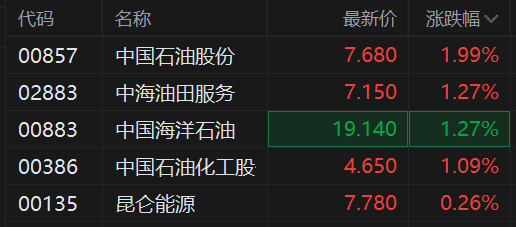
Group 1 - The core viewpoint of the news is that Hong Kong oil stocks collectively rose, driven by geopolitical tensions and rising oil prices, particularly after Trump's comments on potential sanctions against Russian oil buyers [1] - Chinese oil companies saw significant stock price increases, with China Petroleum rising by 2%, and other companies like Sinopec, CNOOC, and China Oilfield Services also experiencing gains of over 1% [2] - Brent crude oil prices reached a one-month high, closing at $72.51 per barrel, with a daily increase of 3.5% and a cumulative rise of nearly 6% over the past two days [1] Group 2 - Analysts predict that the potential for supply risks will increase due to the shortening of the deadline for new U.S. sanctions on Russia, alongside the ongoing traditional fuel consumption peak in the U.S. [1] - There is an expectation of a higher probability for the next round of domestic refined oil price adjustments to be upward, influenced by the easing of tariff concerns following an agreement between the U.S. and the EU [1]


苯乙烯周报:EB:原油扰动剧烈,关注苯乙烯边际转弱和累库时点-20250623
Guang Fa Qi Huo· 2025-06-23 02:51
Report Industry Investment Rating - No information provided in the report. Core Viewpoints - Crude oil prices are rising due to the Israel-Iran conflict, and short - term volatility may be severe. Pure benzene prices have upward potential due to high - level support from crude oil, but the supply - demand contradiction of sluggish destocking in ports may limit the upside. Styrene supply is increasing while demand is decreasing, and its supply - demand may gradually weaken. Short - term geopolitical disturbances are the main pricing factors, and it is recommended to participate cautiously. In the medium term, there is pressure on high prices, and high - short opportunities in resonance with crude oil can be watched [4]. - Futures strategy: Stay on the sidelines for the time being and watch for high - short opportunities in resonance with crude oil in the medium term. Options strategy: Stay on the sidelines [4]. Summary by Directory Pure Benzene - **2025 Production Plan**: There are multiple pure benzene, pure benzene downstream (excluding styrene), styrene, and styrene downstream production plans in different regions and enterprises in 2025, with specific production capacity and production time [6]. - **May - July 2025 Device Dynamics**: Many pure benzene production enterprises have device maintenance plans from May to July 2025, with planned new production capacity of 133 million tons/year and downstream new production capacity of about 40 million tons/year; planned shutdown involves production capacity of 446 million tons/year, and downstream shutdown production capacity is about 589 million tons/year. Overall, supply will decrease by 23.9 million tons and demand will decrease by 34.1 million tons, showing inventory accumulation [8][9]. - **Catalytic Cracking and Related Profits**: Toluene disproportionation profit is low, and there are various price difference data of cracking and related products over the years [15]. - **Pure Benzene Price**: There are price data of East China pure benzene, far - month price, international quotes, and price difference data over the years. South Korea's exports of pure benzene to China remain at a high level, and domestic production and imports lead to continuous inventory accumulation [20][26][31]. - **Pure Benzene Downstream**: The weighted operating rate has increased with the resumption of styrene production. Styrene profit has rebounded significantly, while the profits of other products are still weak [36][43]. Styrene and Its Downstream - **Styrene Futures and Spot**: There are price and price difference data of styrene spot and futures over the years [53]. - **Styrene Supply**: Styrene monthly and weekly production, operating rate, and profit data are provided. China is gradually changing from a net importer to a net exporter of styrene [58][70]. - **Styrene Inventory**: Port inventory has decreased again, and it is at a relatively low level compared to the same period [71]. - **Styrene Downstream**: High production capacity growth rate intensifies competition, and high production supports styrene demand. However, prices follow energy fluctuations, and profits are under pressure. High production leads to high inventory, indicating resistance in demand transmission. Terminal exports are likely to be restricted after the implementation of tariffs, and domestic demand depends on subsidy stimulation [76][81][91].