左侧布局

Search documents
ETF盘中资讯|“i茅台”多款茅台酒今日开售!吃喝板块震荡盘整,机构高呼板块进入左侧布局阶段
Sou Hu Cai Jing· 2026-01-15 03:25
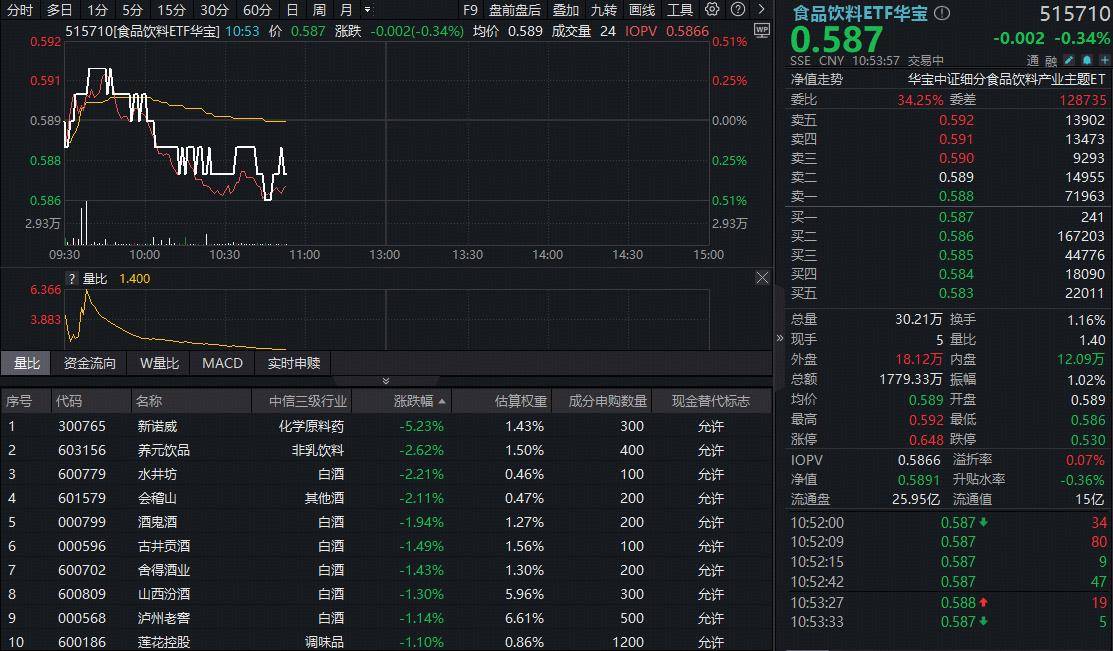
Group 1 - The food and beverage sector is experiencing a pullback, with the Huabao Food and Beverage ETF (515710) showing a decline of 0.34% as of the report time [1] - Major stocks in the liquor segment, such as Shui Jing Fang and Guo Jiu Jiu, are leading the declines, with Shui Jing Fang down over 2% and several others down more than 1% [1] - The valuation of the food and beverage sector is at a historical low, with the food and beverage ETF's price-to-earnings ratio at 20.07, which is in the 5.68% percentile of the last decade, indicating a potential opportunity for long-term investment [2] Group 2 - The market outlook suggests that the current adjustment phase for the liquor industry may be nearing its end, with expectations for a recovery as the Spring Festival approaches [3] - Recent market strategies from major liquor brands like Moutai and Wuliangye are being implemented, which may stabilize prices and reduce pressure on distributors [3] - The Huabao Food and Beverage ETF is heavily invested in leading high-end liquor stocks, with approximately 60% of its portfolio allocated to these stocks, indicating a strategic focus on premium products [4]


“i茅台”多款茅台酒今日开售!吃喝板块震荡盘整,机构高呼板块进入左侧布局阶段
Xin Lang Cai Jing· 2026-01-15 03:01
Core Viewpoint - The food and beverage sector continues to experience a pullback, with the Huabao Food and Beverage ETF (515710) showing a decline of 0.34% as of the latest update, primarily driven by significant drops in the liquor segment [1][8]. Group 1: Market Performance - The Huabao Food and Beverage ETF opened with a brief rise before turning negative, reflecting a broader downturn in the food and beverage sector [1][8]. - Key stocks in the liquor category, such as Shui Jing Fang and Jiu Gui Jiu, have seen declines exceeding 2%, contributing to the overall negative performance of the sector [1][8]. Group 2: Product Launches - Starting January 15, multiple products from Guizhou Moutai will be available for purchase on the iMoutai app, including various versions of Moutai liquor [3][10]. - Specific products include the 53% vol 500ml Moutai liquor, which will be released on the 15th and subsequently on the 9th, 19th, and 29th of each month [10]. Group 3: Valuation Insights - The food and beverage sector is currently at a historical low in terms of valuation, with the price-to-earnings ratio of the underlying index for the Huabao ETF at 20.07, placing it in the 5.68% percentile of the last decade [3][10]. - This low valuation suggests a potential opportunity for left-side positioning in the sector [3][10]. Group 4: Future Outlook - Analysts from CITIC Securities indicate that the liquor industry may be approaching a turning point, with expectations of a recovery coinciding with the upcoming Spring Festival [4][11]. - The market is expected to stabilize as inventory levels decrease and pricing policies are implemented by liquor companies [4][11]. Group 5: Investment Strategy - The Huabao Food and Beverage ETF is recommended for investors looking to gain exposure to core assets in the food and beverage sector, with approximately 60% of its portfolio allocated to leading high-end and mid-range liquor stocks [12]. - The ETF also includes significant positions in beverage, dairy, and seasoning sectors, with top holdings featuring major brands like Moutai and Yili [12].
茅台打出市场化“组合拳”!吃喝板块震荡拉升,行业迎周期底部机遇?
Xin Lang Cai Jing· 2026-01-14 02:50
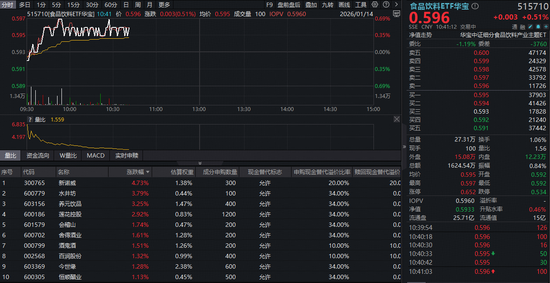
Core Viewpoint - The food and beverage sector is experiencing an upward trend, with the Huabao Food and Beverage ETF (515710) showing a price increase of 0.51% as of the latest report [1][8]. Group 1: Market Performance - The food and beverage ETF Huabao (515710) opened positively and has been fluctuating in the red, with a current price increase of 0.51% [1][8]. - Notable gains were observed in several stocks, including Xin Nuo Wei, which surged over 4%, and Shui Jing Fang and Yang Yuan Beverage, both rising over 3% [1][8]. Group 2: Company Announcements - Kweichow Moutai announced on January 13 that its board approved the 2026 market-oriented operation plan, which aims to return to a "pyramid" product structure [10]. - The new operational model will shift from "self-sale + distribution" to a multi-faceted approach including "self-sale + distribution + agency + consignment" [10]. Group 3: Pricing and Market Strategy - The pricing mechanism will be market-oriented, establishing a dynamic adjustment system for retail prices, with the self-sale price for the flagship product, Moutai 53% vol 500ml, set at 1499 yuan per bottle [10]. - Analysts suggest that this move is a critical step in Moutai's market-oriented transformation, focusing on product, model, channel, and price restructuring to address supply-demand mismatches [10]. Group 4: Valuation Insights - The food and beverage sector is currently at a historical low in terms of valuation, with the food index's price-to-earnings ratio at 20.23 times, placing it in the 6.85% percentile of the last decade [11]. - This presents a potential opportunity for left-side positioning in the sector, particularly as the Chinese New Year approaches, which may signal a turning point for the liquor market [11]. Group 5: Investment Opportunities - The Huabao Food and Beverage ETF (515710) tracks the sub-index of the food and beverage industry, with approximately 60% of its holdings in leading high-end and mid-range liquor stocks, and nearly 40% in beverage, dairy, seasoning, and beer sectors [11]. - Investors can also consider the Huabao Food and Beverage ETF linked funds (Class A 012548/Class C 012549) for exposure to core assets in the food and beverage sector [11].
生猪产能去化开启,迎来左侧布局时机
HUAXI Securities· 2025-12-31 11:45
Report Industry Investment Rating No relevant content provided. Core Views of the Report - The pig farming industry is at the left - side layout stage, with the start of capacity reduction. There is pressure on pig prices in H1 2026, but a rebound is expected in H2. Recommended companies include Lihua Co., Ltd., Muyuan Foods Co., Ltd., and Shuanghui Development Co., Ltd. [27] - In the planting industry, the prices of grains such as corn, wheat, and soybeans are showing signs of recovery, and the industry's prosperity is expected to improve. [29] Summary by Directory 01 Pig Farming: Left - side Layout, Awaiting Reversal - **Weak Season in Peak Season, Lowest Pig Price in Q4 2025 in the Past 10 Years, Capacity Adjustment as the Main Theme**: In 2025, the national pig price decreased quarter - by - quarter. Q4 pig price was the lowest in the past 10 years. Due to factors like post - Spring Festival low demand and sufficient supply, and an increase in the number of breeding sows from September to November 2024, which led to more pig slaughter in Q3 2025. In May 2025, relevant departments guided pig enterprises, and in the second half of the year, capacity reduction was significant, with the number of breeding sows falling below 40 million in October. [10] - **Overall Loss in Purchased Piglet Farming, Promoting Capacity Reduction of Retailers**: With the continuous decline of pig prices, self - breeding and self - raising turned from profit to loss in September, and the loss expanded. Purchased piglet farming was even worse, with an average loss of over 100 yuan per head in 2025. Retailers faced longer - term and deeper losses. [14] - **Policy Guidance, Passive Capacity Reduction, and Future High - quality Development**: Since 2025, relevant departments have held multiple meetings to guide the high - quality development of the pig industry. The central government's No. 1 document proposed to monitor and regulate pig production capacity. The Ministry of Agriculture and Rural Affairs put forward specific plans. In December, the Ministry of Commerce imposed anti - dumping duties on imported pork from the EU, which is expected to relieve domestic supply pressure. [16] - **Pressure on Pig Prices in H1 2026, Possible Rebound in H2**: In H1 2026, pig prices are under pressure because the number of new - born piglets 6 months ago is increasing, indicating sufficient supply. In H2 2026, pig prices are expected to rebound due to reduced supply corresponding to the decrease in the number of breeding sows in October 2025 and seasonal demand. [22] - **Focus on Cost Reduction and Efficiency Improvement, Significant Cost Differentiation**: Pig enterprises have been focusing on cost reduction and efficiency improvement in 2024 and 2025, with significant cost reduction and obvious cost differentiation. Muyuan Foods Co., Ltd. has the lowest cost, followed by other companies with different cost ranges. [25] - **Left - side Layout, Awaiting Reversal**: Since October 2025, the average national pig price has been below 12 yuan per kilogram, and it is expected that there will be no widespread profitability in the industry in H1 2026, with continued capacity reduction. In H2 2026, pig prices may rebound. Recommended companies include Lihua Co., Ltd., Muyuan Foods Co., Ltd., and Shuanghui Development Co., Ltd. [27] 02 Planting: Grain Prices Gradually Recover, Prosperity Expected to Improve - **Corn: High Yield and Falling Planting Costs, Lowest Price in the Past 5 Years**: In 2023, the consumption of corn was mainly for feed and industry, accounting for over 90%. In 2025, the corn price was the lowest in the past 5 years, but it rebounded during the year. The low price was due to high yield and falling planting costs. Future price improvement depends on the recovery of feed demand. [34] - **Wheat: Increased Purchases by the State Grain Reserves and Rising Corn Prices, Rising Wheat Price Center**: In 2023, the consumption of wheat was mainly for food and feed, accounting for over 80%. In 2025, the wheat price center increased. The reasons for the price increase include increased purchases by the state grain reserves, post - festival replenishment demand of flour mills, rising corn prices, and farmers' reluctance to sell. [38] - **Soybeans: Affected by Import Quotes and Shipping Freight, Slight Price Increase**: In 2023, the consumption of soybeans was mainly for crushing, accounting for 84.69%. In 2025, the soybean price increased seasonally. The price decline in Q1 was due to the arrival of low - priced imported soybeans and soybean auctions. The price increase in Q3 was due to rising Brazilian soybean quotes and shipping freight. [42]
ETF盘中资讯|A股融资余额首破2.5万亿!滞涨券商迎来估值修复窗口,机构:关注左侧布局机会
Jin Rong Jie· 2025-12-25 03:16
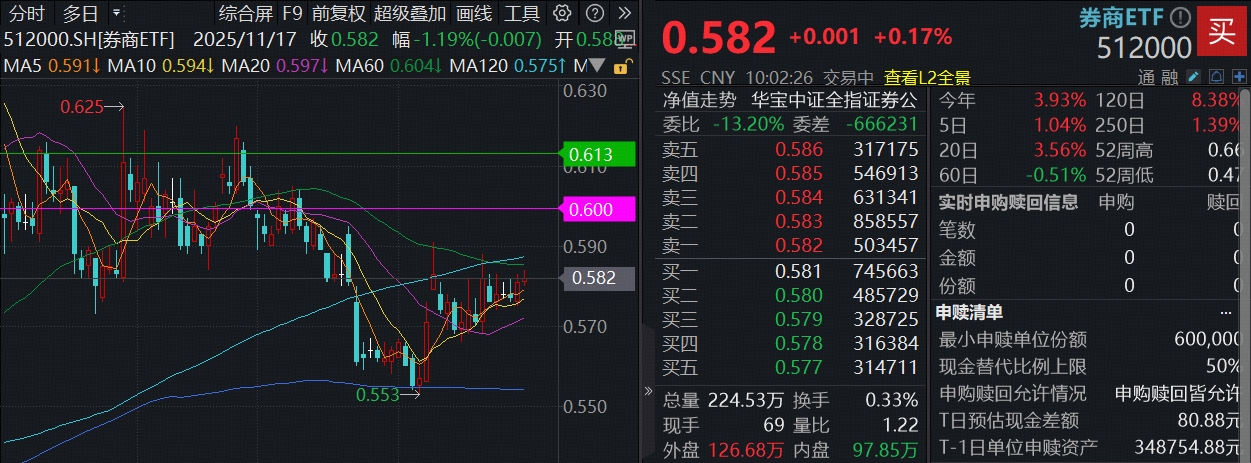
Core Viewpoint - The brokerage sector is experiencing a slight upward trend, with individual stocks showing positive performance, indicating a potential recovery and growth in the industry [1][3]. Group 1: Market Performance - As of December 25, the brokerage sector maintained a slight upward movement, with Northeast Securities rising over 3% and others like Caitong Securities and Jinlong Co. increasing by over 1% [1]. - The brokerage ETF (512000) saw a minor increase of 0.17%, reflecting a gradual upward trend along the 5-day moving average [1]. - The financing balance in the A-share market reached a record high of 25,145.96 billion yuan, marking an increase of 148.59 billion yuan, the first time it has surpassed 25 trillion yuan since the establishment of the margin trading market [2]. Group 2: Industry Outlook - Analysts suggest that as the "14th Five-Year Plan" approaches, the A-share market is entering a critical window for early positioning, with expectations for a spring rally driven by policy expectations and profit recovery [3]. - The brokerage sector is expected to benefit from high market trading volumes and margin financing, supported by policies aimed at stabilizing growth and boosting the capital market [3]. - Despite the current bull market, the brokerage sector has underperformed, with the brokerage ETF only rising 2.88% year-to-date compared to significant gains in major indices like the Shanghai Composite Index (17.58%) and the Shenzhen Component Index (29.5%) [3]. Group 3: Investment Recommendations - Xiangcai Securities indicates that the brokerage industry's performance is recovering, with long-term benefits expected from increased market participation and international business opportunities [4]. - The brokerage sector is currently viewed as having a high safety margin due to its price-to-book ratio falling to a low level over the past decade, suggesting opportunities for left-side positioning [4]. - The brokerage ETF (512000) is highlighted as an efficient investment tool that encompasses 49 listed brokerage stocks, providing a concentrated exposure to both leading and smaller brokerages [4].
板块安全边际较高,关注左侧布局机会
Xiangcai Securities· 2025-12-21 12:12
证券研究报告 2025 年 12 月 21 日 湘财证券研究所 行业研究 证券行业周报 板块安全边际较高,关注左侧布局机会 1.《行业周报:市场交投保持活跃, 关 注 券 商 估 值 修 复 机 会 》 2025.12.21 行业评级:增持(维持) 近十二个月行业表现 % 1 个月 3 个月 12 个月 相对收益 -1 -3 -16 绝对收益 -1 -1 0 -30% -20% -10% 0% 10% 20% 30% 2024/12/19 2025/2/19 2025/4/19 2025/6/19 2025/8/19 2025/10/19 2025/12/19 沪深300 证券Ⅱ(申万) 相关研究: 注:相对收益与沪深 300 相比 分析师:张智珑 证书编号:S0500521120002 Tel:(8621) 50295363 Email:zzl6599@xcsc.com 地址:上海市浦东新区银城路88号 中国人寿金融中心10楼 核心要点: ❑ 市场回顾:本周非银和券商指数领涨,估值仍处于低位 根据 Wind 数据,本周(12.15-12.19)上证指数上涨 0.03%,沪深 300 指数 下跌 0.3%,创 ...
茅台文创新春礼盒亮相!吃喝板块逆市抗跌,食品ETF(515710)近10日吸金近亿元!左侧布局信号已现?
Xin Lang Cai Jing· 2025-12-16 11:33
Core Viewpoint - The food and beverage sector demonstrates resilience amid market pullbacks, with the Food ETF (515710) showing a smaller decline compared to major A-share indices [1][7]. Market Performance - As of the market close on December 16, the Food ETF (515710) fell by 0.17%, outperforming the Shanghai Composite Index (-1.11%) and the CSI 300 Index (-1.2%) [1][7]. - Notable declines were observed in consumer goods and certain liquor stocks, with Miao Ke Lan Duo down 2.5%, and several other stocks like Yang Yuan Beverage and Anqi Yeast dropping over 1% [1][7]. Fund Flows - Recent data indicates that the food and beverage sector has seen a capital influx, with the Food ETF (515710) recording net subscriptions of 16.64 million yuan over the last five trading days, and a total of 97.37 million yuan over the past ten days [1][8]. Company Developments - Moutai Culture recently launched a new product for the 2026 Spring Festival, a gift box featuring two bottles of 53% vol 200mL Guizhou Moutai liquor, designed in collaboration with a renowned master [3][9]. - This initiative aims to enhance cultural value and reach younger consumers through multiple platforms, marking a shift from pure product sales to cultural value output in the liquor industry [3][9]. Valuation Insights - The food and beverage sector is currently at a historical low in terms of valuation, with the Food ETF's underlying index PE ratio at 20.25, placing it in the 6.46% percentile over the past decade, indicating a favorable long-term investment opportunity [3][9]. Future Outlook - Guosen Securities suggests that the liquor sector is in a bottoming phase, with low valuations and holdings, and positive signals from both supply and demand sides could act as catalysts for growth [4][10]. - According to Founder Securities, the liquor industry is undergoing a deep cyclical adjustment, with structural opportunities becoming more significant than broad sector opportunities, emphasizing the importance of stable operations and long-term resilience [5][10]. Investment Strategy - The Food ETF (515710) is highlighted as a key investment vehicle, with approximately 60% of its portfolio allocated to leading high-end and mid-range liquor stocks, and nearly 40% to leaders in beverages, dairy, condiments, and beer [5][11].

科技股深度回调,现“左侧”布局时点,持续关注科创板50ETF(588080)投资机会
Sou Hu Cai Jing· 2025-12-16 04:20
Core Viewpoint - The A-share market is experiencing a downturn, particularly in technology-related sectors, with the STAR Market 50 Index dropping by 2% as of midday trading. However, despite market fluctuations, funds are flowing into technology-related ETFs, indicating investor confidence in the sector's long-term potential [1]. Group 1: Market Performance - The A-share market's three major indices opened lower and continued to decline, with technology sectors under significant pressure [1]. - The STAR Market 50 Index, which consists of 50 large-cap, liquid stocks from the STAR Market, has seen a 2% decrease [1]. Group 2: Investment Trends - Despite the market's volatility, the STAR Market 50 ETF (588080) has attracted over 1 billion yuan in net inflows since December, suggesting a counter-trend investment strategy by investors [1]. - The management fee for the STAR Market 50 ETF is set at a low rate of 0.15% per year, making it an attractive option for investors looking to gain exposure to leading companies in the STAR Market [1]. Group 3: Economic Outlook - According to Shenwan Hongyuan Securities, if economic conditions improve in the first half of 2026, there is a high probability of additional growth support in the second half, leading to marginal economic improvements [1]. - The second quarter of 2026 is expected to be a bottoming phase, with technology and advanced manufacturing sectors likely to show fundamental alpha logic, potentially leading the market recovery ahead of a broader bull market in the second half of 2026 [1]. Group 4: Sector Composition - The STAR Market 50 Index is heavily weighted towards the semiconductor industry, which accounts for over 65% of the index, highlighting the dominance of "hard technology" leaders [1]. - The top five weighted stocks in the STAR Market 50 Index include Cambrian, Haiguang Information, SMIC, Lanke Technology, and Zhongwei Company, collectively representing over 40% of the index [1].
双利好引爆吃喝行情!白酒大面积上攻,食品ETF(515710)逆市收红!机构:白酒或已具备择机布局价值
Xin Lang Cai Jing· 2025-12-15 11:53
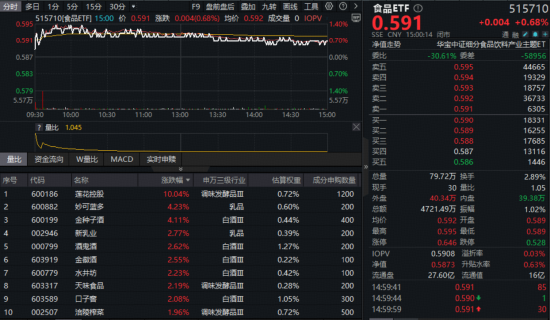
Group 1: Market Performance - The food and beverage sector showed resilience on December 15, with the Food ETF (515710) experiencing a high-level fluctuation, ultimately closing up by 0.68% despite market challenges [1][8] - Notable gains were observed in the liquor segment, with stocks like Lianhua Holdings hitting the daily limit, and others such as Jiu Gui Jiu, Jin Hui Jiu, and Shui Jing Fang rising over 2% [1][8] Group 2: Policy Impact - A joint notification from the Ministry of Commerce, the People's Bank of China, and the Financial Regulatory Authority was issued on December 14, aimed at boosting consumption through various measures [3][10] - The notification emphasizes the implementation of consumption enhancement actions and the removal of unreasonable restrictions in the consumption sector, which is expected to positively impact the large consumption sector's performance and valuation recovery [3][10] Group 3: Liquor Pricing Trends - Recent meetings among Moutai distributors discussed strategies for 2026, focusing on core products like Moutai 1935 and Flying Moutai, which has led to a noticeable recovery in Flying Moutai's wholesale prices [4][11] - Analysts suggest that the current pricing trends indicate a stabilization, with optimistic sales forecasts for the upcoming Spring Festival due to inherent demand for liquor [4][11] Group 4: Investment Opportunities - The food and beverage sector is currently viewed as being at a historical low in terms of valuation, presenting a potential opportunity for left-side positioning [4][12] - The Food ETF (515710) is highlighted as a key investment vehicle, with approximately 60% of its portfolio allocated to leading high-end and mid-range liquor stocks, and nearly 40% to other beverage and dairy segments [5][13]

震荡磨底,港股ETF可以左侧布局了吗?
Jin Rong Jie· 2025-12-04 01:37
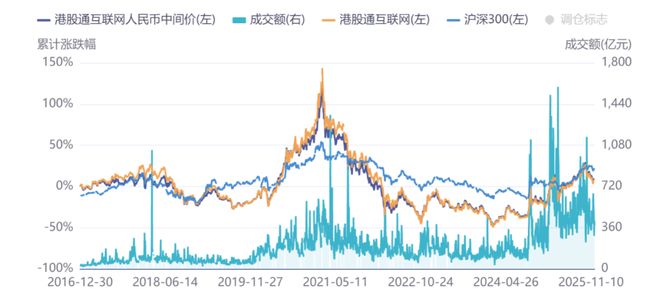
Core Viewpoint - The Hong Kong stock market is currently experiencing a significant left-side layout opportunity due to the release of multiple negative factors that previously suppressed the market, with valuations remaining low or reasonable, and marginal positive factors accumulating for medium to long-term recovery [1][3]. Valuation and Market Position - The Hong Kong stock market is viewed as a "global valuation pit," with major indices showing improved safety margins after adjustments. The Hang Seng Index, despite a significant rebound from its 2024 low, still presents attractive valuations compared to other major markets [1]. - The technology sector's valuation is at historical lows, with the Hong Kong Internet PE-TTM at 25.44 times, which is 58.45% of its historical average, indicating it is cheaper than nearly 40% of the past decade [1][3]. Drivers for Left-Side Layout - Negative factors that previously pressured the market, such as uncertainties in US-China relations and concerns over the internet industry's profitability, have been largely released. The market is nearing a "bad news fully priced in" state, suggesting limited downside [3]. - Positive factors are accumulating, including potential boosts from future industrial policies and breakthroughs in AI technology, which could provide new growth logic for leading companies. Historical data shows that Hong Kong tech assets perform well after interest rate cuts by the Federal Reserve [3]. Capital Flow and Buybacks - There are signs of improvement in capital flow, with significant inflows from southbound capital, totaling 1.39 trillion this year, and a total market value of 6.27 trillion. Notable buybacks from companies like Tencent and Xiaomi indicate recognition of their own value [3][4]. - In the past month, Tencent and Xiaomi executed substantial buybacks of 7 billion and 2 billion HKD, respectively, reflecting confidence in their stock valuations [4][5]. Future Market Outlook - The market is expected to transition from valuation recovery to profit growth by 2026, with a focus on sectors like the internet and pharmaceuticals, where earnings expectations remain stable [6]. - Leading internet companies are shifting from cash-burning models to AI-driven commercial growth, with significant progress noted in companies like Tencent and Alibaba [6]. - High-quality value stocks in finance and consumer sectors, characterized by low valuations and improving cycles, align with the "left-side layout true value" strategy [6]. Investment Products and Strategies - The Hong Kong stock index product line is comprehensive, covering various attractive investment directions, including large-cap indices and thematic ETFs focused on technology and healthcare [8][9]. - Investors are encouraged to consider a gradual accumulation strategy during market fluctuations, as the current environment offers a high cost-performance ratio for long-term value-focused investors [11].